
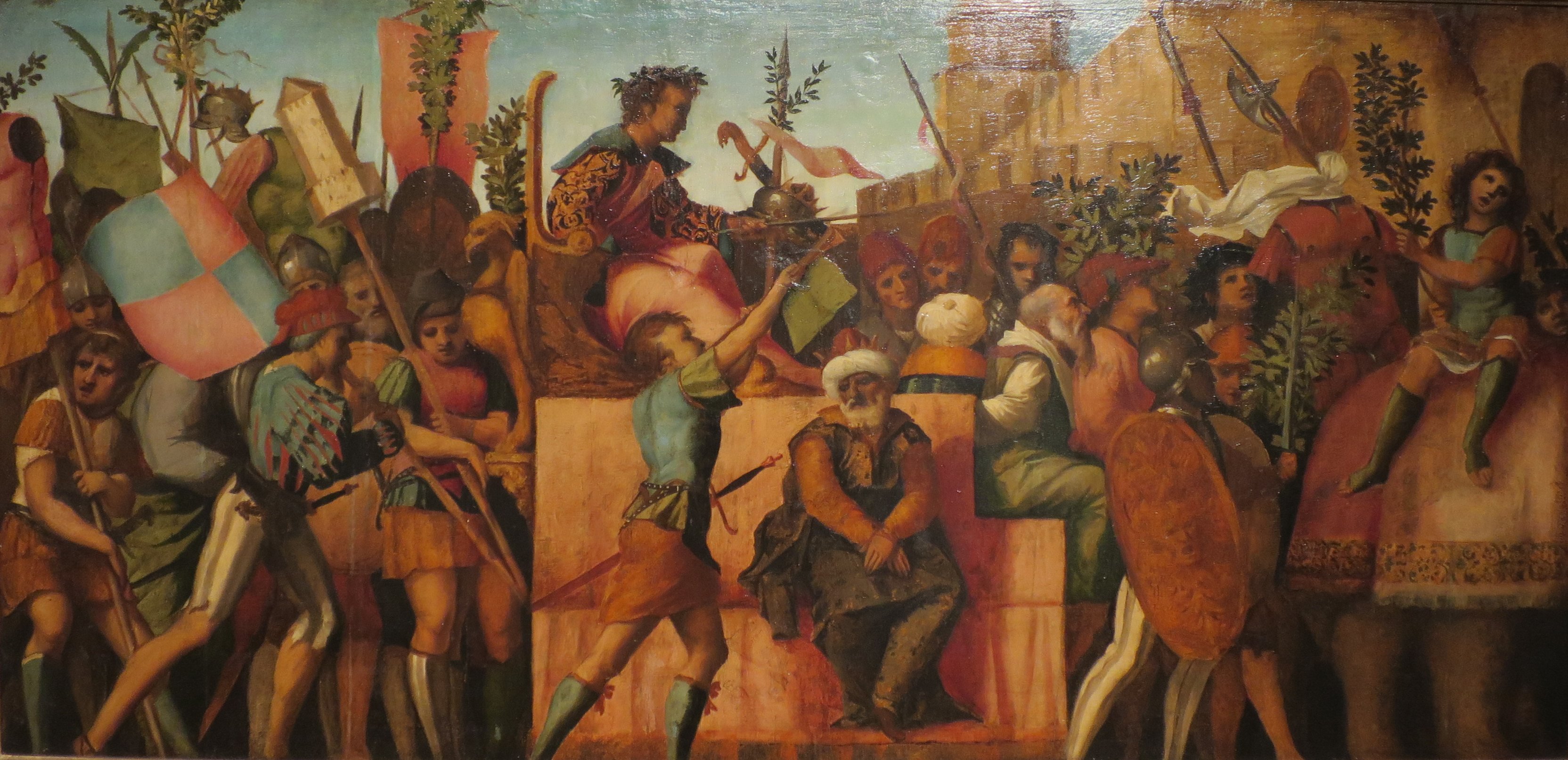
The End of Independent Gaul
Environ -51 av. J.-C.
As the previous chapter closed, Vercingetorix had just surrendered before Alesia, ending the largest uprising Gaul ever mounted against Rome. But the surrender of one man, even one invested with the coalition’s supreme command, is not enough to extinguish eight years of war at a stroke: several peoples, or rather some of their most determined chiefs, choose to continue a now scattered resistance, with no more hope of unity at the scale of Gaul.
This chapter follows this receding phase, marked by a striking contrast with the one before it. Where 52 BC had seen Gaul unite, if only temporarily, around a single chief and a common strategy, 51 BC knows only isolated pockets — a Belgic revolt here, an entrenched stronghold there — which Caesar extinguishes methodically one after another, never again facing a coalition comparable to Vercingetorix’s.
This account is thus dominated by a rhythm of mopping-up rather than conquest: each episode, taken in isolation, might seem minor compared with the great battles of previous chapters, but their accumulation traces the reality of a complete pacification, achieved people by people, stronghold by stronghold.
Four phases structure this account. The first is both administrative and military: the rapid resumption of operations from late December 52 BC, against the Bituriges then the Carnutes. The second is the last large-scale organized resistance, carried by Correus among the Bellovaci and prolonged by Commius’s stubbornness. The third is the siege of Uxellodunum, the ultimate symbol of Gaulish resistance, and the exemplary punishment that ends it. The fourth, finally, is pacification: the submission of Aquitania, the military reorganization of the territory, and the political consecration of the victory in Rome itself.
This chapter closes a cycle opened eight years earlier: that of the Gallic War proper. Gaul definitively ceases to be a collection of independent peoples; with this chapter opens the period during which its fate merges with that of Rome — a transformation whose first developments the next chapter will follow.
I. Winter 52/51 BC: the resumption of operations
On 31 December 52 BC, barely two months after Alesia, Caesar leaves Bibracte with a cavalry escort to rejoin the 13th legion, stationed among the Bituriges — a swift reaction meant to prevent any new revolt. He reinforces his troops by adding the 11th legion, then recalling the 14th and the 6th, then in winter quarters near the Saône, bringing his forces to four legions.
This responsiveness pays off at once: the Bituriges, who had been attempting to rise up, are quickly crushed. Caesar nonetheless chooses not to burn their homes, in order to preserve food and fodder for his own troops — a form of pragmatic restraint that contrasts with the harsher repression applied the previous year.
After only eighteen days’ rest at Bibracte, Caesar sets out again against the Carnutes — this time at the request of the Bituriges themselves, who complain of Carnutian raids on their territory. Caesar sets up camp at Cenabum and disperses the enemy forces without significant organized resistance. This double campaign lasts forty days in all, at the end of which Caesar returns to Bibracte and temporarily discharges part of his troops.
II. Spring 51 BC: the last organized coalition
The Bellovaci, a Belgic people renowned for their strength and who had stayed out of the great revolt of 52 BC, ally with the Ambiani, the Aulerci, the Caletes, the Veliocasses, and with Commius, king of the Atrebates, under the leadership of Correus, of whom Caesar himself says he was known for “an implacable hatred of the Roman name.” Their strategy is twofold: give battle if Caesar arrives with only three legions, harass him if he brings more.
An initial cavalry engagement turns against the Romans: the Remi, faithful allies of Caesar since the start of the war, lose their chief Vertiscus, commander of their cavalry — a setback that for a time boosts Gaulish confidence. Informed shortly after that an ambush awaits his foragers, Caesar sends cavalry and light infantry ahead as a vanguard. Correus charges, but finds himself surrounded by the coordinated Roman manoeuvre and the arrival of the legions. Refusing to surrender, he fights with such courage that his repeated blows finally force the exasperated Romans to run him through with their javelins.
After this defeat, the Bellovaci convene an assembly and send envoys to Caesar, placing responsibility for the revolt on the now-dead Correus. Caesar refuses to fully absolve the community, but accepts their submission in exchange for hostages, without further punishment — a relative clemency that leads to the swift submission of the other coalition peoples. Only Commius refuses to submit, owing to an assassination attempt ordered against him a few years earlier by Labienus; his own resistance will continue, on the margins of the main operations, until his final departure for the island of Britain.
🔍 Zoom – Commius, from the Throne of the Atrebates to a British Dynasty
III. Summer-autumn 51 BC: the siege of Uxellodunum and the final repression
Two chiefs, the Senonian Drappes and the Cadurcian Lucterius, already encountered in this war, gather a band of about 2,000 fighters and seize Uxellodunum (present-day Puy d’Issolud, in the Lot), a stronghold with slopes deemed impregnable, fed by a spring gushing at the foot of the escarpment.
🔍 Zoom – Uxellodunum, a Site Lost Then Found
Setting out to find provisions, they are surprised by the legate Caninius Rebilus, who intercepts and almost entirely massacres their convoy; Lucterius flees without even warning Drappes, who is captured shortly after and lets himself die of starvation in captivity rather than surrender.
 Caption: Plan of the siege of Uxellodunum, from T. Rice Holmes’s “Cæsar’s Conquest of Gaul” (1899) — public domain, via Wikimedia Commons
Caesar then personally takes charge of the final siege. Rather than a frontal assault on a position deemed impregnable, he chooses to cut off the besieged’s vital water supply: the legions build a mound nearly 20 metres high, topped with a wooden tower ten men tall, while underground tunnels are dug to tap and divert the spring itself. Deprived of water, the defenders, who interpret this sudden drying-up as a sign of divine abandonment, are forced to surrender. Lucterius, still on the run, is finally captured by Epasnactus, an Arvernian chief allied with Rome, who hands him over to Caesar.
To deter any further revolt, Caesar inflicts a deliberately non-lethal punishment on the defeated: he has the hands cut off all the men who had borne arms, then spares their lives — a punishment designed to remain visible, to show throughout Gaul the price of resistance. With the fall of Uxellodunum, organized Gaulish resistance comes to a definitive end.
IV. End of 51 BC: pacification and organization of Gaul
 Caption: Map of Gaul at the end of 51 BC — via Wikimedia Commons
At the end of summer, Caesar travels in person to Aquitania, where he receives the submission of local chiefs and the delivery of hostages, without having to fight again. He then distributes his legions into winter quarters spread across the whole territory: four legions in Belgica, under the joint command of Mark Antony, Trebonius, and Vatinius, two among the Aedui, two among the Turones, on the border of the Carnutes, and two more among the Lemovices, on the edge of Arvernian territory. He himself sets up his quarters at Nemetocenna (Arras), after having toured the whole province to oversee its organization.
In Rome, the scale of the victory finds striking political expression: the Senate grants Caesar twenty days of supplicationes, religious thanksgiving ceremonies, a figure then unprecedented, far exceeding the ten days granted to Pompey a generation earlier for his own victories. Caesar also adopts a policy of relative moderation toward the subdued peoples: he avoids needless destruction, relies on local elites to administer the territory, and gradually organizes a Roman peace whose terms Gaul, exhausted by eight years of continuous war, no longer seems able to contest.
🧠 Key points
- As early as 31 December 52 BC, Caesar swiftly resumes the military initiative against the Bituriges and then the Carnutes, in a forty-day campaign.
- In the spring of 51 BC, Correus leads the last large-scale Gaulish coalition, among the Bellovaci; his death in battle leads to the swift submission of most of the coalition peoples, with the exception of Commius.
- Between summer and autumn 51 BC, the siege of Uxellodunum ends with a tactic of drying up the besieged’s spring and with a deliberately non-lethal punishment — the cutting off of the surviving fighters’ hands.
- By the end of the year, Caesar receives the submission of Aquitania, reorganizes his legions into winter quarters across all of Gaul, and is granted twenty days of supplicationes by the Roman Senate, an unprecedented honour.
- With this chapter, the Gallic War proper comes to an end: Gaul ceases to be a collection of independent peoples and enters lastingly into Rome’s orbit.