
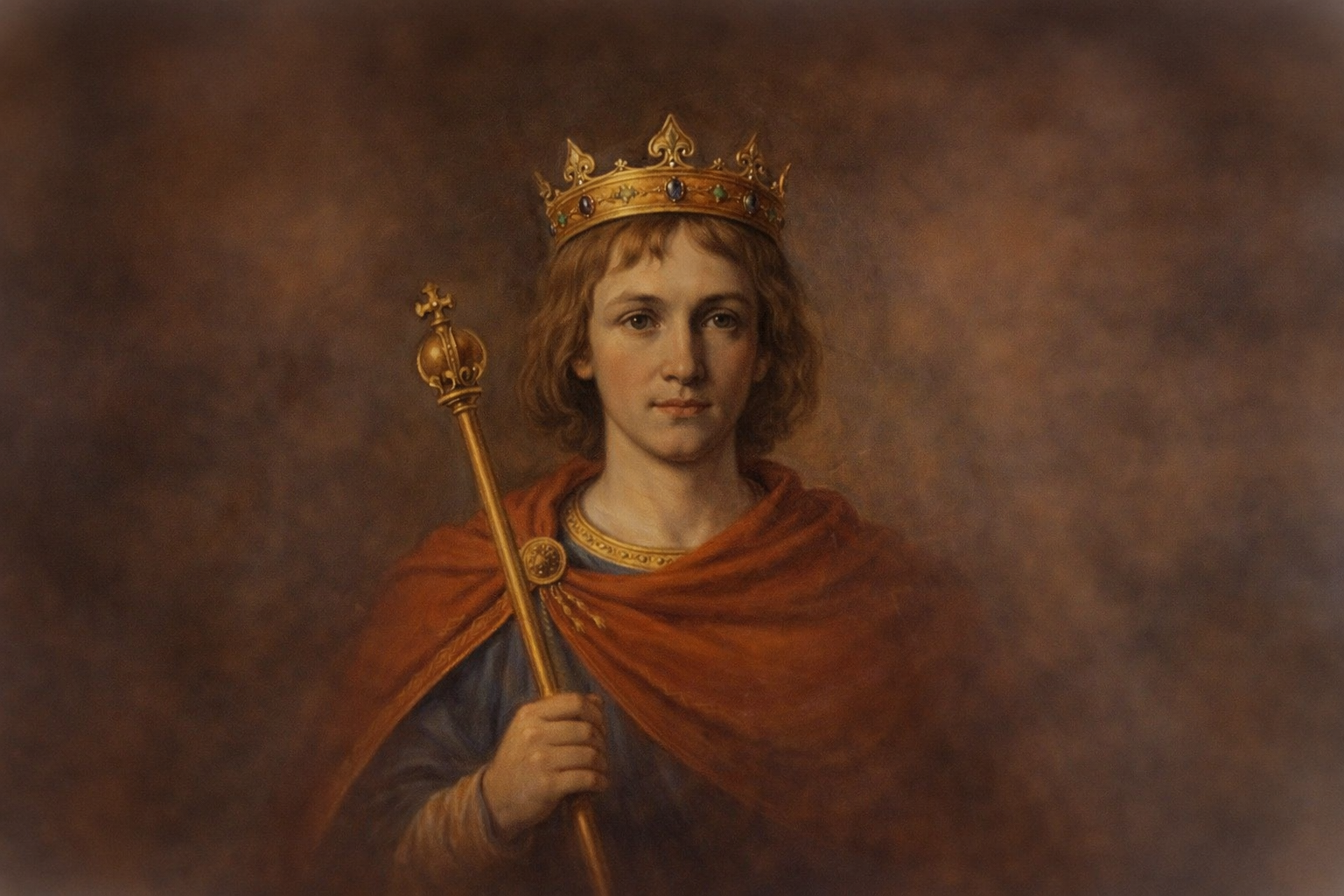
Theudebald: A Brief Reign in Austrasia (Austrasie)
548 à 555
 The Frankish kingdom in 548 — Source: Wikimedia Commons
When King Theudebert I died in 548, his son Theudebald (often written Thibaut/Théodebald) succeeded him on the throne of Austrasia.
Born around 535, Theudebald was only about ten years old when he became king. He was the grandson of Theuderic I, first king of Austrasia, and the great-grandson of Clovis, founder of the Frankish kingdom.
The Austrasia he inherited was one of the strongest kingdoms of the Merovingian dynasty:
- it controlled the Moselle valley and the Rhine regions;
- it included major cities such as Metz, Reims, and Trier;
- it dominated several neighbouring Germanic peoples.
But this kingdom was also fragile. The king’s youth and the ambitions of other Frankish princes made the political balance uncertain.
⏳ Quick Timeline
- 548: death of Theudebert I; Theudebald becomes king of Austrasia.
- 548–555: reign marked by the influence of aristocrats and bishops.
- 555: death of Theudebald at around twenty.
- 555: Chlothar I seizes Austrasia.
🏛️ A Very Young King
Theudebald came to power while still a child.
In Merovingian monarchy, a minor king did not rule alone. Power relied on a network of supporters:
- the kingdom’s great aristocrats;
- military leaders;
- bishops, who often played a major political role.
These elites controlled the military and administrative resources needed to govern.
They ensured continuity of royal power, but they could also limit the young king’s autonomy.
Austrasia had a particularly powerful nobility, formed from older Gallo-Roman elites and Frankish families established in the region for generations.
⚖️ Austrasia’s Fragile Balance
Under Theudebert I, Austrasia had reached a high level of power.
His kingdom:
- dominated the Alamanni;
- exerted influence over the Bavarians;
- even intervened in Italy during the Byzantine-Ostrogothic war.
Under Theudebald, however, this power rested largely on his father’s legacy.
The young king had to maintain:
- loyalty of the aristocracy;
- stability of borders;
- balance against other Frankish kings.
The Merovingian kingdoms remained deeply divided.
The main contemporary rulers were:
- Chlothar I, king of Soissons;
- Childebert I, king of Paris.
Both watched events in Austrasia closely.
💍 A Political Marriage: Vuldetrade
 Depiction of a Merovingian queen — Source: Wikimedia Commons
To strengthen his position, Theudebald married Vuldetrade.
The princess belonged to the Lombard family, a Germanic people settled in central Europe.
This marriage served several goals:
- consolidate alliances with neighbouring Germanic peoples;
- reinforce the young king’s legitimacy;
- preserve political balance around Austrasia.
Royal marriages were essential in Merovingian diplomacy.
They were used to build alliances and stabilise relations between kingdoms.
⚔️ Chlothar’s Ambitions
The situation changed abruptly in 555.
Theudebald died young, probably without an heir.
His death opened a dynastic crisis.
His uncle Chlothar I, already ruler of a vast territory, intervened quickly.
He took over Austrasia and annexed the kingdom.
According to the chronicles, Chlothar even married Vuldetrade, Theudebald’s widow, to legitimise his takeover.
That marriage was soon cancelled under Church pressure, which considered it incestuous.
🧩 A Step Toward Reunification of the Frankish Kingdom
Theudebald’s disappearance marked a turning point.
It allowed Chlothar I to expand his power.
Little by little, he recovered territories left vacant by his brothers’ deaths.
In 558, after the death of Childebert I, Chlothar reunified the entire Frankish kingdom for the first time since Clovis’s death.
The brief reign of Theudebald thus appears as an important political transition in the recomposition of the Merovingian dynasty.
🧠 Key Takeaways
- 548: Theudebald becomes king of Austrasia after Theudebert I’s death.
- He reaches the throne very young and rules under aristocratic influence.
- His reign is relatively calm but politically fragile.
- 555: his death allows Chlothar I to annex Austrasia.
- The event prepares reunification of the Frankish kingdom a few years later.
Theudebald’s reign is short, but it illustrates the fragility of Merovingian monarchies: when a king dies without a solid heir, dynastic balances can shift very quickly.
📷 Image Credits
- Map of the Frankish kingdom — Romain0, Public domain, via Wikimedia Commons
- Depiction of a Merovingian queen — Jean-Paul Laurens, Public domain, via Wikimedia Commons
📚 Sources
Primary sources (public domain)
- Gregory of Tours, History of the Franks https://fr.wikisource.org/wiki/Histoire_des_Francs
Open historical resources
-
Theodebald (Thibaut) — Wikipedia https://fr.wikipedia.org/wiki/Théodebald
-
Chlothar I https://fr.wikipedia.org/wiki/Clotaire_Ier