


Charles VI: Minority, Madness, and Civil War (1380–1422)
p51380 à 1422
The accession of Charles VI in 1380 opens a new phase in the history of the Valois. The son of Charles V the Wise, he ascends to the throne at the age of twelve, at a time when the kingdom of France, after a long effort at reconstruction, has reached a far better military and political situation than that inherited by John II the Good. Yet this improvement remains fragile: the new king is a minor, power passes into the hands of his uncles, and the great balances of the previous reign remain precarious.
The beginning of the reign is therefore shaped by a princely regency. The dukes of Anjou, Berry, Burgundy and Bourbon hold most of the power during the king’s minority. This situation extends the monarchical work of Charles V, but it also reopens tensions that his government had kept in check: rivalry between princes, the weight of taxation, urban unrest, and difficulties on the margins of the kingdom, notably in Flanders and Brittany.
For a long time, however, Charles VI appears as a prince of promise. Initially nicknamed the Well-Beloved, he enjoys in the first years of his reign a favorable image linked to domestic appeasement, the restored prestige of the monarchy, and the legacy of the recovery led by his father. But this promise is shattered from 1392 onwards, when the king is struck by severe episodes of dementia that permanently transform the exercise of power. From then on, royal weakness opens a new era of struggles for control of the government.
The reign of Charles VI is thus one of the most contrasted in French medieval history. It begins in continuity with the Valois recovery, but gradually transforms into a period of growing disunion. The king’s madness, competition between princes, the opposition between Armagnacs and Burgundians, the renewed offensive of England, and the legitimacy crisis culminating in the Treaty of Troyes give this long reign a tragic dimension.
I. 1381: Breton Peace, English Tensions and the Peasants’ Revolt
The year 1381 opens for the kingdom of France with relative appeasement in the West. On 15 January, the second Treaty of Guerande is signed between the crown and Duke John IV of Brittany, ratified on 4 April. This text confirms John IV in possession of the duchy and ends the long Breton succession crisis. In return, Brittany adopts a position of neutrality in the conflict between France and England. For the French monarchy, the agreement is genuinely valuable: it stabilizes a long-contested frontier and brings at least a provisional end to one of the main war zones of the previous reign.
This pacification does not, however, signal an end to tensions in the Franco-Breton sphere. Duke John IV, who had returned to power with English support but was eager to consolidate his own authority, now sought to assert his political independence. In July 1381, he founded the Order of the Ermine, a chivalric institution designed to strengthen the loyalty of Breton nobility around his person. A few months later, on 27 September, at Compiègne, he paid homage to the king of France. This gesture recalled that the duchy remained a great fief of the kingdom, even though its political autonomy remained strong.
At the same time, England was experiencing a major domestic crisis. For several years, the cost of the war against France had led to heavy fiscal pressure. In March 1381, the English government levied a third poll tax, adding to two previous levies and representing a considerable increase in the fiscal burden. This decision provoked deep discontent, all the more so because it came against a background of lasting social tensions since the Black Death, challenges to serfdom, and friction between lords, tax agents, and local communities.
The first violence erupted at the end of May 1381, notably at Brentwood in Essex, where tax collectors were attacked. The movement quickly spread to Essex and Kent, where peasants refused to pay the tax and more broadly contested manorial constraints. Part of the towns supported the insurgents, including Rochester, Maidstone, Canterbury, and finally London. The revolt thus took on exceptional scope, mixing fiscal protest, rejection of serfdom, and denunciation of elite abuses.
 Richard II of England meeting the rebels of the Peasants’ Revolt of 1381: Jean Froissart, Public domain, via Wikimedia Commons
The unrest also found a religious and intellectual echo. Priests joined the movement, notably John Ball, who developed a discourse hostile to traditional hierarchies and aristocratic domination. In the same climate, the ideas of the Lollards, disciples of John Wyclif, gained wider circulation. Without entirely merging with the peasant revolt, this current criticized the papal institution, valued Scripture as the supreme source of faith, and challenged several aspects of the established ecclesiastical order. Together, these elements gave the English crisis a dimension that was not only social but also religious and ideological.
The movement reached its peak in June 1381. On 13 June, Wat Tyler entered London at the head of a vast crowd. The palace of the Duke of Lancaster was burned, while several senior royal officials, including the chancellor and the treasurer, were massacred. On 14 June, the young king Richard II met the insurgents at Mile End and granted them several concessions: abolition of serfdom, limits on certain dues, and greater freedom in work and the circulation of land. But on the very next day, 15 June, Wat Tyler was killed at Smithfield in the king’s presence, during an encounter with the London authorities.
After Tyler’s death, the movement lost its principal leader. Repression was quickly organized under royal authority and with the support of captains such as Robert Knolles. The charters granted at Mile End were annulled, and the revolt was crushed without immediately transforming the political order. It nevertheless left a deep impression on contemporaries. The English ruling classes became aware of the potential violence of social tensions, while royal power measured how closely wartime taxation, serfdom, and religious agitation could combine into a general crisis.
The Battle of Revel
 Battle of Revel (Battle of Montégut-Lauragais) between the Duke of Berry and the Count of Foix, July 1381: Charles-Nicolas Cochin the Elder, Public domain, via Wikimedia Commons
In the Midi, the year 1381 was also marked by armed disturbances that recalled the fragility of royal authority in the southern provinces. The Battle of Revel pitted the Duke of Berry, who exercised royal authority in Languedoc, against Count Gaston Fébus of Foix, one of the most powerful princes of the south. The confrontation was set within a context of strong regional tensions, in which the great lords sought to preserve their margins of autonomy against the growing encroachment of the princes of the blood and royal officials.
II. 1382: Fiscal Revolts, War in Provence, and Victory at Roosebeke
The year 1382 was marked in the kingdom of France by strong tension between the financial needs of the state, princely ambitions, and urban resistance. While the government of the uncles sought to restore royal revenues, several towns revolted against fiscal pressure. At the same time, the monarchy intervened in Flanders and Provence, showing that the beginning of Charles VI’s reign took place in a climate of war, social unrest, and dynastic rivalry.
The starting point of the domestic crisis was fiscal. On 15 January 1382, a royal ordinance re-established several aides, meaning indirect taxes on goods, notably on salt and wine. This decision broke with the reliefs granted at the death of Charles V and immediately provoked violent popular hostility, even before its enforcement. In a kingdom still marked by war, ransoms, poor harvests, and the lasting effects of the plague, these levies were perceived as an unbearable burden.
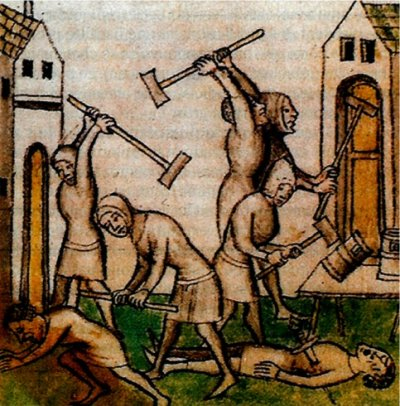 The Maillotins: Besançon, Bibliothèque municipale, Public domain, via Wikimedia Commons
The first great explosion occurred in Rouen. On 24 February 1382, the Harelle began — an urban revolt directed against tax agents and more broadly against forms of royal and seigneurial domination felt by the inhabitants. A few days later, the movement reached Paris, where on 1 March the revolt of the Maillotins began, named after the iron mallets seized by the insurgents. In both cases, the riot mixed rejection of taxation, hostility toward royal officials, and violence against certain privileged groups or those associated with power. Charles VI intervened personally to restore order: he made a solemn entry into Rouen on 29 March, abolished the town’s communal privileges, and initiated a repression intended to reassert monarchical authority.
 Revolt of Languedoc in 1382 against tax agents: Unknown author, Public domain, via Wikimedia Commons
At the same time, the Estates General assembled at Compiègne on 15 April 1382 refused the subsidies demanded by the government. This refusal underscored the difficulty of the power in having its fiscal policy accepted, at the very moment when military and princely expenditure remained considerable. The monarchy, still dominated by the young king’s uncles, appeared to face a double challenge: that of the towns and that of the representative assemblies.
The south of the kingdom was also troubled. In Provence, Louis I of Anjou, adopted by Queen Joan I of Naples, sought to have his rights recognized. As early as February 1382, he went to Avignon to receive the homage of lords and towns, but the community of Aix refused to acknowledge him. This confrontation opened the War of the Union of Aix, a Provençal civil war whose factions were also linked to the two allegiances of the Great Schism. On 30 May 1382, Louis of Anjou received from Pope Clement VII the investiture of the kingdom of Sicily, then departed for Italy in June with a substantial army; he entered the kingdom of Naples in September, without managing to establish himself durably.
Abroad, the conjuncture remained turbulent. In England, Richard II married Anne of Bohemia on 14 January 1382, in a context where the English monarchy was barely recovering from the peasant revolt of 1381. But it was above all in Flanders that the situation became decisive for France. The urban revolt originating in Ghent since 1379 continued, and its leader, Philip van Artevelde, represented a threat both to the Count of Flanders and to the political balance of the northern kingdom. At the request of Count Louis de Male, the French monarchy intervened militarily.
 The Battle of Roosebeke: AnonymousUnknown author, Public domain, via Wikimedia Commons
This intervention led to the Battle of Roosebeke on 27 November 1382. The royal army, fighting under the authority of the young Charles VI but commanded in practice by great captains like Olivier de Clisson, met the Flemish militias of Philip van Artevelde near Ypres. The French victory was decisive. It allowed the momentary crushing of the great revolt of the Flemish towns, the restoration of comital authority, and offered the monarchy a brilliant military success at the start of the reign. The death of Philip van Artevelde, whose body was found among the defeated, symbolized the defeat of the Ghent party. This victory considerably enhanced the prestige of Charles VI, even as his government was being contested at home.
 The death of Philip van Artevelde: Image taken from: Title: “Geïllustreerde geschiedenis van België … Geheel herzien en het hedendaagsche tijdperk bijgewerkt door Eug. Hubert” Author: MOKE, Henri Guillaume. Shelfmark: “British Library HMNTS 9414.l.2.” Place of Publishing: Brussels, Date of Publishing: 1885, No restrictions, via Wikimedia Commons
III. 1383–1385: Internal Repression, Flemish Campaign, and the Peace of Tournai
 The return of Charles VI to Paris in 1383: Jean Froissart, Public domain, via Wikimedia Commons
At the beginning of 1383, the young king returned triumphantly to Paris after the Flemish campaign. On 11 January, this solemn entry served as the backdrop for a political reassertion of control over the capital following the revolt of the Maillotins. The ordinance of 27 January 1383 abolished several Parisian municipal institutions, notably the provostship of merchants, and permanently weakened urban privileges. This policy of repression showed that the princely government intended to draw all the consequences of the disturbances of 1382 and restore royal authority without ambiguity.
That same year, the Flemish situation remained unstable. Despite the French victory at Roosebeke, unrest was not completely extinguished. England attempted to regain a foothold in the Low Countries through the expedition of the Bishop of Norwich, Henry le Despenser, who landed in Flanders in 1383. The English won a success at Dunkirk on 25 May, but the offensive then stalled. In the autumn, Charles VI led a new campaign; English positions were gradually reduced, and Bourbourg capitulated in September after the retreat of Despenser’s forces. This operation confirmed that the French monarchy remained capable of projecting force into the former Flemish Low Countries.
The year 1384 was marked above all by major dynastic reconfigurations. On 26 January 1384, a truce was concluded at Leulinghem between France and England, also covering their respective allies, including Scotland, Castile, and the Ghentois. A few days later, on 30 January, the death of Louis de Male, Count of Flanders, transferred the Flemish inheritance — Flanders, Artois, Rethel, Nevers, Franche-Comté, and other lands — into the orbit of Philip the Bold, husband of his daughter Margaret of Male. This event considerably reinforced the power of the house of Burgundy within the Valois ensemble.
That same year, Angevin policy in Italy took a new turn. Louis I of Anjou, engaged for several years in the struggle for the kingdom of Naples, died on 20 September 1384 near Bari. His son Louis II of Anjou succeeded him under the regency of Mary of Blois, prolonging Angevin ambitions in the Mediterranean. In Provence, these stakes continued to fuel the divisions resulting from the War of the Union of Aix.
In 1385, the truce with England expired in the spring, but operations remained linked to Flemish difficulties and princely balances. On 17 July 1385, Charles VI married Isabeau of Bavaria, a marriage arranged in a context where Philip the Bold, now powerful in Flanders, also sought to consolidate his Germanic support. At the same time, Italian and pontifical affairs continued to interact with French policy: Louis II of Anjou received in May 1385 the investiture of the kingdom of Naples from the antipope Clement VII, within the framework of the Great Western Schism.
But the major event of the year’s end was the Peace of Tournai, concluded on 18 December 1385. It brought an end to the long revolt of Ghent and restored the authority of Philip the Bold over Flanders, while granting a relatively broad amnesty to the rebels. This peace was essential: it closed a cycle of urban warfare and further strengthened the position of the Burgundian branch of the Valois in the former Low Countries. It also showed that henceforth the stability of the northern kingdom depended closely on the intertwined interests of the French crown and the house of Burgundy.
IV. 1386–1388: Fragile Truce, Princely Reconfigurations, and the End of the Uncles’ Government
 Siege of Brest Castle: Master of Anthony of Burgundy, Public domain, via Wikimedia Commons
In 1386, the Breton situation remained tense. In June, John IV of Brittany undertook the siege of Brest, then held by the English, but he failed to retake the city. This difficulty recalled how Brittany remained a space of complex rivalries, where the duke’s interests, those of England, and those of the French crown were closely intertwined. That same year, the monarchy also strengthened its legal instruments: by letters patent of 5 September 1386, Charles VI more formally attributed to the crown the exercise of the right of aubaine and developed the system of letters of naturality, allowing foreigners to be admitted to the enjoyment of certain rights in the kingdom.
In 1387, the great balances of the Midi and the Mediterranean evolved. On 1 January, Charles III the Noble became king of Navarre, while in Aragon, John I ascended the throne a few days later and aligned himself with the pope of Avignon. At the same time, the long War of the Union of Aix neared its end. On 21 October 1387, Louis II of Anjou and his mother Mary of Blois made their entry into Aix-en-Provence; other Provençal towns rallied gradually to the Angevin party. The Angevin victory ended a long Provençal civil war, but left open the question of the eastern territories of the province.
The year 1388 provided a lasting resolution to this Provençal question. Following the War of the Union of Aix, eastern Provence, around Nice and beyond the Var, chose to place itself under the protection of the house of Savoy: this was the dedication of Nice to Savoy, dated 28 September 1388. This event had major consequences, as it gave Savoy a durable Mediterranean access and detached an eastern part of Provence that would henceforth follow a different political trajectory.
Meanwhile, the international situation remained fluid. In England, the Merciless Parliament opened in February 1388 manifested the violence of political struggles around Richard II and the humiliation of the young king before the high nobility led by Thomas of Woodstock. This crisis of English power helped limit the kingdom’s capacity for external action, even if the war was not formally closed.
For the French monarchy, however, the decisive political fact of 1388 was domestic. On 3 November 1388, at Reims, a great assembly of the King’s Council effectively ended the government of the uncles. Although Charles VI was not yet twenty, he decided henceforth to rule by himself. The dukes of Burgundy and Berry were removed from the heart of power, and the king recalled around him the former servants of his father, soon nicknamed the Marmousets. This reorientation opened a new phase of the reign in which the monarchy sought to recover the spirit of methodical government that had characterized the time of Charles V.
V. 1389–1392: Personal Rule, Southern Journey, and the First Crisis of Madness
In England, the year 1389 also saw a political turning point. On 3 May, Richard II began to exercise his personal authority more directly after the humiliations inflicted by the great lords in previous years. This development favored a temporary appeasement between the two kingdoms. On 18 June 1389, the Truce of Leulinghem was concluded between France and England; it was to last until 1 August 1392. This agreement did not end the Hundred Years’ War, but it suspended major military operations and created a more favorable climate for negotiations.
 Queen Isabeau of Bavaria making her entry into Paris: Eduard Schwoiser, Public domain, via Wikimedia Commons
On the domestic front, the French court experienced several important dynastic events. On 17 August 1389, Louis of Orléans, the king’s brother, celebrated at Melun his marriage to Valentine Visconti, a prestigious alliance with the powerful house of Milan. A few days later, on 22 August, Queen Isabeau of Bavaria made her solemn entry into Paris, a ceremony designed to bolster the prestige of the monarchy. These celebrations and alliances gave the beginning of Charles VI’s personal rule the image of a young, splendid, and promising reign.
The king then undertook a long journey to Languedoc, beginning on 2 September 1389 and continuing into early 1390. This journey was not merely symbolic: it allowed the monarchy to manifest its presence in the southern provinces, to reassert its authority in spaces where princes and great towns still enjoyed strong autonomy, and to meet several great southern lords. During this journey, Charles VI passed notably through Avignon, where he met the Avignon pope, then through Montpellier, Béziers, Toulouse, and finally Foix, where he was received by Gaston Fébus. The king’s presence in these cities illustrated the will to give personal rule a truly territorial anchorage.
This southern sojourn took place in an international context marked by the Great Western Schism. On 1 November 1389, Louis II of Anjou was crowned king of Sicily at Avignon by Clement VII, in the presence of Charles VI. This ceremony underscored the close alliance between the French monarchy, the house of Anjou, and the Avignon allegiance. The following day, 2 November 1389, the pontificate of Boniface IX, successor to Urban VI, began in Rome, confirming the lasting division of Christendom between two rival popes. French policy remained firmly oriented toward support for the pope of Avignon, in continuity with the diplomacy of Charles V.
The year 1390 extended this Mediterranean opening. A Franco-Genoese expedition left Marseille on 1 July to conduct an operation against Mahdia in Tunisia, in response to Barbary piracy. The siege began in July but failed in autumn. This undertaking, sometimes described as the crusade of Mahdia, showed that Charles VI’s reign was not defined solely by the war against England: it also participated in crusade projects and the maritime ambitions of the French and Genoese nobility. That same year, Louis II of Anjou landed in Italy and entered Naples on 15 August, in the context of the struggle for the kingdom of Sicily.
 The madness of King Charles VI: Jean Froissart, Public domain, via Wikimedia Commons
But this phase of relative stability ended in 1392. On 14 June, an assassination attempt by Pierre de Craon against Constable Olivier de Clisson caused a shock at court. Charles VI immediately resolved to campaign against the Duke of Brittany, suspected of having sheltered the culprit. It was during this expedition, in the forest of Le Mans, on 5 August 1392, that the king’s first great crisis of madness occurred. Seized by a fit of delirium, Charles attacked his entourage brutally and killed several men before being restrained. The episode deeply shook contemporaries and marked the beginning of an illness that would durably transform the reign.
VI. 1393–1394: The King’s Fragility, the Schism, and the Kingdom’s Hardening
 The Ball of the Burning Men: Georges-Antoine Rochegrosse, Public domain, via Wikimedia Commons
On 28 January 1393, the court was struck by the famous episode of the Bal des Ardents. During a celebration at the Hôtel Saint-Pol, several courtiers disguised as “wild men” caught fire from a torch; the king himself narrowly escaped. Saved at the last moment, Charles VI emerged deeply traumatized. This spectacular accident, in a climate already troubled by his episodes of madness, reinforced the feeling of a royal power exposed both to court disorder and the personal vulnerability of the sovereign.
That same year, the Truce of Leulinghem was renewed on 28 April 1393, extending the suspension of major operations between France and England. This provisional peace allowed both kingdoms to deal with their own domestic difficulties. In England, the political crisis of Richard II’s reign remained intense; in France, it was now the king’s health that became the principal factor of uncertainty.
In June 1393, Charles VI experienced another episode of madness. These recurring episodes prevented any stable continuity in the personal exercise of power and favored the return of princely rivalries. At the same time, the conflict between Olivier de Clisson and Duke John IV of Brittany, protector of Pierre de Craon, continued. This Breton war, lasting until 1395, showed that princely tensions remained acute on the kingdom’s margins, at the very moment when the center of power was weakened by the royal illness.
The year 1394 was dominated by the religious question. Since 1378, the Great Western Schism had divided Christendom between the allegiances of Rome and Avignon. On 6 June 1394, the University of Paris proposed, in an attempt to resolve the crisis, the path known as the via cessionis, meaning the voluntary abdication of both rival popes. This position illustrated the major role played by the University in the political-religious debates of the kingdom, as well as French determination to find a resolution to a division that weakened all of Latin Christendom.
A few months later, on 16 September 1394, the antipope Clement VII died at Avignon. He was replaced on 28 September by Benedict XIII, ensuring the continuity of the Avignon allegiance rather than resolving the schism. The hope of rapid reunification thus receded, and the religious fracture remained firmly embedded in Christian Europe.
In this climate of religious and political tension, the kingdom also experienced an internal hardening. On 17 September 1394, Jews were expelled from the kingdom of France by order of Charles VI. This measure formed part of a long history of restrictions, persecutions, and intermittent expulsions. It marked a lasting step, often presented as the definitive expulsion of the Jews from the French royal domain at the end of the Middle Ages.
In the autumn of 1394, Pope Boniface IX in Rome launched several calls for a crusade against the Turks. These initiatives recalled that the schism did not prevent the Roman papacy from seeking to exercise universal authority. But in practice, Christian Europe remained profoundly divided, and allegiance rivalries often prevailed over plans for a joint crusade.
VII. 1396–1399: Franco-English Rapprochement, the Genoese Question, the Schism, and the English Dynastic Shift
In 1396, several events reflected this phase of relative appeasement. On 19 September, Duke John V of Brittany married Jeanne de France, drawing the ducal Breton house a little closer to the royal dynasty. More importantly, the entente between Charles VI and Richard II deepened: on 27 October 1396, the two sovereigns met at Ardres, and a few days later, on 4 November, Richard II married Isabella of Valois, daughter of the king of France. This marriage, though concluded between an adult king and a princess still a child, symbolized the determination of both courts to entrench the truce over time. It did not legally end the war, but it reflected a genuine search for diplomatic stabilization.
That same year, France also extended its influence in the Mediterranean. By the treaty of 25 October 1396, the Republic of Genoa placed itself under the protection of the king of France, subject to retaining its civic liberties. This first French domination over Genoa, though fragile, showed that the Valois monarchy was thinking not only in terms of the Franco-English theater but also on the scale of Mediterranean balances. It was accompanied by a French presence in Corsica, inscribed within Genoese dependency over the island.
 Execution of Thomas of Woodstock: Froissart, Chroniques, BnF MS Fr 2646, fol. 289, AnonymousUnknown author, Public domain, via Wikimedia Commons
In 1397, the external détente contrasted with the persistent fragility of European kingdoms. A French royal ordinance of 13 February regulated more explicitly the spiritual and funerary treatment of those condemned to death, reflecting growing attention to the forms of justice and salvation. On 28 March, Brest was returned by the English to the Duke of Brittany, further reducing a former English foothold in the West. Meanwhile, plague reappeared in Provence, and in England, Richard II brutally tightened his personal power: the arrest and execution of Thomas of Woodstock and other former opponents signaled a desire for revenge against the high nobility that had humiliated him years before.
The year 1398 was dominated by the question of the Great Western Schism. Since 1378, Latin Christendom had been divided between the allegiances of Rome and Avignon; but now, under the impetus of the University of Paris, the French monarchy sought to impose a solution. On 22 May 1398, a clerical assembly gathered in Paris voted for the withdrawal of obedience — that is, the removal of obedience from the Avignon pope, Benedict XIII — in order to compel him to negotiate an end to the schism. This decision, confirmed by royal edict in July, did not resolve the crisis, but it demonstrated France’s intellectual and political role in the search for an outcome. That same year, a French governor, Colart de Calleville, took up his duties in Genoa, confirming that French tutelage over the Ligurian city was taking concrete form.
 Coronation of Henry IV of England: J. Johnson (engraver), Public domain, via Wikimedia Commons
In 1399, the European scene was transformed by the English crisis. While Marshal Boucicaut departed for the East on an expedition that helped temporarily relieve Turkish pressure on Constantinople, England entered a new dynastic phase. Taking advantage of Richard II’s absence on campaign in Ireland, Henry Bolingbroke returned from exile, rallied a significant part of the nobility, and forced the king to abdicate. On 30 September 1399, he became king under the name Henry IV, founding the house of Lancaster. This dynastic change did not mean an immediate resumption of the war with France, but it profoundly altered the English political framework and prepared the confrontations of the early fifteenth century.
VIII. 1400–1404: Mediterranean, Schism, and Return of Princely Rivalries
In 1400, royal power sought to clarify its instruments of government. An ordinance of 7 January mentioned for the first time the pays d’élection, signaling the administrative evolution of the kingdom and the growing role of fiscal and judicial frameworks in monarchical organization. That same year, French domination over Genoa encountered strong local resistance. On 12 January 1400, a revolt broke out against the French governor Colart de Calleville, who was forced to flee a few days later. This episode showed how fragile French tutelage over the Ligurian republic remained, despite the agreement concluded in 1396. Simultaneously, England experienced a new dynastic hardening: the former king Richard II, deposed the previous year, died in captivity at Pontefract castle in February 1400, consolidating the power of Henry IV of Lancaster.
The Genoese crisis was not, however, abandoned. On 31 October 1401, Marshal Boucicaut entered Genoa as governor of the king of France. His firmness allowed him to restore order; on 6 November, Battista Boccanegra, who had sought to rouse the city against the French, was executed. This reassertion of control underscored the strategic importance of Genoa for Valois Mediterranean policy. At the same time, the French court was being reconfigured: Queen Isabeau of Bavaria settled at the Hôtel Barbette, while a coalition of interests formed around her, the Duke of Berry, and the Duke of Burgundy, against the growing influence of Louis of Orléans. This shift in court balances already foreshadowed the political confrontations of the early fifteenth century.
In 1403, the question of the Great Western Schism again became central. On 12 March, the antipope Benedict XIII fled Avignon as political pressure on him intensified. A few weeks later, on 26 April, an ordinance of Charles VI delegated sovereign authority, during the king’s absences or incapacities, to a council of princes of the blood presided over by Queen Isabeau of Bavaria. This decision institutionally confirmed the central place of the princes and the queen in government, at a time when the king’s episodes of madness made the personal exercise of power increasingly uncertain. Yet despite previous attempts at the withdrawal of obedience, Charles VI signed on 30 May 1403 an act restoring the kingdom to the obedience of Benedict XIII, proof that French policy toward the schism remained hesitant and deeply tied to the diplomatic calculations of the moment.
That same year, the sea remained a space of insecurity. The English corsair William de Wilford attacked a convoy from La Rochelle, captured or burned several ships, then plundered localities along the Breton coast. This episode recalled that even in the absence of great land campaigns between the two kingdoms, the Franco-English war continued in the form of maritime raids, privateering, and harassment of commercial exchanges.
The year 1404 opened a new political phase. On 27 April, Philip the Bold died. His disappearance deprived the kingdom of one of the principal arbiters of princely politics since the minority of Charles VI. His son John the Fearless succeeded him as Duke of Burgundy and inherited a considerable princely ensemble, including Burgundy, Flanders, Artois, and Franche-Comté. Less integrated than his father into the functioning of the royal government, he quickly entered into competition with Louis of Orléans, the king’s brother, whose influence at court was already substantial. The rivalry between these two princes, still latent in 1404, soon became one of the principal axes of the French political crisis.
In this context, Charles VI attempted to preserve monarchical authority by redistributing certain offices: on 6 June 1404, John the Fearless was appointed lieutenant general of the king in Normandy and Picardy. But this appointment was not enough to prevent the exacerbation of princely rivalries. England under Henry IV watched these French divisions with close attention, for they offered favorable medium-term prospects.
The Schism also persisted. In Rome, Boniface IX died on 1 October 1404, and Innocent VII succeeded him a few days later amid strong tensions. At the same time, Benedict XIII continued his itinerant path through the Mediterranean space and was received at Nice by Amadeus VIII of Savoy in December 1404. The division of Christendom thus remained complete, and the European powers continued to divide themselves between the two allegiances.
IX. 1405–1407: Princely Rivalries, the Schism, and the Assassination of the Duke of Orléans
The years 1405 to 1407 marked a turning point in the reign of Charles VI. The king’s illness permanently deprived the monarchy of a stable center of decision, while competition among the princes of the blood intensified. In this context, the rivalry between Louis of Orléans, the king’s brother, and John the Fearless, the new Duke of Burgundy, gradually became the principal axis of political tension in the kingdom. Meanwhile, France remained engaged in the debates of the Great Western Schism, and the war against England continued primarily on the margins.
 This photograph shows the Goldenes Rössl (Little Golden Horse), a masterpiece of goldsmithing offered to King Charles VI by his wife Isabeau of Bavaria at the beginning of the fifteenth century: Bischöfliche Administration der Kapellstiftung, CC BY-SA 4.0, via Wikimedia Commons
In 1405, signs of this deterioration were already visible. At the beginning of the year, Isabeau of Bavaria offered the king the celebrated Goldenes Rössl, a testament to the courtly splendor that still surrounded the monarchy. But already by the end of February, tensions erupted in the Council between John the Fearless and Louis of Orléans, notably over the levying of tailles. The conflict pitted two conceptions of government against each other, as well as two princely clienteles and two antagonistic ambitions around the person of the sick king. During the year, the rivalry became so fierce that the two princes came to arms before a reconciliation of appearances concluded on 16 October 1405. This apparent peace settled nothing; it merely deferred the confrontation.
That same year, France still attempted to weigh in on external balances. In July 1405, a French expedition commanded by Jean II de Rieux was sent to the aid of Owain Glyndŵr, leader of the Welsh revolt against England. The French landed in Wales, captured several places, and advanced with their Welsh allies, but the operation failed for lack of supplies and strategic decision; no decisive battle occurred, and the troops re-embarked. This episode showed that despite the continental truce, France continued to seek to weaken England on peripheral theaters.
In 1406, the domestic French situation remained unstable while the British context evolved. In England, Parliament refused subsidies to Henry IV, further weakening his authority. That same year, a trade treaty was concluded between the king of England and the Duke of Burgundy, a sign that the great French princes were already conducting foreign policies that did not always coincide precisely with the immediate interests of the crown. In France, the marriage of Charles of Orléans to Isabelle of Valois further strengthened the house of Orléans in the princely game. Religiously, the Parlement of Paris abolished the apostolic taxes in autumn, further evidence of lasting tensions between the monarchy, the kingdom’s institutions, and papal administration in the context of the schism.
The year 1407 raised the crisis to a higher level. The kingdom of France continued to intervene in the debate on the Great Western Schism: at the start of the year, the Gallican Church affirmed more clearly that the pope’s authority was valid only in the spiritual realm, and the policy of withdrawal of obedience toward Benedict XIII was confirmed. Negotiations were again attempted between the two rival popes, Benedict XIII and Gregory XII, particularly around a planned meeting at Savona, but they failed. The schism thus continued, with France remaining one of its principal diplomatic and doctrinal poles.
But the capital event of the year was political and dynastic. In the autumn of 1407, John the Fearless returned to Paris; the rivalry with Louis of Orléans immediately reignited. Another attempt at reconciliation was organized on 22 November under the auspices of the Duke of Berry, but it failed. The following day, 23 November 1407, Louis of Orléans was assassinated in Paris by men of John the Fearless, led by Raoul d’Anquetonville, as the duke was returning home after leaving the queen. The murder was carefully prepared and executed as a street ambush.
 Assassination of the Duke of Orléans: Bibliothèque nationale de France (BnF) — Banque d’images du département de la reproduction, Unknown author, Public domain, via Wikimedia Commons
This assassination had an immense impact. It was not merely the elimination of a personal rival: in striking the king’s brother, John the Fearless shifted princely competition into open violence. His immediate flight toward Flanders showed that he measured the gravity of his act, even as he soon sought to justify it politically. From this moment, the fracture between the supporters of the house of Orléans and those of the Duke of Burgundy became the great cleavage of French politics. The assassination of 1407 is traditionally considered the starting point of the civil war between Armagnacs and Burgundians, which would durably weaken the kingdom at the very moment when England was preparing its renewed offensive.
X. 1408–1411: Justification of the Orléans Murder, Precarious Peace, and Entry into Civil War
The years 1408 to 1411 saw the French political crisis change in nature. After the assassination of Louis of Orléans in 1407, the kingdom did not immediately tumble into a general civil war, but entered a phase of ideological justification, facade reconciliations, and then open rupture between the two great parties forming around the houses of Orléans and Burgundy. Meanwhile, the Great Western Schism continued to structure the religious and diplomatic backdrop of the era.
In 1408, the Duke of Burgundy, John the Fearless, first sought to impose his version of events politically. On 17 February, the Burgundian chancellery distributed at Arras a manifesto arguing that the murder of Louis of Orléans had been committed for the good of the kingdom. A few days later, on 28 February, John the Fearless triumphantly re-entered Paris, showing that his party retained powerful support in the capital despite the gravity of the assassination. This strategy of justification transformed a princely crime into an argument of government: the duke claimed to have eliminated a tyrant dangerous to king and state.
 Battle of Othée: François Paquot, CC0, via Wikimedia Commons
That same year, John the Fearless further enhanced his prestige with an external victory. On 23 September 1408, he crushed the rebel Liégeois at the Battle of Othée, in the context of the insurrection waged against John of Bavaria, prince-bishop of Liège. This military success increased his personal authority and gave his party the image of a force capable of restoring order in neighboring principalities. It also strengthened the weight of the Duke of Burgundy in the overall affairs of the kingdom.
In parallel, the question of the Schism remained open. On 15 November 1408, a council convened by Benedict XIII opened at Perpignan in an attempt to resolve the Church’s division. The initiative was insufficient to restore unity, but it showed that the ecclesiastical crisis remained at the heart of concerns for princes and universities, at the very moment when France was sinking into its own divisions.
In 1409, an attempt at appeasement came with the Peace of Chartres, signed on 9 March. The treaty provided, among other things, that John the Fearless acknowledge his responsibility for the murder of Louis of Orléans and present apologies to the deceased’s sons. The ceremony of reconciliation, imposed on the Orléanist princes, remained profoundly fragile: it resolved neither the trauma of the murder, nor the rivalry of noble clienteles, nor the competition for control of the king and the government. The Peace of Chartres thus amounted to a precarious suspension rather than a genuine settlement.
That same year, the Great Western Schism entered a new phase with the election of the antipope Alexander V in June 1409, following the Council of Pisa. Far from resolving the crisis, this election added a third claimant to the tiara and further complicated the European religious situation. At the same time, French presence in Genoa suffered a major setback: in September 1409, a revolt erupted in the city and the French garrison was massacred in the absence of Boucicaut. This episode demonstrated the continued instability of French Mediterranean influence.
 The marriage of Charles of Orléans with Bonne d’Armagnac: Limbourg brothers, Public domain, via Wikimedia Commons
In 1410, the political rupture became clearer. On 15 April, the Treaty of Gien organized the coalition of princes hostile to John the Fearless; around the young Charles of Orléans and especially Count Bernard VII of Armagnac, a camp was formed that would soon play a central role in French political life. The marriage of Charles of Orléans to Bonne d’Armagnac, celebrated on 15 August, further strengthened this dynastic alliance and soon gave its name to the Armagnac party. Even though a new Peace of Bicêtre was concluded on 2 November 1410, it only temporarily masked the kingdom’s entry into a lasting civil war.
The year 1411 confirmed this evolution. The young Duke of Orléans demanded justice for his father’s murder, and the confrontation with John the Fearless became open. The Burgundians then sought external support, including in England, where Henry V was solicited by both camps. In October 1411, John the Fearless entered Paris, then his partisans won a success at Saint-Cloud in November, accompanied by massacres of Armagnacs in the environs of the capital. Political violence changed scale: the princely rivalry transformed into civil war, at the very moment when France was already weakened by the king’s madness and the divisions of Christendom.
XI. 1412–1413: Appeals to England, the Cabochian Crisis, and the Armagnac Takeover of Paris
The years 1412 and 1413 marked a decisive aggravation of the French crisis. The rivalry between Armagnacs and Burgundians then ceased to be a mere court conflict and became a full-scale civil war, in which each party sought external support, including from England. At the same time, the capital was again swept up in political and social violence with the Cabochian revolt, which revealed the depth of the disintegration of monarchical authority.
In 1412, both French camps did not hesitate to seek English help. On 8 May, at Eltham, the Burgundians concluded an agreement with the Lancastrians, opening a phase of cooperation between the Duke of Burgundy and England. A few days later, on 18 May, the Armagnacs replied with the Treaty of Bourges, in which they offered substantial territorial concessions in exchange for English military assistance. This double appeal to a foreign power showed how deeply the French civil war was undermining the kingdom’s cause: in order to defeat their rivals, the princes were willing to compromise the general interest and reopen the door to English intervention.
The conflict immediately took on a military dimension. On 11 June 1412, Charles VI laid siege to Bourges, a stronghold held by the Duke of Berry and several Armagnac leaders. Meanwhile, an English army led by Thomas of Lancaster, son of Henry IV, landed at Saint-Vaast-la-Hougue on 10 August. It conducted a chevauchée through Lower Normandy and Anjou — the first great English offensive in France in several decades — before reaching Bordeaux in autumn. This expedition recalled that the Hundred Years’ War, though not yet resumed on a grand scale, remained intimately tied to the kingdom’s internal divisions.
The year 1413 saw the crisis shift to the very heart of the capital. Assembled at the Hôtel Saint-Pol from 30 January to 9 February, the Estates General opposed the continuation of the civil war and denounced the disorders of the government. In this climate of agitation, John the Fearless chose to support a popular Parisian movement in order to regain the political upper hand. On 28 April, the provost Pierre des Essarts, an Armagnac partisan, retook the Bastille Saint-Antoine in the name of the dauphin. In reaction, the Duke of Burgundy encouraged the riots of the Cabochians, named after the butcher Simon Caboche, a popular leader of the movement.
 The Cabochian revolt at the Hôtel Saint-Pol: G. Burgun, Public domain, via Wikimedia Commons
The Cabochian revolt, which developed from April to August 1413, was one of the most violent episodes in Parisian political life in the early fifteenth century. The insurgents, backed by the Burgundian party, attacked officials, Armagnac partisans, and members of the court circle; they repeatedly invaded the Hôtel Saint-Pol, the royal residence, and exerted heavy pressure on the king and his entourage. Several lords and courtiers were arrested, including the Duke of Bavaria, the queen’s brother. This urban violence was accompanied by a broader reform program. On 25–27 May 1413, the Cabochian ordinances were promulgated, seeking to reform the government, more closely control taxation, and regulate royal finances. Though partly inspired by longstanding demands for reform, they remained closely tied to the momentary dominance of the Burgundian party in the capital.
This dominance, however, quickly generated growing rejection. The excesses of the Cabochians alarmed part of the Parisian population, while the princes sought a political way out. A Peace of Pontoise was concluded between 22 July and 8 August 1413, but it did not durably settle the conflict. A few weeks later, the balance of forces shifted. On 23 August, the Armagnacs recaptured Paris; the Cabochian movement collapsed, and several of its leaders were forced to flee. On 31 August, the Armagnac princes made their entry into the capital, where they in turn imposed their domination. On 5 September, the Cabochian ordinances were abrogated. Power in Paris thus changed hands brutally, without the monarchy recovering any real autonomy.
In parallel, the Western Schism continued. On 9 December 1413, the antipope John XXIII issued the bull convening the Council of Constance, set to assemble the following year. This council was to attempt to resolve the division of Christendom, but for France, the immediate priority remained the domestic crisis. The betrothal of the future Charles VII to Marie of Anjou, concluded on 18 December, showed that the Armagnac camp was already seeking to build around the dauphin a new dynastic and political foundation.
XII. 1414–1415: Civil War, Precarious Peace, and the Disaster of Agincourt
The years 1414 and 1415 marked a decisive turning point in the reign of Charles VI. The civil war between Armagnacs and Burgundians continued despite a provisional peace concluded at Arras, while England took advantage of French divisions to resume the offensive on the continent. The campaign of Henry V culminated in 1415 in the disaster of Agincourt, which opened a new phase of the Hundred Years’ War.
At the beginning of 1414, John the Fearless sought to regain the initiative. Having set out from Lille in January, he marched toward Paris, but the king’s council banished him on 10 February. In response, the Armagnac camp drew Charles VI into a military campaign against the Burgundians: the king left Paris in spring, royal troops retook Compiègne and then Noyon, and laid siege to Soissons, which was taken and brutally sacked in May 1414. This campaign showed that the civil war was no longer merely a struggle for influence at court: it had become an armed confrontation between the kingdom’s great parties.
In this context, each camp sought external support. On 23 May 1414, Henry V of England concluded with John the Fearless the convention of Leicester, opening cooperation between the Burgundian party and the English monarchy. However, a few weeks later, a Peace of Arras was concluded on 4 September 1414 between Armagnacs and Burgundians. Like earlier agreements, this reconciliation remained fragile: it temporarily suspended hostilities without resolving the deep causes of the conflict, notably the rivalry for control of the king and the government.
The year 1415 changed scale entirely. Religiously, the Council of Constance, in session since 1414, began to produce effects: the resignation of Gregory XII in July 1415 contributed to the resolution of the Great Western Schism, even if Church unity was only restored with the election of Martin V in 1417. At the same time, the antipope Benedict XIII withdrew to Peñíscola, confirming the progressive weakening of the Avignon allegiance.
 The Siege of Harfleur: Thomas Grieve, Public domain, via Wikimedia Commons
But the major event of the year was military. On 13 August 1415, Henry V landed in Normandy near Harfleur with a large army and siege artillery. After several weeks of operations, Harfleur capitulated on 22 September. Though his army was weakened by disease and siege losses, the English king chose to march toward Calais. The French, politically divided but numerically superior, eventually intercepted him.
 The Battle of Agincourt: Miniature from the Abrégé de la Chronique d’Enguerrand de Monstrelet, 15th century, Paris — Public domain, via Wikimedia Commons
The engagement took place on 25 October 1415 at the Battle of Agincourt. The French army, superior in numbers, was crushed by the forces of Henry V. As at Crécy and Poitiers, the English archers played a decisive role against a French nobility badly committed on unfavorable terrain. The defeat was immense: a substantial part of the high French aristocracy was killed or captured. Charles of Orléans was taken prisoner and would remain long detained in England; Boucicaut was also captured. Charles VI, because of his illness, had not commanded the army. Agincourt thus represented both a military disaster and a political collapse for a monarchy already undermined by civil war.
The consequences were immediate. On 18 December 1415, the death of the dauphin further weakened dynastic continuity at the very moment when the kingdom was undergoing a major crisis. At the end of the month, Bernard of Armagnac became Constable of France and more forcefully imposed Armagnac dominance over the Parisian government. Royal power, already impaired by the madness of Charles VI, now found itself more dependent than ever on the princely factions, at the very moment when England had recovered its capacity for decisive intervention on the continent.
XIII. 1416–1417: Governmental Weakness, European Diplomatic Game, and English Conquest of Normandy
The years 1416 and 1417 further aggravated the crisis of Charles VI’s kingdom. While the Armagnac government tightened its grip on finances and administration, the international situation became less favorable: Emperor Sigismund, initially welcomed as mediator, drew closer to England, and Henry V methodically prepared a new offensive. At the same time, the Council of Constance was completing the liquidation of the Great Western Schism, giving these years both a military, a political, and a religious dimension.
In 1416, power within the kingdom concentrated further in the hands of the Armagnac party. A large ordinance on the policing of ports and markets in Paris was promulgated in February, while Bernard of Armagnac received on 12 February the charge of captain general of the kingdom and control of royal finances. This rise of the Armagnac leader illustrated the monarchy’s growing dependence on the great princes and their clienteles, in a context where the king’s illness prevented any stable exercise of personal power.
That same year, the European balance shifted. On 1 March 1416, Emperor Sigismund arrived in Paris as mediator. But, failing to reach agreement with the French government, he then went to London, where he arrived on 7 May. On 15 August 1416, he concluded with Henry V the Treaty of Canterbury, an offensive and defensive alliance directed against France. This diplomatic reversal was significant: it showed that the Franco-English war was now embedded in a broader European game, where the Empire could weigh on western power relations.
On the domestic front, the monarchy nonetheless continued to reconstitute itself. The death of the Duke of Berry on 15 June 1416 ended the career of one of the last great princes of the generation of Charles VI’s uncles. His appanage returned to the crown before being redistributed to the dauphin John, then, after his death, to his brother Charles, the future Charles VII. The disappearance of the Duke of Berry also deprived the kingdom of a prince who had often acted as a moderating force, committed to limiting the most brutal confrontations between Armagnacs and Burgundians.
Meanwhile, war continued at sea. The naval battle of Chef-de-Caux in August 1416 ended in another French defeat in the estuary of the Seine, confirming the maritime vulnerability of the kingdom against the English. In parallel, a draft agreement was discussed in autumn between John the Fearless and Henry V, showing that the Burgundian party continued to maintain openings toward England in view of the French civil war.
The year 1417 marked an even more serious turning point. On 5 April, the dauphin John died, and his younger brother Charles de Ponthieu became heir to the throne; he was soon recognized as dauphin, received Berry, and was appointed lieutenant general of the kingdom on 14 June. This promotion placed a still very young prince at the center of the political game, at a moment when the monarchy was already profoundly weakened.
But it was above all the resumption of the English offensive that transformed the situation. On 1 August 1417, Henry V landed at the mouth of the Touques, near Trouville, with the clear objective of durably conquering Normandy. This campaign was not a mere chevauchée like those of the fourteenth century: it inaugurated a genuine enterprise of territorial subjugation. Norman towns fell rapidly: Saint-Lô surrendered without resistance in spring, then Caen was taken by assault in September, followed by Bayeux, Argentan, Alençon, and finally Falaise in December. Normandy thus began to pass under English domination.
In parallel, the Council of Constance progressed toward ending the Great Western Schism. On 9 October 1417, it promulgated the decree Frequens, affirming the principle of periodic council meetings to more closely supervise the papacy. Then, on 11 November 1417, Oddone Colonna was elected pope under the name Martin V. His election, after the deposition or disappearance of the other claimants, ended the schism that had begun in 1378. For the French monarchy, this reunification of the Church occurred, however, at the very moment when the kingdom was militarily threatened and politically divided.
XIV. 1418: Burgundian Takeover of Paris, Armagnac Massacres, and the Kingdom’s Rupture
The year 1418 marked a decisive aggravation of the French crisis. While the English conquest of Normandy continued, the civil war between Armagnacs and Burgundians reached an unprecedented level of violence with the Burgundian seizure of Paris, the massacres of Armagnac prisoners, and the establishment of a rival power around the dauphin Charles who had taken refuge at Bourges. At the same time, the Council of Constance concluded and the Great Western Schism neared its end.
Religiously, the year opened in continuity with the Council of Constance, which closed on 22 April 1418. On 2 May, Martin V published the concordats of Constance concluded with the various nations represented at the council, among them France, England, Germany, and Spain. These agreements aimed to reorganize relations between the restored papacy and the different Churches of the Latin world following the long division that had begun in 1378. For the kingdom of France, the end of the schism removed a great source of religious disorder, but it came at the very moment when the kingdom’s political power was more torn than ever.
The political rupture occurred in Paris. During the night of 28 to 29 May 1418, the Burgundian Perrinet Le Clerc opened the Porte Saint-Germain to the men of Jean de Villiers de L’Isle-Adam, allowing the party of John the Fearless to seize the capital. This seizure of Paris represented a major shift: the city, the center of government and seat of the principal royal institutions, passed under Burgundian domination. The dauphin Charles, threatened with capture, managed to escape and eventually reached Bourges, where he arrived in June. From then on, the kingdom was politically split between a Parisian government dominated by the Burgundians and a rival princely power organized around the dauphin.
 John the Fearless seizing the capital: Histoire de France en cent tableaux by Paul Lehugeur, Public domain, via Wikimedia Commons
The seizure of Paris was followed by extreme violence. On 12 June 1418, popular executioners and Parisian butchers forced open the prisons and massacred Armagnac detainees, among them Bernard VII of Armagnac, Constable of France and leader of the party. The killings continued into August, notably at the Bastille and in several capital prisons. These massacres had enormous consequences: they decapitated the Armagnac party in Paris, terrorized its supporters, and made reconciliation between the two camps even more difficult. The civil war then changed in nature: it was no longer merely a rivalry of princes but a logic of vengeance and physical elimination.
 Massacre of prisoners in Paris in 1418: Unknown author, Public domain, via Wikimedia Commons
Faced with this situation, the dauphin Charles undertook to establish his own legitimacy. On 24 June 1418, he assumed on his own authority the title of regent of the kingdom, citing the incapacity of his father Charles VI, still alive but dominated by the Burgundian camp. A few months later, he created a Parlement at Poitiers, in order to endow his government with institutions capable of rivaling those of Paris. This act was decisive: it marked the birth of an alternative power, rooted in the center and south of the kingdom, already prefiguring the future camp of the “king of Bourges.”
While the civil war intensified, the English continued their advance in Normandy. On 29 July 1418, they began the siege of Rouen, the great Norman capital, while Cherbourg surrendered in turn in August. The military pressure of Henry V thus combined with French divisions: the more the kingdom tore itself apart between Armagnacs and Burgundians, the greater the English advantage grew. In this context, the Treaty of Saint-Maur of 16 September 1418 attempted to organize a rapprochement between the king, Queen Isabeau of Bavaria, and John the Fearless, but it had no real effect on the division of the kingdom, since the dauphin refused to recognize its terms.
XV. 1419–1420: From Montereau to the Treaty of Troyes
The years 1419 and 1420 constituted a decisive turning point in the reign of Charles VI. The civil war between Armagnacs and Burgundians, already open since the assassination of Louis of Orléans in 1407, tipped into a new phase after the death of John the Fearless. At the same time, the England of Henry V fully exploited French disunion and imposed on the king of France a dynastic settlement of unprecedented gravity.
In 1419, the Burgundian camp initially remained committed to its alliance with the English. On 5 January, at Arras, Philip the Good, the new Duke of Burgundy, ratified the convention concluded by his father with England. A few days later, on 17 January, Charles VI forbade by letters patent the Parisians to obey his son, the dauphin Charles; Queen Isabeau of Bavaria, in conflict with him, further distanced herself from the dauphinois party. At the same time, the dauphin sought to consolidate his authority in the Midi and the center of the kingdom: it was in this context that a Parlement at Toulouse was created, an institution designed to offer the dauphinois government a sovereign court in the pays de langue d’oc.
 Assassination of John the Fearless: Assassination of Duke John the Fearless on the bridge of Montereau. Illumination from the chronicle of Enguerrand de Monstrelet, 15th century — Public domain, via Wikimedia Commons
But the capital event of 1419 was the assassination of John the Fearless at the bridge of Montereau on 10 September. Having come to meet the dauphin in hopes of a political rapprochement, the Duke of Burgundy was killed during the encounter. The murder caused a major upheaval: Philip the Good, his son, broke definitively with the dauphin and drew even closer to Henry V. From this moment, reconciliation between the two great French parties became almost impossible, and the Anglo-Burgundian alliance acquired a far more solid political foundation.
This shift resulted in the Treaty of Troyes, concluded on 21 May 1420. On behalf of King Charles VI, incapable of fully exercising his authority, Queen Isabeau of Bavaria and the Parisian government recognized Henry V of Lancaster as heir and regent of France. The dauphin Charles was excluded from the succession, presented as unworthy of the crown. The treaty further provided for the marriage of Henry V to Catherine of Valois, daughter of Charles VI, celebrated on 2 June 1420. This text represented one of the gravest dynastic surrenders in Capetian and Valois history: for the first time, the crown of France was promised to an English sovereign and his heirs.
The dauphin naturally refused this settlement and maintained his authority over the center and south of the kingdom. France was thus divided between two rival legitimacies: that of the sick king and the Anglo-Burgundian government in Paris, and that of the dauphin, supported by territories that had remained loyal to his cause. At the end of the year, the solemn entry of Henry V, Charles VI, and Philip the Good into Paris, then the approval of the treaty by the Estates General assembled at the Hôtel Saint-Pol, gave this new political construction an appearance of legality. But this legality remained strongly contested throughout the space that had remained dauphinois.
Thus, between 1419 and 1420, the French crisis changed in nature. The civil war, far from abating, led to a durable alliance between Burgundy and England, while the Treaty of Troyes opened the prospect of an Anglo-French monarchy. In seeking to exclude the dauphin Charles, this settlement transformed the dynastic conflict into a question of survival for the French monarchy itself, and prepared the great confrontations of the following decade.
XVI. 1421–1422: Baugé, the English Conquest, and the Death of Two Kings
The years 1421 and 1422 closed the long reign of Charles VI in a climate of war, dynastic division, and extreme political uncertainty. While the Treaty of Troyes had placed the French monarchy under the tutelage of Henry V of England, the dauphin Charles maintained his resistance in the center of the kingdom. The nearly successive deaths of the two sovereigns in 1422 then opened a major succession crisis, leaving face to face the very young Henry VI and the one who would soon proclaim himself Charles VII.
 The Battle of Baugé: Alfred de Dreux, Public domain, via Wikimedia Commons
In 1421, the balance of forces remained uncertain. On 24 February, Catherine of Valois, daughter of Charles VI and wife of Henry V, was crowned queen of England, giving solemn expression to the dynastic union provided by the Treaty of Troyes. But a few weeks later, on 23 March 1421, the English suffered a significant setback at the Battle of Baugé in Anjou, where Thomas of Lancaster, Henry V’s brother, was killed. This victory, won by the Franco-Scottish forces loyal to the dauphin, showed that the Anglo-Burgundian camp had not yet assured its complete domination of the kingdom.
Henry V reacted quickly. On 2 May 1421, he obtained from his Parliament the means for a new expedition to France and returned to the continent in summer. At the same time, the Burgundians continued to strengthen their position in the north of the kingdom. Their victory at Mons-en-Vimeu on 30 August 1421, against the Armagnacs, confirmed their strategic value for the English camp and contributed to isolating the dauphin further. England, Burgundy, and the Parisian government then appeared as the three pillars of a single political bloc.
Henry V then methodically pursued the conquest of the northern kingdom. On 6 October 1421, he laid siege to Meaux, a strategically important town controlling the eastern approach to Paris. The siege lasted many months and ended with the town’s capitulation on 2 May 1422. At this point, English domination extended over a large part of Normandy, Île-de-France, and the northern kingdom as far as the approaches of the Loire. The dauphin nonetheless retained the center and south, where he continued to structure a rival power.
The year 1422 was thus dominated by the question of succession. On 22 April, the dauphin Charles married Marie of Anjou at Bourges, consolidating the princely network that supported him in the territories that had remained loyal. A few weeks later, the fall of Meaux further increased English pressure. But the fate of the Treaty of Troyes was soon overturned by a double disappearance. On 31 August 1422, Henry V died prematurely. His son Henry VI, only a few months old, succeeded him in England. Then, on 21 October 1422, Charles VI died in turn.
The disappearance of both kings within less than two months opened a political crisis of the first order. According to the logic of the Treaty of Troyes, Henry VI was to become king of France and England. But the dauphin refused to recognize this agreement, which he considered null. On 30 October 1422, at Mehun-sur-Yèvre, he proclaimed himself king under the name Charles VII. Two rival legitimacies now faced each other: that of the very young English king, represented in France by the Duke of Bedford, and that of the Valois prince supported by the lands of the center and south.
In this context, the regency of the English camp organized itself rapidly. On 19 November 1422, the Duke of Bedford, having become regent of France in the name of Henry VI, asked the Parlement of Paris to swear allegiance to the young king. This step aimed to give the Anglo-French monarchy a solid institutional foundation. But the kingdom was now too divided for such a solution to prevail without challenge. The Hundred Years’ War then entered a new phase, in which the question was no longer merely that of English conquest, but that of the very legitimacy of the king of France.
Thus, between 1421 and 1422, the reign of Charles VI ended in a complete disintegration of monarchical authority. The victory of Baugé showed that resistance to the Treaty of Troyes remained possible; the death of Henry V followed by that of Charles VI made the situation even more confused. From 1422 onward, the kingdom was divided between an English king recognized in Paris and a Valois king proclaimed at Bourges: this duality would henceforth structure the entire remainder of the conflict.
🧠 Key Takeaways
- 1380–1388: the minority of Charles VI places the kingdom under the government of his uncles; the central question becomes control of finances, taxation, and the machinery of state.
- 1382: the revolts of the Harelle in Rouen and the Maillotins in Paris reveal the political cost of wartime taxation, despite the victory at Roosebeke in Flanders.
- 1388–1392: the young king briefly rules in person with the Marmousets; this phase of administrative and diplomatic rebalancing is broken by the king’s first crisis of madness.
- 1392–1407: the illness of Charles VI permanently weakens the monarchy and fuels the rivalry between Louis of Orléans and John the Fearless.
- 1407: the assassination of Duke Louis of Orléans opens the civil war between Armagnacs and Burgundians.
- 1412–1413: both parties appeal to England for help; the Cabochian crisis and Parisian violence reveal the collapse of royal authority.
- 1415: the defeat at Agincourt brutally relaunches the Hundred Years’ War and further weakens the kingdom.
- 1418: the Burgundian seizure of Paris, the Armagnac massacres, and the installation of the dauphin at Bourges consecrate the political division of the kingdom.
- 1420: the Treaty of Troyes excludes the dauphin and recognizes Henry V as heir to Charles VI.
- 1422: at the death of Charles VI, two rival legitimacies confront each other: Henry VI recognized in Paris, and Charles VII proclaimed at Bourges.