

Louis XI: the spider and the construction of the modern state (1461-1483)
1461 à 1483
The accession of Louis XI, in 1461, opened a decisive phase in the history of the French monarchy. Son of Charles VII, from whom he inherited a kingdom already restored after the worst decades of the Hundred Years’ War, he came to the throne with a reputation for skill, suspicion, and political flexibility that very early earned him the nickname “the spider.” His reign clearly belongs within dynastic continuity, but it also marks a change of method: where his father had above all rebuilt the crown, Louis XI set out to make it more present, more active, and harder to evade.
The new king nevertheless received an unstable inheritance. The high nobility resented being kept at a distance from government, the princely appanages remained powerful centers of opposition, Brittany remained uneasy, and Burgundy stood as a first-rank rival on the borders of the kingdom. To these feudal tensions were added increasingly entangled European issues: relations with England, the affairs of Aragon, the politics of the Flemish cities, and the ambitions of the dukes of Burgundy between France, the Empire, and the Low Countries. From that point on, governing did not simply mean commanding; it meant dividing, negotiating, buying, threatening, delaying, and striking at the opportune moment.
The dominant trait of the reign lies precisely in this combination of diplomacy, calculation, and action. Louis XI governed through information, through the choice of men, through control of ecclesiastical benefices, through the use of assemblies, treaties, pensions, and exemplary punishments. He faced the great princes, resisted the League of the Public Weal, recovered what he had had to concede, exploited the divisions of his enemies, and made the struggle against Charles the Bold the central axis of the second half of his reign. This policy excluded neither setbacks nor humiliations, as the episode of Peronne shows, but it reveals a remarkable continuity of purpose.
Under this reign, the monarchy did not act only in the military or diplomatic sphere. It also intervened in the economy, promoted Lyon, reorganized the fairs, brought the nobility more firmly under control with the Order of Saint Michael, reformed the instruments of government, and continued the concrete expansion of the royal domain. From the towns of the Somme to Roussillon, from the Burgundian crisis to the annexation of Anjou, Maine, and Provence, the kingdom expanded and grew more structured. Yet the destruction of the personal power of Charles the Bold did not lead to a simple victory: it also opened the era of rivalry with the Habsburgs.
The reign of Louis XI thus occupies a pivotal place between the still feudal France of the mid-fifteenth century and the more centralized monarchy that asserted itself on the eve of the modern era. Between 1461 and 1483, this chapter follows both the king’s establishment in power, the revolt of the princes, the duel with Burgundy, and then the reforms and territorial enlargements that marked the end of the reign. It shows how, through crises, treaties, wars, and territorial recoveries, Louis XI left Charles VIII a state broader in scope, politically better armed, and more firmly controlled than it had been at the time of his own accession.
I. 1461-1463: accession, governmental ruptures, and first conquests
On 14 August 1461, Louis XI was crowned at Reims according to the traditional rite that conferred full dynastic legitimacy upon his accession to the throne. Yet the new king’s accession took place in a tense social climate: the days following the coronation were marked by urban disturbances, the tricoteries of Angers on 29 and 31 August and the miquemaque of Reims, popular manifestations of unrest at the time of the change of reign that revealed the fragility of social balances in the kingdom’s great cities. Louis XI paid them little attention. On the road back to Paris, he stopped at Saint-Denis on 30 August to have a solemn service celebrated in memory of his father Charles VII; on that occasion, the papal legate lifted the excommunications incurred by the late king for having promulgated the Pragmatic Sanction of Bourges, the founding text of Gallican liberties that the dauphin himself, during his exile at the Burgundian court, had promised to abolish. This first gesture says much about the method that would characterize the reign: honoring his father while quietly preparing the abandonment of a principle dear to the crown, in other words making symbolic continuity coexist with political rupture.
From September 1461, this rupture took a concrete form. Louis XI dismissed the advisers who had formed the government of Charles VII and replaced them with men of his own confidence. Among the new favorites, Tristan l’Hermite, provost of the marshals, and Olivier Le Daim, a barber of Flemish origin who had become an intimate adviser, embodied a new type of government: low-born executors devoted solely to the person of the king precisely because they possessed no feudal base that might allow them to resist him. This structural distrust of the high nobility was a constant of Louis XI and was expressed from the very first weeks of the reign.
To this renewal of the entourage were added carefully calculated acts of grace. From the moment of his accession, Louis XI had several prisoners released, among them the poet Francois Villon, condemned for brawls and misdeeds, a picturesque figure of those urban margins that royal justice kept under control.
 Francois Villon and Louis XI: Job (Jacques Marie Gaston Onfroy de Breville) and Georges Montorgueil, Public domain, via Wikimedia Commons
In the same spirit, on 11 October, John II of Alencon, a great lord sentenced to death under Charles VII for complicity with the English, was rehabilitated by letters patent and recovered his lands. These measures were not matters of royal generosity alone: by erasing the sentences of the previous reign, Louis XI signaled to the nobility that a new era was beginning, one in which loyalty to his own person would take precedence over the legacies of the past.
The religious dimension of this reconfiguration became clearer on 27 November 1461, when Louis XI formally notified the pope of the abolition of the Pragmatic Sanction of Bourges. By renouncing this text, which had guaranteed the relative independence of the Church of France from Rome, the king yielded on a Gallican principle defended by his predecessors since 1438. But the exchange was profitable: in return he obtained papal goodwill and, above all, greater control over benefice appointments, in other words the power to distribute ecclesiastical offices to his followers. This was a political resource that Louis XI would use consistently. In November of the same year, he also granted the county of Berry to his younger brother, designated at court under the name of Monsieur Charles. The concession seemed harmless; it was not: by endowing a prince of the blood with a substantial territorial base, the king created, perhaps unknowingly, the conditions for a future noble coalition that would cost him dearly.
After this intense phase of establishment, the year 1462 shifted toward foreign affairs, and it was there that Louis XI’s particular talent appeared most clearly. John II of Aragon, grappling with the revolt of Catalonia, desperately sought outside military support. The opportunity was too good to miss. Preliminary alliance terms were negotiated at Olite on 12 April with Gaston IV of Foix-Bearn, acting on behalf of France; the direct meeting at Salvatierra in Bearn on 3 May prepared the ground for the final agreement, concluded on 9 May in the form of the Treaty of Bayonne, ratified on 21 May at Saragossa and then on 15 June at Chinon. The result speaks for itself: John II of Aragon obtained French military support, but had to hand over the county of Roussillon and Cerdagne as a pledge. For Louis XI, it was the perfect demonstration of his method: inserting himself as an arbiter into a foreign conflict in order to obtain substantial territorial gains by contractual means without exposing a single one of his armies. On the economic front, on 20 October 1462, an ordinance forbade French merchants from attending the fairs of Geneva, with the deliberate aim of concentrating commercial flows on the fairs of Lyon, the first act of a coherent policy meant to make the Rhone city the crossroads of major European trade.
These gains quickly took concrete form in 1463. On 8 January, the royal army commanded by Jacques d’Armagnac took Perpignan and occupied the main strongholds of Roussillon and Cerdagne, giving substance to the Bayonne agreement. This southern success was followed, in September, by a similar success in the north: Louis XI bought back from the dukes of Burgundy the towns of the Somme - Amiens, Corbie, Saint-Quentin, and several other places - that had been ceded by the Treaty of Arras in 1435. In a few months, without fighting a single decisive battle, the kingdom had extended its hold over two strategic fronts at once. At the same time, on 15 February, Louis XI purchased for his personal use the lordship of Montils-les-Tours from Hardouin de Maille: this estate, which he would enlarge and fortify, would become the castle of Plessis-les-Tours, his favorite residence and the place of his death in 1483.
The king’s energy was not exhausted, however, by these territorial operations. In commercial matters, on 8 March, a fourth annual fair was granted to Lyon - each lasting fifteen days - completing the eclipse of the old Champagne fairs and establishing Lyon as the true economic capital of the kingdom.
 A fair in Champagne in the 13th century: Unidentified engraver, in Album historique dir. Ernest Lavisse, Paris, Armand Colin (1898), Public domain, via Wikimedia Commons
That same year saw Louis XI multiply interventions on other fronts. On 28 April, he met Henry IV of Castile at Urtubie, on the Bidasoa, consolidating the peninsular diplomatic axis. On 7 May, a great fire devastated Toulouse: three quarters of the medieval city went up in smoke - timber-framed houses, convents, churches, and the town hall - spread by a violent wind through narrow streets; the king made his solemn entry there on 26 May, returning from agreements concluded in Guyenne. On the administrative level, on 20 July, an ordinance ordered ecclesiastics to declare all of their property, revealing the royal will to extend fiscal transparency to the clergy. In November, a directive forbade the importation of spices except through the ports of Languedoc and Roussillon, orienting Mediterranean commercial routes toward French centers. In December, letters patent founded the University of Bourges, showing a parallel concern for the kingdom’s intellectual prestige. Finally, on the diplomatic plane, on 22 December, the ambassador of the Duke of Milan Francesco Sforza received from Louis XI the feudal investiture of Genoa and Savona, an agreement ratified in Milan on 25 January 1464, which cemented the Franco-Milanese alliance into a lasting axis of royal foreign policy.
Francois Villon, for his part, offered that same year a striking counterpoint to this royal success. Freed at the accession, he was banished from Paris on 5 January 1463 following new convictions and thereafter disappeared entirely from the documentary record. He left behind the Ballade des pendus and a body of work that would make him one of the recognized fathers of modern French poetry, the final paradox of a man whom royal grace had for a time saved, and whom royal justice ultimately erased.
 The Ballade des pendus - facsimile of the Pierre Levet edition (1489): Pierre Levet (printer), Oeuvres de Francois Villon, Paris, 1489, Public domain, via Wikimedia Commons
II. 1464-1465: royal reforms and the first major crisis - the League of the Public Weal
The year 1464 began under the sign of institutional construction. On 19 June, by the Edict of Luxies, Louis XI established the “letter post”: a network of relay stations spread along the kingdom’s main roads, intended to ensure the rapid transmission of royal correspondence. The exact date is still debated among historians, but the intention is clear: a king who governs in the shadows and through information needs his messages to travel quickly. The institution directly foreshadowed the organization of the modern French postal system. In a similar spirit of rationalization, Louis XI also abolished that same year the right of hunting in France, directly attacking one of the oldest symbols of noble prestige. On the diplomatic front, on 5 October at Abbeville, he signed a suspension in favor of Charles the Bold, Count of Charolais, halting all lawsuits and disputes concerning the borders between France and Burgundy: a way of calming a potentially dangerous adversary without settling the substance of the conflict. On 18 December, he assembled at Tours an assembly of princes to deal with the affairs of Brittany, whose chronic unrest continued to concern the crown.
These diplomatic precautions were not enough to contain the crisis that had been maturing since the beginning of the reign. The great lords of the kingdom had accumulated grievances: they found themselves excluded from government, replaced by low-born men devoted solely to the king’s person; fiscal reforms weighed on the towns and the clergy; the repurchase of the towns of the Somme in 1463 had particularly irritated Charles the Bold, who saw it as a direct affront to the house of Burgundy. This scattered discontent was only waiting for a catalyst.
It appeared at the beginning of 1465. On 4 March, Charles of France, the king’s younger brother - that Monsieur Charles to whom Louis XI had imprudently granted the county of Berry as early as 1461 - fled from Poitiers and joined Brittany, thereby giving the rebellion its nominal leader.
 The dinner at Etampes - meeting of the League of the Public Weal against Louis XI (1465): Unidentified illustrator, in Jules Janin, La Bretagne, Paris, Ernest Bourdin (1844), Public domain, via Wikimedia Commons
On 10 March, at Nantes, the League of the Public Weal was officially formed around a manifesto claiming to defend the kingdom against royal “tyranny.” The coalition was formidable: John II of Bourbon, Rene of Anjou, John II of Alencon, Francis II of Brittany, John V of Armagnac, the Duke of Albret, and above all Charles the Bold, the true organizing force of the whole. Beneath the rhetorical wrapping of the “public weal” lay very concrete ambitions: to regain control over royal finances, offices, and the army, and to place the person of the king under princely tutelage.
🔍 Zoom - 1465: the War of the Public Weal
Louis XI did not allow himself to be destabilized. As early as 16 March, he published a counter-manifesto in his own hand, rejecting the accusations of tyranny and affirming the legitimacy of his government. At the same time, he acted on the ground: on 26 March, he quickly occupied strategic points in Berry and Bourbonnais to cut off the route to insurgents from central France, before being compelled to move back north under Burgundian pressure on Paris. On 17 June, his envoys concluded at Liege an alliance with the Liegeois in revolt against their prince-bishop, thereby opening a front in the rear of Philip III of Burgundy, a diversionary tactic characteristic of Louis XI’s diplomacy.
 The Battle of Montlhery - illumination from the Memoirs of Commynes (c. 1518-1524): Circle of Etienne Colaud (miniaturist), Memoirs of Philippe de Commynes, Musee Dobree, Nantes, Ms. XVIII, fol. 7v (c. 1518-1524), Public domain, via Wikimedia Commons
Military confrontation broke out in summer. On 5 July, the Burgundian army, after crossing Picardy, occupied Saint-Denis, the rallying point of the coalition at the gates of Paris. On 16 July, the Battle of Montlhery pitted Louis XI against the league’s troops commanded by Charles the Bold. The outcome was indecisive: the king held the field but had to withdraw to Paris, where he returned only after negotiation, on 28 August. The battle proved two things at once: Louis XI was not militarily unbeatable, but the coalition was also unable to crush him in open battle.
 The Treaty of Conflans between Louis XI and Charles the Bold (1465): Henri Felix Emmanuel Philippoteaux (composition), engraving by Lacoste jeune, in Paul Lehugeur, Histoire de France en cent tableaux, Paris, A. Lahude (c. 1883), Public domain, via Wikimedia Commons
Forced to negotiate, the king signed the Treaty of Conflans on 5 October, then that of Saint-Maur-des-Fosses on 29 October. The concessions were severe and painful. The towns of the Somme, patiently repurchased two years earlier, were restored to Charles the Bold, a bitter loss that erased one of the clearest successes of the beginning of the reign. Charles of France received Normandy as an appanage and entered Rouen on 25 November, to be installed there as duke on 1 December. For Louis XI, it was the most humiliating retreat since his accession.
But this retreat was temporary, and the king did not accept it as final. From December 1465 through January 1466, he reconquered Normandy, erasing the most symbolically costly concession of the treaties. Meanwhile, the coalition fell apart through its own contradictions: the Liegeois were cut to pieces by the Burgundian army on 20 October at the Battle of Montenaken, ruining the alliance Louis XI had woven on that flank. On 22 December, by the Treaty of Saint-Trond, Charles the Bold imposed his conditions on the defeated people of Liege. On the Breton front, on 23 December, the Treaty of Caen restored peace with Francis II of Brittany - but at a price: the duke required recognition of the Breton dukes’ right to collect the regale, a concession that weakened royal authority in the duchy. On the governmental side, Louis XI made revealing strategic adjustments: Guillaume Jouvenel des Ursins, dismissed as early as 1461, resumed his functions as Chancellor of France on 9 November, a welcome sign of political normalization; on 19 November, John II of Bourbon, now rallied to the king, received a vast general lieutenancy over a territory stretching from Orleanais to Perigord, a reward that durably anchored his loyalty.
The crisis of 1465 ultimately revealed the two faces of the reign: remarkable tenacity in the face of collective adversity, but also the limits of what even a skillful king can impose on a coalition of determined princes. Louis XI drew from it a lesson he would never lose sight of: it is better to divide one’s enemies than to confront them as a single bloc.
III. 1466-1468: the reconquest of Normandy, the accession of Charles the Bold, and the humiliation of Peronne
Barely had the Treaties of Conflans and Saint-Maur been signed than Louis XI undertook to recover what he had just ceded. Charles of France, duke of Normandy for only a few weeks, left Rouen for Honfleur on 17 January 1466, tried in vain to embark for Flanders, and ended up retreating to Brittany. His departure was a sign that the Norman appanage was already weakened. Louis XI immediately took advantage: on 23 January, he retook Normandy and reincorporated it into the royal domain. The most symbolically costly concession of the autumn treaties had thus lasted less than two months. This swift reversal had consequences: it fueled the hostility of Charles the Bold and Francis II of Brittany and prepared, from 1467 onward, a new wave of feudal opposition.
The year 1466 was also marked by events that reshaped the external political landscape. On 8 March, Francesco Sforza, Duke of Milan and loyal ally of the French crown, died; his son Galeazzo Maria Sforza succeeded him. The continuity of the Franco-Milanese alliance was not called into question, but Francesco’s disappearance - that of a long-standing partner - introduced an element of uncertainty. On the internal front, Louis XI continued to establish his loyalists in the provinces: on 5 June, the constable John II of Bourbon received the general lieutenancy of Languedoc, further enlarging the territory entrusted to this lord now won over to the crown. In November, letters patent allowing the installation of the first silk looms in Lyon confirmed the coherence of royal economic policy, which made the Rhone city the center of luxury textile production in France.
 Canut workshop in Lyon: Jules Ferat / Frederick William Moller, Public domain, via Wikimedia Commons
That same year saw Charles the Bold harden his methods in the Low Countries. On 25 August, he took and razed Dinant, a city of Liege that had resisted his authority, making this sack a demonstration of force meant to intimidate all future resistance. On 23 October, he concluded an alliance with Edward IV of England, increasing the pressure on France from a potential coalition on two fronts. A plague epidemic reported as early as 9 September in Chalons-sur-Marne further aggravated the kingdom’s internal difficulties: it caused at least 40,000 victims in the Ile-de-France, disrupting the economic and administrative life of the towns.
The year 1467 was above all one of major dynastic turning point. On 15 June, Philip the Good, Duke of Burgundy, died: Charles the Bold succeeded him and now became sovereign of Burgundy, Franche-Comte, and the Low Countries. The change was considerable. Philip the Good had been a formidable adversary but endowed with a certain prudence; his son combined unrestrained military energy, a desire for personal revenge, and territorial resources unmatched in the West of the time. The rivalry between Louis XI and Charles the Bold entered its decisive phase. In the months that followed, the coalition re-formed: on 1 October, a new league united the dukes of Brittany, Alencon, Berry, and Burgundy against Louis XI. On 13 October, the men of Charles of Berry took Caen, reopening the Norman front. Louis XI replied methodically: on 15 October, he rewarded the loyalty of Gaston IV of Foix by granting him the treasure of Villandraut, confiscated from a lord who had supported the League of the Public Weal in 1465. On the Liege flank, on 28 October, the Battle of Brustem saw Charles the Bold crush the rebellious Liegeois near Saint-Trond; on 11 November, Liege surrendered, and the duke stripped it of its privileges.
 The Burgundian state under Philip the Good: G CHP, after Marco Zanoli, CC BY-SA 4.0 / CC BY-SA 3.0, via Wikimedia Commons
The year 1468 opened with an attempt at stabilization. On 2 February, a truce was concluded between Louis XI and the league of dukes; peace talks began in April at Cambrai. But Louis XI did not passively await negotiations: he convened the Estates General at Tours from 6 to 14 April, obtaining a solemn condemnation of the League of the Public Weal and, above all, the affirmation of the principle of the inalienability of Normandy, a skillful political gesture that made the defense of the royal domain a national cause rather than a dynastic quarrel. On the Breton front, the Treaty of Ancenis of 10 September extracted from Francis II of Brittany a commitment to break his alliances with Burgundy and England, in exchange for a pension and the promise of an appanage to be defined for Charles of France - a way of neutralizing one member of the coalition without fighting a battle.
These diplomatic successes made the catastrophe that followed all the more brutal. On 3 July, Charles the Bold had married Margaret of York, sister of Edward IV of England, at Bruges: the Burgundian-English dynastic union was thus sealed, constituting for Louis XI a threat of encirclement that he sought to neutralize through direct negotiation. It was in this context that he went, with a small escort and perhaps excessive confidence in his powers of persuasion, to the meeting at Peronne on 10 and 14 October. The trap closed: Charles learned that Louis was secretly encouraging the revolts of Liege and Ghent, and held the king of France prisoner in his own castle. To obtain his freedom, Louis XI had to cede Champagne to his brother Charles of Berry and, in the supreme humiliation, personally attend the repression of the revolt of Liege by Burgundian troops. From 30 October to 3 November, the city was sacked and razed.
🔍 Zoom - 1468-1475: the duel with Charles the Bold
The episode of Peronne was one of the darkest moments of the reign. Louis XI, a prisoner of his own diplomatic game, emerged physically free but politically diminished, forced publicly to endorse Burgundian violence against the allies he himself had armed in secret. The Parliament of Toulouse, suspended since April 1467 and transferred to Montpellier, did not recover its seat until 23 December 1468 - one sign among others that the king was struggling to maintain the thread of normal administration in a France wracked by wars, epidemics, and repeated political crises. But Louis XI knew better than anyone that treaties imposed by force last only until the moment one turns back against them. The revenge for Peronne was already being prepared.
IV. 1469-1471: royal recovery, economic confrontation, and return to war against Burgundy
In the aftermath of Peronne, Louis XI first set about regaining the initiative without immediately provoking a frontal rupture. The year 1469 nevertheless opened with a Burgundian show of strength. On 15 January, at Brussels, Charles the Bold solemnly received reparations from the deputies of Ghent, whose city lost its privileges. The scene illustrated the duke’s growing authority over the former Low Countries and reminded the king of France that he now faced a prince capable of ruling his states with a harshness comparable to that of a sovereign. Louis XI responded less with spectacle than with political demolition. On 23 April 1469, his adviser Jean de La Balue and Bishop Guillaume de Haraucourt were arrested for treason. Their downfall revealed the scale of the intrigues surrounding the crown since the crisis of Peronne; La Balue’s confinement at night in a cage soon became one of the most famous symbols of the pitiless justice attributed to the reign.
 Louis XI visiting Cardinal La Balue in his iron cage: Jean-Leon Gerome, Public domain, via Wikimedia Commons
The question of the king’s brother remained at the same time at the heart of domestic politics. On 29 April, Charles of France became Duke of Guyenne. This transfer of appanage followed the logic already begun before the meeting at Le Braud: Louis XI sought to move him away from Champagne, too close to Burgundian lands, and thus loosen the bond between the two Charleses. The maneuver fully took shape on 7 September, when the king traveled to Lower Poitou to meet his brother at the crossing of Le Braud, on the Sevre Niortaise. The two princes then seemed to reconcile: Charles renounced Normandy as well as Berry, while Louis XI substituted Guyenne for them and granted him Poitou as an appanage to compensate for the loss of the former concessions. Behind this apparent family pacification lay a very clear strategic operation: separating Charles of France from Charles the Bold and preventing the immediate reconstitution of a princely bloc similar to that of 1465.
At the same time, the Franco-Burgundian conflict changed scale through the play of alliances. On 9 May 1469, the Treaty of Saint-Omer concluded between Charles the Bold and Archduke Sigismund of Tyrol pledged Alsace and the Breisgau as security against a loan of 50,000 florins. Without directly involving France, the agreement considerably increased the political reach of the Duke of Burgundy and fed Louis XI’s fear of a real intermediary state stretching from the Low Countries to the margins of the Empire. The king therefore sought in return to strengthen the loyalty of his own servants. On 1 August 1469, he created the Order of Saint Michael, intended to reward nobles attached to the crown. The institution was not a mere chivalric ornament: it allowed the monarchy to frame the high nobility, offer it a mark of honor competing with the Burgundian Order of the Golden Fleece, and bring aristocratic loyalties back into the orbit of central power.
 Louis XI wearing the collar of the Order of Saint Michael: Georges Alexandre Lucien Boisselier, Public domain, via Wikimedia Commons
The year 1470 saw this duel move more openly onto the diplomatic and economic ground. On 1 March, the powerful Warwick, now estranged from Edward IV of England, landed in Normandy with an English fleet and placed himself under the protection of the king of France. Louis XI thus regained room for maneuver in English affairs and could hope to loosen the grip of an ever-threatening Anglo-Burgundian rapprochement. On the domestic plane, he also continued a policy of economic construction. On 12 March, he ordered that Mace Picot, treasurer of Nimes, be provided with the funds necessary to transport to Tours the silk workers recently established in Lyon, along with their working instruments. This administrative detail, modest in appearance, revealed the continuity of a voluntarist policy: attracting techniques, controlling skilled men, and making the monarchy one of the direct actors of manufacturing growth.
In the autumn, tension with Burgundy became frontal. Louis XI assembled at Tours, on 20 October 1470, an assembly of representatives from the kingdom’s principal towns. On 25 October, he published an ordinance forbidding exports to the Burgundian states; Charles the Bold replied on 8 November by prohibiting trade with France. This customs war was not a mere circumstantial episode. It marked the monarchy’s entry into a confrontation in which the economic weapon complemented diplomacy and prepared the resumption of armed hostilities. That same month, the founding of two fairs at Caen followed this logic of redirecting commercial circuits for the benefit of the kingdom. Finally, on 3 December, at Amboise, Louis XI crossed a decisive threshold: he declared the Duke of Burgundy guilty of lese-majeste and felony; at the same time, an assembly of princes of the blood, prelates, lords, and counselors gathered at Tours annulled the Treaty of Peronne. The coercion suffered in 1468 was thus juridically erased, and war again became possible without the king appearing to break his word.
This policy logically led to the resumption of operations in 1471. From January, Louis XI campaigned in Picardy. The men of the constable of Saint-Pol invested Saint-Quentin on 6 January, then Antoine de Chabannes entered Amiens on 2 February. The reconquest of the towns of the Somme, already at the heart of the struggles since the Treaty of Conflans, once again became one of the monarchy’s major objectives. At the same time, the king still spared England: on 16 February, a trade treaty was signed at London between the two kingdoms, proof that Louis XI intended to isolate Burgundy rather than reopen all fronts simultaneously. When Charles the Bold besieged Amiens from 10 March to 10 April without success, the Burgundian failure confirmed the solidity of the French offensive return; the city remained loyal to the crown.
The king accompanied this reconquest with a series of initiatives showing how deeply war, for him, fitted into a general policy of government. On 10 April 1471, from Beauvais, he forbade the importation of “spices and groceries” that did not travel on a French ship, reserving that trade to the kingdom’s galleys. On 27 June, the marriage of Francis II of Brittany with Margaret of Foix reminded observers that the Breton front was never completely extinguished. Still more worrying were the alliances concluded by the Duke of Burgundy: on 10 August, an offensive and defensive treaty united him with Ferdinand of Aragon; on 1 November, another Treaty of Saint-Omer joined Charles the Bold, John II of Aragon, and Ferdinand of Sicily against the king of France. In the meantime, on 3 October, the Treaty of Le Crotoy had indeed been signed between Louis XI and Charles the Bold: there the king promised to restore Amiens and the towns of the Somme, apparently confirming the old agreements of Arras, Conflans, and Peronne. But he took care not to ratify its clauses, faithful to a proven method: gain time by treaty, keep the ground through facts. Thus, between 1469 and 1471, the reign recovered its own rhythm, made of provisional negotiations, displays of authority, noble supervision, and limited war, all in the service of one end: preventing the formation of a Burgundian state capable of enduringly rivaling the French monarchy.
🔍 Zoom - 1468-1475: the duel with Charles the Bold
V. 1472-1475: the war in Picardy, the diplomatic encirclement of Burgundy, and the triumph of Picquigny
The year 1472 marked a new escalation in the confrontation between Louis XI and Charles the Bold. On 24 May, the death of Charles of France, Duke of Guyenne and the king’s brother - whose disappearance immediately gave rise to suspicions of poisoning without decisive proof - allowed Louis XI to occupy the duchy promptly. The Duke of Burgundy seized on this circumstance to resume war. From 11 June, he besieged Nesle; the town, taken on 12 June, was sacked, burned, and its population massacred. On 16 June, Roye surrendered without a fight, while Charles accused the king of having had his brother assassinated and declared war on him. The Burgundian campaign at first appeared irresistible. Yet this advance broke against the kingdom’s great cities: on 27 June, the siege of Beauvais began, and the town resisted with a vigor that became legendary, associated with the figure of Jeanne Hachette during the assault of 22 July. After this failure, the Bold moved into Normandy and vainly besieged Rouen from 30 August to 3 September. Meanwhile, Pierre Doriole had been appointed Chancellor of France on 26 June, and Louis XI, while supporting the defense of the north, led a campaign in Brittany in July, before a truce on 15 October. On 3 November, the Truce of Compiegne suspended hostilities for five months: the war of 1472 had not destroyed the monarchy, but it had shown that despite the ravages of Nesle, the kingdom’s defensive system could break the Burgundian momentum.
 Jeanne Hachette at the siege of Beauvais (1472): E. Crete after H. Grobet, Public domain, via Wikimedia Commons
The king did not content himself with resisting militarily; he exploited the crisis to strengthen his political apparatus. On 7 and 8 August 1472, Philippe de Commynes, chamberlain of Charles the Bold, left his master to enter the service of Louis XI, who made him one of his trusted men. This defection was a major success: the king gained both a privileged observer of the Burgundian court and a future architect of his diplomacy. At the same time, Louis XI continued his grip over ecclesiastical affairs. The Concordat of Amboise, concluded from 13 August to 31 October 1472 with Sixtus IV, recognized the pope’s share in the collation of benefices, but maintained royal consultation for the granting of bishoprics. On the southern front, the war against the great feudal lords remained intense: the lord of Beaujeu took Lectoure from John V of Armagnac, before the latter retook the town on 19 October and made Beaujeu prisoner. In November, Louis XI then sent an army commanded by the cardinal of Albi, Jean Jouffroy, which besieged Lectoure from the end of December 1472 to 4 March 1473. Finally, on 7 December 1472, Charles the Bold bought the Duchy of Guelders from Arnold of Egmont, further proof that he had by no means renounced building a continuous territorial whole between the Low Countries and the marches of the Empire.
The year 1473 confirmed that the struggle now extended beyond the Picard frontier alone. In the south, John II of Aragon entered Perpignan on 1 February, while Louis XI had the Duke of Alencon arrested in February and shut up in the castle of Rochecorbon. On 5 March, John V of Armagnac was assassinated during the capture of Lectoure by royal troops, which completed the destruction of one of the oldest turbulent houses of the Midi. On the Roussillon theater, on 15 April, the king sent an army led by Philip of Savoy to besiege the king of Aragon in Perpignan, without lasting success; a truce was concluded on 24 June. According to several sources, Louis XI was also struck in May 1473 by a first stroke [To be verified], an episode that nonetheless did not interrupt his political activity. In the northeast, Burgundian expansion continued: the campaign in Guelders, begun at Maastricht on 10 June, led to the capitulation of Venlo on 21 June, then to the capture of Nijmegen on 19 July. The truce was renewed at the conference of Senlis in July-August, but without resolving the substance of the conflict. The high point came at the meeting of Trier, from 30 September to 25 November 1473, between Charles the Bold and Emperor Frederick III. The duke hoped to have his kingship recognized and to raise his state to the rank of a sovereign power; the failure of this ambition ruined his immediate grand design, even if the proposed marriage between Mary of Burgundy and Maximilian of Habsburg already opened the prospect of a dynastic recomposition unfavorable to France. At the same moment, the Treaty of Nancy of 15 October secured garrisons for the duke in Lorraine, while at the French court the marriage contract between Louis of Orleans and Jeanne of France was signed on 28 October, and the betrothal of Pierre de Beaujeu and Anne of France on 3 November, preparing the succession balances of the reign.
In 1474, Louis XI turned more clearly to a strategy of diplomatic encirclement. In February, he granted privileges to foreign merchants established in Bordeaux, a sign of his continuing attention to economic balances. But the essential issue was played out against Burgundy. Between 29 March and 4 April, the League of Constance united Sigismund of Tyrol, several cities of Alsace, and the Swiss cantons against Charles the Bold; the king of France encouraged this convergence, which diverted Burgundian military energy eastward. Internally, however, the monarchy still faced social and princely tensions: the “detestable commotion” of Bourges, on 23 April, was harshly repressed; on 14 May, Louis XI reconciled himself at Fargniers with the constable of Saint-Pol; on 18 July, Parliament condemned the Duke of Alencon to death for lese-majeste, a sentence immediately commuted by the king to life imprisonment. At the same time, the Bold still sought English support: on 25 July 1474, Edward IV, by a treaty concluded in London, undertook to land in France with ten thousand men before 1 June 1475. But Charles soon became bogged down in the siege of Neuss, begun on 31 July 1474 and prolonged until 26 June 1475. His immobilization favored the outbreak of the Burgundian Wars: the Swiss declared war on 25 October, the treaty with France was ratified on 26 October, and the Battle of Hericourt on 13 November saw the allies of the Alsatians and the Swiss inflict an important setback on the Burgundians. Finally, on 31 December 1474, the Treaty of Andernach sealed an alliance between France and the Empire against Burgundy: the coalition policy desired by Louis XI was now fully bearing fruit.
The year 1475 crowned this strategy. On 2 January, Louis XI ratified the treaty concluded with the Swiss cantons; on 10 March, after the capitulation of Perpignan, he occupied Cerdagne and Roussillon; on 21 April, he further encouraged the establishment of German printers by exempting Conrart Hanequis and Pierre Scheffre from the droit d’aubaine. Above all, at the expiration of the truce, he led from 1 to 18 May a vigorous campaign in Picardy, retaking notably Montdidier, Roye, Corbie, and Doullens. When Edward IV landed at Calais on 4 July with a large army, the danger of an Anglo-Burgundian coalition appeared imminent. But Charles the Bold, still held back by the end of the siege of Neuss, joined the English only belatedly on 14 July, then treated them with a mistrust that ruined their cooperation. At Peronne, in August, he even refused to open his city to them; before Saint-Quentin, the hostility of Constable Saint-Pol further shook Edward IV’s confidence. Louis XI seized this opportunity with all the skill that characterized him. On 29 August 1475, the Treaty of Picquigny bought the English withdrawal, ended the war begun in the fourteenth century between the two crowns, and freed Margaret of Anjou for a ransom.
🔍 Zoom - 1475: the Treaty of Picquigny and the neutralization of England
 Meeting of Edward IV and Louis XI at Picquigny: James William Edmund Doyle, Public domain, via Wikimedia Commons
A few weeks later, on 13 September, the Truce of Soleuvre, concluded for nine years with Charles the Bold, provisionally removed the Burgundian threat, while the peace of Senlis, ratified in October, stabilized relations with Brittany. The rest of the year nevertheless confirmed that the balance remained unstable: the Swiss again defeated Burgundy’s allies, Rene II of Lorraine was driven from Nancy on 29 November, and sanitary or social pressure remained high even in the kingdom’s margins, as shown by the Breton order of 5 December concerning lepers and the caqueux. The most spectacular event finally came on 19 December 1475, when Louis of Luxembourg, Count of Saint-Pol and Constable of France, was beheaded on the Place de Greve in Paris for treason. By striking down one of the greatest lords of the kingdom in this way, Louis XI brought a decisive sequence to completion: between 1472 and 1475, he had resisted the Burgundian invasion, isolated his principal adversary, neutralized England, and reaffirmed, through the exemplary punishment of unfaithful princes, the superiority of royal authority.
🔍 Zoom - 1468-1475: the duel with Charles the Bold
VI. 1476-1479: the fall of the Bold, the dismantling of Burgundy, and the emergence of the Habsburg threat
The year 1476 opened a new phase in the reign of Louis XI, in which the policy of encirclement directed for several years against Charles the Bold began to produce its most spectacular effects. On 2 March 1476, the Duke of Burgundy was defeated at Grandson by the Swiss; on 22 June, he suffered another defeat at Morat. Without being present on the battlefield, the king of France reaped the fruits of a patient strategy based on the duke’s diplomatic isolation, discreet support for his adversaries, and exploitation of every fracture in the Burgundian space. In autumn 1476, Rene II of Lorraine retook Nancy, before Charles returned to try to restore his authority. These successive reverses did not yet destroy the Burgundian state, but they ruined the Bold’s military prestige and weakened a territorial whole already difficult to hold together, stretched from the former Low Countries to the margins of Lorraine. For Louis XI, the hour was no longer merely to contain the adversary: it was approaching when one could claim to gather his inheritance.
 Battle of Nancy (1477): Eugène Delacroix, Public domain, via Wikimedia Commons
That break came at the beginning of 1477. On 5 January, at the Battle of Nancy, Charles the Bold was defeated and killed. The event overturned the political balance of western Europe. With the duke’s disappearance, the question of his succession immediately opened, and Louis XI acted with extreme speed. As early as 12 January 1477, royal troops entered Dijon. The king then advanced an argument of feudal law: the Duchy of Burgundy, held as a fief of the crown, had to revert to the royal domain for lack of a direct male heir. This recovery was not merely juridical; it was accompanied by a military and administrative offensive aimed at dismantling the structure patiently built by the dukes of Burgundy. Yet the game was not won. On 11 February 1477, Mary of Burgundy, daughter of the Bold, had to concede the Great Privilege to the towns and estates of her northern possessions, a sign of her political weakness. But that fragility also opened the way to a dynastic recomposition capable of thwarting French ambitions.
 Map of the Burgundian Low Countries in 1477: Denis Jacquerye, CC BY-SA 2.5 https://creativecommons.org/licenses/by-sa/2.5/deed.en, via Wikimedia Commons
The danger became clearer in August 1477, when Mary of Burgundy married Maximilian of Habsburg. This marriage profoundly changed the nature of the conflict. Until then, Louis XI had faced a great territorial prince whom he sought to overthrow and despoil; from then on, he had to reckon with the house of Austria, called upon to defend Mary’s rights and to transform the Burgundian inheritance into a lasting European issue. The French monarchy nonetheless continued its offensive. From the end of July to 7 October 1477, the French failed before Dole, showing that the disappearance of the Bold did not bring about either the automatic collapse of Franche-Comte or the submission of all Burgundian lands. The year 1478 confirmed this shift: the struggle ceased to be a simple liquidation of a succession and became a longer war, combining dynastic rights, provincial resistance, and confrontation between the crown of France and the Burgundian-Habsburg bloc in formation.
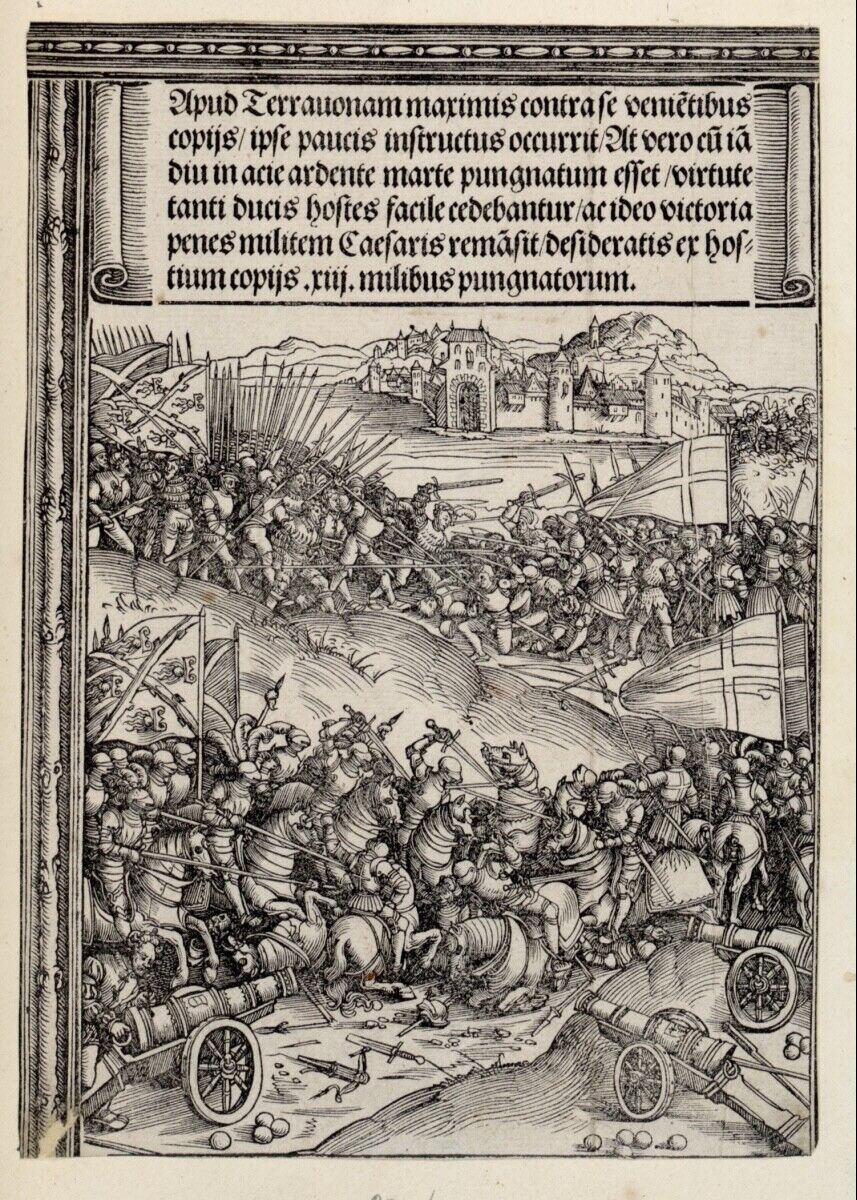 Battle of Guinegatte (1479): Wolf Traut, Public domain, via Wikimedia Commons
In 1479, Louis XI tried to regain the advantage by force of arms. In April-May, the French seized Dole; in June, the siege of Vesoul ended in a royal success. These operations showed that the monarchy retained a real offensive capacity in Franche-Comte and that it intended to draw the fullest benefit possible from the Burgundian crisis. But French progress soon encountered a decisive limit. On 7 August 1479, at the Battle of Guinegatte, Maximilian of Habsburg won an important success. This victory did not entirely overturn Louis XI’s gains, but it prevented any rapid triumph and signaled that a new first-rank adversary had imposed himself on the northeastern frontier. In just a few years, the king had thus moved from a personal confrontation with Charles the Bold to a broader problem, destined for a long European duration. Between 1476 and 1479, the French monarchy had helped to bring down the Burgundian state as it had existed under the Valois dukes, but at the same time it had seen the birth of the power that would soon dominate the continent’s dynastic competition: that of the Habsburgs.
🔍 Zoom - 1468-1475: the duel with Charles the Bold
VII. 1480-1483: final reforms, the Angevin inheritance, and the close of the reign
From 1480 onward, the reign of Louis XI entered its final phase, in which the effort of internal consolidation became inseparable from preparation for the succession. On 10 July 1480, the death of King Rene of Anjou allowed Charles V of Anjou to inherit Anjou and Provence, a transitional stage that already prepared the future attachment of this whole to the royal domain. A month later, on 10 August, Louis XI transferred the Parliament of Burgundy from Beaune to Dijon, giving a more stable institutional framework to a province recently recovered and still marked by the aftershocks of the Burgundian crisis. On 11 October 1480, he abolished the franc-archers, judged insufficiently effective, and replaced them with a more permanent infantry. This reform, which accompanied a broader evolution in military practices, shows that at the close of his reign the king abandoned neither organizational questions nor the ambition of a more regular monarchical apparatus.
The year 1481, however, revealed a power now weakened by the sovereign’s state of health. In March, Louis XI suffered a stroke, a sign of physical decline that did not prevent him from continuing to govern. In the month of June, he had the camp of Pont-de-l’Arche created to train the bands of Picardy on the Swiss model, proof that military reflection continued despite illness. On 27 July, he renounced the monopoly established in favor of French galleys and restored freedom of trade, while the dearth of the summer forced him to intervene against famine. These decisions recall that the end of the reign cannot be reduced to waiting for the king’s death: it remained a time of administrative, military, and economic adjustments, in which the monarchy continued to exercise direct action upon the kingdom.
The major territorial turning point came on 11 December 1481. At the death of Charles V of Anjou, Anjou, Maine, and Provence entered the royal domain; Marseille was attached to the kingdom, and Louis XI also inherited the Angevin rights over Naples. This enlargement was considerable. It completed the crown’s southern extension, strengthened the kingdom’s Mediterranean footing, and transmitted to the French monarchy an Italian question destined to take on growing importance under the following reigns. Louis XI’s policy was therefore not merely a policy of defense or recovery against the great feudal lords: it concretely enlarged the space subject to royal authority and prepared the new horizons of the French monarchy at the end of the fifteenth century.
 The Departure of Mary of Burgundy for the falcon hunt: Charles Tilmont, Public domain, via Wikimedia Commons
The year 1482 at the same time brought a provisional settlement of the Burgundian question. On 27 March, the death of Mary of Burgundy, following a fall from a horse, left the Low Countries to Philip the Fair under the regency of Maximilian of Austria. This disappearance altered the balance of the conflict opened by the death of Charles the Bold. Louis XI took advantage of it to seek a favorable compromise, while preparing the transfer of power to his son. On 21 September 1482, he had political instructions read to the dauphin Charles that organized his education in government and expressed an explicit will to control the succession. Finally, on 23 December 1482, the Treaty of Arras restored to France the Duchy of Burgundy and Picardy, while Maximilian retained Franche-Comte and the Low Countries. The marriage project between the dauphin Charles and Margaret of Austria inscribed this compromise within a dynastic logic. Without definitively eliminating the Franco-Habsburg rivalry, the agreement allowed the king to close his reign with a substantial restoration of the French position.
In 1483, the last months of the reign still combined acts of administration with organization of the future. In March, Louis XI restored the Saint-Germain-des-Pres fair; on 23 June, the betrothal of the dauphin Charles to Margaret of Austria extended the Arras agreements onto the matrimonial plane. But the decisive question was no longer that of a new conquest: it was that of transmission. On 30 August 1483, Louis XI died at Plessis-les-Tours. On that same day, the reign of Charles VIII began, the new king still an adolescent, under the political guidance of Anne de Beaujeu and Pierre de Beaujeu. Thus ended a reign of twenty-two years that profoundly transformed the French monarchy. Between 1461 and 1483, Louis XI had contained the great princes, weakened and then dismantled Burgundian power, enlarged the royal domain, strengthened the instruments of government, and prepared, amid difficulties, dynastic continuity. His death did not close all the conflicts he had bequeathed; yet it left his successors a state broader, stronger, and more centralized than it had been at the time of his accession.
🧠 Key Takeaways
- 1461-1465: Louis XI very early imposed a personal government, pushed aside part of the great lords, and in return provoked the crisis of the League of the Public Weal.
- 1465-1468: despite humiliating treaties and the ordeal of Peronne, the king retained the political initiative and methodically prepared his revenge.
- 1469-1475: the conflict with Charles the Bold became the center of the reign; Louis XI combined war, economic pressure, alliances, and diplomacy to isolate Burgundy.
- 1475: the Treaty of Picquigny neutralized England and marked one of the great diplomatic successes of the reign.
- 1476-1479: the fall of Charles the Bold allowed the crown to recover part of the Burgundian inheritance, but at the same time gave rise to the lasting threat of the Habsburgs.
- Throughout the reign: the monarchy strengthened its instruments of government, brought the nobility more tightly under control, supported certain economic centers, and exercised a more continuous authority over the kingdom.
- 1481-1483: the attachment of Anjou, Maine, and Provence greatly enlarged the royal domain and opened new Mediterranean and Italian horizons.
- 1483: at his death, Louis XI left Charles VIII a monarchy more centralized, more extensive, and politically stronger than it had been at his accession.