

The Origins of Humanity
Environ 1,2 million à 400 000 ans avant notre ère
The Origins of Humanity in France
Long before the name “France” designated any territory or nation, the land it occupies today was already being traveled, walked, and exploited by human groups arriving from Africa in successive waves. The oldest known evidence dates back to around 1.2 million years, found at three distinct points across the territory — in the Hérault, on the Côte d’Azur, and in the Centre region — proof that this presence was neither isolated nor exceptional, but firmly rooted in the long span of the Pleistocene.
Reconstructing this period raises a difficulty specific to the archaeology of human origins: traces are rare, fragmentary, and their interpretation is often the subject of lively scientific debate. The site of Chilhac, long presented as one of the oldest in Europe, has since lost that status for lack of evidence of intentional flaking; the huts of Terra Amata, described by Henry de Lumley as the oldest structured dwelling in France, are disputed by Paola Villa; the mastery of fire itself, at Tautavel as at La Micoque, remains an open question rather than an established certainty. This chapter chooses to embrace this uncertainty rather than conceal it.
Against this shifting backdrop, a coherent trajectory nonetheless emerges: one of technical progress that was extremely slow, yet continuous. The roughly shaped pebbles of the Oldowan gave way, from 760,000 years onward, to the Acheulean handaxe, more symmetrical and more effective; at the same time, anonymous human groups gave way to a species better defined by science, Homo heidelbergensis, whose skull from Tautavel offers the most complete portrait found in France.
Four main threads structure this chapter: the earliest settlements of the territory and their geographic distribution, the arrival of a new industry and a new species, an in-depth study of an emblematic site through the example of Tautavel, and finally the day-to-day coexistence with a megafauna now extinct, at once a resource and a constant danger.
This long story of origins, spanning nearly a million years, sets the stage for the arrival of a new species, better adapted to Europe’s cold climates: Neanderthal man, whose lasting settlement opens the next chapter.
I. ~1.2 million – 800,000 years before present: the earliest settlements of French territory
Long before France existed as a political entity, the territory it occupies today was already being traveled by human groups. The earliest evidence comes from three distinct regions, attesting to a broad, non-isolated presence across French soil from the very beginning of the Early Pleistocene. At Bois-de-Riquet, in the commune of Lézignan-la-Cèbe (Hérault), a joint team from the CNRS and the National Museum of Natural History uncovered, in August 2008, twenty-three tools shaped from quartzite and basalt, associated with more than four hundred faunal remains belonging to some twenty species — bovids, equids, cervids, rodents, carnivores, reptiles, birds, and possibly mammoth remains. Dated to roughly 1.2 million years, this association — rare for such an early period — of stone tools and datable fossils within the same geological layer places the site among the oldest in Western Europe, alongside Pirro Nord in Italy and Kozarnika in Bulgaria.
On the Côte d’Azur, the Vallonnet cave, at Roquebrune-Cap-Martin (Alpes-Maritimes), provides complementary evidence. Discovered in 1958 by an eight-year-old girl, Marianne Van Klaveren, it has been the subject of systematic excavations since 1962 under the direction of Henry de Lumley, then Pierre-Élie Moullé. Layer III of the site, dated to roughly 1 million years by paleomagnetism — confirmed in 2017 by uranium-lead dating placing the whole between 1.2 and 1.1 million years —, has yielded one hundred and eleven Oldowan-type tools shaped from limestone, sandstone, quartz, and flint, without any retouching. The twenty-five mammal species identified — cave bear, panther, saber-toothed tiger, hyena, rhinoceros, southern elephant — attest to a dry climate and an open oak-woodland landscape. Bones bearing fracture marks attest to marrow extraction, but the absence of any hearth or dwelling trace suggests behavior closer to scavenging than active hunting.
Further inland, the site of Pont-de-Lavaud, in the commune of Éguzon-Chantôme (Indre), discovered in 1982, completes this picture. Electron spin resonance dating applied to fluvial quartz places its occupation between 1.1 and 0.8 million years. The industry found there, based on a bipolar-on-anvil technique combined with direct percussion with a hard hammer, produces pointed objects from pebbles and veins of local quartz. Its location, far from the Mediterranean coasts of the two previous sites, shows that these human groups were not confined to the Mediterranean rim but ventured into the interior, despite marked periglacial climatic fluctuations.
These three sites share the same industry, described as archaic or Oldowan: roughly shaped pebbles and raw flakes, without secondary retouching, far below the sophistication of the handaxe that would characterize the following period. None of them allows these traces to be attributed with certainty to a precisely identified human species — neither Homo erectus nor Homo heidelbergensis is formally attested there — and scientific caution requires speaking simply of “archaic human groups.” A fourth site, at Chilhac (Haute-Loire), long presented as one of the oldest deposits in Europe with shaped pebbles dated to between 1.2 and 2 million years, has since lost that status: the work of P.-J. Texier, following the excavations of Christian Guth in the 1970s, found no evidence of intentional flaking, the observed shapes possibly resulting from natural volcanic processes. The episode illustrates how attributing a site to human presence rests on rigorous examination, rather than on the apparent antiquity of the remains alone.
These populations lived in an unstable climatic context, marked by the alternation of glacial and interglacial phases that punctuated the entire Pleistocene. The Günz glaciation, the oldest of the major Alpine glaciations identified by geologists, closes this period around 600,000 to 540,000 years before present — a boundary roughly corresponding to the rise of a new, more elaborate industry: the Acheulean handaxe.
🔍 Zoom – The earliest traces of human presence in France
II. ~700,000 – 450,000 years before present: Homo heidelbergensis and the rise of the Acheulean
Around 760,000 to 700,000 years before present, a new lithic industry, born in East Africa nearly a million years earlier, reached Western Europe: the Acheulean succeeded the archaic industry of the previous sites. The name of this industry comes from a French site, that of Saint-Acheul, on the outskirts of Amiens (Somme), where flaked flints were described as early as 1854 by Dr. Rigollot, before excavations led by Albert Gaudry then Gabriel de Mortillet led the latter to propose the term “Acheulean.” In France, the arrival of this industry on the territory is also attested by the deposits of Moulin Quignon and La Noira, at Brinay (Cher), dated between 695,000 and 670,000 years. Unlike the roughly shaped pebbles of the earlier period, the Acheulean handaxe shows unprecedented technical mastery: shaped by soft-hammer percussion on large flakes, it displays a carefully balanced bilateral symmetry, without the irregular fractures that marked the previous industry.
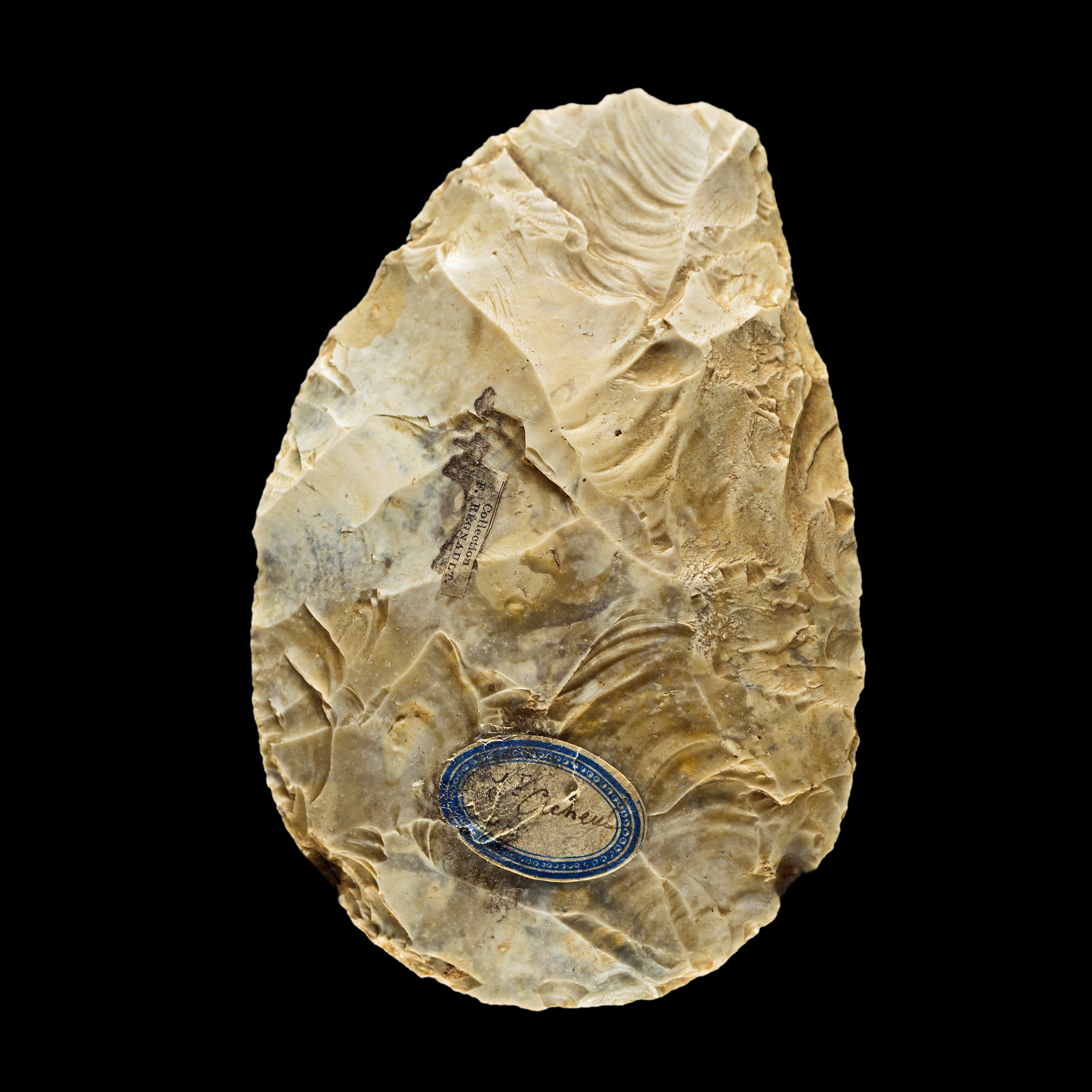 Caption: Handaxe from Saint-Acheul, Muséum de Toulouse — Didier Descouens, CC BY-SA 4.0
This technological break coincides with the emergence, on European soil, of a species better defined than the anonymous archaic groups of the previous section: Homo heidelbergensis. Described in 1908 by Otto Schoetensack from a mandible discovered the previous year in a sand quarry near Heidelberg, Germany — hence its name —, the species spread widely across the continent, from Germany to Greece, from England to Portugal, and occupied France at several sites, including that of Tautavel, examined further below. With a cranial capacity of between 1000 and 1300 cm³ and an average height of around 1.65 m for males, Homo heidelbergensis is today considered by geneticists to be the probable common ancestor of European Neanderthals and Asian Denisovans, a divergence estimated at around 450,000 years.
This species is also credited with the oldest structured dwelling known on French territory, at Terra Amata, on Mont Boron in Nice. Uncovered during earthmoving works interrupted in 1965, the site was the subject of official excavations led by Henry de Lumley from 28 January to 5 July 1966. Electron spin resonance dating places the occupation at around 400,000 years (380,000 ± 80,000). De Lumley described twenty-one superimposed oval huts, nine to sixteen meters long, built on a wooden post frame, each organized around a central hearth protected on one side by a low stone wall, where goethite was reportedly heated to produce a red pigment. This interpretation, long taken as a reference in textbooks, has however been challenged by the archaeologist Paola Villa, who proposes a later dating, around 230,000 years, and even disputes the existence of the huts, considering that the site’s state of preservation had been overestimated — a debate that illustrates the limits of archaeological interpretation when faced with such fragile remains.
 Caption: Rescue excavation site at Terra Amata — Oscar Rapaz, CC BY-SA 4.0
The question of fire mastery finds a less disputed answer at Menez-Dregan, in the commune of Plouhinec, in Finistère. Discovered in 1985 by Bernard Hallégouët, this site has, after more than thirty years of excavation campaigns, yielded a sequence of occupation spanning from 500,000 to 200,000 years. Its oldest layer, dated to 465,000 years, is considered one of the oldest traces of controlled fire in the world — only four other sites worldwide provide comparable evidence for such an early period. More recent layers, dated between 396,000 and 369,000 years, show clearly structured hearths: stones arranged in a circle or arc, associated with concentrations of charcoal. More than one hundred and fifty thousand lithic remains, mostly flaked flint and shaped sandstone pebbles, have been collected and studied at the Rennes archaeology laboratory. Elsewhere in Europe, the difficulty of distinguishing human-caused combustion from a natural fire makes this dating exceptional: ash and charcoal are poorly preserved, and few sites allow a built hearth to be formally identified.
III. ~450,000 years before present: Tautavel Man, an emblematic site
In the Pyrénées-Orientales, a karstic cavity overlooking the Verdouble valley from eighty meters up has yielded one of the richest deposits in European prehistory. The Caune de l’Arago, at Tautavel, was first observed as early as 1829, but it was not until 1948 that systematic excavations began there, intensifying in 1964 under the direction of Henry de Lumley and Marie-Antoinette de Lumley. A first human tooth was discovered there in 1965, a prelude to the find that made the site famous: during the summer of 1971, the team uncovered a partial fossil skull, named Arago 21.
 Caption: The Caune de l’Arago, Tautavel — Toony, CC BY-SA 3.0 / GFDL
This skull belonged to a male individual in his twenties, measuring around 1.65 m and weighing 45 to 55 kg. His flat, receding forehead and prominent brow ridges combine with a cranial capacity of 1150 cm³, measurements that allow him to be dated to around 450,000 years. His discoverers first proposed seeing in him a distinct subspecies, Homo erectus tautavelensis, but most current authors now attribute these fossils to Homo heidelbergensis — the same species already encountered at Terra Amata and Menez-Dregan. The cave’s sedimentary infill, more than fifteen meters thick, covers an occupation of the site spanning between 700,000 and 100,000 years; the main archaeological levels, grouped in “assemblage III,” lie between 450,000 and 300,000 years.
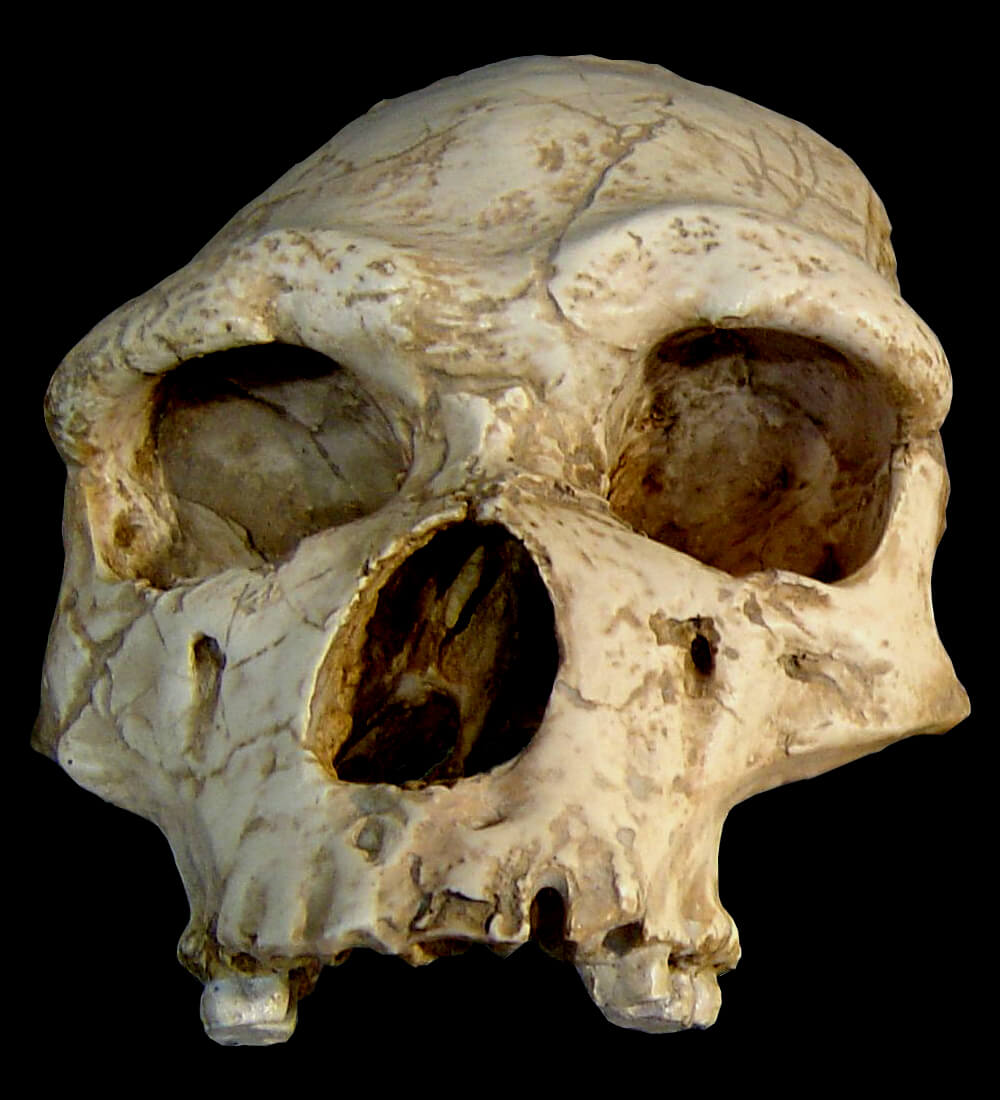 Caption: Cast of the Arago 21 skull, Musée de Tautavel — Luna04, CC BY-SA 3.0 / GFDL
The cave’s position is no accident: perched eighty meters above a ford through which herds of large herbivores passed, it offers an ideal observation post for spotting game on the plain. A hundred and twenty-two animal species have been identified there, with the slender horse (Equus mosbachensis tautavelensis) as the main prey, alongside bison, reindeer, deer, fallow deer, mouflon, rhinoceros, and Deninger’s bear. The lithic industry found on site, made from local materials in 80% of cases — mainly quartz —, includes scrapers, notched tools, and shaped pebbles; the handaxe, then in full expansion elsewhere on the territory, remains exceptional here, with fewer than one example per thousand tools.
Beyond the Arago 21 skull alone, more than one hundred and fifty human remains have been unearthed at the site, including bones of children and adults, suggesting occupation by mixed groups rather than isolated individuals. One detail draws particular attention from researchers: the Arago 21 skull itself bears traces of stone tools used to strip the flesh from it, a sign of cannibalistic practice within the group. The question of fire mastery at the site remains, by contrast, debated: some studies suggest meat was eaten raw, for lack of a hearth identified with certainty, while others mention traces of combustion among the remains — a point that archaeological publications have not yet conclusively settled [To verify].
IV. ~450,000 – 400,000 years before present: living in a world of megafauna
In the Dordogne, in the commune of Les Eyzies-de-Tayac-Sireuil, the site of La Micoque offers one of the most continuous records of this ancient occupation of the territory. First reported in 1895 by a landowner who noticed stones “that seemed retouched to him,” it was subsequently the subject of a long series of excavations: Louis Capitan from 1896, Édouard Harlé in 1897, Denis Peyrony in 1898 and again from 1929 to 1932, Otto Hauser between 1906 and 1907, and finally François Bordes in 1956. The oldest archaeological assemblage lies between isotopic stages 12 and 10, or roughly 480,000/425,000 to 370,000/335,000 years — a range that places the site’s oldest traces at around 450,000 years, in direct continuity with Tautavel.
 Caption: Rock shelter of La Micoque, Les Eyzies-de-Tayac-Sireuil — Sémhur, CC BY-SA 4.0
The horse (Equus caballus and Equus mosbachensis) overwhelmingly dominates the fauna found in every layer, alongside bovids, red deer, and ibex. Exploitation of these animals was not limited to meat consumption: long bones were systematically broken, a practice revealing the intent to extract marrow, a particularly sought-after, nutrient-dense resource. No hearth, however, has been uncovered at the site, leaving open the question of how far these groups had mastered fire at this period — an uncertainty that echoes the one already encountered at Tautavel. Since no human remains have been found at La Micoque either, the attribution of the remains stays presumed, between late Homo erectus and Homo heidelbergensis.
The lithic industry found on site, known as Tayacian, stands out for its rudimentary flaking, producing mainly scrapers, denticulates, and notched pieces — a cruder production than the Acheulean handaxe developing elsewhere on the territory at the same time, evidence that several technical traditions coexisted on French soil.
🔍 Zoom – The megafauna of the Pleistocene
Beyond the horse hunted at La Micoque, these groups shared their territory with a bestiary of giants now extinct — woolly mammoths, woolly rhinoceroses, steppe bison — as well as formidable predators, the cave lion and the cave bear, capable of disputing prey or shelter with humans. This coexistence required constant vigilance, in which survival depended as much on cooperation within the group as on the transmission, generation after generation, of hunting knowledge and safe routes.
Around 400,000 years, this long phase of occupation by archaic populations or by Homo heidelbergensis came to an end. A new human species, better adapted to the rigors of the European climate, was about to occupy French territory in turn for several hundred thousand years: Neanderthal man.
🧠 Key points
- The earliest traces of human presence in France date back to around 1.2 million years (Lézignan-la-Cèbe, Vallonnet, Pont-de-Lavaud)
- Around 760,000 years, the Acheulean industry (handaxe), named after the site of Saint-Acheul, replaced the archaic Oldowan industry
- This technical break coincides with the emergence of a better-defined species, Homo heidelbergensis, present at numerous French sites
- The skull of Tautavel Man (Arago 21, ~450,000 years) offers the most complete portrait of this species in France, with signs of cannibalism
- Several scientific debates run through this period without being settled: the authenticity of Chilhac, the dating of the Terra Amata huts, the mastery of fire at Tautavel as at La Micoque
- These nomadic groups lived in constant interaction with a now-extinct megafauna (mammoths, woolly rhinoceroses, cave lions and bears)
- Around 400,000 years, this long period ended with the foretold arrival of Neanderthal man, better adapted to Europe’s cold climates