
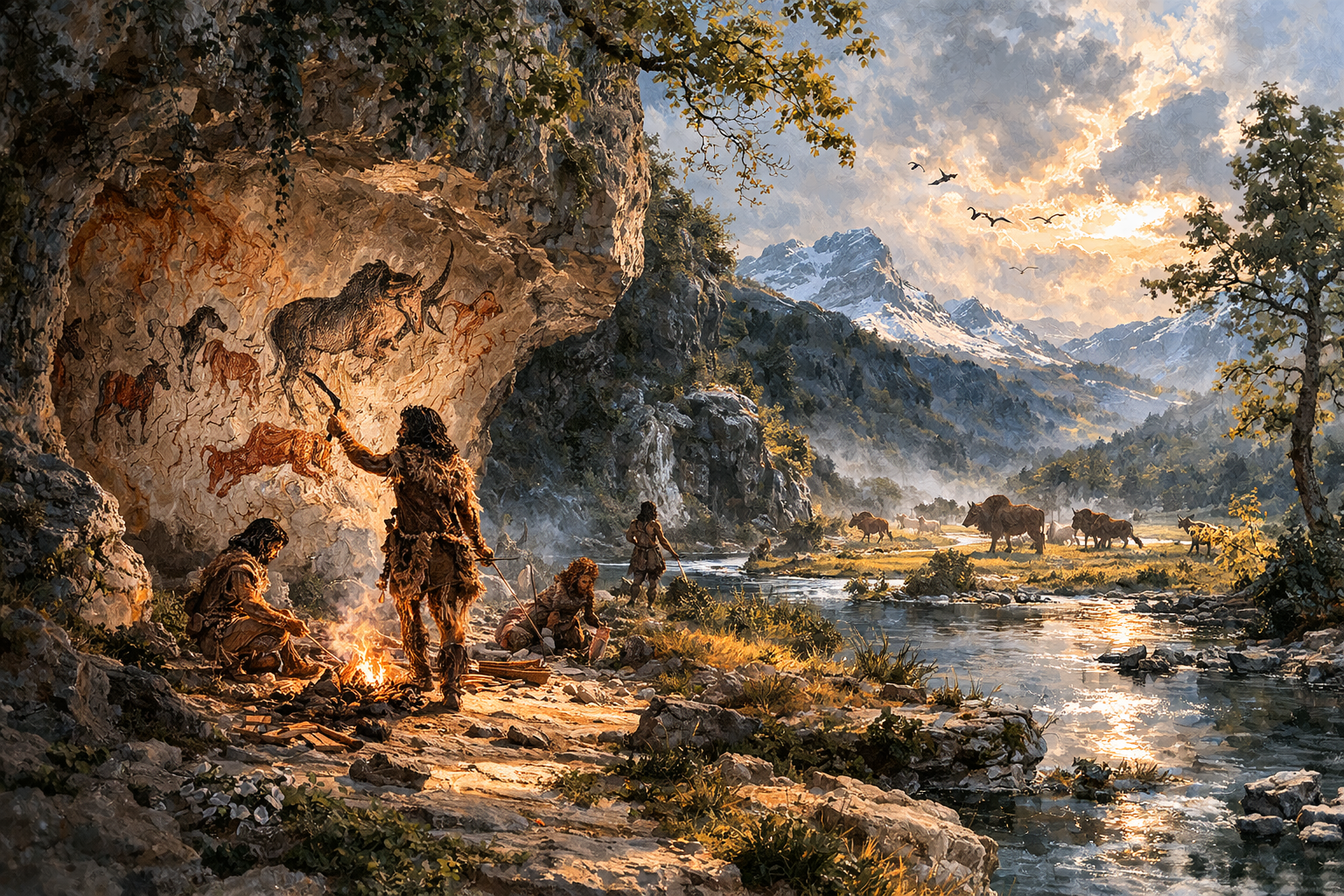
Neanderthal and the Peak of the Paleolithic
Environ –430 000 à –10 000 ans avant notre ère
Neanderthal and the Peak of the Paleolithic in France
When the previous chapter closes, a new species is about to occupy French territory for several hundred thousand years: Neanderthal man. Its origin, however, lies outside France, in the Spanish chasm of Sima de los Huesos, where an exceptional assemblage of more than seven thousand bones, dated to around 430,000 years, has yielded the oldest known genetic evidence of this lineage. The very name of the species comes from a much later discovery: it was in 1856, in Germany’s Neander Valley, that its remains were first recognized as belonging to a humanity distinct from our own.
Tracing this very long period — nearly 420,000 years, from Neanderthal’s arrival to the end of the Upper Paleolithic — requires weaving together two parallel stories. First, that of a humanity in its own right: burials arranged at La Chapelle-aux-Saints and La Ferrassie, a big-game hunter’s diet confirmed by isotopic analysis of French bones, and a symbolic mindset whose existence continues to divide researchers. Second, that of another humanity that arrived later to occupy the same land: Homo sapiens, whose presence in France is now dated to at least 54,000 years, well before a site in the Périgord, the Cro-Magnon rock shelter, gave it its popular name.
Far from a brutal replacement, these two species lived alongside one another, observed each other, and sometimes interbred: genetics today attests to genuine hybridization, before Neanderthal died out, according to the most recent dating, between 44,200 and 40,600 years ago — several thousand years earlier than long believed. This disappearance, whose exact causes remain debated, opened the way to what remains one of the summits of human creativity: the explosion of cave art, embodied in France by several exceptional sites, Chauvet, Cosquer, and Lascaux.
This chapter thus follows six major moments: Neanderthal’s settlement in Europe and its technical break with earlier industries; the archaeological evidence of an elaborate social and spiritual life; the arrival of Cro-Magnon and the coexistence of the two humanities; Neanderthal’s disappearance and the hypotheses surrounding it; the birth of cave art; and finally the technical innovations — the eyed needle, the spear-thrower, personal ornament — that transformed daily life in the Upper Paleolithic.
This period shapes, perhaps more than any other, the image we have of Prehistory: that of a plural humanity, capable of mourning, creation, and technical innovation, well before the invention of agriculture that opens the next chapter.
I. ~430,000 – 240,000 years before present: Neanderthal’s arrival and settlement in Europe
In Spain, in the chasm of Sima de los Huesos, at the site of Atapuerca, a stratigraphic layer dated to around 430,000 years has yielded more than seven thousand fossilized human bones, representing a minimum of twenty-eight to thirty-two individuals — the largest assemblage of Middle Pleistocene human fossils known in the world. Long attributed to Homo heidelbergensis, these remains were subjected to mitochondrial and then nuclear DNA sequencing that confirmed their membership in the oldest known Neanderthal lineage — Sima de los Huesos remains, to this day, the only non-permafrost site allowing the study of such ancient human DNA. It is thus in Spain, not France, that the best-documented source of this new humanity is found, one that would soon spread across the entire European continent.
The very name of the species comes from a much later discovery. In August 1856, in the Kleine Feldhofer cave, in the Neander Valley near Düsseldorf, Germany, workers quarrying limestone uncovered a skullcap and several limb bones. The remains were collected by the schoolteacher Johann Carl Fuhlrott, who submitted them to the anatomist Hermann Schaaffhausen, of the University of Bonn. The two men presented their interpretation before a learned society in Bonn on 2 June 1857, before Schaaffhausen published his conclusions in 1858: for the first time, a human fossil was recognized as belonging to a species distinct from modern man.
 Caption: Skullcap, type specimen of Homo neanderthalensis, Neander Valley — Eunostos, CC BY-SA 4.0
This biological shift was accompanied by an equally clear technical break. In the Ardèche, the site of Orgnac 3, occupied between around 312,000 and 265,000 years ago by populations still attributed to Homo heidelbergensis, is among the oldest deposits to have yielded an industry based on Levallois debitage: a method involving the careful preparation of a core with two convex surfaces in order to detach flakes of predetermined shape. Having emerged in East Africa more than 400,000 years ago before spreading across Eurasia, this technique would become the signature of the Mousterian, the industry associated with Neanderthal. In 1986, the archaeologist Éric Boëda demonstrated that the original description given by François Bordes was only one variant among several, within a broader “Levallois concept” encompassing different methods of preferential and recurrent debitage.
The earliest Neanderthal fossils formally attested on French territory come from Biache-Saint-Vaast, in the Pas-de-Calais. A first skull, probably that of a woman, was discovered there on 5 May 1976 by the volunteer excavator F. Carré; fragments of a second skull, this one male, followed on 8 November 1986. Dated between 240,000 and 175,000 years, these remains constitute the oldest known human fossils in northern France, marking Neanderthal’s entry, as an identifiable species, into the national archaeological record.
This new humanity displays a morphology clearly adapted to the cold climates that then dominated Europe: a stocky body, a broad trunk, shortened limbs, consistent with the thermoregulation principles governing mammalian anatomy in cold environments. An older hypothesis also attributed to the Neanderthal nose, with its particularly large nasal cavities, a role in warming and humidifying inhaled air, linked to the high energy needs of a heavily built hunter. This interpretation has, however, recently been challenged by the study of the Altamura Man, in Italy, whose nasal cavity shows no sign of such an adaptation — suggesting that Neanderthal’s characteristic facial morphology results from a more complex combination of factors than a simple response to cold.
II. ~300,000 – 45,000 years before present: Neanderthal, a humanity in its own right
In the Corrèze, in the Bouffia Bonneval cave, in the Sourdoire valley, the fossil of a Neanderthal was unearthed on 3 August 1908 by the priests Amédée and Jean Bouyssonie, their brother Paul, and Louis Bardon. Nicknamed “the Old Man,” this individual, aged 50 to 60, had lost most of his teeth and suffered from bone resorption — a remarkably advanced age for the species. His skeleton lay in a shallow pit, legs folded, head turned to the west: these observations made it possible to establish, for the first time, proof of a deliberate burial among Neanderthals, dated to around 45,000 years. This discovery permanently changed the image of a crude Neanderthal devoid of inner life.
 Caption: Skull and mandible of the man of La Chapelle-aux-Saints, Muséum national d’histoire naturelle — Eunostos, CC BY-SA 4.0
In the Dordogne, the La Ferrassie rock shelter, discovered by chance in 1895 during road works, was excavated from 1909 to 1929 by Denis Peyrony, a schoolteacher in the village of Les Eyzies, and Dr. Louis Capitan. The site yielded eight Neanderthal skeletons — a woman, a man, several children, a newborn, and a fetus — making it a genuine family necropolis. In 1920, the two excavators uncovered the remains of a fetus of about seven months, associated with tools, a scraper and a point; the following year, a sixth burial revealed the skeleton of a three-year-old child. A recent direct dating of one of these skeletons, La Ferrassie 8, obtained by radiocarbon dating and confirmed by mitochondrial DNA, places this individual between 41,700 and 40,800 years ago — one of the latest dates ever established for the species in France.
Isotopic analyses carried out on French Neanderthal bones paint the portrait of a formidable hunter, positioned at the top of the food chain. At Marillac (Les Pradelles, Charente), the earliest studies of the collagen carbon/nitrogen ratio, conducted notably by Hervé Bocherens, reveal isotopic signatures comparable to those of large carnivores. At Saint-Césaire (Charente-Maritime), a skeleton dated between 40,000 and 30,000 years confirms a diet dominated by the meat of large herbivores, close to that of contemporary wolves. Across the continent, the Neanderthal diet is thus estimated at around 80% meat — mammoth, rhinoceros — for only 20% plant matter, a diet made possible by the use of pointed hunting weapons.
The question of Neanderthal symbolic thought remains disputed. At Krapina, in Croatia, eagle talons shaped to be mounted as a bracelet or necklace have been dated to around 130,000 years — well before the arrival of Homo sapiens in the region, which rules out any confusion with another species. Other evidence — red and black pigments, feathers, perforated and tinted shells — supports the idea of a developed symbolic behavior. But the debate is not settled: the reliability of certain datings and the real intentionality of certain gestures continue to divide researchers, a minority of whom prefer to attribute these objects to modern humans rather than to Neanderthal himself.
III. ~54,000 – 40,000 years before present: the arrival of Cro-Magnon and coexistence with Neanderthal
In France itself, the chronology of this arrival was overturned by a recent discovery. In Mandrin cave, at Malataverne, in the Drôme, excavations conducted since the early 2000s by Ludovic Slimak uncovered nine human teeth spread across most of the site’s archaeological levels. A study published in February 2022 revealed that they belonged to an original industry, named the Neronian, attributed to an archaic Homo sapiens whose only known cultural affinities lie in Lebanon, at the Ksar Akil site. Dated to around 54,000 years, this Neronian layer appears directly framed by Neanderthal occupations of the same age: Mandrin cave thus shows not a simple replacement of one species by another, but an alternating occupation of the same place by the two humanities — pushing back the arrival of Homo sapiens in Europe by around ten thousand years compared to earlier estimates.
Yet it is another, later site that gave its name to this new humanity. In March 1868, road works carried out near the village of Les Eyzies, in the Dordogne, uncovered the remains of five human skeletons, in what would become the Cro-Magnon rock shelter. Louis Lartet, commissioned by the Ministry of Public Education, led the excavations and officially presented the discovery on 16 April 1868. The skeletons, associated with perforated marine shells used as ornaments and numerous flaked flints, are spread across several levels attributed to the Aurignacian, now dated between 33,000 and 26,000 years. This was the very first discovery of anatomically modern humans in a prehistoric context — a founding event that would give its name, “Cro-Magnon man,” to Homo sapiens in everyday language.
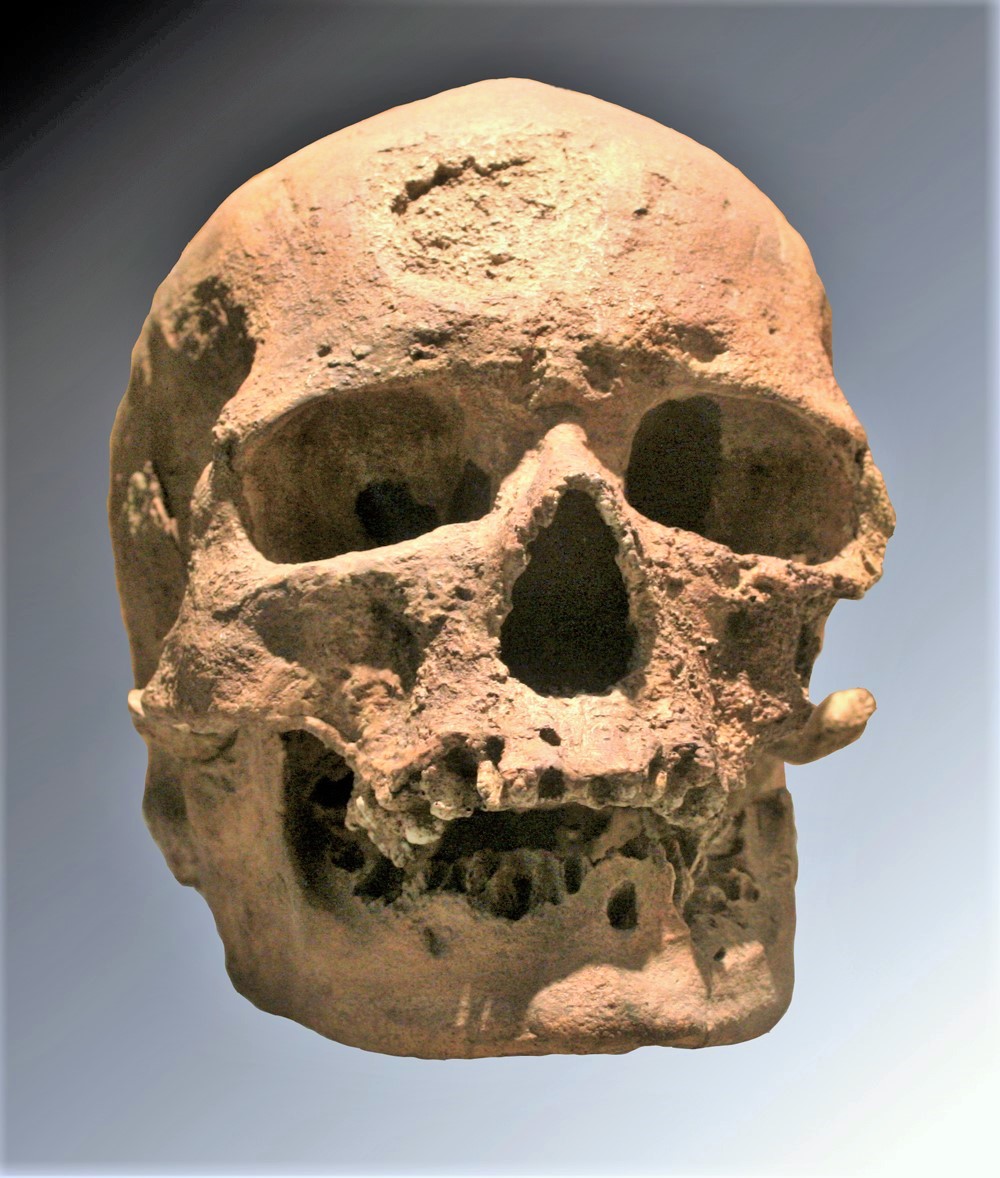 Caption: Skull of Cro-Magnon 1, cast, Musée de l’Homme — CC BY-SA 3.0 / GFDL
For several millennia, Cro-Magnon and Neanderthal thus shared the European territory, and genetics has ultimately provided direct proof of this. In Romania, the human jawbone discovered in the Peștera cu Oase cave — the individual known as Oase 1 — yielded, once its genome was sequenced, a spectacular result: between 6 and 9% Neanderthal DNA, far more than the 2 to 4% found in present-day Europeans, implying a direct Neanderthal ancestor only four to six generations earlier. This result is part of the work of the Swedish geneticist Svante Pääbo, who led the sequencing of a significant portion of the Neanderthal genome in 2010, before receiving the 2022 Nobel Prize in Physiology or Medicine for his body of work. His research definitively established that modern humans today carry a small proportion of DNA inherited from Neanderthal — and from the Denisovans, discovered later in Asia —, acquired through hybridization at the very moment Homo sapiens was extending its presence across Eurasia.
IV. ~44,000 – 40,000 years before present: Neanderthal’s disappearance
Long placed around -30,000, Neanderthal’s disappearance has been considerably pushed back in time by a methodical review of dating. The archaeologist Thomas Higham, of the University of Oxford, led a new analysis of Neanderthal bone fragments from major European sites, applying an ultrafiltration technique to collagen designed to eliminate contamination by modern particles that had skewed earlier radiocarbon measurements. His results, published in 2014, place the species’ disappearance in northwestern Europe between 44,200 and 40,600 years ago, up to eight thousand years earlier than previously thought. This redating supports the hypothesis of direct economic competition with Homo sapiens, defended notably by Chris Stringer, of the Natural History Museum in London: the two species hunted the same game, gathered the same plants, and sought out the same shelters, which would have placed Neanderthal in a persistently disadvantageous position.
Another hypothesis, complementary or competing, invokes a sudden environmental factor: the eruption of the Campanian Ignimbrite, in the Phlegraean Fields, Italy, around 39,300 years ago — the most violent eruption Europe experienced in the last two hundred thousand years. Coinciding with the onset of an extremely cold climatic episode, the Heinrich 4 event, this eruption may have caused a volcanic winter, lowering temperatures by several degrees across Eastern Europe and Northern Asia. Several studies point out, however, that this effect, though real, appears to have spared the main centers of Neanderthal population in Western Europe, and probably does not, by itself, suffice to explain the species’ complete disappearance.
For France and northern Spain specifically, statistical estimation models put the duration of overlap between the two humanities, before Neanderthal’s final disappearance from this territory, at only 1,400 to 2,900 years — a brief window of coexistence on a prehistoric timescale, but sufficient, as the evidence already gathered in Romania with Oase 1 suggests, to allow for occasional contact and interbreeding.
One of the last cultural strongholds attributed to Neanderthal in France is located at the Grotte du Renne, at Arcy-sur-Cure, in the Yonne. Its Châtelperronian levels yield Neanderthal remains associated with numerous personal ornaments, decorated bone tools, and colorants — a set of finds long interpreted as proof of Neanderthal acculturation through contact with Homo sapiens. This reading is now contested: several stratigraphic analyses consider the hypothesis of accidental mixing with the overlying Protoaurignacian levels equally plausible, without any consensus yet emerging. This uncertainty, like the other debates already encountered in this chapter, illustrates the difficulty of settling between competing interpretations of the same set of remains.
🔍 Zoom – The mystery of Neanderthal’s disappearance
V. ~37,000 – 17,000 years before present: the explosion of cave art
On 18 December 1994, three amateur cavers, Jean-Marie Chauvet, Éliette Brunel, and Christian Hillaire, discovered at Vallon-Pont-d’Arc, in the Ardèche, a cavity that would yield the oldest known cave-art masterpiece to date: Chauvet Cave. More than a thousand exceptionally well-preserved drawings and engravings have been recorded there. A fifteen-year scientific controversy over the site’s exact age was finally settled by a multidisciplinary team led by Anita Quiles, of the French Institute of Oriental Archaeology, whose work, published in the journal PNAS, established for the first time such a precise chronological framework, expressed in calendar years, for a decorated site. Two phases of occupation stand out: an early one, Aurignacian, between 37,000 and 33,500 years, then a second, Gravettian, beginning 31,000 years ago and ending 29,400 years ago, when a rockfall permanently sealed the entrance — preserving the cave’s contents until its rediscovery.
What sets Chauvet apart from most other decorated sanctuaries is the choice of its subjects. Where later cave art focuses almost exclusively on large herbivores — horses, aurochs, deer —, the walls of Chauvet massively depict predators: cave lions, woolly rhinoceroses, bears, mammoths, alongside horses rendered with a realism and mastery of movement remarkable for such an early period. This work predates Lascaux by ten to fifteen thousand years, which has permanently upended the idea of a linear, progressive evolution of prehistoric art, from the crudest to the most accomplished.
 Caption: Paintings from Chauvet Cave, replica, Anthropos Museum (Brno) — HTO, public domain
A third French site deserves special mention: Cosquer Cave, in the Calanques of Marseille. Explored from the mid-1980s onward by the diver Henri Cosquer, it was only officially declared in 1991, after three divers died in the passage marking its access. It is the only decorated cave in the world whose entrance opens beneath the sea, at a depth of 37 meters — a location that explains both its late discovery and the exceptional state of preservation of its remains. Two phases of occupation are distinguished there: an early one, between 33,000 and 29,000 years, marked by sixty-five negative hand stencils — forty-four black, twenty-one red — made by blowing pigment over a hand pressed against the rock; a second, around 19,000 years ago, adding further engravings and animal paintings.
 Caption: Negative hand stencil, Cosquer Cave, Musée d’Archéologie nationale — SiefkinDR, CC BY-SA 3.0 / GFDL
In Montignac, in the Dordogne, the cave of Lascaux was discovered later, on 8 September 1940, when a young man’s dog, Marcel Ravidat, dashed into an underground passage; he returned there on 12 September with three friends, Jacques Marsal, Georges Agnel, and Simon Coencas. Closed to the public as early as 1963 to protect it from degradation caused by overcrowding — the proliferation of algae and calcite deposits linked to carbon dioxide, humidity, and artificial lighting —, the cave is the subject of a dedicated zoom, given that its iconographic richness deserves its own full treatment.
🔍 Zoom – Lascaux, a global masterpiece
Far from being mere decoration, this cave art conveys a fully formed symbolic mindset: it stages the relationship between humans and the animal world, likely plays a part in the transmission of beliefs and knowledge, and presupposes a social organization capable of devoting considerable time and resources to activities with no immediate survival function. This creative explosion, of which France preserves three of the most exceptional examples in the world, marks the Upper Paleolithic’s entry into its richest phase.
VI. ~20,000 – 13,000 years before present: technical innovations and daily life in the Upper Paleolithic
Fitted clothing appeared at the very end of the Solutrean, around 20,000 years ago, with the spread of the eyed needle. An emblematic example comes from the Chaire-à-Calvin rock shelter, at Mouthiers-sur-Boëme, in the Charente. Made of bone using the double-groove technique — two parallel grooves cut into a long bone to extract a thin rod —, these needles were pointed at one end and delicately pierced at the other to form the eye. Although it first appeared at the end of the Solutrean, this tool only became widespread in the Magdalenian, a period during which it allowed the making of sewn, fitted clothing, better suited to harsh climates than the simple draped hides of earlier periods.
Hunting itself benefited from a major innovation with the spear-thrower, a lever arm that greatly increases the range and power of a thrown spear. The most famous French example, known as the “fawn with birds,” was discovered in 1940 by Saint-Just Péquart in the Mas d’Azil cave, in the Ariège. Dated to the Upper Magdalenian, around 13,000 years ago, this 29.5-centimeter object, carved from reindeer antler, depicts a fawn turning its head toward two perched birds — a piece of remarkable grace and refinement, a true masterpiece of Paleolithic portable art. A nearly identical piece, found in the Bedeilhac cave, suggests the circulation of shared models or craftsmanship between neighboring groups.
Portable art also manifests itself in the depiction of the human figure. In 1894, the archaeologist Édouard Piette uncovered, at the entrance to the Grotte du Pape, at Brassempouy, in the Landes, a small head carved from mammoth ivory, only 3.65 centimeters tall, known as the “Lady of Brassempouy.” Dated to the Gravettian, between 22,000 and 25,000 years ago, it is one of the oldest realistic representations of the human face ever found.
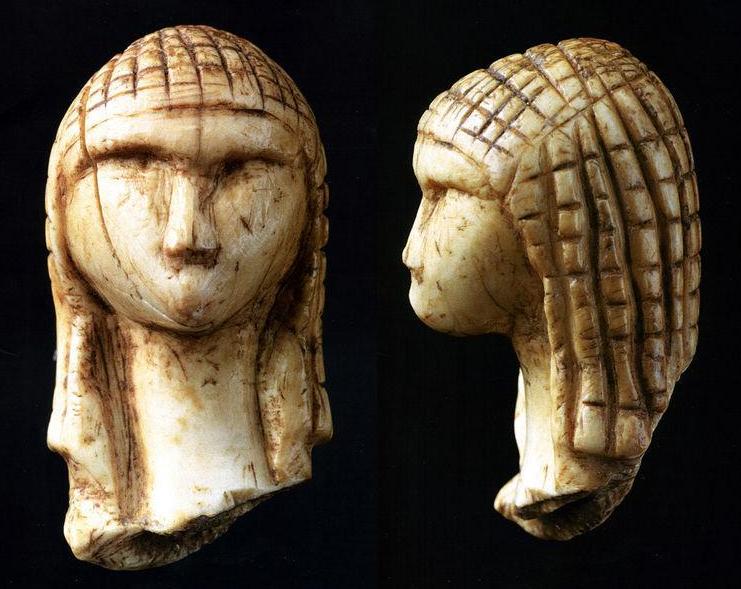 Caption: Lady of Brassempouy, mammoth ivory, Musée d’archéologie nationale — Jean-Gilles Berizzi, public domain
These technical innovations went hand in hand with a profound transformation of habitat: camps became more structured, distinguishing rest areas, work areas, and areas for collective activities, a sign of a better-coordinated society.
🔍 Zoom – Daily life in a tent camp
🧠 Key points
- Neanderthal man, whose genetic origin traces back to Sima de los Huesos (Spain, ~430,000 years ago), owes his name to a discovery made in 1856 in Germany’s Neander Valley
- The burials at La Chapelle-aux-Saints (1908) and La Ferrassie (1909-1929) provide the first proof of Neanderthal social and spiritual life
- Homo sapiens is attested in France from around -54,000 (Mandrin cave), well before the Cro-Magnon rock shelter (1868) that gave the species its name
- Genetics (Oase 1, the work of Svante Pääbo) proves genuine hybridization between the two species
- Neanderthal became extinct between 44,200 and 40,600 years ago according to the most recent dating, for reasons still debated
- France is home to several of the oldest and richest cave-art sanctuaries in the world: Chauvet (~36,000 years), Cosquer (~33,000-19,000 years), and Lascaux (~17,000 years)
- Innovations such as the eyed needle, the spear-thrower, and personal ornament transformed daily life in the Upper Paleolithic