
From the Mesolithic to the Neolithic Revolution
Environ -10 000 à -2 500 av. J.-C.
From the Mesolithic to the Neolithic Revolution
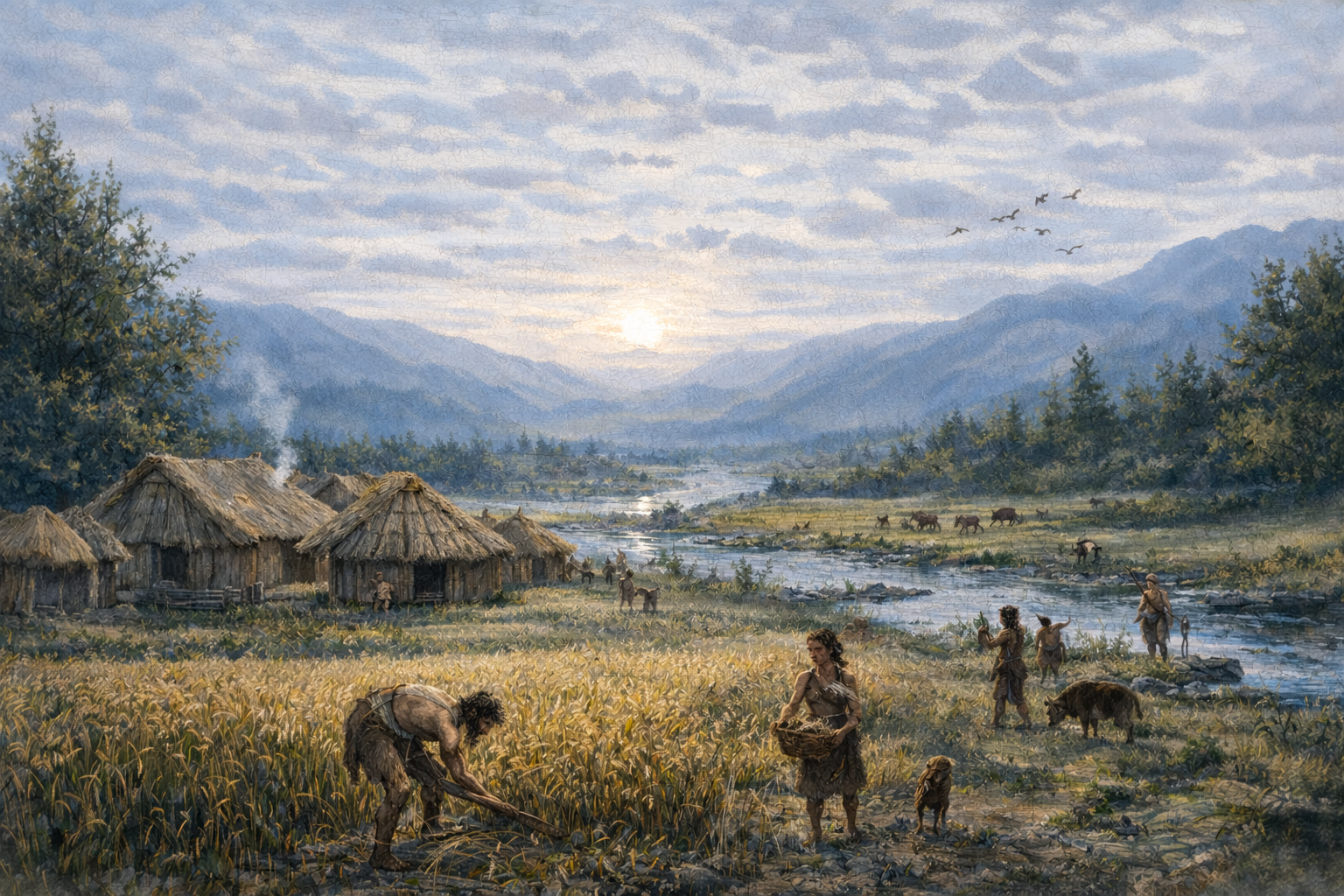
When the previous chapter closes, humanity has just lived through the peak of the Upper Paleolithic, marked by the explosion of cave art. But the warming climate that ends the last glaciation, around 10,000 BCE, radically transforms the French landscape: icy steppes give way to dense forests, megafauna disappears, and the last hunter-gatherers of the Mesolithic must reinvent their survival techniques, as shown by the Breton necropolises of Téviec and Hoëdic.
This chapter traces the greatest break in human history: the shift, over a few millennia, from an economy of predation to an economy of production. This revolution was not born on French soil: it arrived by two distinct routes, a Mediterranean one with the Cardial culture, a continental one with the Linear Pottery (Rubané) culture, before permanently transforming how populations related to their territory — permanent settlement, storage, long-distance trade, as shown by Alpine jade found as far away as Brittany.
This new abundance, however, came at a price. Sedentary life and the accumulation of wealth gave rise, for the first time, to lasting social inequalities, which archaeology finds both in differentiated grave goods and in the far darker traces of collective violence, as at the site of Bergheim, in Alsace.
This chapter thus follows five major moments: the last hunter-gatherers of the Mesolithic; the arrival of agriculture by two migratory routes; the birth of the first villages and long-distance trade networks; the growing hierarchization of agricultural societies; and finally the erection of the first great stone monuments, the megaliths, of which Brittany preserves the most impressive examples in the world.
This period thus lays the foundations for all the societies that would follow: property, hierarchy, organized trade, and the collective monument. It opens the way to the Age of Metals, which would see these trends intensify further.
I. ~10,000 to 6,000 BCE: the last hunter-gatherers of the Mesolithic
As the last glaciation comes to an end, French territory undergoes a radical transformation of its environment: cold steppes give way to dense forests, and Pleistocene megafauna disappears, replaced by smaller, more elusive game — deer, wild boar, small mammals. An early transitional culture, the Azilian, marks the passage between the last embers of the Magdalenian and this new postglacial world: dated to around 12,000 to 11,000 BP, it was defined as early as 1889 by Édouard Piette — the same archaeologist who would uncover the Lady of Brassempouy in 1894 — from the levels he excavated in the Mas d’Azil cave, in the Ariège, already encountered in this account for its “fawn with birds” spear-thrower. The Azilian is recognized by its microlithic points with rounded backs and its small flat harpoons carved from deer antler. Hunter-gatherers then adapted their toolkit to this new world: the Tardenoisian industry, characterized by geometric microliths shaped as trapezes, triangles, and asymmetric points, developed between roughly 8200 and 5500 BCE; discovered in 1885 by E. Taté at Coincy, in the Aisne, it dominates the center and north of the Paris Basin. At the same time, the Sauveterrian, recognizable by its very small triangular microliths shaped from irregular blades, developed between 8000 and 6500 BCE; its type artifact, the “Montclus triangle,” is found in Brittany as well as in the southern Paris Basin and the northern Alps.
Two Breton sites offer the fullest record of this final phase of nomadic life. On the islet of Téviec, in the Morbihan, a first discovery was made in 1883 by F. Gaillard, but it was between 1928 and 1930 that Marthe and Saint-Just Péquart — the same couple of archaeologists who would later uncover, in 1940, the “fawn with birds” spear-thrower at Mas d’Azil — methodically excavated the site over an area of 320 m². They recorded twenty-one individuals there, buried within a shell midden, dated to between the middle of the seventh and the middle of the sixth millennium BCE.
A little further south, the islet of Hoëdic yields a comparable assemblage: its burials, spotted in 1934, were excavated by the same Péquarts between 1934 and 1954, and dated from the start of the eighth to the start of the sixth millennium BCE. Together, Téviec and Hoëdic form the largest anthropological collection associated with the French Mesolithic, and remain an essential source for understanding the funerary practices of the last hunter-gatherers, on the eve of agriculture’s arrival on the territory.
II. ~5,800 to 5,000 BCE: the arrival of agriculture by two routes
The first migratory wave followed the Mediterranean route. The so-called Cardial culture — named after the Cardium shells used to decorate pottery by impression — reached the coasts of Languedoc and Provence from Italy. The site of Peiro Signado, at Portiragnes, in the Hérault, discovered in the mid-1970s, offers one of the oldest examples: dated between 5700 and 5600 BCE, it ranks among the very first Neolithic settlements in southern France. Its pottery allowed the archaeologist J.-L. Roudil to define a previously unknown cultural facies, which he linked to that of the Ligurian cave of Arene Candide, in Italy, confirming the trans-Alpine origin of this first wave of settlement. Excavations resumed in 1996 and 1997 uncovered the remains of an oval-plan building marked by post holes and partly burnt daub, surrounded by clay-extraction pits reused as refuse dumps.
The second wave followed an entirely different, continental path. The Linear Pottery culture, or Rubané, developed in Central Europe — Hungary, Bohemia, the Rhineland — between 5500 and 5000 BCE, before the first farmers entered the Paris Basin around 5000 BCE. The village of Cuiry-lès-Chaudardes, in the Aisne, excavated from 1972 to 1994 by a joint CNRS and University of Paris 1 team, is its most complete example: an extremely rare site fully excavated for this period, it reveals long rectangular or trapezoidal houses, with timber frames and daub walls, built on freshly cleared plots.
Though of distinct origin, these two migratory waves introduced the same coherent technical package: pottery, allowing grain and liquids to be stored; the quern, for turning cereals into flour; and polished stone, more resistant than flaked stone, essential for clearing forests and shaping durable farming tools. Within a few centuries, this “Neolithic package” radically transformed how French populations related to their land, replacing the constant mobility of hunter-gatherers with a lasting anchoring to the soil.
III. ~5,000 to 3,000 BCE: new villages and new techniques
The site of Bercy, in Paris, excavated in 1991-1992 southeast of the present-day sports complex, on a former arm of the Seine, concretely illustrates this new relationship to territory. Three Neolithic occupations succeed one another there: two belonging to the Middle Neolithic — the Cerny group, around 4500-4200 BCE, then the Chasséen culture, between 4200 and 3400 BCE —, and a third from the Late Neolithic, around 3000-2600 BCE. Excavators uncovered ten oak dugout canoes there, entirely hollowed out by fire and then by stone axes, along with traces of three buildings, a palisade, and a landing stage — proof of a genuine village organized on the riverbank, where fishing and river traffic complemented the agricultural economy. Several of these canoes are now displayed at the Musée Carnavalet, in Paris.
 Caption: Oak dugout canoe P03, Bercy site, Musée Carnavalet — public domain
These farming communities, however, did not live in isolation: they were part of continent-wide exchange networks, the best evidence of which remains the trade in Alpine jade. In 1865, the mineralogist Alexis Damour defined the mineral “jadeite” from polished axes discovered in the Morbihan; he first imagined a Far Eastern origin, before pointing, as early as 1881, to an Alpine source, near Monte Viso, southwest of Turin. It would take the JADE Project, however, conducted from 2006 to 2010, for Pierre and Anne-Marie Pétrequin to precisely locate, in June 2003, the quarries themselves: those of the Monte Viso massif, worked at altitudes between 1,500 and 2,400 meters, and, more marginally, those of the Beigua massif, north of Genoa.
The large axes carved from this precious stone circulated over considerable distances during the fifth and fourth millennia BCE: as far as 3,300 kilometers from west to east, from Ireland to Bulgaria, and more than 2,000 kilometers from north to south, from Denmark to Sicily. Far from being mere tools, these rare and precious objects belonged to a gift economy controlled by elites, blending social competition, display, and religious ritual — further proof that Neolithic societies, barely out of nomadism, were already organized along well-established hierarchies.
IV. ~4,300 to 3,000 BCE: a society growing hierarchical
Competition for fertile land left bloody traces. In 2012, the site of Bergheim, in Alsace, north of Strasbourg, excavated by the firm Antea-Archéologie under the direction of Bertrand Perrin, revealed a pit about a meter and a half in diameter and two meters deep, filled with human remains. The oldest deposit, dated between 4300 and 4150 BCE, contains at least seven severed upper limbs — hands, fingers, and arms — all bearing cut or amputation marks made with a blade or an axe. Strikingly, these limbs systematically come from the left side, a peculiarity also noted at the neighboring site of Achenheim. Researchers see them as trophies taken from enemies fallen in combat, brought back to the village to be displayed publicly; recent isotopic analyses further suggest that the complete skeletons and the severed limbs found at the site do not share the same geographic origin.
This violence went hand in hand with a growing hierarchization of societies, visible in funerary architecture from around 4700 BCE onward. At Lattes, in the Hérault, the burial known as Rauze-Basse yields prestigious grave goods: arrowheads, finely polished ornamental axes made of Alpine green stone, and perforated spheroids carved from rare stones — all objects with no practical function, reserved for the display of social status. Elsewhere, it is gold, ivory, coral, amber, or copper that set certain burials apart from others. From 4000 BCE onward, such evidence multiplies, particularly in southern France, where nearly four hundred burials or body deposits have been recorded, sketching a society in which access to wealth, prestige, and perhaps power was no longer equally shared.
V. ~4,850 to 3,000 BCE: the mystery of the megaliths
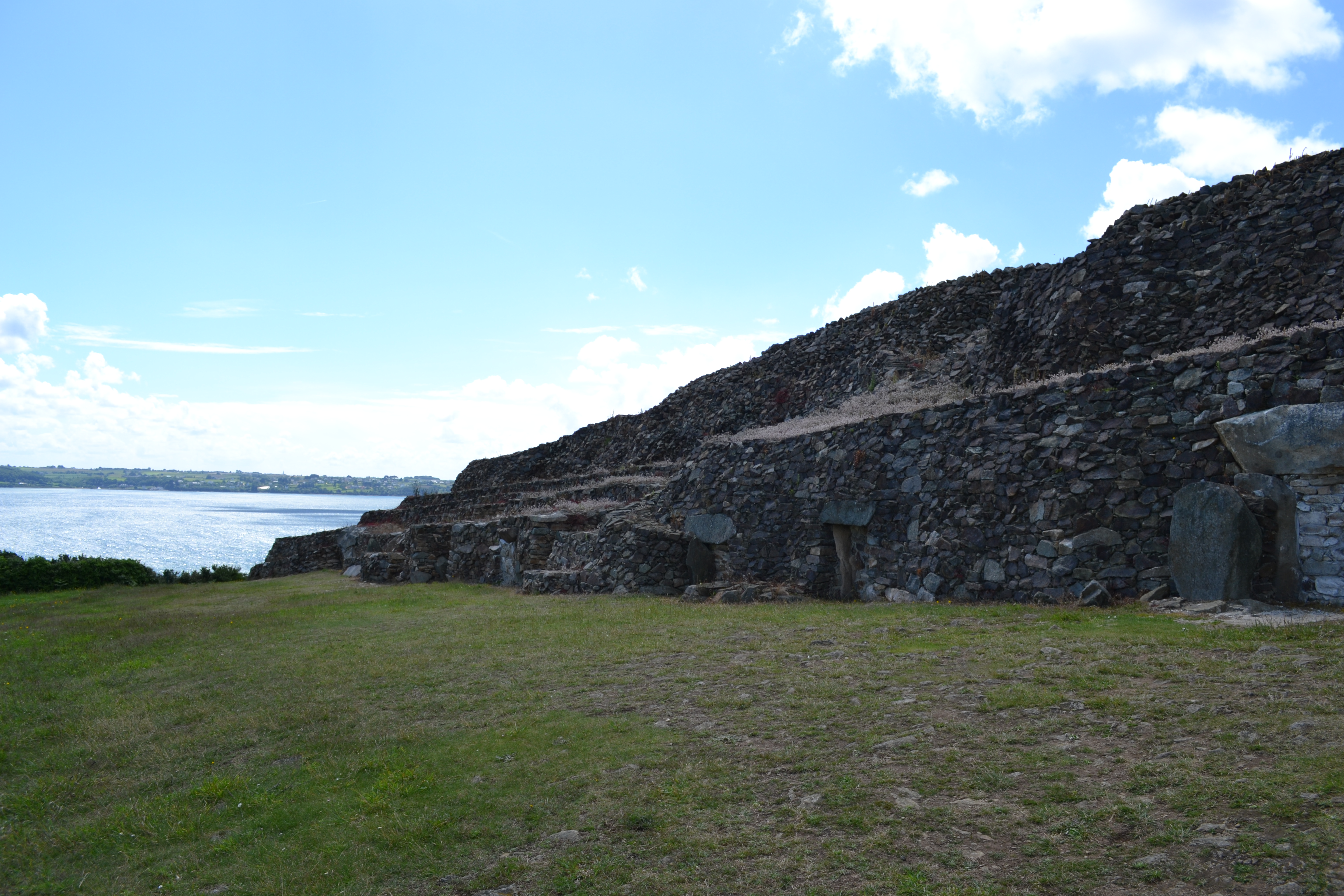
The Neolithic also saw the erection of the first great stone architecture: the megaliths (from the Greek mega, great, and lithos, stone). The oldest known example is found in Brittany, at the Barnenez cairn, in the commune of Plouezoc’h, in Finistère. 75 meters long and 28 meters wide, this imposing dry-stone mound, formed of two adjoining cairns housing eleven passage graves, dates to the 5th millennium BCE, its oldest part going back to between 4850 and 4450 BCE — making it the oldest known continental megalithic construction to date. The monument very nearly disappeared: in the spring of 1955, a contractor opened a quarry there and began gutting several of its burial chambers, before the journalist Francis Gourvil alerted the prehistorian Pierre-Roland Giot, who had the work stopped.
 Caption: Barnenez cairn, Plouezoc’h — Florent Ls, CC BY-SA 3.0
Megaliths were not limited to collective tombs: Brittany also preserves the largest menhir ever raised in Europe. At Locmariaquer, in the Morbihan, the Grand Menhir Brisé of Er Grah measured, once erected around 4500 BCE alongside some twenty other blocks, about 20 meters in height, with an estimated weight of between 280 and 330 tonnes. It was deliberately toppled and broken into several pieces around 4400 BCE, for reasons that remain debated. Associated with the Er Grah tumulus and the Table des Marchands dolmen, it was the subject of a vast archaeological research program between 1986 and 1992.
 Caption: Grand Menhir Brisé of Er Grah, Locmariaquer — Karsten Wentink, CC BY-SA 4.0
It is nonetheless at Carnac, also in the Morbihan, that this megalithic phenomenon reaches its most spectacular expression, with several thousand menhirs aligned over several kilometers, likewise erected between roughly 4500 and 3000 BCE.
🔍 Zoom – The Carnac Alignments
Whether collective tombs, standing stones, or vast alignments, these monuments attest to a new capacity to mobilize, over several generations, considerable labor in the service of a shared project — a sign of a society far more organized, and already far more hierarchical, than the simple story of the invention of agriculture would suggest.
🧠 Key points
- The Mesolithic (~10,000 to 6,000 BCE) sees the last hunter-gatherers adapt to postglacial warming (Tardenoisian, Sauveterrian, the necropolises of Téviec and Hoëdic)
- Agriculture arrives in France by two routes: Mediterranean (Cardial culture, Peiro Signado, ~5700 BCE) and continental (Rubané culture, Cuiry-lès-Chaudardes, ~5000 BCE)
- The first permanent villages (Bercy and its dugout canoes) and long-distance trade (Alpine jade circulating over more than 3,300 km) transform the Neolithic economy
- The Bergheim massacre (~4300-4150 BCE) and differentiated burials (Rauze-Basse at Lattes) attest to the emergence of collective violence and social inequality
- Brittany’s megaliths (the Barnenez cairn, the Grand Menhir Brisé of Er Grah, Carnac) testify to a society capable of mobilizing considerable labor over several generations
- This Neolithic revolution lays the foundations of property, social hierarchy, and permanent settlement that would structure the whole of France’s later history