
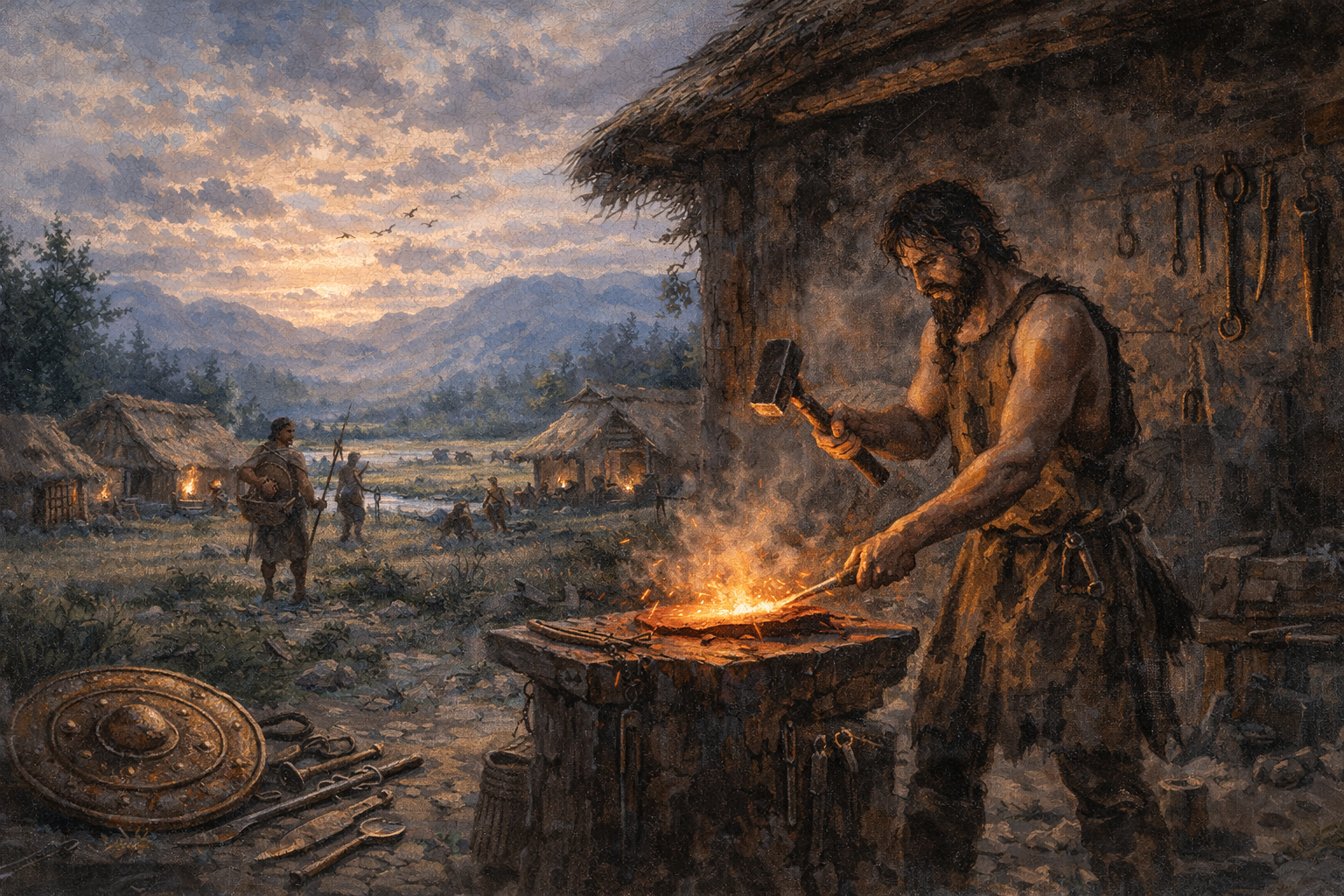
The Bronze Age and the Dawn of Iron
Environ -2 500 à -600 av. J.-C.
The Bronze Age and the Dawn of Iron
When the previous chapter closes, Neolithic societies in France had already raised their most impressive collective monuments — the Barnenez cairn, the Grand Menhir Brisé of Er Grah, the Carnac alignments — and, around Alpine jade, developed a genuine system of prestige economy. It is on this legacy that a new technical and social chapter of French prehistory opens, around 2500 BCE: the age of metals.
This legacy is not only material. Excavations from the end of the Neolithic, at Bergheim as at Lattes, had already revealed a society in which collective violence and funerary inequality were becoming permanent fixtures. The shift from polished jade to copper, then to bronze, only extends and amplifies this same logic: the scarcity of a material, and the distance traveled to obtain it, continue to found the prestige of a minority, while the rest of the population remains largely excluded from these exchange networks.
This chapter is dominated by the gradual emergence of a warrior aristocracy, whose power and social status can be read directly in funerary goods: bronze weapons, then iron, gold ornaments, objects imported from distant lands. From the princely tumuli of Armorica to the Hallstatt tumuli of Burgundy, by way of the funerary rupture of the urnfields, Bronze and Iron Age France sees the foundations of a hierarchical society being built, grave after grave, hoard after hoard — a society that nothing in the preceding millennia had announced so clearly.
Three main threads structure this period of nearly two millennia. The first is technical: from Bell Beaker copper to Armorican bronze, then from bronze to the first iron alloys of Hallstatt, each metallurgical innovation reshuffles the cards of social prestige. The second is commercial: the tin route linking Armorica and Cornwall to the Mediterranean, the amber route from the Baltic, and the great Atlantic hoards such as that of Vénat, trace an exchange network at the scale of the continent, long before France entered written history. The third, finally, is funerary: from individual burial under a tumulus to the generalized cremation of the urnfields, then to the return of spectacular aristocratic tombs at Hallstatt, practices surrounding death constantly evolve, a faithful reflection of the social changes underway.
This chapter ends on the threshold of a decisive shift: around 600 BCE, as Mont Lassois begins its fortification in Burgundy and Hallstatt princely residences multiply from France to southern Germany, Greek sailors from Phocaea found the city of Marseille on the shores of Provence. The Celtic world, until then turned toward its own continental exchange networks, is about to open lastingly to the Mediterranean — a turning point that will open, in the next chapter, the properly Mediterranean history of ancient France.
I. ~2300 to 1600 BCE: the birth of the Bronze Age in Armorica
Even before bronze itself was mastered, a vast cultural current had already transformed western Europe: the Bell Beaker phenomenon, characterized by bell-shaped pottery decorated with geometric motifs, spread between roughly 2900 and 1900 BCE, the oldest examples — dated to 2800–2500 BCE — appearing on the Iberian Peninsula and in eastern France. This Bell Beaker current already carried, before bronze proper, a system of prestige goods: triangular copper daggers, projectile points worked in the same metal, gold ornaments meant to set a minority apart. In Languedoc, metallurgical activity is attested as early as this Bell Beaker period; elsewhere in France, its spread generally precedes any local trace of metallurgy. This logic is not new: it directly extends that of Alpine jade, which, in the final Neolithic, already distinguished an elite through the scarcity and distant origin of exchanged objects — only the material changes, from polished jade to copper and then to bronze.
It is in Brittany that this logic takes, at the very start of the Bronze Age, its most spectacular form. Dated to roughly 2150 to 1600 BCE, with a possible overlap into the Middle Bronze Age up to around 1350, the culture known as the Armorican Tumulus culture brings together more than a thousand documented burials in Lower Brittany. Funerary architecture there is remarkably diverse, ranging from simple pits to monumental tumuli reaching several dozen meters in diameter. Most of the dead were buried individually, the body flexed on its side, the head oriented eastward. A minority of tombs, however, stand out through an accumulation of wealth with no equivalent in western Europe at the time: finely worked arrowheads, bronze weapons, gold ornaments and exotic objects, some burials bringing together up to ten daggers in a single vault. These Armorican daggers follow a recognizable typology, marked by parallel grooves along the blades and six rivet holes meant to fix the handle.
 Caption: Triangular Early Bronze Age dagger (~1800–1500 BCE), Armorican Tumulus culture — José-Manuel Benito Álvarez, public domain, via Wikimedia Commons
The tumulus of Kernonen, at Plouvorn in Finistère, some fifty kilometers east of Brest, offers the best-documented example of this emerging aristocracy. Dated to roughly 2150 to 1800 BCE, the site was first explored in 1901 by Paul du Châtellier, before being largely damaged; a rescue excavation was carried out there in 1966 by Jacques Briard. Beneath a cairn two meters high lay a rectangular burial chamber measuring 4.70 by 1.40 meters, sealed by an enormous granite slab. Three oak coffers held four bronze axes, three bronze daggers with bark sheaths whose wooden handles bear a geometric decoration of gold nails, a necklace of amber beads, an archer’s wristguard, and some forty flint arrowheads — an assemblage that alone illustrates the scale of the resources mobilized to honor a high-ranking individual.
Research into this period fits within a typically Breton generational continuity. Pierre-Roland Giot (1919–2002), already encountered as the director of the excavation of the Barnenez cairn between 1955 and 1968, had himself previously directed, in September 1953, the excavation of the Kervingar tumulus, at Plouarzel in Finistère, with the veterinarian Louis L’Hostis — a project that yielded one of the region’s very first radiocarbon dates (GrN-1670, 3550 ± 50 BP, or roughly 1600 BCE). Giot thus moved directly from Kervingar to Barnenez; among his students was Jacques Briard, the very same who would take up the excavation of Kernonen in 1966. This scientific lineage is matched by a diversity in funerary practices themselves, as illustrated by the tumulus of Saint-Fiacre, at Melrand in the Morbihan: dated by radiocarbon to roughly 1950 BCE, explored as early as October 1897 by Paul Aveneau de La Grancière and listed as a historic monument in 1972, this circular mound, 50 meters in diameter and 5 meters high, held the cremation burial of a chief whose dagger, its handle entirely encrusted with small gold nails, testifies to the same aristocratic taste for display — grave goods acquired in 1926 by the Ashmolean Museum in Oxford, proof of the early international spread of Breton collections.
II. ~1600 to 800 BCE: from the Middle Bronze Age to the urnfields of the Late Bronze Age
The French Middle Bronze Age (~1600 to 1350 BCE) leaves, compared with the profusion of Armorican princely tumuli, markedly rarer archaeological traces — but a single site in Languedoc suffices to illustrate the scale of the exchange networks already in place. The Collier cave, at Lastours in the Aude, excavated in 1961, yielded the burial of a girl of about seven years old, dated to roughly 1500 BCE, adorned with bronze jewelry (bracelets, elements of a pectoral), glass-paste beads, and pieces of amber — beads, a multiperforated plaque, and a pendant. The plaque, of a type known as Kakovatos, named after a Mycenaean site in the Peloponnese, bears the same engraved eye motif as the pendant: the composition of the amber confirms its Baltic origin, revealing a contact, through this child buried thousands of kilometers from the Baltic, between northern Europe and the Mycenaean world of the eastern Mediterranean.
This relatively quiet phase was followed, from roughly 1350 BCE, by a major funerary rupture: the culture known as the urnfields generalized cremation, replacing the individual burial under a tumulus that had dominated the previous period. The ashes of the dead were now placed in urns grouped by the hundreds in veritable open-air necropolises. This phenomenon, whose main center lay in present-day Hungary, with secondary sources in Lusatia, Saxony, and Silesia, first reached central France — the Nièvre, the Yonne, the Allier — before spreading to the Tarn, the Toulouse plain, and the Pyrenees, then to Roussillon and the Narbonne region via the Rhône valley, marking the beginning of what archaeology calls the Late Bronze Age, which extends to around 800 BCE. This classic migratory reading has, however, been debated since 1986: part of the research community now favors the hypothesis of an endogenous change in funerary practices rather than a movement of populations from Central Europe.
The intensity of exchange during this period can be read in the scale of certain metal hoards, among which the Vénat hoard, discovered in 1893 in the commune of Saint-Yrieix, near Angoulême, in the Charente, offers the most spectacular example. Gathered in a vessel 0.60 meters tall, 2,721 pieces, weighing a total of 75 kilograms of bronze — accompanied by a fragment of iron and a small gold leaf — were unearthed there. About 30% of these objects came from other regions, while 70% were of local manufacture, sometimes inspired by foreign models copied on site: proof of a vast Atlantic exchange network running from Great Britain to Portugal. The whole was published in 1981 by the archaeologists André Coffyn, Jean Gomez, and Jean-Pierre Mohen in L’apogée du Bronze atlantique.
🔍 Zoom – The Vénat Hoard, an Exceptional Deposit
This Atlantic seaboard was organized in particular around the tin trade, a raw material essential to bronze-making and rare on the continent. Extracted from Armorica and Cornwall, it was carried by sea and then by river — up the Loire before continuing, via overland relays, to the Rhône valley toward the Mediterranean. The river port of Corbilo, mentioned later by Greek geographers at the mouth of the Loire, has never been located with certainty by archaeology, but tinned bronze objects found near Nantes, Toulouse, and Narbonne confirm that this route genuinely functioned as early as the Bronze Age. It extends, on a continental scale, the same logic already observed for Neolithic jade and then for Bell Beaker copper (section I): the value of a material lies as much in its scarcity as in the distance traveled to obtain it.
In contrast to this funerary rupture, settlement patterns show remarkable continuity: on the shores of Lake Chalain and Lake Clairvaux, in the Jura, pile-dwelling villages were occupied without interruption from roughly 4000 to 750 BCE.
 Caption: Reconstruction of a pile-dwelling settlement from Lake Chalain and Lake Clairvaux (Jura), Musée des Beaux-Arts de Lons-le-Saunier — Arnaud 25, CC BY-SA 4.0, via Wikimedia Commons
The exceptional preservation of wood in this waterlogged environment allows for dendrochronology of unmatched precision for this period, providing an absolute chronology accurate to the decade — a 9.35-meter dugout canoe is thus precisely dated to 959 BCE. These sites were inscribed in 2011 on the UNESCO World Heritage List among the prehistoric pile-dwelling sites around the Alps, a rare testament to stable settlement that crossed, seemingly without rupture, the funerary and technological upheavals shaking Late Bronze Age France elsewhere.
III. ~800 to 600 BCE: the arrival of Iron and the dawn of Hallstatt
The very first iron objects circulating in France, as early as the 10th and 9th centuries BCE, remained crude in workmanship: thick hammered sheets, as seen in the Le Bourget-type arrowheads, small rivets set into objects otherwise made of copper alloy, or inlaid decoration such as on the so-called Vierzon sword. Only from the early Hallstatt C period onward — the so-called Gündlingen phase, which opens around 800 BCE — do more elaborate iron weapons appear, starting with the antenna-hilted swords of Gündlingen type. One long-held assumption deserves nuance, however: iron, more abundant than bronze, did not for that reason bring about an immediate democratization of tool ownership. The most recent studies show, on the contrary, a very low degree of integration of iron into society, extending all the way to Hallstatt D1 and even La Tène A1 — a sign of a much slower and more gradual diffusion than older historiography assumed.
🔍 Zoom – Bronze and Iron: Two Metallurgies, Two Crafts
This emerging warrior elite can be read in the aristocratic tumuli of the early Hallstatt period excavated at Poiseul-la-Ville, in the Côte-d’Or, by René Joffroy, assisted by M. Moisson and R. Paris — two preliminary reports published in 1973 and 1978. This same Joffroy, together with Maurice Moisson, had uncovered twenty years earlier, in 1953, the burial of Vix, a few dozen kilometers away. The grave goods of the Châtillonnais tumuli comparable to those of Poiseul-la-Ville include a large iron sword, a bronze razor, and a corded cista — a bronze sheet-metal vessel ringed with parallel ribs. These burials attest to the existence of a Hallstatt warrior aristocracy, distinguished by the possession of iron weapons, well before the spectacular rise of Mediterranean imports that would characterize the following Hallstatt phase.
It was precisely at the turn of 600 BCE that this regional aristocracy shifted into another dimension altogether. Occupied since the Neolithic, Mont Lassois, also in the Côte-d’Or, then took on new importance: it controlled a stretch of the tin trade route linking Great Britain to Italy — the same axis already used by Atlantic bronze (section II). Excavations carried out since 2002 by an international team coordinated by Bruno Chaume have uncovered an imposing peripheral rampart encircling the base of the site and opening northward, toward the Seine: an early urban phenomenon for Celtic Europe.
 Caption: View of Mont Lassois, in the Côte-d’Or — Claude Piard, CC BY-SA 4.0, via Wikimedia Commons
Mont Lassois was not an isolated case: it was at this same date, around 600 BCE, that a whole series of Hallstatt princely residences of this type emerged, along an axis running from Burgundy to Württemberg — a sign that the Celtic world was now genuinely opening up to exchange with the Mediterranean. It was this same Mediterranean world that, at the same moment and a few hundred kilometers to the south, saw Greek sailors found the city of Marseille on the shores of Provence.
🧠 Key points
- Around 2500 BCE, the shift from Neolithic jade to copper and then to bronze extends the same logic of prestige founded on the scarcity and distant origin of materials.
- The princely tumuli of Armorica (Kernonen, Saint-Fiacre) attest, as early as the Early Bronze Age, to an aristocracy capable of accumulating considerable wealth.
- Long-distance trade intensifies in the Late Bronze Age: the Armorican tin route, the Baltic amber route, and great Atlantic hoards such as that of Vénat (2,721 pieces, 75 kg).
- Around 1350 BCE, the generalization of cremation in the urnfields breaks with the tradition of individual burial under a tumulus.
- Iron, which appeared as early as the 10th century BCE, spread slowly: contrary to a common assumption, it did not immediately democratize tool ownership.
- Around 600 BCE, the rise of Mont Lassois and of Hallstatt princely residences, from Burgundy to Württemberg, signals the opening of the Celtic world to the Mediterranean, at the very moment Marseille is founded by the Phocaeans.