
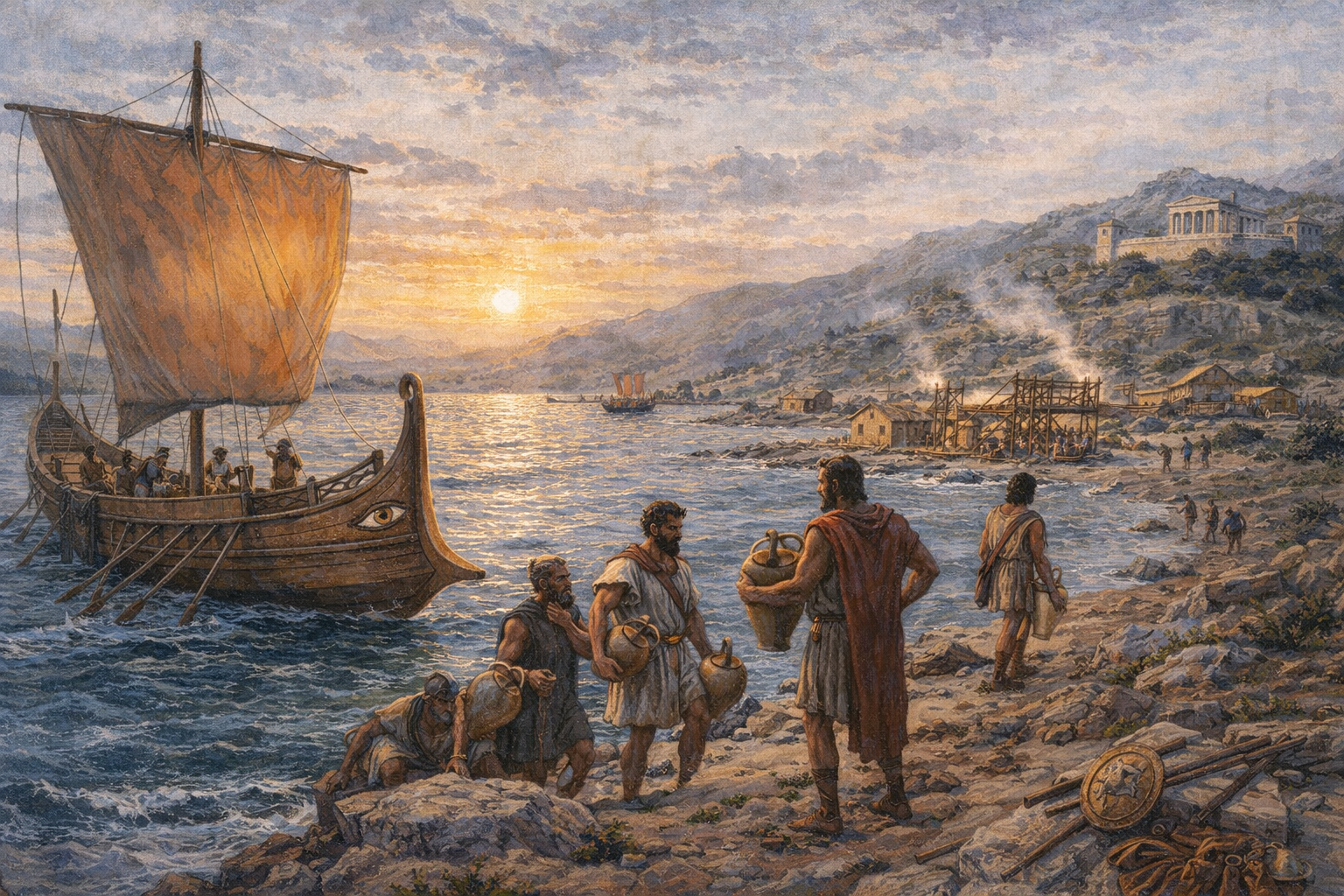
Marseille and the Phocaeans
Environ -600 à -325 av. J.-C.
When the previous chapter closes, Mont Lassois begins its fortification and controls a stretch of the tin route, while some ten Hallstatt princely residences stretch from Burgundy to Württemberg: the Celtic world was then opening, around 600 BCE, to exchange with the Mediterranean. It is at this very same pivotal date that Greek sailors from Phocaea, in Ionia, founded the city of Massalia — future Marseille — on the shores of Provence.
This founding owed nothing to chance. Phocaea, a city cramped on a narrow territory, had long since turned its economy toward the sea; two successive waves of refugees, driven from their mother city by the Persians in 546/545 BCE and again in 494 BCE, would go on to reinforce the young colony. On site, the Greek settlement was not without friction either: while legend retains the image of an alliance sealed by a marriage between Greeks and Segobrigii, ancient sources also report an armed attempt to retake the city, repelled by the Massaliotes.
This chapter is dominated by a singular phenomenon: that of a Greek city-state, with its own institutions, its own coinage, and its own cults, transplanted onto Gaulish soil and, from its very origin, deeply entangled in the exchange networks of the Celtic hinterland. Massalia was neither a mere trading post nor an isolated settler colony: it was a full-fledged polis, governed by an aristocracy of 600 citizens, which within a few generations became one of the most active ports in the western Mediterranean.
Three threads structure this account. The first is institutional and urban: the government of the Timouques, the ramparts and necropolises uncovered by archaeology, the sanctuaries dedicated to Artemis of Ephesus, Apollo Delphinios, and Athena. The second is economic and cultural: the rise of commercial viticulture and olive-growing, the striking of its own coinage from 500 BCE, and an exchange network running up the Rhône to Celtic lands, traded for tin and amber. The third, finally, is scientific and maritime: the exploration of the North Atlantic by the Massaliote Pytheas, whose observations, long derided, would be confirmed centuries later by modern science.
In many ways, this chapter marks France’s entry into written history. After four chapters devoted to a prehistory known only through archaeology — Alpine jade, the megaliths, the Bronze Age, then the dawn of iron — Massalia opens the age of direct ancient sources: Aristotle, Herodotus, Strabo, and Justin allow, for the first time, the testimony of texts to be cross-checked against that of excavation. Through this Mediterranean port, all of Gaul was about to tip into a new world — one of cities, writing, and exchange with the great civilizations of antiquity.
I. ~600 to 494 BCE: the founding of Massalia
Phocaea, an Ionian city on the western coast of Anatolia, suffered from a cramped and infertile territory, which pushed its inhabitants to exploit the sea rather than the land. It was in this context that they founded Massalia around 600 BCE, a date now confirmed by archaeology: the oldest Greek remains have been found directly atop virgin soil on the Saint-Laurent hill, the westernmost part of the site, before the city rapidly expanded onto two neighboring hills, those of the Moulins and the Carmes. The founding population was not limited to Phocaeans alone: it also included Athenians and Phocidians, all members of the Ionian confederation. Two reinforcement waves, too often absent from simplified accounts, subsequently strengthened the young city: the fall of Phocaea itself before the Persians, in 546/545 BCE — after the inhabitants of Chios had refused to cede them the Oenussae islands as a refuge —, then a second fall in 494 BCE, during the suppression of the Ionian Revolt. Each of these crises pushed new Phocaean settlers toward Marseille, so that, from the 5th century BCE onward, Massalia established itself, alongside Carthage, as one of the leading ports of the western Mediterranean.
The Ligurian presence prior to the Greek settlement deserves to be qualified. Contrary to a widespread belief, no permanent Ligurian occupation has been uncovered on the site of Marseille itself. Sediment core samples have nonetheless revealed, on the shores of the Lacydon — the cove that would become the Vieux-Port —, seasonal activities well predating the arrival of the Phocaeans: fishing, reed gathering, and salt exploitation, attested as early as the 2nd millennium BCE. The site was thus not devoid of any human presence, but before the Greeks it saw only occasional visits rather than an established settlement.
The legend of the founding of Marseille has come down to us through two ancient sources whose details contradict one another. Aristotle, in his Constitution of the Massaliotes — known through the quotation Athenaeus makes of it in his Deipnosophistae —, names the local princess Petta, makes a certain Euxenus the husband she chooses, and Protis their son, ancestor of the Protiades family; his account emphasizes the role of chance, of Tyche. Trogus Pompeius, in his Philippic Histories — lost, but summarized by the Roman historian Justin in the 3rd–4th centuries, in book XLIII of his Epitome —, offers a different version: the princess is named Gyptis, and it is Protis himself, accompanied by a second Phocaean leader named Simos, who marries her directly; this account emphasizes strategic alliance rather than chance. The modern historian Henri Tréziny suggests that this myth evolved over time: the successive destructions of Phocaea, in 546 and then 494 BCE, and the arrival of new waves of settlers, would gradually have made Protis the central figure of the story, at the expense of Euxenus, initially more prominent in Aristotle’s version.
🔍 Zoom – Gyptis and Protis: the afterlife of a founding myth
The image of a purely peaceful settlement also deserves correction. Justin reports an attempt to retake the city by the Segobrigii, led by a chief named Comannus; their defeat allowed the Massaliotes to extend their territory as far as the Marseilleveyre massif — proof that coexistence between Greeks and local populations was not free of armed tension. One last, thoroughly modern piece of evidence lends further support to this whole account: a genetic study conducted in 2011 showed that 4% of men in the present-day Marseille region carry haplogroup E-V13, a marker characteristic of Greek populations — tangible confirmation, more than 2,600 years after the fact, of this Phocaean ancestry.
II. ~600 to 500 BCE: a Greek city-state on Gaulish soil
Strabo described Massalia’s aristocratic constitution as a true model of government. It rested on an assembly of 600 members appointed for life, the Timouques, all heads of family holding the right of citizenship. This assembly was presided over by a commission of fifteen members responsible for the city’s day-to-day affairs, itself presided over by three of its members, one of whom actually governed the city — a precise institutional hierarchy (600, then 15, then 3, then 1) far more elaborate than the simple “council of 600 aristocrats” often vaguely invoked.
This political organization was matched by an ambitious urban plan, revealed by the excavations at the Bourse, begun in 1967: the first major operation in French urban archaeology, they sparked fierce controversy over the site’s planned destruction, before some 10,000 m² were listed as a historic monument and put on public display in what is now the Jardin des Vestiges, while about 20,000 m² were sacrificed for the construction of the Centre Bourse. Later excavations, carried out between 1992 and 1994, refined the dating of an archaic rampart from the late 6th century BCE, found at the southern end of the site: a foundation some sixty centimeters high, made of cut Saint-Victor limestone blocks laid in courses of 20 to 30 centimeters, topped with mudbrick. This rampart first enclosed the Moulins hill, then the Saint-Laurent hill, before the city expanded into the Grand-Rue district and, very probably, the Carmes hill.
 Caption: The Jardin des Vestiges, in Marseille, displaying the remains of the archaic Greek rampart uncovered during the Bourse excavations — Vincent (Imac.vincent), public domain, via Wikimedia Commons
These same excavations also revealed, north of the via Italica, two rectangular funerary enclosures of about 100 m² each, built in the early 4th century BCE and abandoned at the end of the 3rd century BCE: nineteen cremations were counted in the northern enclosure, six in the neighboring “monument with triglyphs” — evidence of a prestigious necropolis at the gates of the Greek city, presumably reserved for its wealthiest inhabitants.
Massalia’s religious life, for its part, was organized around three main sanctuaries: those of Artemis of Ephesus, Apollo Delphinios, and Athena. The cult of Artemis is directly tied to the founding story according to Strabo: before leaving Phocaea, an oracle is said to have advised the future settlers to take a guide provided by the goddess; she is said to have appeared in a dream to a high-ranking Phocaean woman, Aristarche, ordering her to sail with the settlers, bringing with her a reproduction of the statue from the sanctuary at Ephesus. Once the colony was established, a temple was built and Aristarche became its first priestess, an exceptional honor reserved for a single family. Despite the richness of this account, the exact location of the temple of Artemis has never been formally established by archaeology: only an Ionic capital, presumed to have belonged to the sanctuary and made of limestone from the La Couronne quarries, has been found.
III. ~600 to 400 BCE: the revolution of wine, coinage, and daughter colonies
Contrary to a common assumption, the vine and the olive tree were not introduced to Gaul from nothing by the Phocaeans: pollen and seed studies show that wild vines and olive trees already existed there. What the Greeks truly introduced was their systematic, domesticated cultivation for commercial purposes, until then absent from the territory. The oldest traces of wine production in Gaul date to around 600 BCE, at Massalia itself, where the remains of an amphora-making workshop have been found, along with evidence of viticulture near Lattes. Wine quickly became one of the main vectors of exchange with the Celtic world: through a network of clientship, the Massaliotes exported their production both to the Mediterranean world and to Celtic chiefdoms, in exchange notably for tin and amber — trade that extended, on the Mediterranean side, the tin route already described for inland Gaul. Massaliote amphorae, recognizable by their distinctive clay, have been found at numerous sites across southern France, following the Saône valley up to the Rhine.
🔍 Zoom – Gaulish wine through Greek eyes: the testimony of Diodorus Siculus
This economy relied very early on its own coinage: Massalia began striking silver fractions as early as the last third of the 6th century BCE, and the oldest known struck coin on French soil was issued at Massalia around 500 BCE. The mint, located in the city itself, marked its issues with the abbreviated inscription “MA,” for Massalia.
 Caption: Silver drachma of Massalia with the head of Artemis — this example postdates 200 BCE, later than the first coinage discussed here, but illustrates the same monetary tradition. Hermann Junghans, CC BY-SA 3.0, via Wikimedia Commons
This early coinage accompanied and facilitated the already-flourishing trade with the Gaulish hinterland.
Massalia thus became the indispensable crossroads between the Mediterranean and northern Europe. The Greeks exported wine, olive oil, and refined pottery; in return, tin from Brittany, amber from the Baltic, and salt traveled up the Rhône — resources essential to the prestige economy already observed on the Gaulish side.
From the late 5th or early 4th century BCE, Massalia founded Agathe — present-day Agde —, its first well-attested daughter colony. Other foundations would follow in the centuries that followed as Massaliote influence spread along the coast, at Olbia, Antipolis, or Nikaia, but these later episodes, extending into the 2nd century BCE and involving Roman intervention, lie beyond the chronological scope of this chapter.
IV. ~325 BCE: Pytheas and the exploration of the North Atlantic
 Caption: Statue of Pytheas by Auguste Ottin (19th century), façade of the Palais de la Bourse in Marseille — Rvalette, CC BY-SA, via Wikimedia Commons
Around 325 BCE, the Massaliote sailor, astronomer, and mathematician Pytheas left the port of Massalia in search of the origin of tin and amber, two precious materials arriving from the north. He passed through the Pillars of Hercules — the Strait of Gibraltar, then under Carthaginian control — and set out into the Atlantic Ocean. He followed the coasts of Gaul and Spain, sailed around Great Britain, which he called Prettanike, then pushed further north still, to a land he called Thule, which he placed six days’ sail north of Scotland. There he described the midnight sun and a sea where water and ice mingled in a kind of slush, which he compared to a “sea lung.”
🔍 Zoom – Thule: the geographical riddle that was never solved
This voyage was accompanied by remarkable scientific feats for the time. Using a gnomon, Pytheas measured the height of the sun at Massalia on the day of the equinox, March 21, at noon, obtaining a ratio of 120 to 111 between the rod and the shadow it cast — corresponding to a latitude of 43° 16′ 15″, barely more than a minute off the true value (43° 17′ 56″). He was also the first to clearly establish the link between tides and the Moon, observing that their rhythm lagged by about 50 minutes each day, or roughly one day per month — exactly like the lunar cycle. He further determined the celestial pole and the obliquity of the ecliptic with surprising precision, and proposed an estimate of Earth’s circumference of about 39,500 kilometers, against 40,074 kilometers in reality at the equator — a margin of error under 2%.
Pytheas recorded his voyage in a work now lost, known only through citations and summaries by later authors: Timaeus, Eratosthenes, Hipparchus, Strabo, Diodorus Siculus, Pliny the Elder, as well as Geminus, Cleomedes, and Polybius. Two of these authors, Polybius and Strabo, considered him a fabulist: it seemed inconceivable to them that inhabited lands could exist beyond Ireland. Other scholars, however, such as Eratosthenes and Hipparchus, took his astronomical observations seriously. It would take centuries, and the progress of modern geography and astronomy, to confirm the accuracy of most of his measurements and observations.
🧠 Key points
- Around 600 BCE, the Phocaeans founded Massalia, reinforced by two waves of refugees after the falls of Phocaea to the Persians (546/545 BCE, then 494 BCE).
- The myth of Gyptis and Protis, transmitted in two diverging versions (Aristotle vs. Trogus Pompeius), coexists with very real tensions between Greeks and Segobrigii, including an armed attempt at reconquest under Comannus.
- Massalia governed itself as a full-fledged Greek city-state, led by a hierarchy of Timouques (600, then 15, then 3, then 1, according to Strabo).
- The Bourse excavations (since 1967) have revealed ramparts, a necropolis, and sanctuaries, archaeologically confirming much of the ancient account.
- The city developed commercial viticulture and olive-growing, struck its own coinage from 500 BCE, and became the crossroads of trade between the Mediterranean and Celtic Europe.
- Around 325 BCE, the explorer Pytheas reached the North Atlantic and Thule, with scientific observations (latitude, tides, Earth’s circumference) of remarkable precision for the era.
- This chapter marks France’s entry into written history, cross-referencing ancient sources and archaeology for the first time.