
The Birth of the Gaulish World
Environ -500 à -400 av. J.-C.
Around 600 BCE, Mont Lassois was beginning its fortification, and some ten Hallstatt princely residences stretched from Burgundy to Württemberg, opening the Celtic world to the Mediterranean — a turning point already told, from the Greek side, through the founding of Massalia. This chapter follows the Gaulish side of that same story: how, on this same ground, an original culture took shape between 500 and 400 BCE.
This Hallstatt legacy carried within it the seeds of its own transformation. Around 480 BCE, the Hallstatt culture gave way to that of La Tène, an aesthetic and technical break that arose not from a single dated event but from a diffuse process, begun at the western margins of the old Hallstatt world. At the same time, the lasting Greek settlement at Massalia and the circulation of Mediterranean goods deep into the territory — attested by the Auriol hoard — intensified contact between the Celtic world and the Mediterranean basin.
This chapter is dominated by a twofold, seemingly contradictory movement. On one hand, the assertion of an increasingly recognizable Celtic cultural identity, carried by a new art and by the unmatched brilliance of princely tombs such as that of Vix. On the other, a geographical expansion that saw Celtic groups leave their homeland to settle as far as northern Italy. Gaul in this period was thus neither static nor withdrawn into itself — yet it had no political unity either: its identity remained above all cultural.
Four threads structure this account. The first is technical and artistic: the transition from Hallstatt to La Tène, which gives its name — from a site on the shores of Lake Neuchâtel — to an entire civilization. The second is economic: the relay role played by Massalia and the archaeological proof offered by the Auriol hoard. The third is funerary and social: the apogee of the Hallstatt princely residences, embodied by the tomb of Vix. The fourth, finally, is demographic and political: the Celtic migrations toward northern Italy, and a tripartite social organization that never resulted in centralized power.
This chapter occupies a pivotal position in the history of ancient Gaul. It is not yet the Gaul the Romans would encounter, but its cultural, artistic, and social foundations were now in place. Powerful, connected, and expanding, this emerging Gaulish world paved the way for the golden age the Celtic peoples of the territory would know over the following two centuries.
I. ~480 to 450 BCE: the Hallstatt-La Tène transition
On the north shore of Lake Neuchâtel, in Switzerland, a site was identified in November 1857 by Hans Kopp, a fisherman and collector of objects working for Colonel Friedrich Schwab: excavations there uncovered numerous swords and ornaments. This site, named La Tène, gave its name to the entire pre-Roman Celtic culture, which extends roughly from 480 BCE to 50/25 BCE, from Ireland to western Anatolia.
Around 480 BCE, the Hallstatt culture — in its most recent phase, known as Hallstatt D, running from about 650 to 450 BCE — gradually gave way to that of La Tène. This transition was not a sudden shift but a gradual process, first detected through the appearance of elite objects in La Tène style at the western margins of the former Hallstatt zone. This phenomenon explains precisely the shift of the Celtic world’s center of gravity toward the west and northwest, in particular toward Champagne, the Ardennes, and the Moselle-Sarre region, which became major centers of this new culture.
This transition came with a clear aesthetic break from the geometric Hallstatt tradition. La Tène art borrowed from the Greek repertoire motifs such as palmettes, lotus flowers, and S-shapes. Metalwork in bronze, iron, and gold is characterized by complex spirals and engraved or inlaid interlace, applied to fine vessels, helmets, shields, horse harness, and elite jewelry. The earliest style remained static and geometric; only later, beyond this chronological window, would it evolve toward more dynamic forms such as triskelions.
This shift toward Champagne finds direct archaeological illustration in the tomb of the Prince of Lavau, discovered by Inrap between October 2014 and April 2015 in a monumental necropolis on the outskirts of Troyes, in the Aube. Dated to the mid-5th century BCE, it falls squarely within this section’s chronological window. The burial chamber, protected by a tumulus 40 meters in diameter, held a deceased individual resting on a two-wheeled chariot, richly adorned with a torque and two gold bracelets, a lignite bracelet, and finely worked amber beads. The centerpiece of the grave goods remains an Etruscan bronze cauldron about a meter in diameter, accompanied by a sumptuous Greco-Italic drinking set. Specialists explicitly compare this tomb to that of Vix (section III): two nearly contemporary “kingdoms” emerged at this time, one in Burgundy, the other in Champagne, each attesting to the integration of these elites into Mediterranean networks.
 Caption: Gold torque from the tomb of the Prince of Lavau (Aube) — Gérald Garitan, CC BY-SA 4.0, via Wikimedia Commons
🔍 Zoom – The Prince of Lavau, a Rival to Vix in Champagne
II. ~480 BCE: Massalia and the Auriol hoard
Without returning to the founding of Massalia itself, it is worth recalling the relay role the Phocaean city played between the Gaulish world and the Mediterranean during this period. Greek wine traveled inland, coins and precious objects circulated, and advanced commercial practices — chief among them the use of coinage rather than barter alone — gradually spread through the Celtic societies of the hinterland.
A hoard discovered in the 19th century offers concrete archaeological proof of this early integration. In February 1867, a farmer named Aubert was plowing his field between Auriol and Belcodène, at a spot called “les Barres,” north of the Baou-Rouge, when he unearthed a broken clay vessel, hidden beneath a large flat stone.
This vessel contained more than two thousand Greek silver coins — around 2,130 — belonging to two distinct monetary standards: the Phocaic standard, whose obol weighs on average 0.88 grams, and the Milesian standard, originating from Miletus in Asia Minor, whose obol weighs on average 1.12 grams. Struck between 525 and 470 BCE, these coins are among the very first to have circulated on French soil. Their varied iconography refers directly to the cities of origin: a ram’s head for Clazomenae, a lion’s head for Cyzicus, a dog’s head for Colophon, a griffin’s head for Teos or for Phocaea itself, a mask for Abydos.
🔍 Zoom – The Auriol Hoard, at the Origins of Provençal Numismatics
Buried around 460 BCE — shortly after the striking of the most recent coins it contains — this hoard demonstrates that southern Gaul was already, by this date, deeply integrated into the international economic networks of the Mediterranean, well before the arrival of Rome.
III. ~480 BCE: the Hallstatt apogee — the tomb of Vix
Mont Lassois, whose fortification beginning around 600 BCE was already noted, illustrates a broader phenomenon: that of the Hallstatt princely residences, which multiplied during this period along an axis linking Burgundy to Württemberg. These hilltop sites, often fortified, were not mere strongholds: they commanded entire stretches of strategic trade routes, accumulated wealth imported from the Mediterranean, and provided the foundation for a new aristocracy, whose power now rested as much on control of exchange as on military force alone.
It was precisely at the foot of this same Mont Lassois, a few generations after the start of its fortification, that this phenomenon reached its most spectacular and best-documented expression: the princely tomb of Vix, dated to roughly 480 BCE. A high-ranking woman lies there surrounded by grave goods of exceptional richness, including the largest bronze vessel known from antiquity — striking proof of this Hallstatt aristocracy’s integration into the Mediterranean exchange networks already described for Massalia and the Auriol hoard.
🔍 Zoom – The Princely Tomb of Vix (~480 BCE)
🔍 Zoom – The Torque: Warrior’s Jewel and Sacred Object
IV. 5th century BCE: Celtic mobility and migrations
According to Livy, in his History of Rome, a great expedition toward northern Italy was said to have been launched around 600 BCE — at the very time of the founding of Marseille and the reign of Tarquinius Priscus at Rome — by the Biturigan king Ambigatus, who sent his nephew Bellovesus toward northern Italy, where he is said to have founded Mediolanum, present-day Milan, while a second nephew, Segovesus, headed toward the Hercynian forest. This very early dating is now regarded by modern historians more as a founding myth of the Insubrian people than as a reliable historical event: the ancient sources themselves in fact place the bulk of the Gaulish entry into Italy in the 4th century BCE, a century and a half after the legendary date of Bellovesus’s expedition.
The real, better-documented movements paint a more gradual picture. Celtic populations were in fact present in northern Italy well before this date: the Golasecca culture, established in the lake region at the foot of the Alps, is attested there as early as the 9th century BCE and reached its apogee between the 6th and early 5th centuries BCE, before continuing on into the 4th century — proof that the Celtic settlement of northern Italy was a gradual process spread across several centuries, not a single sudden invasion. The Lingones settled between the Po delta and the northern Apennines, in what is now the province of Ferrara. The Senones, for their part, only crossed the Alps around 400 BCE — at the very end of the period covered by this chapter — and settled between Ravenna and Ancona after driving out the local Umbrian populations; their settlement in Italy would open, in the following decades, a phase of direct confrontation with Rome.
V. A powerful but fragmented Gaul
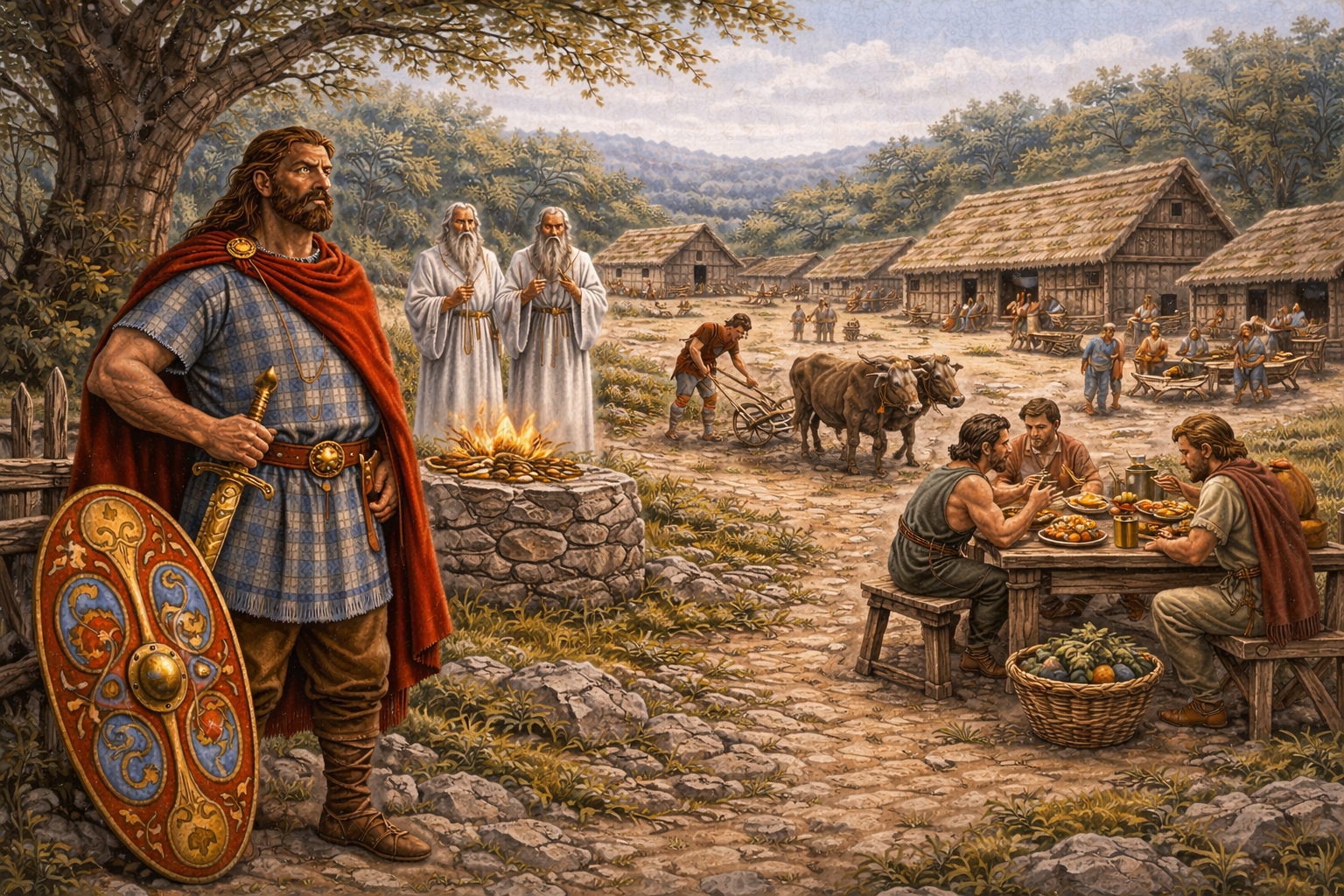
Gaulish society of this period was broadly organized according to a tripartite structure combining a priestly class, a warrior aristocracy, and a class of producers. The druids were the keepers of religious and legal knowledge; the warrior aristocracy controlled the territories, the exploitation of resources, and trade — it was this class that produced princely burials such as that of Vix (section III); the class of producers — craftsmen, farmers, and herders — supported this entire social edifice. This hierarchy, already visible in the differentiated grave goods observed since the Bronze Age, became more pronounced and defined during this period.
Unlike Massalia’s precise institutional structure — the assembly of Timouques, already described in the previous chapter —, the Gaulish world of this period had no political structure unified across the whole territory. Each people formed a distinct entity, itself often subdivided into clans. A king (rix), where one existed, remained above all a military leader whose power was not absolute; in several peoples, this kingship gradually gave way to a nobility organized into a kind of aristocratic council. Alliances between peoples remained temporary, resting on ties of clientship rather than lasting political integration.
This organization into autonomous peoples did not prevent the Gaulish world from being dynamic: connected to both Mediterranean and continental trade networks, and expanding geographically, as shown by the migrations toward northern Italy. It was a powerful, mobile society, whose unity nonetheless remained above all cultural and linguistic rather than political.
🧠 Key points
- Around 480 BCE, the Hallstatt culture gradually gave way to that of La Tène, named after a site on the shores of Lake Neuchâtel identified in 1857.
- This transition shifted the Celtic world’s center of gravity toward the west and northwest — Champagne, the Ardennes, the Moselle-Sarre region.
- The Auriol hoard (discovered in 1867, around 2,130 Greek coins) attests to the early integration of southern Gaul into Mediterranean economic networks, via Massalia.
- The princely tomb of Vix (~480 BCE), discovered at the foot of Mont Lassois, embodies the apogee of the Hallstatt princely residences.
- The legendary account of Bellovesus (Livy) wrongly places the first Celtic migrations into northern Italy around 600 BCE; the real movements (the Golasecca culture, the Lingones, the Senones) unfolded from the 5th to the 4th century BCE.
- Gaulish society was organized according to a tripartite structure (druids, warrior aristocracy, producers), without ever achieving centralized political power comparable to that of Massalia.
- Powerful, connected, and expanding, the emerging Gaulish world remained united above all by its culture and language rather than by any shared political organization.