
The Golden Age of the Gauls
Environ -400 à -200 av. J.-C.
As the previous chapter closed, the Senones had just crossed the Alps, around 400 BC, to settle permanently in the Po valley — one of the many movements by which the Celtic world was then expanding well beyond Gaul itself. This chapter follows the immediate continuation: the following decade sees these same Senones carry arms to the very heart of Rome.
This legacy is not an isolated case. The settlement of the Boii and the Insubres in the same region, already under way at the end of the previous chapter, is confirmed and continues for nearly two centuries, while the political fragmentation of the Gaulish world — already noted without judgment in the previous chapter — continues to characterize each of these movements, which remain the work of peoples acting separately rather than a unified Celtic entity.
This chapter is dominated by an apparent paradox: between 400 and 200 BC, the Celtic peoples reach the greatest geographic extent and influence of their entire ancient history — from northern Italy to Asia Minor — without this expansion ever translating into a corresponding political unity. It is a golden age in the strictest sense: one of radiant power, but always fragmented.
Four threads structure this account. The first is military and symbolic: the taking of Rome by the Senones around 390 BC, an episode whose very account transforms over the centuries, from an admission of defeat in Polybius to the heroic legend of Camillus in Livy. The second is territorial: the lasting settlement of several Gaulish peoples in the Po valley. The third is geographic and distant: the Balkan expedition, the failure before Delphi, and the founding, in Asia Minor, of the Galatian kingdom. The fourth, finally, is strategic: the occasional alliance between several Gaulish peoples and the Carthaginian general Hannibal, during the Second Punic War.
This chapter marks the geographic and military apex of the Celtic world before the balance of power begins to reverse. The next chapter will pick up this account from 200 BC onward, when a consolidated Rome methodically sets out to regain the initiative against the Gaulish peoples of northern Italy, and then of Gaul itself.
I. Around 390 BC: the taking of Rome by the Gauls
The battle that precedes the taking of Rome takes place on 18 July, though the year itself remains debated among modern historians: 390/389 BC according to the traditional Varronian chronology, or 387/386 BC according to the Greek chronology. It pits the Senones, a Gaulish people settled in northern Italy, against the Roman army, on the banks of the Allia, a tributary of the Tiber located only 16 kilometres from Rome. The troop figures traditionally given by ancient sources — up to 15,000 Romans against 30,000 Gauls — are today considered by historians to be heavily exaggerated.
The ancient sources that report this episode — Polybius, Diodorus Siculus, Livy, Plutarch — all write nearly four centuries after the events, and diverge notably from one another. The very name of the Gaulish chief, Brennus, appears only starting with Livy: it is absent from both Polybius and Diodorus Siculus. The sources also contradict each other on the fate of Rome’s allies during the battle: according to Polybius, Latin contingents came to reinforce the Roman army, whereas the Roman annalists claim on the contrary that Rome was abandoned by its Latin and Hernician allies.
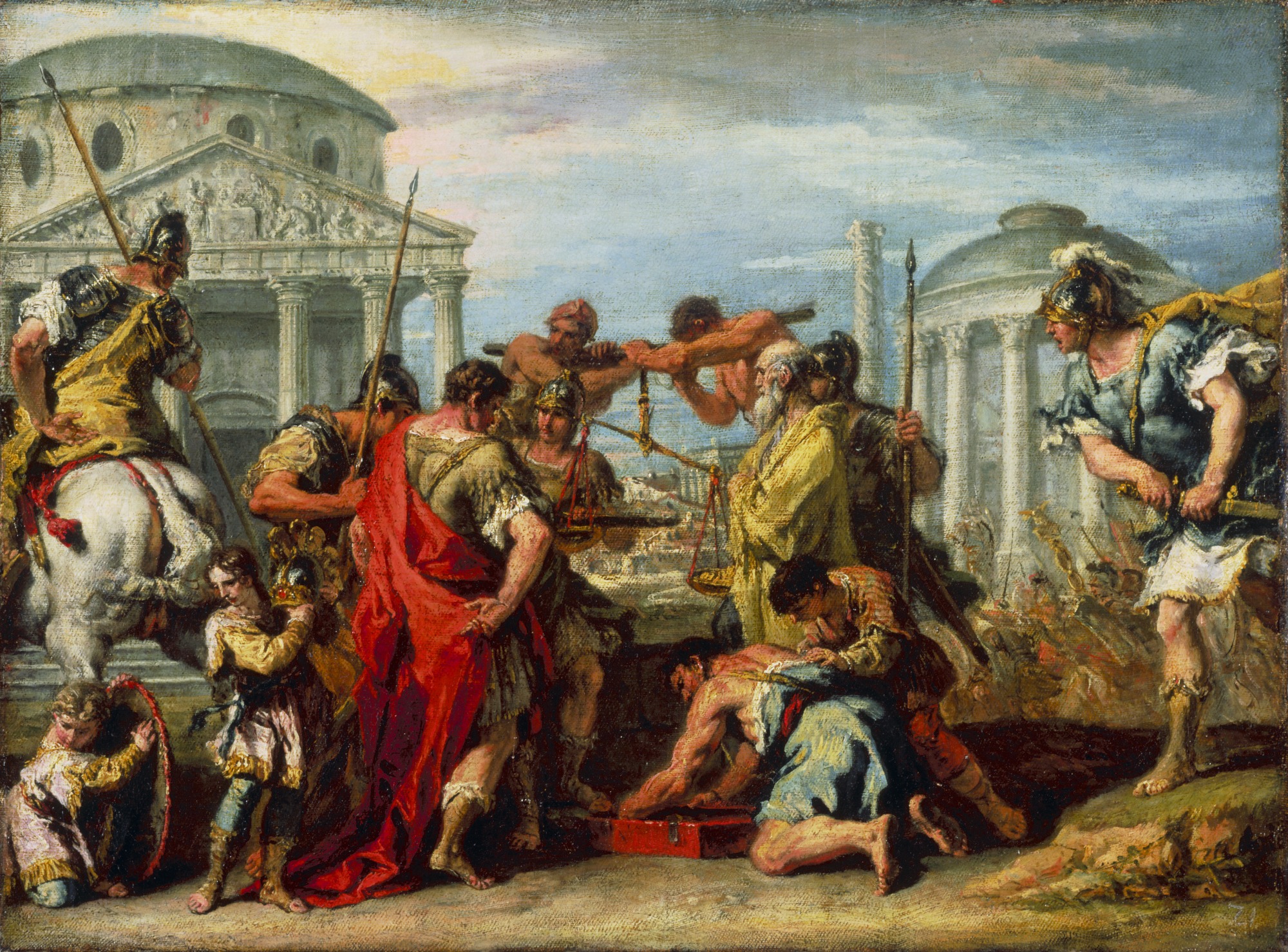
After their victory, the Gauls march on Rome and sack the city; only the Capitol resists, where the last defenders entrench themselves. The Romans eventually negotiate the departure of the Gauls in exchange for a ransom traditionally set at 1,000 pounds of gold, roughly 330 kilograms.
 Caption: “Le Brenn et sa part de butin” (“Brennus and His Share of the Spoils”), Paul Jamin, 1893 — a 19th-century history painting imagining the division of the spoils after the sack of Rome, public domain, via Wikimedia Commons
The account of this episode nonetheless evolves significantly over the centuries among the ancient authors themselves, an evolution worth nuancing. Polybius, the closest to the events, simply admits that the city was plundered without organized Roman resistance. Diodorus Siculus then introduces the idea of a Roman revenge and a recovery of the ransom paid to the Gauls. Livy, finally, writing under the reign of Augustus, claims that the ransom was in fact never paid to Brennus, thanks to the providential intervention of the general Camillus, returned from exile to save Rome in extremis. This portrayal of Camillus as saviour is today considered by historians to be an invention of later Roman historiography, meant to erase the shame of having had to negotiate for survival against an invader — Rome having, in fact, actually paid. Modern archaeology adds a material argument to this caution: no trace of destruction matching the scale of the sack described by ancient sources has been found for this date.
🔍 Zoom – The Sack of Rome by the Gauls
II. About 400 to 200 BC: the Gaulish settlement of northern Italy
Around 400 BC, the Etruscans are driven out of the Po valley, and various Gaulish tribes settle in what will become Cisalpine Gaul. One nuance is worth noting: the Insubres probably did not arrive with this great wave of the early 4th century, unlike the Boii, the Cenomani, and the Senones — archaeology suggests instead that they descend from the Golasecca culture, already established in the region since the 6th century BC. A useful reminder: the Celtic settlement of northern Italy is a process stratified over several centuries, not a single event.
🔍 Zoom – The Golasecca Culture, Before the Gauls
 Caption: Map of Cisalpine Gaul, with the approximate location of the Celtic peoples who settled there (Insubres, Boii, Cenomani, Lingones, Senones) — Sémhur, CC BY-SA 4.0, via Wikimedia Commons
The Insubres settle in present-day Lombardy, the most fertile region of the Po valley, where they found Mediolanum, present-day Milan, their major seat of power. A second wave of Celtic invasions, around 396 BC, sees Gauls seize Melpum, a site associated with the origins of Milan.
🔍 Zoom – Melpum, the City Swallowed by Oblivion
The Boii, for their part, originate from Bohemia — whose very name derives from theirs, Boiohaemum, “the land of the Boii.” They take the lands between the northern Apennines and the Po, and are associated with the sites of Bononia (Bologna) and Brixellum (Brescello).
This Gaulish presence in northern Italy is not limited to these two peoples: the Cenomani, the Lingones, and the Senones, already settled around 400 BC, each have a homonymous mother-tribe remaining in Gaul itself — proof of a maintained link between these Italian settlements and their territory of origin. This is therefore not simply a series of raids, but a lasting foothold, establishing populations destined to become permanent neighbours, then regular adversaries, of Rome. In 218 BC, the very same year Hannibal would cross the Alps, Rome would go on to found the colonies of Cremona and Placentia in this same region — a sign of the growing pressure it was already exerting on these Gaulish populations.
III. About 280 to 275 BC: the invasion of the Balkans and the birth of the Galatians
In 279 BC, a Celtic chief named Brennos — not to be confused with the Brennus of 390 BC, a century earlier; the recurrence of the name suggests it may be a title rather than a proper name, as the uncertainty surrounding the first Brennus already suggested — leads, together with a second chief named Acichorius, the “Great Expedition” that penetrates Macedonia with a considerable army: 65,000 warriors according to Trogus Pompeius, a figure to be treated with the same caution as the troop numbers given for the battle of the Allia. The king of Macedonia Ptolemy Ceraunus and his general Sosthenes are killed while attempting to repel the invasion.
Brennos continues his march south with his elite troops, ravages Thessaly, then is stopped at Thermopylae. His forces are finally defeated and scattered by the Greeks at Delphi, in 279 BC; Brennos dies shortly after, around 278 BC. The sanctuary of Delphi subsequently establishes the Soteria games — sporting and musical competitions — to commemorate this victory. Although the expedition ends in failure for the Celts, it will have a lasting impact on Mediterranean politics, opening the way to the establishment of a Celtic kingdom in Asia Minor.
After the failure at Delphi, three Celtic tribes — the Tectosages, the Tolistobogii, and the Trocmi — cross Thrace and then the Bosphorus toward Asia Minor. The contingents of two chiefs, Leonnorius and Lutarius, are invited by Nicomedes I, king of Bithynia, then at war with the Seleucid king Antiochus I. They cross the Hellespont around 278 BC and quickly eliminate Zipoetes II, brother and rival of Nicomedes. The Celtic army then settles south of Bithynian territory, on the banks of the Sangarios River: this is the birth of the future Galatia.
The three peoples divide up the territory: the Trocmi occupy the inland territories around their capital Ancyra — present-day Ankara —, the Tectosages hold cities such as Pessinus and Gordium, and the Tolistobogii control notably Tavium. Each of these peoples is governed by a tetrarchy, a division of power among four officials: a chief, a judge (the dikastes), and a military commander (the strategos), the latter having under him two subordinate officers. Beyond these tetrarchies specific to each people, each was assisted by a council of 300 members, and the three Galatian tetrarchies as a whole met once a year at the sanctuary of Drynemeton — “the great sanctuary,” or “sanctuary of the oak” — according to Strabo, to handle common affairs and administer justice there: a limited but real confederal level, which slightly nuances, without contradicting it, this chapter’s general conclusion on the absence of Gaulish political unity.
 Caption: The Dying Gaul (Roman marble copy of a Hellenistic bronze original, c. 230/220 BC), Capitoline Museums, Rome — commemorates the victories of Attalus I of Pergamon over the Galatians a century later rather than a scene from this section, but remains the most famous image associated with the Celtic warriors of Asia Minor. Burkhard Mücke (Pimpinellus), CC BY-SA 4.0, via Wikimedia Commons
IV. About 218 BC: the Gauls and Hannibal
At the end of 218 BC, at the start of the Second Punic War, the Carthaginian general Hannibal crosses the Alps with his army — a journey of about two hundred kilometres spread over some fifteen days. Along the way, he crosses the territory of the Allobroges, a Gaulish people settled between the Rhône and the Isère, in the northern Alps. Hannibal intervenes there in a succession dispute, helping to restore a chief named Brancus to power. In return, Brancus shows him lasting gratitude: he provides Hannibal with guides and auxiliaries for the first part of the Alpine ascent, as well as weapons, provisions, clothing, and new shoes for his army.
 Caption: “Hannibal traversant les Alpes à dos d’éléphant” (“Hannibal Crossing the Alps on an Elephant”), Nicolas Poussin, c. 1625-1626 — a classical depiction, painted nearly two millennia after the events, public domain, via Wikimedia Commons
Once the Alps are crossed and the Po valley reached, the Carthaginian army, worn down by the crossing, sees its ranks swelled by several thousand Gauls who rally to Hannibal’s cause — among them, very likely Boii and Insubres, already settled in the region since the 4th century (section II), and increasingly hostile to the growing Roman pressure on their territories.
In December 218 BC, at the battle of the Trebia, Hannibal lures the Roman legions into an icy winter trap: around 20,000 Romans are killed or captured. The following year, at the battle of Lake Trasimene (217 BC), Hannibal fields between 31,000 and 39,000 infantry and 10,000 cavalry, a composite army mixing Gaulish, Carthaginian, Iberian, and Numidian contingents.
At the battle of Cannae, in 216 BC, Hannibal positions the Gaulish infantry at the centre of his formation, facing the Roman legions, flanked on either side by the heavy African infantry, his elite troops which he commands personally; on the wings, the Iberian and Gaulish cavalry, commanded by Hasdrubal, faces the Numidians commanded by Hanno. This victory, one of the most resounding of antiquity, costs Hannibal fewer than 6,000 men — a majority of them Gauls, according to ancient sources, engaged at the centre of the formation where Roman pressure was strongest.
🔍 Zoom – The Gauls and Hannibal
V. A power without unity
Over nearly two centuries, between 400 and 200 BC, the Celtic peoples act across an immense space — from northern Italy to Asia Minor — without ever coordinating among themselves. The Senones who take Rome around 390 BC (section I), the Boii and the Insubres who settle permanently in the Po valley (section II), the Tectosages, the Tolistobogii, and the Trocmi who found Galatia in Asia Minor (section III), and the Gaulish peoples who ally with — or oppose — Hannibal (section IV) constitute so many independent initiatives, separated by centuries and thousands of kilometres, never unified by a common strategy or authority.
When a political organization does exist, such as the Galatian tetrarchy, it remains confined to a single people or a specific region, never extending to the Celtic world as a whole. The alliances observed, such as the one forged between Brancus and the Allobroges with Hannibal, are themselves occasional and self-interested, concluded people by people according to local circumstances, not the product of a concerted Celtic policy.
This dispersion does not, however, prevent the Celtic peoples from exerting, over nearly two centuries, a considerable influence on the Mediterranean world: the taking of Rome, the settlement of northern Italy and Asia Minor, participation in the greatest battles of the Second Punic War are all proof of this. The Celtic power of this period thus rests on the strength and local initiative of each people, not on a political structure unified across the Celtic world.
🧠 Key points
- Around 390 BC, the Senones led by a chief called Brennus take Rome after their victory at the Allia; the account of this episode will be extensively reworked by later Roman historiography.
- The Boii, the Insubres, and other Gaulish peoples settle permanently in the Po valley between 400 and 200 BC, founding centres of power such as Mediolanum (Milan) and Bononia (Bologna).
- Around 279 BC, a Celtic expedition led by a second Brennos invades Macedonia and threatens Delphi before being repelled.
- Around 278 BC, three Celtic tribes settle in Asia Minor and found Galatia, organized into tetrarchies.
- In 218 BC, several Gaulish peoples ally with Hannibal during his crossing of the Alps and take part in his great victories (Trebia, Trasimene, Cannae).
- Despite this considerable influence across the whole Mediterranean basin, the Celtic peoples never formed a unified political entity.
- This geographic apex of the Celtic world directly precedes the reversal of the balance of power against Rome, the subject of the next chapter.