
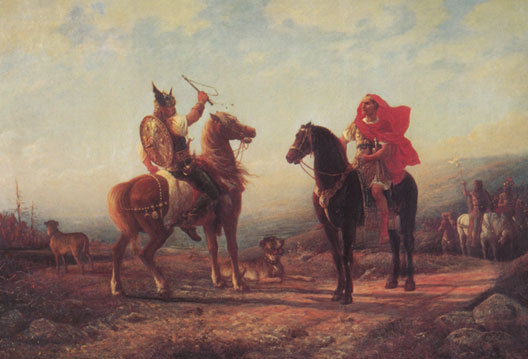
Gaul Faces Rome
Environ -200 à -58 av. J.-C.
As the previous chapter closed, the Celtic peoples had just experienced, between 400 and 200 BC, the height of their Mediterranean influence — from the taking of Rome to the alliance with Hannibal, by way of the founding of Galatia in Asia Minor. But this radiant influence was never matched by a corresponding political unity: each Gaulish people continued to act according to its own interests, with no common authority able to coordinate a response to outside threats. It is this fragmentation, already noted without judgment in previous chapters, that this chapter sees turn against Gaul itself.
Two outside powers take advantage of this lack of unity to establish themselves permanently on Gaulish soil. To the south, Rome intervenes first at Massalia’s request, before keeping the conquered territory for itself: Transalpine Gaul becomes, as early as 118 BC, a full Roman province. To the east, a purely Gaulish rivalry — the one pitting the Aedui, Rome’s privileged allies, against the Sequani — pushes the latter to call on Germanic warriors from across the Rhine. In both cases, the outside party, once in, does not leave.
This chapter is threaded through by the same mechanism, repeated at two different scales: a local conflict opens the door to an outside power, which takes advantage of this opening to settle in permanently rather than withdraw after its intervention. Rome at Entremont and Ariovistus among the Sequani follow, without knowing it, the same logic — the second intervention, Germanic, paradoxically paving the way for the third, Roman, which closes the chapter.
Four threads structure this account. The first is military and territorial: the Roman intervention against the Salyes and the Arverni, which leads to the birth of Transalpine Gaul. The second is political: the landscape of the great Gaulish peoples of this period — a weakened Arverni, a privileged Aedui, a rival Sequani — and their own institutions. The third is a bitter lesson: the Sequani’s appeal to Ariovistus’s Germans, which turns against the whole region. The fourth, finally, is decisive: Julius Caesar’s intervention in 58 BC, first against the migrating Helvetii, then against Ariovistus himself.
This chapter occupies a pivotal position: it does not yet tell the story of the conquest of Gaul, but it already lays out all its mechanisms — a Gaul powerful yet disunited, a Rome ready to intervene as soon as a pretext presents itself, and a general, Caesar, who discovers in free Gaul a stage worthy of his ambition. The next chapter picks up this account with the Gallic War proper.
I. About 125 to 121 BC: the Roman intervention and the birth of Transalpine Gaul
Around 125 BC, Massalia, threatened by the Salyes — a Celto-Ligurian confederation dominating Provence from their oppidum of Entremont — appeals once again to Rome, as it had already done in the past. The consul Marcus Fulvius Flaccus launches the first operations against the Ligures, the Salyes, and the Vocontii in Transalpine Gaul; his successor, Gaius Sextius Calvinus, continues the campaign the following year.
In 123 BC, Sextius Calvinus crushes the Salyes and destroys their oppidum of Entremont. According to Diodorus Siculus, several thousand inhabitants had gathered there in an attempt to block the passage of the Roman army; the defeated population is reduced to slavery.
 Caption: Remains of the rampart of the Entremont oppidum, destroyed by Sextius Calvinus in 123 BC — Mark Landon, CC BY 4.0, via Wikimedia Commons
The following year, Sextius founds nearby Aquae Sextiae — present-day Aix-en-Provence —, at the foot of the former Salyes stronghold, near the hot springs that give the city its name, paired with that of the proconsul himself.
That same year, 122 BC, Cnaeus Domitius Ahenobarbus confronts the Arverni, then the most powerful Gaulish people, led by their king Bituitus and allied with the Allobroges. He defeats them at Vindalium, at the confluence of the Sorgue and the Rhône; ancient sources mention the use of Roman war elephants, whose presence is said to have sown panic in the Gaulish ranks. The following year, on 8 August 121 BC, Quintus Fabius Maximus joins Ahenobarbus, and the two generals together crush the Arverno-Allobrogian coalition at the confluence of the Isère and the Rhône — up to 200,000 Gaulish combatants according to ancient sources, a figure almost certainly exaggerated, like other troop numbers of this kind already encountered for this period. Fabius Maximus is rewarded with the surname Allobrogicus.
The fate of Bituitus himself remains uncertain: according to the surviving summary of Livy, he was captured while on his way to negotiate with the Roman Senate, rather than in battle. Brought to Rome, he becomes one of the centrepieces of the triumph celebrated by his conquerors, parading with his richly coloured weapons and his silver chariot. The Senate decides he will never see Arvernia again: he ends his days under house arrest at Alba, in Latium. These victories open the way to a permanent Roman presence: as early as 120 BC, proconsul Domitius Ahenobarbus has the via Domitia laid out, linking Italy to Romanized Spain across southern Gaul, and in 118 BC Narbo Martius (Narbonne) is founded, a Roman colony that gives its name to the new province: Transalpine Gaul.
 Caption: Location of Gallia Narbonensis (in red) within the Roman world — ArdadN, public domain, via Wikimedia Commons
The young province narrowly avoids being swept away, however. On 6 October 105 BC, at Arausio (Orange), two Roman armies commanded by consul Mallius Maximus and proconsul Servilius Caepio — whose personal rivalry prevented any coordination — are annihilated by the Cimbri and the Teutones, Germanic peoples then migrating: up to 80,000 Roman soldiers perish there according to ancient sources, one of the heaviest military disasters in all of Roman history. The threat only dissipates three years later, in 102 BC, when the general Marius, invested with exceptional powers after the disaster, crushes the Teutones at the battle of Aquae Sextiae — the very city Sextius Calvinus had founded barely twenty years earlier. The young Transalpine Gaul, far from being a definitively stabilized acquisition, thus remains, for several years, a territory disputed down to its very existence.
🔍 Zoom – The War of the Cimbri and the Teutones
II. Late 2nd / early 1st century BC: the great Gaulish peoples and their rivalries
Beyond the borders of the new Roman province, Gaul remains dominated by several great peoples, whose balance is redrawn after the Arverni defeat. The Arverni, though politically weakened by Bituitus’s capture, remain a rich and populous people: their former splendour, under the reign of Bituitus’s father, Louernios, is described by the Greek philosopher Posidonius of Apamea, who travels through Gaul around 101/91 BC. Louernios is said to have had vast feasting enclosures built where anyone who wished could freely eat, distributing gold and silver himself from his chariot to those who followed him — a vivid image of the aristocratic economy of prestige that then characterizes Gaulish high society.
The Aedui, whose capital is Bibracte, establish themselves as Rome’s privileged allies. Already linked to Rome during the war of 121 BC against the Arverni and the Allobroges, they receive from Rome an exceptional diplomatic title, granted at the time to almost no other foreign people: that of fratres consanguinei, “brothers and blood relatives” of the Roman people. This privileged status makes them, in Rome’s eyes, the Gaulish people of reference — a position that will carry considerable weight in the following decades.
Facing them, the Sequani, settled to the east around their stronghold of Vesontio (Besançon), appear as natural rivals: the two peoples contend for control of the trade routes linking northern and southern Gaul, a dispute whose consequences will be fully felt in the following decades.
On the institutional level, Caesar describes, in his Commentaries on the Gallic War, an already well-established organization among the Aedui: a senate of notables, presided over by the druids, elects each year a supreme magistrate, the vergobret. This official holds power of life and death over routine matters, but the gravest decisions — foremost among them entering into war — fall to the aristocratic council or to the assembly of armed men. This organization, specific to each people, never extends to the whole of the Gaulish world: each city retains its own institutions, its own alliances, and its own rivalries.
III. About 71 to 59 BC: the appeal to the Germans and the Aeduan defeat
Worried by the growing power of their Aeduan rivals, the Sequani appeal, in the last third of the 2nd century, to Germanic warriors from across the Rhine: the Suebi, led by a chief named Ariovistus. Between 65 and 62 BC, the Sequano-Suebian coalition inflicts several successive defeats on the Aedui: they lose a large part of their cavalry and must hand over hostages as a guarantee of their submission.
The confrontation culminates at the battle of Magetobriga — whose exact dating remains debated among modern historians, between 63 and 61 BC —, where Ariovistus’s Suebi, fielding around 20,000 men against a comparable number of Aeduan warriors, definitively crush the latter. The hostages previously handed over are reduced to slavery, and the Germans settle on a third of Sequani territory. The reversal is cruel for the Sequani themselves: having called on Ariovistus to rid themselves of a troublesome rival, they in turn find themselves subject to ever-growing demands — new lands, new Germanic contingents summoned as reinforcements — with no way left to free themselves of him.
Faced with this situation, the Aeduan druid Diviciacus travels in person to Rome, around 63/60 BC, to plead his people’s cause before the Senate. Tradition reports a striking scene: invited to sit as was customary for ambassadors, he refuses and pleads standing, leaning on his shield. Hosted in Rome by Cicero, a friend of his brother Quintus, Diviciacus nonetheless meets with no success: his embassy ends in failure, the Senate granting him no concrete military aid.
🔍 Zoom – Diviciacus and Dumnorix, Two Brothers, Two Gauls
Worse still for the Aeduan cause: in 59 BC, under the consulship of Julius Caesar himself, the Roman Senate officially recognizes Ariovistus as rex et amicus populi Romani — “king and friend of the Roman people.” This recognition, obtained while Caesar holds Rome’s highest magistracy, closes the trap on the Aedui a little further: their Germanic oppressor now bears, in Rome’s eyes, an official title of ally. History’s irony would have it that this same Caesar, the following year, takes up arms against Ariovistus as proconsul of Gaul.
IV. 58 BC: Caesar, the Helvetii, and Ariovistus
In 61 BC, the Helvetian noble Orgetorix conspires with the Aeduan Dumnorix and the Sequanian Casticus to each seize power in their own people. Exposed, he escapes judgment by the Helvetian assembly by appearing escorted by his armed retinue, then dies shortly after under disputed circumstances — a suicide, according to rumour. His death does not halt the project he had championed: the Helvetii burn their twelve oppida and four hundred villages, along with their grain surpluses, to close off any possibility of turning back, and join the Rauraci, the Tulingi, the Latobrigi, and Boian contingents. According to tablets in Greek script later found in their camp and cited by Caesar himself, the whole group numbered 368,000 people — a figure to be treated with the same caution as other ancient counts already encountered in this account.
🔍 Zoom – The Conspiracy of Orgetorix
In the spring of 58 BC, the migration sets out and asks to cross the Roman Provincia via Geneva. Caesar, then proconsul, refuses: he has the bridge over the Rhône destroyed and, within a few days, has a nineteen-mile rampart built along the river. Forced to turn aside, the Helvetii take the Sequani territory through the Jura, with the secret complicity of Dumnorix, the Aeduan already involved in Orgetorix’s conspiracy. Caesar, alarmed by this crossing, gathers his legions and gives chase: he surprises and destroys the Tigurine canton as it crosses the Saône, a symbolic revenge since the Tigurini had once killed a Roman consul.
 Caption: “Les Romains passant sous le joug” (“The Romans Passing under the Yoke”), Charles Gleyre, 1858 — an evocation, a century after the events, of the humiliation inflicted in 107 BC by the Tigurini on the Roman consul Cassius Longinus, the episode Caesar symbolically avenges in 58 BC, Musée cantonal des Beaux-Arts, Lausanne, public domain, via Wikimedia Commons
The decisive confrontation then takes place not far from Bibracte, the Aeduan capital, toward the end of June: the battle lasts from noon until nightfall and ends in a complete defeat for the migrants. The survivors retreat to Lingones territory before surrendering; Caesar sends them back to their homeland, tasked with serving as a buffer against any future Germanic push, except for the Boii, who are allowed to settle among the Aedui at their own request. Of the 368,000 who set out, only 110,000 are said to have returned according to Caesar’s own count — a figure probably inflated to magnify the scale of the victory.
This victory immediately changes Caesar’s standing in Gaulish eyes: an assembly of chiefs, gathered at Bibracte, now appeals to him directly against Ariovistus. A tense meeting between the two men fails: the Germanic chief proposes dividing Gaul between a Germanic north and a Roman south, refuses any concession, and lets a thinly veiled threat hang over Caesar’s own person.
 Caption: “Entrevue de César et d’Arioviste en Alsace” (“Meeting between Caesar and Ariovistus in Alsace”), Louis-Frédéric Schützenberger, before 1883 — a later depiction of the meeting between the two chiefs before the battle, Musée des beaux-arts de Mulhouse, public domain, via Wikimedia Commons
A rumour about the savagery and invincibility of the Germanic warriors then spreads through the Roman camp, causing panic even among some officers and tribunes; Caesar restores his troops’ morale with a now-famous speech, declaring himself ready to march with the tenth legion alone if need be. Ariovistus, for his part, delays the confrontation for several days: the Germanic matrons, consulted through the casting of lots, had announced that a battle fought before the new moon would be lost.
The battle finally takes place on 14 September 58 BC, at the foot of the Vosges — the exact site remains uncertain. The Roman legions, deployed in three lines, first see their left wing waver under Germanic pressure, until the intervention of the young Publius Crassus, commander of the cavalry, who commits the third reserve line and restores the fight. The Germanic rout becomes general; the legions pursue the fleeing enemy for nearly fifty miles, all the way to the Rhine. Ariovistus, wounded, manages to escape by boat with a few companions just in time; his two wives and his daughters, caught up in the flight on the wagons, are killed or captured, and Roman prisoners held by the Germans — including the knight Marcus Valerius Procillus — are freed. Ariovistus’s power in Gaul is broken.
V. A Gaul that opens the door
Over nearly a century and a half, between 200 and 58 BC, Gaul faces two distinct but converging pressures. To the south, the Roman intervention, first requested by Massalia against the Salyes, leads to the lasting annexation of an entire province, Transalpine Gaul (section I). To the east and centre, the rivalry between the Aedui and the Sequani (section II) leads the latter to call in Germanic warriors as reinforcements — a decision that backfires on both them and their adversaries, delivering the whole region to Ariovistus’s growing domination (section III).
In both cases, the same pattern repeats: a local conflict pushes one of the parties to seek an outside power, which then settles in permanently rather than departing after its intervention. Rome at Entremont and Ariovistus among the Sequani follow the same logic — the only difference lies in the identity of the intervening party, and in what each gains from it.
It is precisely this second precedent, Germanic domination, that opens the way for Rome to intervene in free Gaul, until then beyond its direct reach. The failure of Diviciacus’s embassy, followed by the recognition of Ariovistus as rex et amicus populi Romani in the very year Caesar reaches the consulship, shows just how far from improvised this intervention was: it fits within a diplomatic game in which Rome carefully manages all parties, until the moment arises to tip the balance in its own favour (section IV). Once Ariovistus is defeated, Caesar establishes himself in Gaulish eyes as a protector — a role nothing in the preceding decades had suggested for a Roman general freshly arrived at the head of his province.
This intervention, conceived and presented as a one-off, does not however end with the departure of the legions. It marks instead the beginning of a permanent Roman military presence in free Gaul — a turning point whose full scope neither the Gauls themselves, nor perhaps Rome, yet fully grasp at this stage.
🧠 Key points
- Between 125 and 121 BC, Rome intervenes against the Salyes, then against the Arverni of Bituitus, opening the way to the creation of Transalpine Gaul (Aquae Sextiae 122 BC, Narbo Martius 118 BC).
- The Aedui, Rome’s privileged allies and holders of the exceptional title of fratres consanguinei, oppose the Sequani for control of Gaulish trade routes.
- To weaken the Aedui, the Sequani call on the Suebian warriors of Ariovistus, who crush them at Magetobriga before turning their domination against the Sequani themselves.
- The embassy of the Aeduan druid Diviciacus to the Roman Senate fails; in 59 BC, under Caesar’s consulship, Ariovistus is even recognized as “king and friend of the Roman people.”
- In 58 BC, Caesar crushes the Helvetian migration near Bibracte, then defeats Ariovistus at the foot of the Vosges on 14 September, ending the organized Germanic presence in Gaul.
- These two outside interventions, Roman and Germanic, reveal the same mechanism: a local Gaulish conflict opens the door to a power that settles in for good.
- By the end of this chapter, Caesar establishes himself as the undisputed protector of Gaul in the eyes of several Gaulish peoples — a position that opens directly onto the Gallic War.