
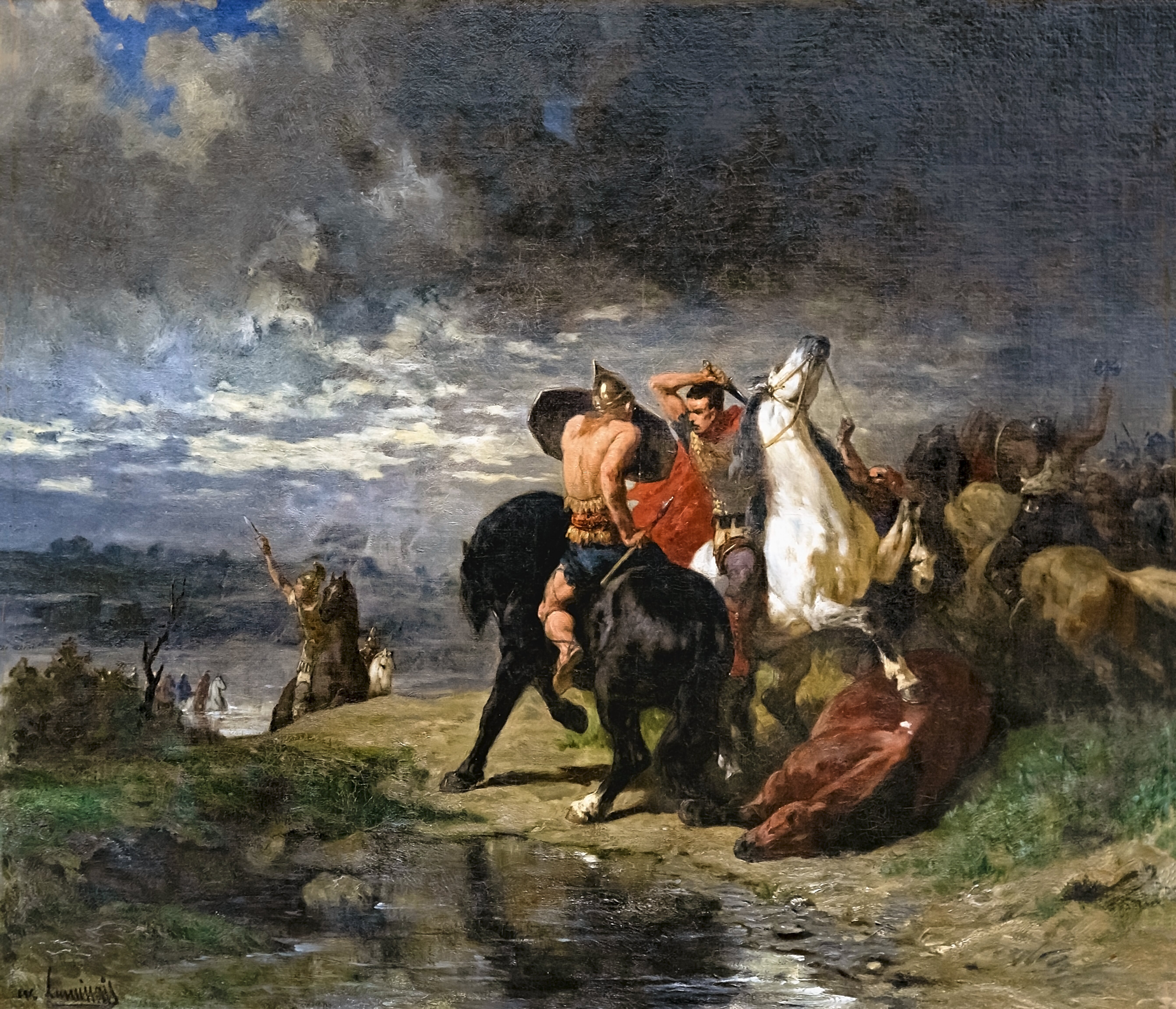
The Gallic Wars
Environ -57 à -53 av. J.-C.
As the previous chapter closed, Caesar had just crushed the Helvetian migration near Bibracte, then defeated the Germanic chief Ariovistus at the foot of the Vosges, in 58 BC. These two victories, won in the name of an intervention presented as a one-off, permanently established Roman legions in free Gaul and made Caesar, in the eyes of several Gaulish peoples, an undisputed protector.
This new status soon turns into a source of tension. As early as the following year, the peoples of Belgica, worried at seeing this Roman presence take root on their doorstep, form a coalition to oppose it by force. This chapter follows, year by year, the succession of campaigns by which Caesar responds to this resistance, then to those that follow it in every corner of Gaulish territory.
This account is threaded through by a sustained, almost annual military rhythm that never gives Gaul time to catch its breath: each completed campaign gives rise to a new one, among another people, on another front. This continuous pressure comes with a stark contrast between spectacular Roman successes — the battle of the Sabis, the Veneti naval battle, the submission of the island of Britain — and severe setbacks, foremost among them the disaster at Aduatuca, one of the worst ever suffered by a Roman army.
Five annual campaigns structure this account. In 57 BC, Belgica is subdued after the harsh battle of the Sabis. In 56 BC, it is the Veneti of Armorica and the peoples of Aquitania who fall under Roman control, while the first Germanic pressures appear on the Rhine. In 55 BC, Caesar crosses the Rhine, then carries out a first reconnaissance of the island of Britain. In 54 BC, a second, more ambitious British expedition is followed by the gravest military disaster of the entire war: the annihilation of the legates Sabinus and Cotta in the face of the Eburonian revolt. In 53 BC, finally, Caesar restores his authority through a methodical repression, culminating in the execution of the Carnutian chief Acco.
This chapter occupies a key position in the story of the conquest: it shows a Gaul militarily subdued people by people, but never truly pacified in spirit. Acco’s execution, meant to close the cycle of revolts, instead lights its fuse: the next chapter will tell how this accumulated resentment breaks out, as early as 52 BC, into the largest Gaulish uprising of the entire war.
I. 57 BC: the Belgic campaign
Worried by growing Roman power in Gaul, the peoples of Belgica form a coalition led by Galba, king of the Suessiones, reinforced by Germanic contingents. In the summer of 57 BC, the coalition besieges Bibrax, an oppidum of the Remi, allies of Caesar; the siege fails within a day and a night thanks to the dispatch of Roman reinforcements — Numidian archers, slingers, and cavalry.
🔍 Zoom – The Peoples of the Gallic Wars: Who’s Fighting Whom?
 Caption: Map of the Belgic campaign, 57 BC — via Wikimedia Commons
The coalition then turns toward the fortified camp Caesar has built on the right bank of the Axona (the Aisne). The confrontation turns in Caesar’s favour, and he wins the battle of the Aisne; the coalition disperses at once. Caesar turns successively against the Suessiones, who capitulate, then against the Bellovaci and the Ambiani, subdued in their turn.
There remains the most formidable coalition: the Nervii, the Atrebates, and the Viromandui, led by the Nervian chief Boduognatus, who is said to have gathered up to 60,000 men. At the battle of the Sabis (the Sambre), a Nervian reserve of 35,000 men, kept hidden in the forest, surprises the Roman right wing — the VIIth and XIIth legions — and very nearly tips the outcome of the battle. Caesar personally engages in the front line, snatching a shield from a soldier’s hands to rally his troops; the arrival of the XIIIth and XIVth legions, until then guarding the baggage, turns the situation around. The Nervii are crushed.
At the end of the summer, the Atuatuci, informed of their allies’ defeat, retreat into their fortified oppidum. After an initial surrender agreement, they attempt a surprise night sortie against the Roman lines, which fails with 4,000 dead. Considering the agreement broken, Caesar has the entire population sheltering in the town sold at auction — 53,000 people according to his own count. At the end of this campaign, Caesar recognizes Commius as king of the Atrebates — a choice that will prove heavily consequential, Commius later becoming one of the leaders of the anti-Roman revolt.
II. 56 BC: the Veneti, Aquitania, and Germanic pressure
In the winter of 57/56 BC, the Veneti, a seafaring Armorican people, capture two Roman prefects sent to requisition grain, prompting other Armorican peoples to join the revolt. Caesar has a fleet built on the Loire; in September 56 BC, off the Rhuys peninsula, the largest naval battle of the Gallic Wars pits some 220 Venetic ships against the galleys of Decimus Junius Brutus in the Gulf of Morbihan. The Gaulish ships, taller and built of solid oak, at first resist boarding; the Romans then resort to long poles fitted with hooks to cut the ropes holding up the sails. The wind eventually drops, immobilizing the Venetic fleet, which Brutus methodically destroys. As punishment for the capture of the prefects — a violation of ambassadorial immunity — Caesar has the Venetic council executed and the rest of the population sold into slavery.
Meanwhile, the legate Quintus Titurius Sabinus faces, in northern Armorica, a coalition of the Unelli, the Lexovii, and the Aulerci Eburovices, led by Viridovix. Sabinus feigns fear and holes up in his camp, then sends a fake deserter to convince the Gauls that the terrified Romans are about to flee. The Gauls rush to assault the camp up a slope; exhausted by the climb, they are caught off guard by a proper Roman sortie and routed.
To the south, Publius Crassus, son of the triumvir, campaigns in Aquitania against the Sotiates, led by Adiatuanus, who maintains a personal bodyguard of 600 soldurii bound to him by an oath of shared death. After a failed sortie by these men, Adiatuanus capitulates. Crassus then faces an Aquitanian coalition reinforced by veterans who had fought under Sertorius in Spain, adopting Roman-style tactics and camp layout; he attacks and destroys this camp, winning a decisive victory that extends Roman influence over all of Aquitania.
 Caption: Map of the Aquitanian campaign, 56 BC — via Wikimedia Commons
At the end of the year, the Germanic peoples of the Usipetes and the Tencteri, driven from their lands by the Suebi, cross the Rhine and settle on its left bank — a new pressure Caesar will have to answer the following year.
III. 55 BC: the Rhine and the first expedition to Britain
Now resolved to no longer tolerate Germanic peoples on Gaulish soil, Caesar enters negotiations with the Usipetes and the Tencteri, broken off after his cavalry suffers a surprise defeat at Germanic hands. The next day, as Germanic chiefs come to apologize and negotiate a truce, Caesar holds them prisoner and launches a surprise attack on their camp, massacring men, women, and children or driving them into the Rhine. Caesar himself puts the total population of these two peoples at 430,000 — a figure concerning their overall population, not the number killed, and whose scale nonetheless calls for the same caution as other ancient counts already encountered in this account. The episode sparks fierce controversy as far as Rome: senator Cato proposes that Caesar be handed over to the Germans for having broken the truce.
 Caption: Map of Caesar’s campaign, 55 BC — via Wikimedia Commons
Immediately after, Caesar has a pile bridge built across the Rhine, completed in just ten days — an unprecedented technical feat, no regular army having ever crossed the river by such means. He spends eighteen days on the right bank, ravaging the territory of the Sugambri, who evade him by retreating into the forests, before recrossing the Rhine and having the bridge destroyed.
At the end of the summer, Caesar has a fleet of eighty ships built at Portus Itius to carry the VIIth and Xth legions to the island of Britain; the eighteen ships carrying the cavalry, held back by the wind, cannot set sail. Departing around midnight, the first ships reach the British coast around ten in the morning, finding armed Britons massed on the heights overlooking the beach. As the soldiers hesitate to disembark into deep water facing the enemy, the standard-bearer of the Xth legion leaps alone into the sea, crying out: “Jump, comrades, unless you want to betray the eagle to the enemy; as for me, I shall have done my duty to the republic and to the general” — a gesture that at once triggers the landing of the rest of the troops.
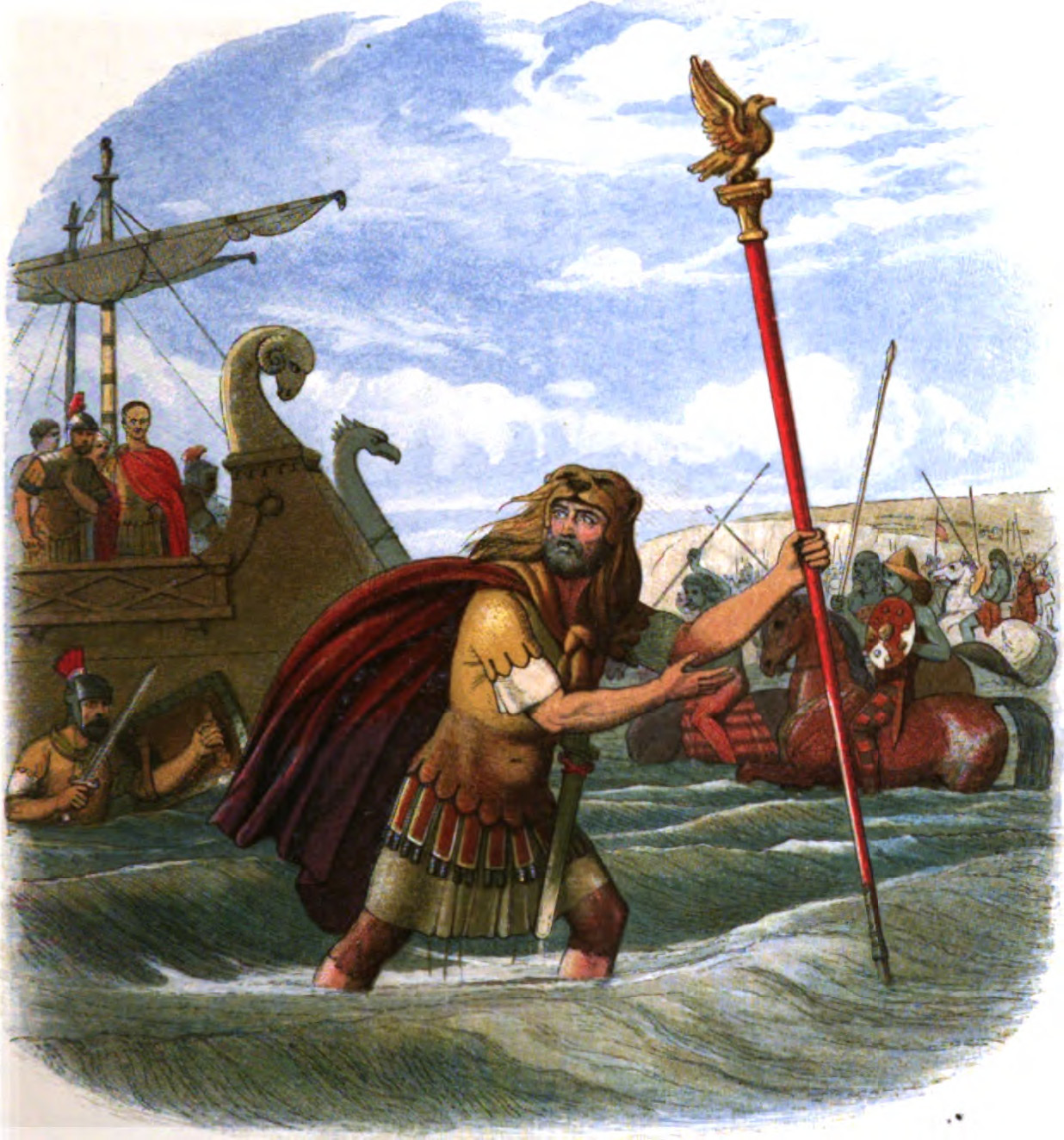 Caption: “The Standard Bearer of the Tenth Legion,” James William Edmund Doyle, 1864 — a later depiction of the scene reported by Caesar, from A Chronicle of England, public domain, via Wikimedia Commons
After difficult fighting, the Britons sue for peace and hand over hostages. But a storm, combined with an exceptional tide, badly damages the fleet beached on the shore; seizing the opportunity, the Britons take up arms again and attack a foraging column of the VIIth legion. Caesar intervenes and repels the attack; the Britons sue for peace a second time. Lacking cavalry and with the equinox approaching, Caesar chooses to cross back to Gaul as early as September, without having established any lasting presence on the island — a reconnaissance expedition rather than a conquest.
IV. 54 BC: the second expedition to Britain and the Eburonian revolt
In the spring of 54 BC, Caesar first intervenes among the Treveri, a people of Gallia Belgica, to settle an internal rivalry between Cingetorix and his father-in-law Indutiomarus; he throws his support behind Cingetorix, a choice that will leave Indutiomarus lastingly hostile to Rome.
 Caption: Map of Gaul and Caesar’s operations, 54 BC — via Wikimedia Commons
Caesar then launches a second expedition to the island of Britain, far more ambitious than the first: a fleet of about 800 ships this time carries five legions and more than a thousand Gaulish cavalry. The landing this time goes unopposed, the Britons having withdrawn at the sheer size of the fleet; but a fresh storm damages part of the ships beached on the shore, forcing Caesar to halt his advance to organize repairs and fortify a naval camp.
The Roman army then faces the British coalition, now commanded by Cassivellaunus, a chief who had previously killed the father of the prince of the Trinovantes, Mandubracius — the latter, a refugee in Gaul, had begged Caesar for protection. Cassivellaunus, giving up frontal confrontation after an initial defeat, adopts a guerrilla war led by his war chariots, before retreating beyond the Thames, of which only a single fordable crossing remains, bristling with stakes. Caesar nonetheless forces the crossing. The Trinovantes rally to Caesar and secure Mandubracius’s restoration at their head; several other British peoples submit in turn and reveal the location of Cassivellaunus’s fortified oppidum, which Caesar takes. A last attempt by Cassivellaunus, a coordinated attack by four kings of Kent against the Roman naval camp, also fails. Cassivellaunus capitulates, hands over hostages, and accepts a tribute; this time, unlike the first expedition, Caesar waits for their actual delivery before crossing back to Gaul as the equinox approaches.
The harvest having proven poor that year, Caesar spreads his legions across winter quarters more widely than usual throughout Gallia Belgica. Fifteen cohorts, some 6,000 to 9,000 men under the command of the legates Quintus Titurius Sabinus and Lucius Aurunculeius Cotta, settle in Eburonian territory, at Aduatuca. The Eburonian chief Ambiorix attacks the camp, then proposes a truce: he claims a general uprising is under way across Gaul and offers safe passage to the nearest Roman camp. Sabinus, against Cotta’s advice, chooses to trust this promise and evacuate the camp; the Roman column, ambushed in a narrow valley, is cut down by missiles fired from the heights. Sabinus and Cotta are killed; several legionaries, refusing capture, take their own lives. Only a handful of men manage to escape through the woods to bring news of the disaster to Labienus’s camp. This disaster stands as the gravest setback suffered by Rome throughout the entire Gallic War.
Emboldened by this victory, the Nervii in turn besiege the camp of the legate Quintus Cicero, brother of the orator, with a large army. A Nervian named Vertico, who had gone over to the Romans, manages to get a message to Caesar via a Gaulish slave, the letter concealed inside a javelin shaft; Caesar replies in Greek, so that any interception would reveal nothing of Roman plans to the enemy. Urgently gathering the nearest legions, Caesar forces the march and manages to relieve the besieged camp.
At the same time, Indutiomarus, passed over by Caesar in favour of Cingetorix, drives the Treveri into open revolt and mounts repeated attacks against the camp of Titus Labienus. Labienus eventually draws him out of his positions and kills him in a cavalry engagement, which temporarily quells the Treveran insurrection. The year 54 BC thus ends on a striking contrast: the successes in Britain poorly mask an increasingly unstable Gaul, where revolts multiply and Roman authority, barely a year after its most spectacular assertion, finds itself seriously shaken.
V. 53 BC: repression and the reorganization of Gaul
In early spring 53 BC, two legions sent by Pompey join Caesar, bringing his army to ten legions. He first ravages the territory of the Nervii, then turns against the Eburones of Ambiorix and their allies, defeating the Menapii and the Treveri separately. He then recrosses the Rhine on a new bridge to deter any Germanic support for the rebels, but gives up pursuing the Suebi, who retreat into forests difficult to access. Caesar finally resumes his hunt for Ambiorix, systematically ravaging Eburonian territory as far as the Ardennes, in August, without managing to capture him.
In April 53 BC, Caesar convenes a general assembly of the Gaulish peoples at Samarobriva (Amiens). The Treveri, the Carnutes, and the Senones refuse to attend; Caesar dissolves the assembly and militarily subdues these three peoples.
In the autumn, a new assembly is held at Durocortorum (Reims): the concilium Galliae, meant to try those responsible for the year’s revolts. Acco, a Carnutian chief judged responsible for his people’s uprising, is condemned there according to Roman custom reserved for the worst criminals: bound to a stake, beaten with rods, then beheaded. Far from serving as the deterrent warning Caesar had hoped for, this execution produces the opposite effect: several Gaulish chiefs, shocked at the fate dealt to a notable respected well beyond his own people, meet in secret after Caesar’s departure. It is in these secret gatherings that the plan for a general uprising of Gaul begins to take shape.
The Roman legions then take their winter quarters among the Lingones and the Senones, near the recently pacified areas, while Caesar returns to Cisalpine Gaul. Roman authority appears, by the end of 53 BC, more solidly established than ever across Gaulish territory. But this domination remains fragile: Acco’s execution, far from having closed the cycle of revolts, has just lit its fuse. The following year will see this accumulated resentment erupt into the largest uprising Gaul ever mounted against Rome.
🧠 Key points
- In 57 BC, Caesar subdues Belgica after the harsh battle of the Sabis against the Nervii, then the surrender of the Atuatuci; Commius is recognized as king of the Atrebates.
- In 56 BC, the Venetic fleet is destroyed in the Gulf of Morbihan and Aquitania subdued by Crassus, while the Usipetes and the Tencteri cross the Rhine.
- In 55 BC, Caesar massacres these two Germanic peoples — an episode that sparks controversy as far as the Roman Senate —, crosses the Rhine on a bridge built in ten days, then leads a first reconnaissance expedition to the island of Britain.
- In 54 BC, a second expedition subdues Cassivellaunus in Britain, but the year ends with the disaster at Aduatuca: the legates Sabinus and Cotta and their fifteen cohorts are annihilated by the Eburonian revolt of Ambiorix.
- In 53 BC, Caesar restores his authority through methodical repression, culminating in the execution of the Carnutian chief Acco at the assembly of Durocortorum.
- This execution, far from deterring further revolt, instead pushes several Gaulish chiefs to secretly prepare a general uprising, which will break out the following year.