
Vercingetorix's Revolt
-52 av. J.-C.
As the previous chapter closed, Caesar had just had the Carnutian chief Acco executed at Durocortorum, hoping to deter any further revolt. The effect achieved is the opposite: several Gaulish chiefs, shocked by this punishment inflicted on a notable respected well beyond his own people, meet in secret to prepare an uprising of unprecedented scale. This chapter tells how this project, carried by a young Arvernian noble until then marginal, becomes within a few months the largest movement of unity Gaul has ever known in the face of Rome.
This unity, spectacular as it is, does not arise on its own. Vercingetorix must first impose himself against his own family and the Arvernian oligarchy, before rallying people after people to his cause — sometimes through persuasion, sometimes through the constraint of hostages and imposed contingents. This laborious construction of a coalition, within a Gaulish world whose structural political fragmentation the previous chapters have consistently shown, is itself one of the major events of this account.
This chapter is thus dominated by a paradox that closes the one from the previous chapter: at the very moment Gaulish resistance reaches its fullest unity, it collides with a methodical Roman power, technically superior and already solidly established on the territory after six years of campaigns. This union, achieved at considerable cost, perhaps arrives too late to reverse a balance of power already tilted.
Five phases structure this account. The first is the outbreak of the insurrection, from Genabum to the scorched-earth strategy. The second is the siege of Avaricum, where Gaulish determination collides for the first time with Roman engineering. The third is Caesar’s failure before Gergovia, one of the few clear-cut tactical setbacks of his entire Gaulish career. The fourth is the spread of the revolt, crowned by Vercingetorix’s confirmation as supreme commander at the assembly of Bibracte. The fifth, finally, is the siege of Alesia, where the fate of independent Gaul is decided and sealed.
This chapter occupies a pivotal position in the whole ancient history of the territory: it marks the end of free Gaul and the opening of a new era, that of a Gaul integrated into the Roman Empire for several centuries. Vercingetorix’s surrender is not only the defeat of a man or an army: it closes, for a long time, the question of a Gaul master of its own destiny.
I. January-March 52 BC: the outbreak of the insurrection
On 23 January 52 BC, at an agreed signal, the Carnutes, led by Cotuatos and Conconnetodumnos, massacre at Cenabum (Orléans) the Roman citizens settled there for trade, among them Caius Fufius Cita, a Roman knight in charge of the army’s grain supply. The news spreads at once across the Gaulish countryside through a system of cries relayed from field to field: in a single night, it travels some 240 kilometres to Arvernian territory.
Among the Arverni, the young Vercingetorix tries to rally his people to the insurrection. Son of Celtillus, a once-powerful chief condemned to death and burned alive a generation earlier for aspiring to kingship — a sentence his own brother Gobannitio may have contributed to —, Vercingetorix first runs up against the Arvernian oligarchy: his uncle Gobannitio has him driven out of Gergovia. He then raises troops in the countryside, among the poor and the dispossessed, returns in force a few days later, in turn drives out his uncle, and has himself proclaimed king.
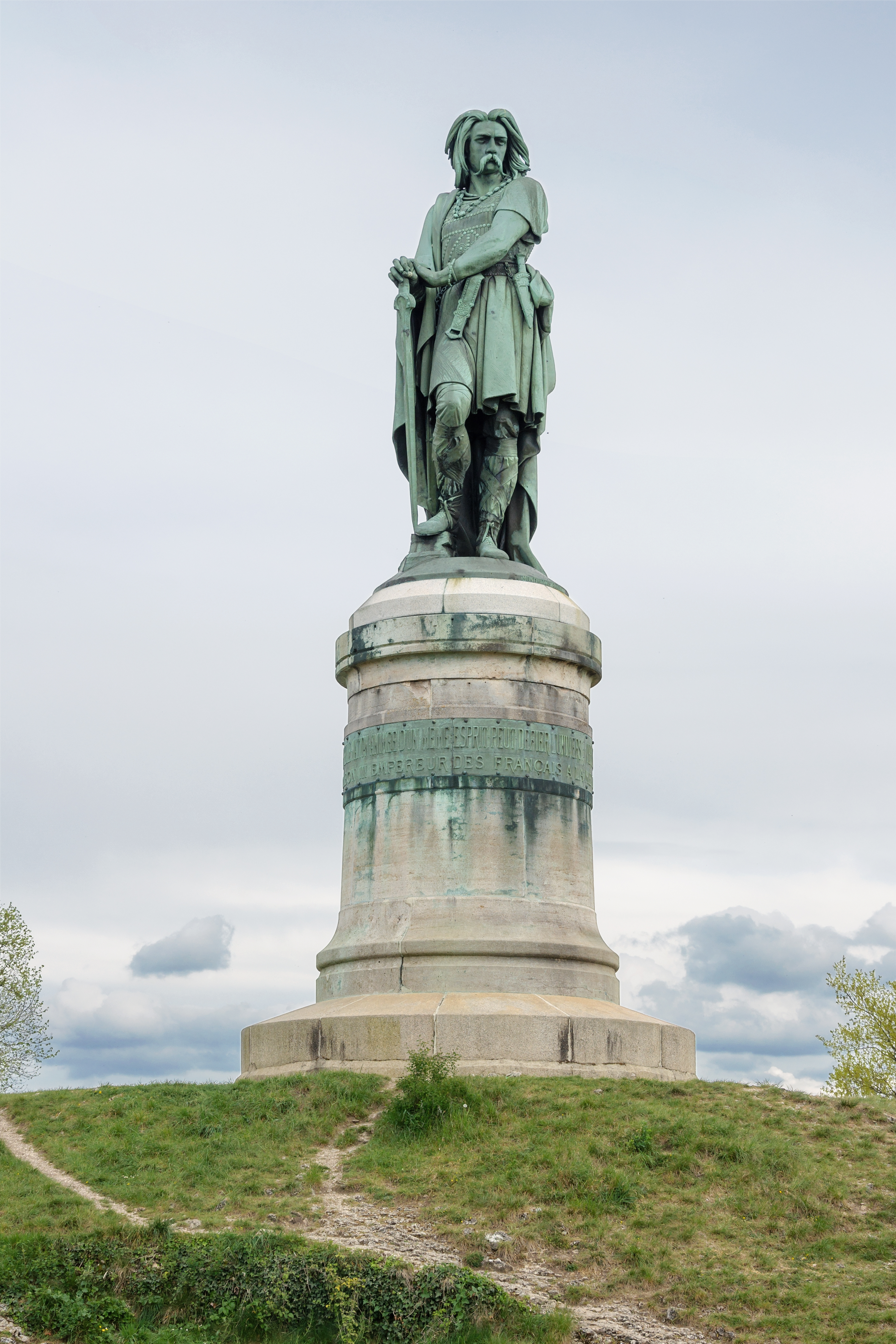 Caption: Monument to Vercingetorix, Aimé Millet (statue) and Eugène Viollet-le-Duc (base), commissioned by Napoleon III and inaugurated in 1865 on Mont Auxois — a 19th-century evocation, not a period portrait, Myrabella, CC BY-SA 4.0, via Wikimedia Commons
He sends embassies to the main Gaulish peoples and, at a general assembly, has himself recognized as supreme commander of the coalition — imposing strict discipline, hostages demanded from allied peoples, and fixed contingents per people to back it up.
🔍 Zoom – Vercingetorix’s True Face?
Caesar, then in Cisalpine Gaul, learns the news and rejoins his legions by a forced march across the snow-covered Cévennes, deemed impassable at this season, surprising the Arverni before converging with the rest of his army toward Agedincum (Sens). Between 25 February and 8 March, he successively takes Vellaunodunum (among the Senones), Cenabum — sacked in reprisal for the massacre —, then Noviodunum, among the Bituriges. Before this last stronghold, Vercingetorix’s cavalry, arriving as reinforcement, is routed by Caesar’s Germanic auxiliary cavalry, hastening the town’s surrender.
Faced with these successive setbacks, Vercingetorix convenes a war council and imposes a new strategy: scorched earth, destroying towns and crops rather than leaving them for Roman supply. Some twenty Biturigian towns are burned in a single day. The sole exception, won through hard argument by the Biturigian notables: Avaricum (Bourges), deemed impregnable, is spared.
II. March 52 BC: the siege of Avaricum
Protected on almost its entire perimeter by marshes and a river, leaving only a narrow approach to the town, Avaricum seems to justify the Bituriges’ confidence. Vercingetorix camps nearby to harass the siege works without ever giving pitched battle, imposing formidable discipline on his own troops — several sentries caught asleep are executed.
In twenty-five days, the legions build a gigantic agger, an assault ramp about 100 metres wide and 27 metres high, brought almost to the rampart itself, accompanied by mantlets and two siege towers. The Gauls multiply countermeasures — tunnels to set fire to the ramp, hooks to tear away the Roman protective screens — while famine spreads through the besieging camp. Caesar considers for a time lifting the siege, but his soldiers refuse, demanding above all to avenge their compatriots massacred at Cenabum.
A night evacuation attempt narrowly fails: the women of the town, rushing to the public squares, weepingly beg the men not to abandon them with their children; when the men refuse to yield, the women begin to cry out, unwittingly alerting the Romans to the escape plan. Fearing they would be cut off by enemy cavalry, the Gauls abandon the attempt. Taking advantage shortly after of a spell of bad weather that relaxes the defenders’ vigilance, the legions launch a final assault and take the town by surprise. Of about 40,000 inhabitants, only 800 escape, fleeing to join Vercingetorix; no mercy is shown to the elderly, the women, or the children.
The fall of Avaricum exposes Vercingetorix to accusations of treason within the coalition. He defends himself in a now-famous speech, justifying each of his choices — going so far as to have Roman prisoners testify to the famine that had gripped Caesar’s camp — and recalling that he himself had advised, while the decision was still possible, burning the town rather than defending it. The speech galvanizes his troops, who acclaim him more than ever as supreme commander. Vercingetorix, now anxious to win over the Aedui to his cause, deliberately refrains from applying scorched earth on their territory, judging that such an act would amount to a declaration of war.
III. April-May 52 BC: the failure at Gergovia
After Avaricum, Caesar splits his army: he entrusts four legions to Labienus, tasked with an offensive to the north against the Senones and the Parisii, and keeps six legions for himself to march on Gergovia, the Arvernian oppidum where Vercingetorix has withdrawn. Among the Aedui, a succession dispute pits two claimants to the title of vergobret against each other, Convictolitavis and Cotus; Caesar, called upon to arbitrate, travels in person to Decetia and rules in favour of Convictolitavis, younger and more popular, obtaining in return the reinforcement of 10,000 Aeduan infantry and cavalry.
This force, on its way to join Caesar, is however diverted by the Aeduan noble Litaviccus, who convinces it, on the strength of a false rumour, that the Aeduan hostages held by Caesar have just been massacred. The column rises up, massacring or plundering the Roman citizens accompanying it — Convictolitavis himself, though just installed by Caesar, joins the movement. Alerted, Caesar rides to meet it with his cavalry and produces the hostages very much alive, defusing this particular column’s revolt; but the rumour has already done its work at Bibracte and at Cabillonum (Chalon-sur-Saône), where Roman citizens are massacred or plundered — a sign of Aeduan resentment now impossible to contain.
 Caption: Modern view of the Gergovia plateau, whose terrain explains the strength of the Arvernian oppidum’s natural defences — Dysmorodrepanis, CC BY-SA, via Wikimedia Commons
Before Gergovia, an oppidum perched on a plateau with formidable natural defences, Caesar seizes a nearby height by night and has a second, smaller camp built there, to cut off the besieged’s access to water. He then orders a limited assault, meant only to draw Gaulish attention toward a secondary point in the fortifications; but the legionaries’ momentum, poorly controlled, carries them all the way to the foot of the town’s main rampart, where they find themselves exposed with no hope of scaling it. The retreat turns to disaster: Caesar himself acknowledges the loss of more than 700 legionaries and 46 centurions — one of the few clear-cut tactical setbacks he suffers throughout the entire Gallic War.
Faced with the impossibility of renewing the assault, Caesar addresses his troops, blaming their indiscipline while praising their courage to preserve the army’s morale, then lifts the siege and withdraws, leaving Vercingetorix master of Gergovia. This double humiliation — the military failure and the Litaviccus episode — finally convinces the Aedui: they openly break with Rome in the following weeks, offering the Gaulish coalition its most significant rallying since the revolt began.
IV. Summer 52 BC: the spread of the revolt and the assembly at Bibracte
To the north, Labienus marches with his four legions on Lutetia, held by the Parisii and supported by the Senones and the Carnutes under the old chief Camulogenus. Slowed at first by the marshes of the Bièvre, which hinder the Roman advance, Labienus soon feigns a general retreat to draw the Gauls out of their positions; the ruse succeeds, the ensuing battle turns to Roman advantage, and Camulogenus is killed there.
 Caption: “Camulogenus, chief of the Parisii, attacks Labienus, Caesar’s lieutenant,” Fernand Cormon, 1906-1911 — a later depiction of the battle of Lutetia, Petit Palais, public domain, via Wikimedia Commons
Labienus thus manages to disengage and rejoin Caesar, just as news of the disaster at Gergovia and the Aeduan defection begins to spread.
On this momentum, the Aedui, now officially rallied to the revolt, convene a general assembly of the Gaulish peoples at Bibracte, their own capital, hoping to claim leadership of the coalition. But the assembly, meeting during the summer, instead confirms Vercingetorix in his supreme command — a recognition all the more significant as it comes from a people long Rome’s privileged ally. Strengthened by this massive rallying, Vercingetorix imposes reinforced cavalry contingents on each people and devises a new strategy, aimed this time at cutting Caesar’s communications with the Roman Province and harassing his retreat northward.
Near the Vingeanne, as Caesar makes his way to rejoin Labienus, the Gaulish cavalry, launched in three columns, engages the Roman horsemen. The clash at first favours the Gauls, until Caesar’s Germanic auxiliary cavalry, deployed en masse from a height dominating the area, reverses the situation: it routs the Gauls and pursues them into the ranks of Vercingetorix’s infantry, causing great slaughter. This disaster, which deprives Vercingetorix of much of his cavalry, forces him into a hasty retreat: he takes the road to the oppidum of Alesia, where the Gaulish coalition will soon fight its decisive battle.
V. August-October 52 BC: the siege of Alesia and the surrender
Withdrawn into the oppidum of the Mandubii, at Alesia, a naturally strong position overlooking two rivers, Vercingetorix sends his cavalry away by night, before the Roman blockade closes, to disperse to their respective peoples and raise a relief army — each people being assigned a fixed contingent.
Caesar then has one of the most impressive military works of antiquity built: a double line of fortifications, the contravallation, facing Alesia over some fifteen kilometres to contain the besieged, and the circumvallation, facing outward over about 21 kilometres to guard against the expected relief army.
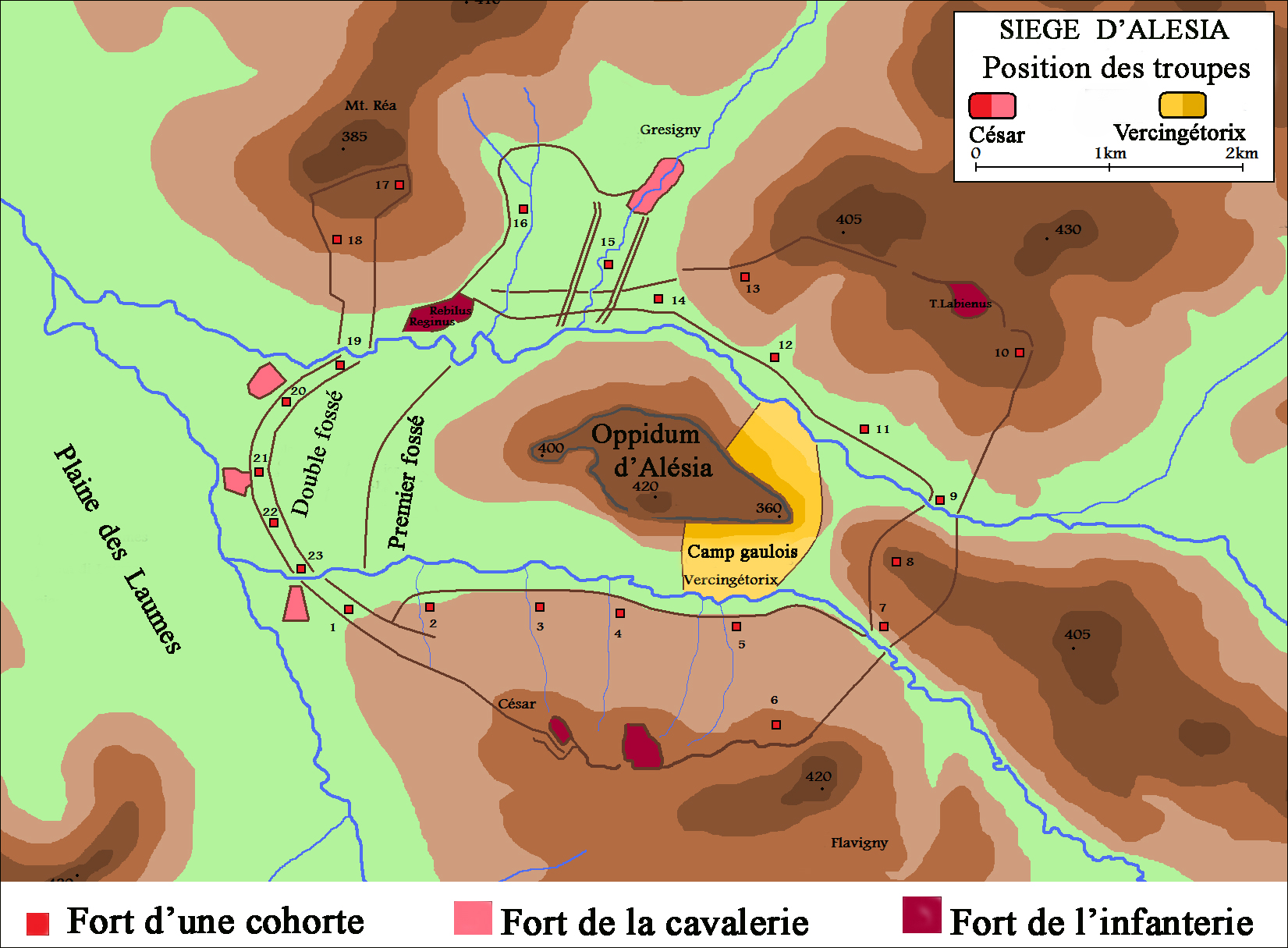 Caption: Plan of the siege of Alesia in 52 BC, showing the double system of Roman fortifications and the surrounding river network — Muriel Gottrop, CC BY-SA 2.5, via Wikimedia Commons
Ditches, palisades, watchtowers, and concealed traps — the famous lilies, boundary stakes, and goads — bristle across the whole system. Some 80,000 Gaulish warriors thus find themselves shut in alongside Vercingetorix.
With supplies running out rapidly, a war council is held in the besieged town. The Arvernian Critognatus proposes an extreme solution: feed on those mouths judged useless in combat rather than surrender. The council prefers another, scarcely less cruel outcome: the Mandubii, women and children included, are expelled from the town, in the hope that Caesar would let them through his lines. Caesar categorically refuses, abandoning them to a slow death from hunger and cold in the empty space separating the two camps, under the gaze of both armies.
🔍 Zoom – Critognatus: Caesar’s Propaganda
In early September, the relief army finally arrives, under the joint command of Commius, king of the Atrebates whom Caesar himself had installed on his throne a few years earlier (section I), of Vercassivellaunus, Vercingetorix’s cousin, and of the Aedui Viridomarus and Eporedorix. Caesar himself puts its strength at 240,000 infantry and 8,000 cavalry — a figure to be received with the same reserve as other ancient counts of this scale. After several days of repelled assaults, the Gauls discover a weak point in the Roman system, on the northern slope, where the rugged terrain had not allowed the fortifications to be fully completed; Vercassivellaunus launches his best warriors there. Labienus, sent as reinforcement with several cohorts, contains the breach, while Caesar personally commits his Germanic cavalry in a flanking manoeuvre that takes the attackers from behind. The Gauls break and scatter; Vercassivellaunus is captured.
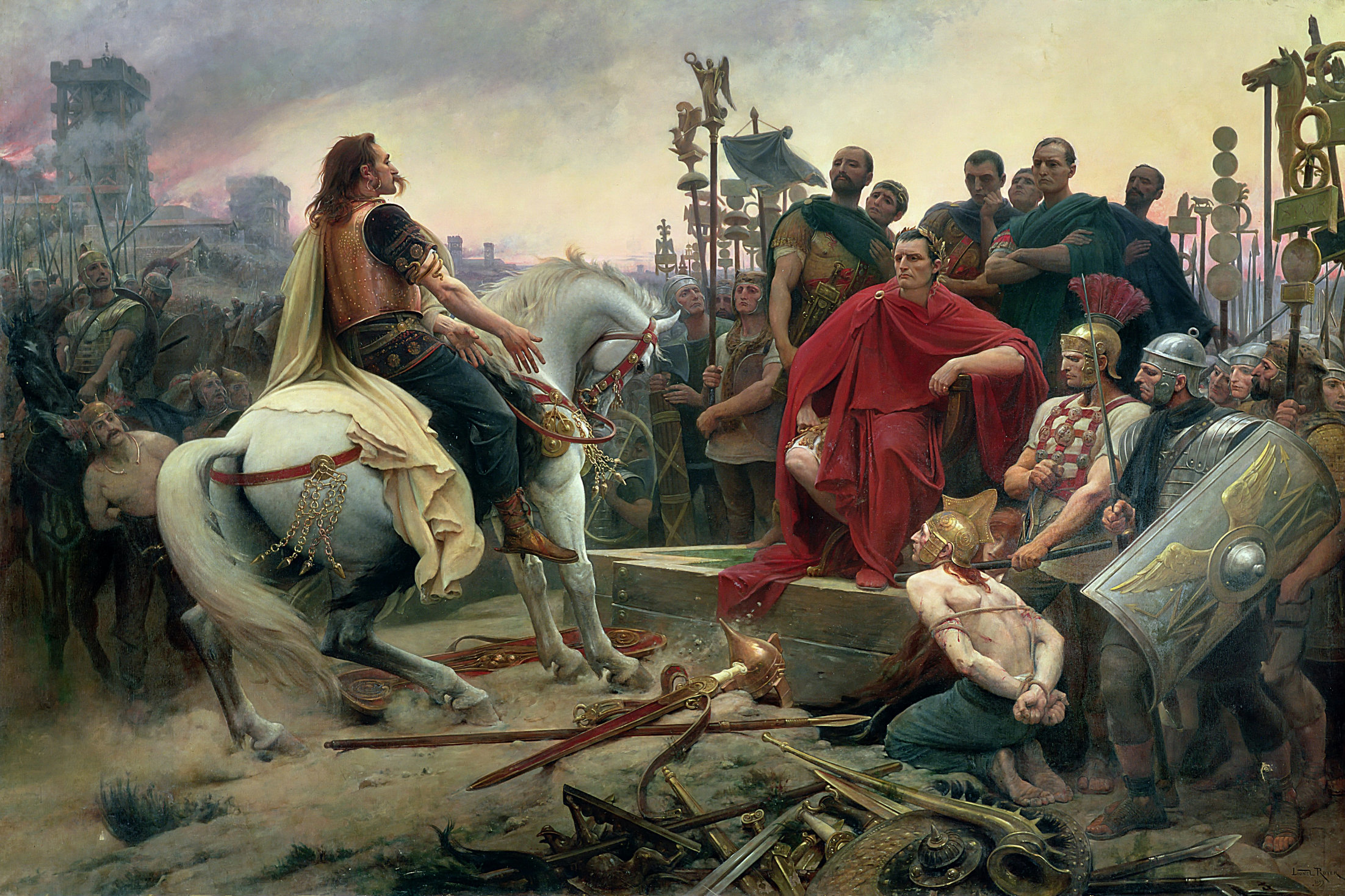
Deprived of all hope after the destruction of the relief army, Vercingetorix convenes a final council and chooses to surrender to spare his men. The scene of his surrender, popularized much later by tradition and by 19th-century painting, is in fact known mainly through the late account of Plutarch, several of whose precise details — the horse, the silence, the gesture of the weapons — are debated by historians today. After the capitulation, the Aeduan and Arvernian warriors are spared for political reasons and sent back to their peoples; the rest are distributed as slaves to the legionaries, one captive per soldier. Vercingetorix himself is taken prisoner and sent to Rome, where he will wait several years for the fate Caesar has in store for him.
🔍 Zoom – Vercingetorix’s Surrender: Myth and Reality
🧠 Key points
- On 23 January 52 BC, the massacre at Genabum triggers the insurrection; Vercingetorix, a young Arvernian noble driven out then recalled by his own people, establishes himself as supreme commander of the Gaulish coalition.
- Caesar breaks the first pockets of resistance (Vellaunodunum, Cenabum, Noviodunum), pushing Vercingetorix to adopt the scorched-earth strategy — except for Avaricum, whose siege ends in a massacre.
- Caesar’s failure before Gergovia (more than 700 legionaries and 46 centurions lost) and Litaviccus’s revolt precipitate the Aedui’s rallying to the Gaulish coalition.
- The assembly at Bibracte confirms Vercingetorix as supreme commander, but his cavalry is then decimated at the battle of the Vingeanne, forcing him to retreat to Alesia.
- The siege of Alesia, one of the greatest military works of antiquity, ends with the destruction of the Gaulish relief army (partly commanded by Commius) and the surrender of Vercingetorix, between late September and early October 52 BC.
- This defeat marks the end of independent Gaul and opens several centuries of Roman domination over the territory.