

Henry I: Preserving the Capetian Balance (1031-1060)
1031 à 1060
In 1031, at the death of Robert II, the Capetian dynasty is firmly established, but royal power remains limited. The new king, Henry I, rules in a kingdom where the great territorial princes (Normandy, Anjou, Blois, Aquitaine, Flanders) possess power comparable to, and sometimes greater than, that of the king outside his own domain.
 France in 1030 - Source: Wikimedia Commons
The priority of the reign is not expansion, but the preservation of balances: ensuring dynastic continuity, safeguarding the royal domain, and preventing the emergence of one dominant power.
🔍 Zoom - 1031-1034: A Disputed Succession and Capetian Compromise
⚔️ 1031-1034 - A Contested Crown
At the death of Robert II the Pious in 1031, his son Henry I accedes to the throne under difficult conditions. The succession, though prepared by an anticipatory coronation, is immediately challenged by his younger brother Robert, supported by part of the aristocracy and by their mother, Queen Constance of Arles, who seeks to favor him.
This challenge reveals the limits of the still recent Capetian dynastic principle: hereditary transmission is accepted, but remains fragile in the face of princely ambitions and family rivalries.
At the same time, the kingdom is going through a period of deep crisis. Between 1032 and 1033, a major famine strikes the Loire valley and Burgundy after severe weather (hail and storms) destroys the harvests. Chroniclers, especially Raoul Glaber, describe extreme distress marked by population movements and episodes of cannibalism. This crisis heightens political tensions by weakening the entire social fabric.
⚔️ 1031-1033: Civil War
In this context, a genuine civil war breaks out between Henry I and the supporters of his brother.
Robert gathers around him several lords hostile to royal power, forming a feudal coalition. Faced with this threat, Henry I must seek support beyond his own domain. In particular, he relies on the duke of Normandy, Robert the Magnificent, whose military backing proves decisive.
The king does not limit himself to a defensive posture: he personally leads military operations to keep control of the royal domain. This phase of the reign shows a sovereign compelled to fight to preserve his legitimacy, in a context where royal authority is still far from self-evident.
At the same time, religious initiatives such as the peace councils (Bourges, Limoges in 1033) attempt to frame violence, though without truly containing aristocratic conflict.
🌍 1032-1034: Political Recomposition
The internal crisis takes place within a broader context of European recomposition.
In 1032, the death of King Rudolph III of Burgundy, without an heir, opens a struggle for control of his kingdom. Emperor Conrad II the Salian claims this inheritance and succeeds in integrating it into the Holy Roman Empire in 1034, after defeating local opposition.
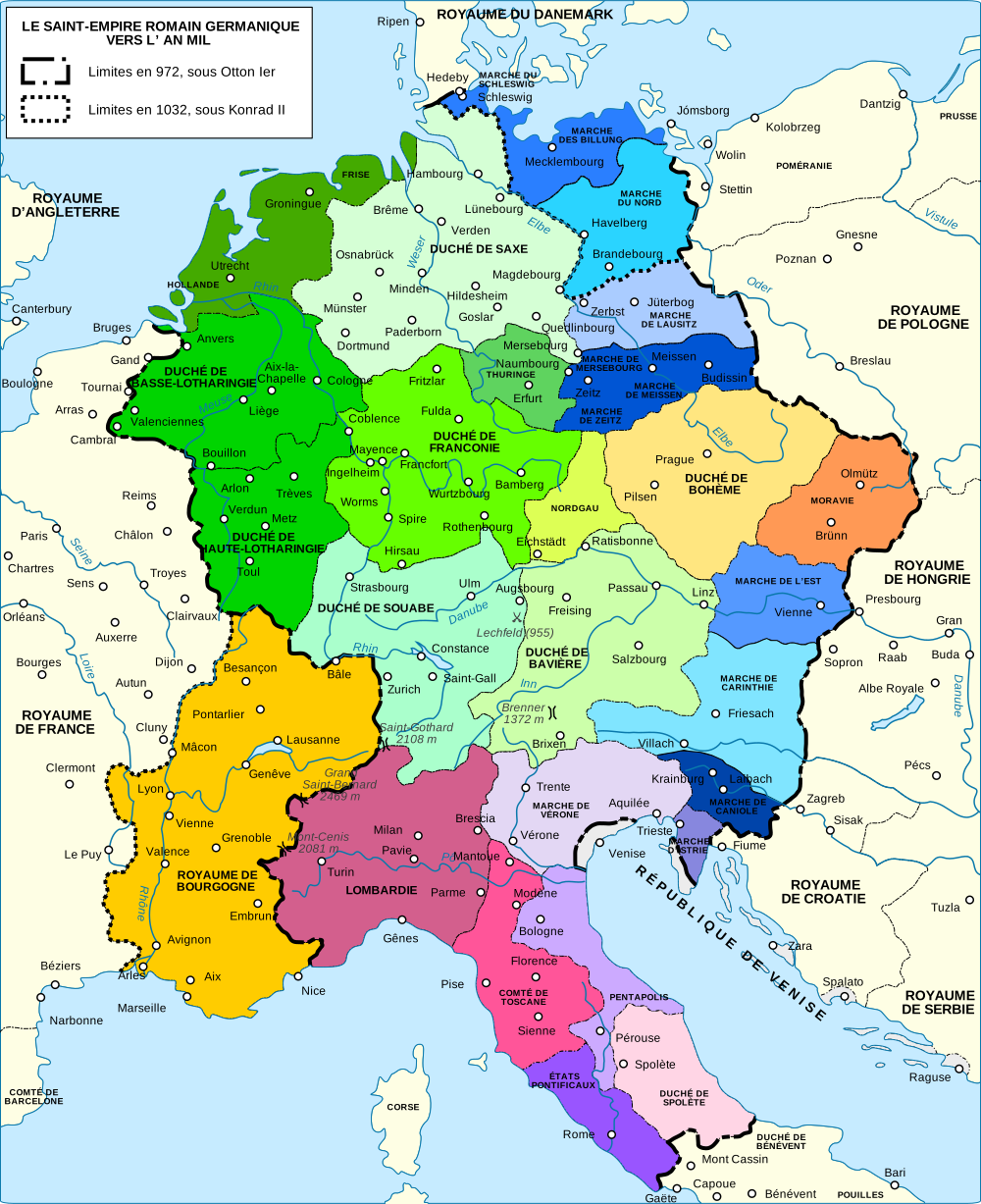 Map of the Holy Roman Empire - Source: Wikimedia Commons
In this context, Count Odo II of Blois, one of the most powerful princes in the kingdom, tries to take advantage of the situation to extend his influence toward Burgundy. He comes into conflict with the emperor and stirs unrest in the region.
Faced with this threat, Henry I allies with Conrad II at a meeting in 1033 (Deville-sur-Meuse). This temporary alliance illustrates the need for the king of France to operate within diplomatic balances extending far beyond his own kingdom.
🤝 1034: Compromise and Stabilization
After several years of conflict, a compromise is reached in 1034.
Henry I recognizes his brother Robert as duke of Burgundy, bringing the civil war to an end. This choice stabilizes the immediate situation, but it has lasting consequences:
- it strengthens the autonomy of the principalities
- it establishes an independent Capetian prince on the doorstep of the royal domain
- it confirms that the Capetian monarchy still rests as much on negotiation as on authority
This compromise illustrates the nature of royal power at the beginning of the 11th century: a power that is fragile but resilient, capable of surviving crises through adaptation rather than direct domination.
🕊️ 1031-1039 - Crises, the Peace of God, and Society
The beginning of Henry I’s reign is marked by major social and religious tensions, in a context of economic fragility and changing power structures.
Faced with growing violence linked to seigneurial rivalries, the Church strengthens the movement of the Peace of God, born at the end of the 10th century and now widely diffused throughout the kingdom.
Several conciliar assemblies mark this period:
- 1033: council of Bourges, where Archbishop Aymon encourages the formation of peace militias tasked with enforcing ecclesiastical decisions
- 1033: council of Limoges, where the Truce of God is preached, aiming to ban fighting during certain periods (Sundays and religious festivals)
These initiatives reflect a desire to frame aristocratic violence by subjecting it to religious rules. They also mark an evolution: the Church no longer merely condemns, it seeks to organize peace concretely.
However, their effectiveness remains limited. In 1038, in the region of Bourges, a peace militia is annihilated at Chateauneuf-sur-Cher by the viscount of Deols. This episode illustrates the resistance of local lords, who refuse to see their power constrained by ecclesiastical norms.
At the same time, subsistence crises continue throughout the decade:
- 1035: famine and epidemic in Paris, worsening the difficulties already present from the start of the reign
- 1039: shortage and epidemic of “St. Anthony’s fire” (ergotism) in Neustria, hitting rural populations hard
These calamities, often interpreted by contemporaries as divine signs, strengthen the Church’s role in the moral supervision of society, but also reveal the limits of royal power in the face of economic crises.
Thus, the first years of Henry I’s reign unfold in a climate of general fragility, where social tensions, seigneurial violence, and economic hardship combine to make the exercise of power particularly delicate.
🌍 1035-1056 - Relations with the Empire
Henry I’s reign unfolds within a broader political space, where relations with the Holy Roman Empire play an important role, especially in frontier regions such as Burgundy, Lorraine, and the Saone valley.
After the death of Conrad II in 1039, his son Henry III succeeds him. His strong authority contrasts with the more fragmented situation of the Capetian kingdom. The emperor pursues an active policy of controlling the principalities and strengthening imperial power, notably by relying on bishops.
Henry I maintains regular relations with him, marked by several diplomatic meetings:
- 1043: first meeting at Ivois, which helps stabilize relations after the tensions linked to Burgundy
- 1048: second meeting, in a context of political recomposition in Lorraine and the imperial sphere
- 1056: third meeting, marking one of the last direct contacts between the two sovereigns
These meetings reflect a shared desire to preserve a political balance, without any relationship of vassalage. The king of France asserts his independence, while the emperor seeks to avoid instability on his western frontier.
At the same time, the Empire strengthens its influence in certain regions close to the kingdom:
- in 1041-1042, the archbishop of Besancon obtains comital power, illustrating the growing role of prince-bishops
- in 1047-1048, the emperor’s reorganization of Lorraine (with the rise of the House of Alsace) shows the imperial capacity to structure its borderlands durably
Thus, relations between Henry I and Henry III fit within a logic of coexistence and mutual surveillance, in which each sovereign seeks to preserve his interests without entering into direct confrontation.
After 1056, at Henry III’s death, relations between the two political spheres loosen. The context changes, balances shift, and the king of France’s concerns focus more and more on internal rivalries within the kingdom, particularly in the face of the rising power of Normandy.
🤝 1035-1047 - The Alliance with Normandy
In 1035, the death of Duke Robert the Magnificent marks a turning point for Normandy. Before leaving on pilgrimage to Jerusalem, he had had his son William, still a child, recognized as heir. At his death, the duchy enters a long period of instability.
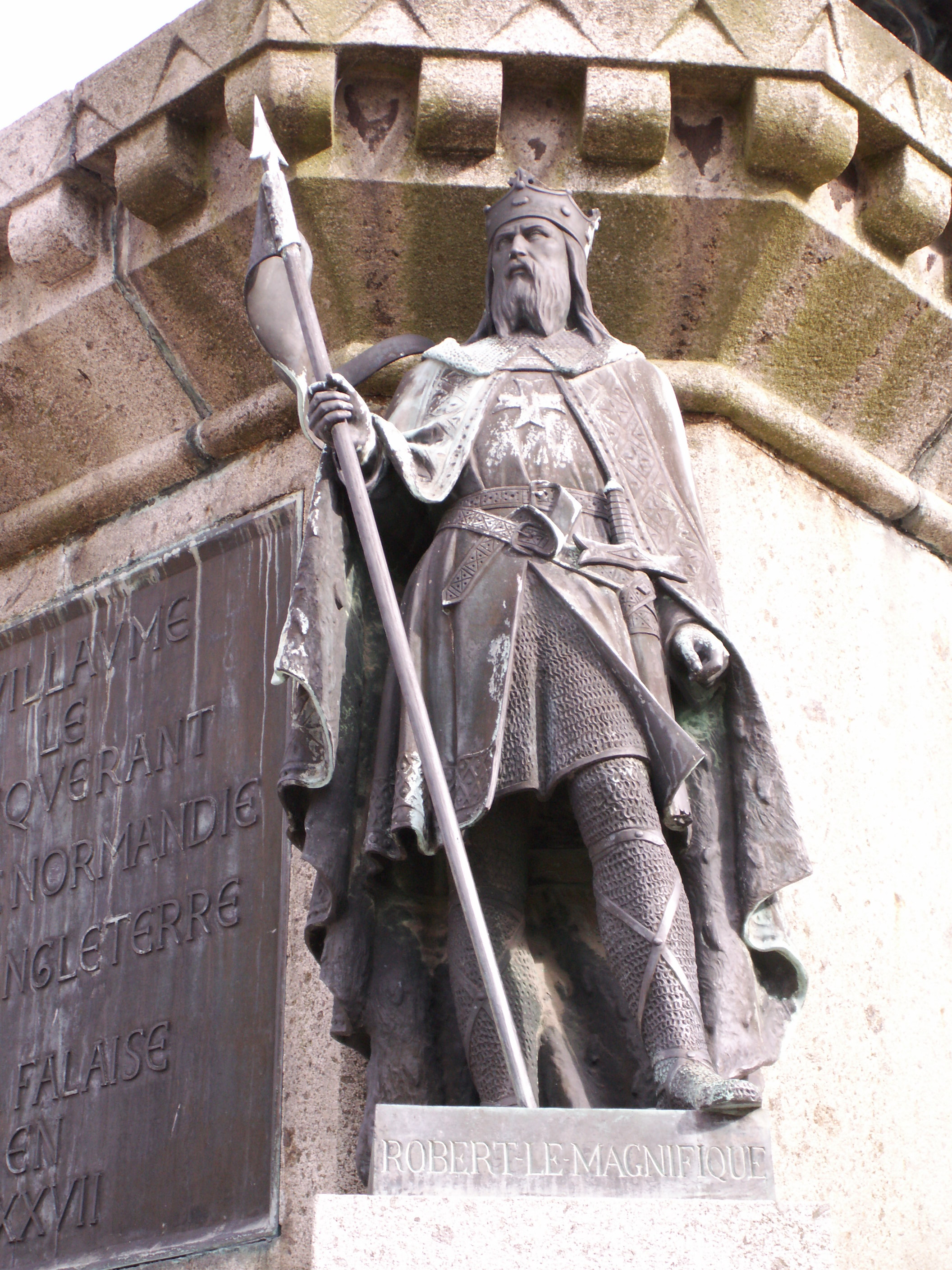 Robert the Magnificent - Source: Wikimedia Commons
During William’s minority (1035-1047), Normandy is shaken by violent rivalries among the barons. Internal struggles, assassinations, and shifting alliances weaken ducal power and threaten the unity of the duchy.
For Henry I, this situation represents a strategic risk. A Normandy left in lasting disorder could:
- become a source of instability on the borders of the royal domain
- fall under the influence of another great prince
- or favor the emergence of a hostile coalition
The king therefore chooses to support William. This policy fits a logic of balance: better a legitimate duke, even a fragile one, than a territory left to anarchy.
Royal support is visible on several occasions, but it becomes decisive in 1047. That year, a major noble revolt breaks out in the west of the duchy. The Norman barons attempt to overthrow the young duke.
 Battle of Val-es-Dunes - Source: Wowerata, CC0, via Wikimedia Commons
Henry I then intervenes directly alongside William. Together, they confront the rebels at the battle of Val-es-Dunes (10 August 1047).
The victory is decisive:
- it puts an end to the great noble rebellion
- it restores ducal authority in Normandy
- it marks the beginning of William’s personal rule
In the short term, this intervention strengthens regional stability and confirms the king’s role as an arbiter of feudal balances.
In the longer term, it has unexpected consequences: by helping William secure power, Henry I contributes to the emergence of an exceptionally powerful prince who will soon become one of his main adversaries.
🔍 Zoom - 1035-1047: Supporting William
🏰 1037-1054 - Princely Rivalries
Henry I’s reign is marked by constant rivalries among the kingdom’s great principalities, whose clashes regularly redraw regional balances.
In 1037, the death of Odo II of Blois, defeated and killed in the county of Bar, is an important turning point. Head of one of the kingdom’s most powerful principalities, he represented a direct threat to the Capetian balance. His disappearance temporarily weakens the House of Blois, but does not end its power: his son Theobald I succeeds him and maintains the family’s ambitions.
In the following years, rivalries concentrate mainly in the west of the kingdom, where the houses of Blois and Anjou oppose each other.
In 1044, a decisive clash takes place: Count Geoffrey Martel of Anjou defeats and captures Theobald of Blois at the battle of Nouy, near Tours. This victory brings a major shift:
- Touraine passes under Angevin control
- the regional balance is profoundly altered
- the power of the House of Blois is durably weakened
 The capture of Tours - Jean Fouquet
In this context, Henry I intervenes alongside Geoffrey Martel, taking part in the recapture of Tours, then disputed between the two powers. This intervention illustrates the way the king exercises his authority: not through direct domination, but through a play of alliances, supporting one prince against another in order to prevent the rise of a dominant power.
However, this policy carries risks. By helping weaken Blois, the king indirectly encourages the rise of Anjou, which in turn becomes a major power in the kingdom.
At the same time, Henry I seeks to strengthen his own domain. In 1054, at the death of Count Rainard, he annexes the county of Sens to the royal domain. Located very close to the Capetian heartland, this acquisition is an important strategic gain:
- it consolidates royal control over a major axis between Paris and Burgundy
- it strengthens the territorial continuity of the domain
- it illustrates a strategy of gradual expansion by opportunity rather than by direct conquest
Thus, between 1037 and 1054, the king appears above all as an arbiter of princely rivalries, intervening to preserve the kingdom’s balance while pragmatically trying to strengthen the territorial bases of his own power.
⚔️ 1048-1057 - Rivalry with Normandy
After 1047, the situation changes profoundly. The young duke William of Normandy, once supported by the king, now establishes himself as a powerful and autonomous prince. The stabilization of the duchy marks a turning point: the former ally gradually becomes a rival.
This rise in power worries Henry I, whose means remain limited in the face of a duchy now better organized and militarily effective.
🌍 A European Dimension
William’s power quickly extends beyond the framework of the kingdom.
- in 1051, according to certain Norman sources, he is considered a potential successor to King Edward the Confessor of England, who has no direct heir
- in 1053, his marriage to Matilda of Flanders further strengthens his position by allying him with one of the most influential principalities in the north of the kingdom
These developments give Normandy an international dimension, profoundly changing the political balance. William is no longer only a powerful duke: he becomes a major actor in western politics.
⚔️ Conflicts with the King
Faced with this rise in power, Henry I changes strategy. He now seeks to contain his former ally, especially by relying on princely coalitions.
-
1052-1054: formation of a coalition with Geoffrey Martel of Anjou
-
1054: battle of Mortemer
The royal army, campaigning in Normandy, is surprised and defeated by William’s forces. This defeat reveals the duke’s tactical efficiency and the limits of coordination among the royal forces. “Duke William of Normandy, called the Bastard, defeated the French at the battle of Mortemer and sent a messenger to the defeated King Henry of France.” Illustration from the Chronicles of Saint-Denis, 14th century.
 -
1057: battle of the ford of Varaville
A new expedition against Normandy. William exploits the terrain and the tides to trap the royal army, inflicting a second defeat on Henry I.
These two reverses are significant:
- they show the king’s inability to impose his military authority on a great vassal
- they establish Norman power as one of the strongest in the West
- they force Henry I to adopt a more cautious policy in the final years of his reign
Thus, between 1048 and 1057, the relationship between the king and the duke of Normandy shifts from a logic of alliance to a genuine political and military rivalry, foreshadowing the lasting tensions between the Capetian monarchy and Anglo-Norman power.
🔍 Zoom - Mortemer and Varaville
⛪ Religious Reform
Henry I’s reign belongs to a context of religious renewal affecting the whole of Christian Europe in the 11th century. The Church seeks to assert its authority, frame society, and clarify doctrinal practices.
This dynamic takes shape through monastic reforms, theological debates, and initiatives designed to regulate violence.
🏛️ Intellectual and Monastic Renewal
In 1045, the Italian monk Lanfranc becomes prior of the abbey of Bec, in Normandy. There he develops a school that quickly becomes one of the major intellectual centers of the West.
This institution plays an important role in spreading theological and legal learning and helps train a new ecclesiastical elite. It illustrates the vitality of the Norman monastic world and the growth of reform networks.
📜 Doctrinal Debates
In 1050, a major controversy breaks out around the theologian Berengar of Tours, who questions the traditional interpretation of the Eucharist.
His positions, asserting a symbolic presence of Christ in the consecrated bread and wine, are condemned at several councils (Rome, Tours, Vercelli, Paris). This affair shows the Church’s growing determination to:
- define orthodoxy more precisely
- regulate theological teaching
- fight interpretations judged deviant
It also reveals the intensity of intellectual debate at this time.
🕊️ Framing Violence: Peace and Truce of God
At the same time, the Church continues its effort to frame aristocratic violence.
In 1054, the council of Narbonne marks an important stage: it strengthens the rules of the Truce of God and forbids certain forms of private warfare. The council notably declares that the man “who kills a Christian sheds the blood of Christ,” underscoring the religious gravity of violence.
These measures extend the initiatives of the previous century and help structure a moral and social framework:
- distinction between legitimate and illegitimate violence
- protection of non-combatant populations
- progressive sacralization of certain rules of war
Thus, religious reform under Henry I does not concern the Church alone: it contributes to a broader transformation of society, in which religion becomes a structuring framework for politics and social life.
👑 1051-1060 - Dynasty and Succession
From the early 1050s onward, Henry I pays particular attention to a central issue of Capetian power: ensuring dynastic continuity.
On 19 May 1051, he marries Anne of Kiev at Reims, daughter of Prince Yaroslav the Wise, ruler of Kievan Rus’. This marriage, preceded by several embassies (1048-1049), constitutes a prestigious and relatively rare alliance for the Capetian monarchy:
 Henry marries Anne of Kiev: Levan Ramishvili from Tbilisi, Georgia, Public domain, via Wikimedia Commons
- it opens the kingdom to eastern Europe
- it strengthens the symbolic standing of the king of the Franks
- it shows the search for alliances beyond the usual circles of western principalities
In 1052, the birth of their son Philip brings the expected dynastic security. The choice of this Greek name probably reflects the cultural influence of the court of Kiev and underscores the monarchy’s international openness.
Faithful to the practice established since Hugh Capet, Henry I anticipates the succession. On 23 May 1058, the young Philip is crowned king at Reims, when he is only seven years old.
This anticipatory coronation serves several objectives:
- avoiding any challenge at the king’s death
- imposing dynastic continuity as a political norm
- strengthening the link between kingship and religious legitimacy
In the last years of his reign, Henry adopts a more cautious policy. Weakened by his failures against Normandy, he now gives priority to internal stability and the transmission of power rather than military enterprises.
Thus, on the eve of his death in 1060, the essentials are secured:
- an heir is designated and recognized
- the succession is prepared
- the Capetian dynasty is inscribed in lasting continuity
🌍 A Fragmented Kingdom
In the middle of the 11th century, the kingdom of France remains deeply fragmented, heir to feudal structures still taking shape.
Royal power rests on a fragile balance, characterized by:
- a limited royal domain, centered around the Ile-de-France
- powerful territorial princes (Normandy, Anjou, Flanders, Aquitaine, Blois), often autonomous in their decisions
- a royal authority based less on domination than on negotiation, alliances, and arbitration
In this context, the king does not rule a unified territory, but a collection of principalities whose ambitions he must constantly contain.
In 1060, Henry I dies after nearly thirty years of reign. Thanks to the practice of anticipatory coronation, the succession takes place without rupture: his son Philip I, already crowned, succeeds him.
The young king is placed under the regency of his mother, Anne of Kiev, assisted by Count Baldwin V of Flanders, a major figure of the aristocracy of the kingdom’s north. This regency illustrates the central role of princely alliances in maintaining political stability.
🔍 Zoom - 1059-1060: Succession
🧠 Key Takeaways
- 1031: a fragile beginning to the reign
- 1034: compromise with Burgundy
- 1047: stabilization of Normandy
- 1054-1057: defeats against William
- 1051: marriage to Anne of Kiev
- 1058: Philip’s coronation
- 1060: succession secured
- 1066: rise of Anglo-Norman power
Image Credits
-
Henry I of France: Merry-Joseph Blondel, Public domain, via Wikimedia Commons
-
Map of France in 1030: Zigeuner, CC BY-SA 3.0 https://creativecommons.org/licenses/by-sa/3.0, via Wikimedia Commons
-
Robert asks the duke of Normandy for help: AnonymousUnknown author, Public domain, via Wikimedia Commons
-
Map of the Holy Roman Empire, 972-1032: User:Semhur, CC BY-SA 3.0 https://creativecommons.org/licenses/by-sa/3.0, via Wikimedia Commons
-
The capture of Tours: Jean Fouquet, Public domain, via Wikimedia Commons
-
Robert the Magnificent: Michael Shea, imars, CC BY-SA 2.5 https://creativecommons.org/licenses/by-sa/2.5, via Wikimedia Commons
-
Battle of Val-es-Dunes: Wowerata, CC0, via Wikimedia Commons
-
Henry marries Anne of Kiev: Levan Ramishvili from Tbilisi, Georgia, Public domain, via Wikimedia Commons
-
William the Bastard defeated the French at the battle of Mortemer: Chronicles of Saint-Denis, Public domain, via Wikimedia Commons