

Louis VII: Crusade, Lost Aquitaine, and the Plantagenet Challenge (1137–1180)
1137 à 1180
In 1137, Louis VII succeeded Louis VI. He inherited a Capetian domain better structured than at the beginning of the twelfth century, yet a kingdom where great princes (Champagne, Blois, Normandy) retained considerable autonomy.
The beginning of his reign was marked by a major event: his marriage to Eleanor of Aquitaine, heiress to a vast territorial ensemble in the southwest of the kingdom. This union temporarily placed the king at the head of one of the largest princely dominions in the West.
However, this initial advantage gradually became a fragility, and the reign unfolded around three major phases:
- 1137–1146: royal affirmation and the apex of influence through Aquitaine;
- 1147–1152: crusade, failure, and marital crisis;
- 1152–1180: diplomatic struggle against the Plantagenet Empire.
🔍 Zoom – 1152: Marriage annulment and the “Plantagenet shock”
I. ⚖️ 1138–1146 — Arbitrating the Kingdom and Governing Through the Church
The beginning of Louis VII’s reign was marked by strong religious influence and an exercise of power frequently mediated by the Church.
Between 1138 and 1140, the king faced his first tensions with great princes, particularly in Champagne and Blois, while consolidating his authority in the Île-de-France. He established himself as an arbiter of feudal conflicts, a role that progressively reinforced the centrality of the monarchy.
Meanwhile, the international context remained unstable. In England, rivalry between Stephen of Blois and Empress Matilda provoked prolonged civil war. The confrontations of 1141 (Battle of Lincoln, Winchester crisis) illustrated this instability, which temporarily weakened Anglo-Norman power, the Capetians’ principal adversary.
On the religious and intellectual plane, the reign was marked by doctrinal tensions. In 1140, the Council of Sens, under the influence of Bernard of Clairvaux, condemned the theses of Peter Abelard, illustrating the Church’s determination to control intellectual development.
In parallel, the monarchy participated in a religious and artistic renewal. In 1140, the transformation of the basilica of Saint-Denis, under the impetus of Suger, marked a major architectural turning point with the first elements of the Gothic style. This enterprise reinforced the symbolic prestige of the monarchy.
In 1141, Louis VII intervened in the conflict surrounding the archbishopric of Bourges, indirectly opposing Pope Innocent II, revealing tensions between royal power and papal authority.
The breaking point came in 1142, during war against Thibaut IV of Champagne. The fire that consumed the church of Vitry-en-Perthois, where many inhabitants perished, constituted a major moral shock. The event profoundly affected the king’s image and left a lasting mark on his reign.
🔍 Zoom – 1142: Vitry, moral scandal and the Champagne war
 Fire of the church of Vitry: anonym 1396, Public domain, via Wikimedia Commons
From 1143 onward, under papal pressure, the king gradually reconciled with the Church and evacuated Champagne. This evolution prepared a change in the reign’s direction, marked by a desire for penance and religious commitment.
 Interior of the Basilica of Saint-Denis: Emile Pierre Joseph De Cauwer, Public domain, via Wikimedia Commons
In 1144, the consecration of the renovated basilica of Saint-Denis confirmed the central role of the monarchy in the religious and artistic renewal of the kingdom.
🔍 Zoom – 1144: Saint-Denis, Suger and the Capetian monarchy
II. ✝️ 1145–1149 — The Second Crusade: Religious Ambition and Political Failure
 Routes of the Second Crusade: Guilhem06~commonswikiDerivative work: Arrow303, CC BY-SA 3.0, via Wikimedia Commons
The turning point of the reign came in the middle of the 1140s, in a context of religious and moral tension.
In 1145, under the influence of Bernard of Clairvaux, the king took up the struggle against heresy in the South (also called the Midi). On December 25, at the assembly of Bourges, Louis VII officially announced his intention to depart on crusade. This decision was part of both a broader European religious dynamic and a personal gesture of penance following the events of Vitry.
In 1146, Pope Eugene III renewed the crusade appeal. On March 31, at Vézelay, Bernard of Clairvaux preached before the king, the court, and an enormous crowd. Louis VII took the cross publicly and decided to bring with him his wife, Eleanor of Aquitaine.
 Saint Bernard preaching the 2nd Crusade at Vézelay: Émile Signol, Public domain, via Wikimedia Commons
The mobilization rapidly exceeded the French framework. Bernard traveled through the kingdom and then the Empire, notably obtaining the commitment of Emperor Conrad III by year’s end.
⚔️ 1147 — Departure and the March to the East
In June 1147, Louis VII took the road with a large army, accompanied by numerous pilgrims. The expedition’s financing rested partly on contributions exacted from vassals.
The king traversed Central Europe:
- crossing the Rhine at Worms
- traversing Hungary
- arrival at Constantinople in October
 Arrival of the Crusaders at Constantinople: Jean Fouquet, Public domain, via Wikimedia Commons
There he met the Byzantine Emperor Manuel I Komnenos, in a climate of mutual mistrust.
Meanwhile, other crusading expeditions were underway:
- in Northern Europe (crusade against the Wends)
- in the Iberian Peninsula (taking of Almería and Lisbon)
These operations showed that the crusade assumed a broader dimension than the East alone.
⚔️ 1148 — Military Failure and the Crisis of the Royal Couple
The Anatolian expedition proved disastrous.
In early 1148, the French army suffered several reversals against Turkish forces:
- ambushes in the Maeander valley
- heavy losses during the crossing of the Anatolian mountains (Mount Cadmos)
Weakened, the army reached the coast with difficulty and then Antioch.
 Raymond of Poitiers receives Louis VII in Antioch: Jean Colombe and Sebastien Marmerot., Public domain, via Wikimedia Commons
There occurred a major political and personal crisis. Eleanor drew close to her uncle Raymond of Poitiers, who favored a campaign against Aleppo. Louis VII refused this strategy and imposed the continuation of the pilgrimage to Jerusalem.
The conflict between the spouses worsened: Eleanor invoked consanguinity to request the annulment of the marriage.
In June 1148, the crusaders convened at the Council of Acre and decided to attack Damascus.
 Siege of Damascus: Jean Colombe, in Passages d’outremer by Sébastien Mamerot, Public domain, via Wikimedia Commons
The expedition rapidly turned to disaster:
- poorly coordinated siege
- divisions between crusaders and local barons
- arrival of Muslim reinforcements
The siege was abandoned after a few days (July 1148).
This failure marked a major turning point: the crusade resulted in complete military and political failure.
⚔️ 1149 — Return and Consequences
In 1149, Louis VII left the Holy Land.
After celebrating Easter in Jerusalem, he embarked for Europe and landed in Southern Italy, where he met King Roger II of Sicily. Upon his return, he passed through Rome where the pope attempted to reconcile the royal couple.
However, the consequences were profound:
- the king’s prestige was weakened
- relations with Byzantium deteriorated severely
- tensions with Eleanor of Aquitaine became irreversible
The crusade’s failure and the marital crisis opened a new phase of the reign, marked by a major recomposition of political balances in the West.
🔍 Zoom – 1147–1149: Second Crusade, Anatolia and Damascus
III. 🌍 1150–1160 — Dynastic Rupture and the Birth of the Plantagenet Empire
Following the crusade’s failure, Louis VII’s reign entered a decisive phase marked by a profound recomposition of political balances in the West.
⚖️ 1150–1152: Tensions with the Plantagenets and Rupture with Eleanor
From 1150 onward, Louis VII had to confront the rising power of young Henry Plantagenet, heir to the Angevin domains. After an unsuccessful attempt before Arques, the king finally accepted his homage for Normandy in exchange for territorial concessions in the Vexin.
The situation changed radically in 1152.
On March 21, 1152, the marriage between Louis VII and Eleanor of Aquitaine was annulled at the Council of Beaugency, officially on grounds of consanguinity. This separation ended the union between the Capetian monarchy and one of the kingdom’s vast territorial ensembles.
A few weeks later, on May 18, 1152, Eleanor married Henry Plantagenet, Duke of Normandy and Count of Anjou.
Through this marriage, Aquitaine shifted to the Angevin sphere.
This moment constituted a major turning point: the King of France lost an essential region, while there emerged a territorial power without precedent.
👑 1153–1154: The Birth of a Rival Power
In 1153, the Treaty of Wallingford ended English civil war. King Stephen of Blois recognized Henry Plantagenet as his successor.
In 1154, Henry became King of England as Henry II.
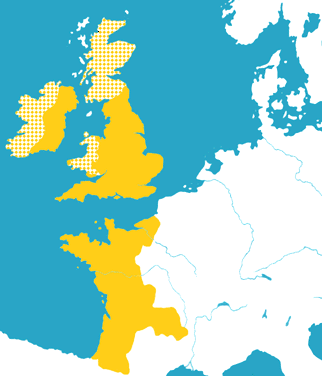 Plantagenet Empire under Henry II: Cartedaos (talk) 01:46, 14 September 2008 (UTC), CC BY-SA 3.0 https://creativecommons.org/licenses/by-sa/3.0, via Wikimedia Commons
He then controlled an exceptional territorial ensemble:
- England
- Normandy
- Anjou
- Maine
- Touraine
- Aquitaine (through Eleanor)
This ensemble, which historiography calls the “Plantagenet Empire,” extended from the Pyrenees to Scotland.
Faced with this power, Louis VII found himself in a paradoxical position: he was the feudal suzerain of Henry II for his continental lands, yet in practice, his vassal was more powerful than he was.
⚖️ 1154–1156: Capetian Response and the Kingdom’s Framework
Louis VII reacted through a policy of internal consolidation and diplomatic balance.
 Map of France in 1154: © Sémhur / Wikimedia Commons
In 1154, he married Constance of Castile, seeking to strengthen his alliances. He also undertook a pilgrimage to Santiago de Compostela, a gesture both religious and political.
In 1155, the king affirmed his authority through measures of peace:
- Council of Soissons
- proclamation of a general peace of the kingdom
- confirmation of the customs of Lorris, model of an urban charter
These actions aimed to stabilize the royal domain against Plantagenet power.
In 1156, Henry II rendered homage to Louis VII for his French possessions. This gesture formally confirmed the feudal hierarchy, but in no way reduced the power gap between the two sovereigns.
⚔️ 1158–1160: Tensions and Unstable Equilibrium
Relations between Louis VII and Henry II oscillated between confrontation and compromise.
In 1158, the Treaty of Gisors organized a dynastic alliance: the daughter of Louis VII, Margaret, was promised to Henry the Young, son of Henry II. The Vexin was to constitute her dowry.
However, rivalry remained.
In 1159, Henry II launched a campaign against Toulouse, but encountered the intervention of Louis VII, who supported the local count. Refusing to attack his suzerain directly, Henry withdrew.
This episode showed the limits of Plantagenet power: the feudal framework continued to structure relations of force.
In 1160, Louis VII reinforced his alliances by marrying Adèle of Champagne, following the death of Constance of Castile. This union brought the monarchy closer to the powerful counts of Champagne.
🔍 Zoom – 1152–1154: Eleanor, Henry II and the Birth of the Plantagenet Empire
IV. ⛪ 1162–1170 — Becket, the Church, and Rivalry with the Plantagenets
From the 1160s onward, the rivalry between Louis VII and Henry II Plantagenet shifted partly to religious terrain.
⛪ 1162–1164: The Becket Crisis
In 1162, Thomas Becket was appointed Archbishop of Canterbury. A former chancellor of Henry II, he rapidly broke with the king in defending the independence of the Church.
In 1164, Henry II promulgated the Constitutions of Clarendon, which aimed to submit the clergy to royal authority. Becket opposed them firmly and had to flee England.
He found refuge in France, where Louis VII granted him protection. The King of France thus indirectly supported religious opposition to his Plantagenet rival.
At the same time, Pope Alexander III, himself in conflict with the Empire, established himself in France (Sens, 1163–1165), reinforcing the kingdom’s role as a political and religious center.
🏗️ 1163–1167: Religious Affirmation and the Kingdom’s Framework
These years were also marked by a strengthening of the kingdom’s religious role.
In 1163, construction began on Notre-Dame de Paris, under the impetus of Bishop Maurice de Sully, a symbol of the capital’s growth.
 Notre Dame de Paris under construction: L’Archevêché / A. Estampe Musée Carnavalet, Histoire de Paris
Several councils testified to the struggle against heresies:
- Council of Tours (1163) against Catharism
- development of repressive measures against dissenting movements
Louis VII also intervened as an arbiter in local conflicts:
- in 1166, intervention in Burgundy at the request of the abbey of Cluny
- maintenance of order against seigneurial abuses
The king appeared as a protector of the Church and guarantor of Christian order.
⚔️ 1166–1169: Plantagenet Expansion and Feudal Equilibrium
Meanwhile, Henry II considerably strengthened his power:
- taking control of Brittany (through his son Geoffrey’s marriage)
- interventions in Ireland (from 1169)
- consolidation of his continental possessions
In 1169, the Peace of Montmirail temporarily organized relations between the two sovereigns. Henry II distributed his lands among his sons:
- Henry the Young (Normandy, Anjou)
- Richard (Aquitaine)
Richard was engaged to Adèle of France, daughter of Louis VII.
This dynastic policy aimed to stabilize the Plantagenet Empire while maintaining a feudal link with the Capetian monarchy.
⚔️ 1170: Becket’s Assassination and Political Shock
In 1170, the crisis reached its peak.
After an attempt at reconciliation between Henry II and Becket (conference of Fréteval), tensions resumed. The coronation of Henry II’s son without Becket’s agreement provoked a new rupture.
On December 29, 1170, Thomas Becket was assassinated in Canterbury Cathedral by knights close to the King of England.
 Thomas Becket is assassinated by order of the King of England: Jean-Baptiste Marie Pierre, Public domain, via Wikimedia Commons
The event provoked an immense shock throughout Christendom.
Henry II was gravely discredited, while Louis VII appeared as the defender of the Church. This affair reinforced the moral position of the King of France against his powerful rival.
🔍 Zoom – 1164–1170: Thomas Becket, exile in France and Anglo-Norman crisis
V. ⚔️ 1171–1180 — Revolts, Equilibrium with the Plantagenets, and Dynastic Transition
In the 1170s, Louis VII’s reign entered its final phase, marked by an indirect but decisive struggle with Plantagenet power.
⚖️ 1171–1172: The Kingdom’s Framework and Arbitral Role
In the early 1170s, Louis VII pursued an already well-established policy: to strengthen royal authority not through territorial conquest, but through the framework of political and social forces of the kingdom.
In 1171, a meeting took place between the King of France and Emperor Frederick I Barbarossa, near Toul. The two sovereigns agreed on the necessity of fighting bands of mercenaries — notably the Brabançons (or “cotereaux”) — who ravaged the countryside and escaped all seigneurial control.
At the same time, Louis VII continued to exercise his role as an arbiter in local conflicts. At the appeal of the abbot of Cluny, he intervened in Burgundy against the count of Mâcon, accused of exactions against ecclesiastical property. The king imposed peace and recalled the superior authority of the crown in disputes between princes and religious institutions. This type of intervention illustrated the king’s growing function as a guarantor of justice and protector of the Church, beyond his direct domain.
In parallel, Louis VII reinforced the economic regulation of the kingdom. He confirmed the privileges of the hanse of Parisian water merchants, which held the monopoly of commerce between the bridges of Paris and that of Mantes.
This corporation, equipped with representatives (provost and échevins), constituted a structured economic actor, capable of regulating exchanges and defending its interests. In recognizing and protecting its privileges, the king favored the stability of commercial circuits and contributed to the capital’s growth.
The king no longer limited himself to a military or feudal role, but affirmed himself as an organizer of the political, economic and social order of the kingdom.
This capacity for arbitration and regulation constituted one of the foundations of Capetian authority at the end of the twelfth century.
⚔️ 1173–1174: The Great Revolt Against Henry II
In 1173, a major crisis erupted within the Plantagenet Empire, revealing the deep tensions crossing this exceptional political construction. The King of England Henry II had to face a revolt led by his own sons — Henry the Young, Richard (future Lion-Heart) and Geoffrey — supported by their mother Eleanor of Aquitaine, in rupture with her husband.
This dynastic conflict rapidly transformed into a European war. The rebel princes sought external support, and Louis VII seized the opportunity to weaken his powerful rival. As feudal suzerain of part of the Plantagenet lands, he received Henry the Young at his court, legitimized his rebellion, and committed himself to his side.
The revolt then expanded on a large scale:
- in Normandy and England, where several barons rose against Henry II
- in Flanders and Boulogne, whose counts actively supported the insurgents
- in Scotland, where King William the Lion invaded northern England
- in western France, notably in Aquitaine, where the Plantagenet king’s authority was contested
In this context, Louis VII intervened directly in the field. He conducted campaigns in Normandy and besieged the strategic stronghold of Verneuil in 1173, attempting to deliver a decisive blow to the Anglo-Norman system. However, despite some initial successes, coordination between the various allies remained fragile.
The situation rapidly shifted in Henry II’s favor:
- in August 1173, Louis VII was defeated before Verneuil, after having burnt the town
- the Flemish and their allies were gradually pushed back
- in 1174, Henry II regained the initiative on all fronts
- the King of Scotland William the Lion was captured at Alnwick, depriving the rebels of major support
- Eleanor of Aquitaine herself was arrested while attempting to rejoin her sons
 William the Lion captured: Creator:Edward Frank Gillett, Public domain, via Wikimedia Commons
Faced with this series of reversals, the coalition disintegrated. The conflict ended with the Treaty of Montlouis (1174), which marked the formal reconciliation between Henry II and his sons, as well as with the King of France.
Despite the exceptional scale of this revolt, Henry II emerged strengthened. He reaffirmed his authority over all his possessions and consolidated the Plantagenet Empire’s cohesion.
For Louis VII, the failure was significant but not decisive: he had not succeeded in breaking Anglo-Norman power, but he had demonstrated his capacity to intervene in great European conflicts and to exploit the divisions of his adversaries.
⚖️ 1174–1179: Political Stabilization and Religious Framework of the Kingdom
The Treaty of Montlouis (1174) reestablished a form of political coexistence: Louis VII retained his status as feudal suzerain, while Henry II reaffirmed his authority over all his possessions after having repressed his sons’ rebellion.
The King of France, now aged, reduced his direct military engagement and privileged a policy of kingdom framework, founded on arbitration, religious legitimacy, and the reinforcement of structures.
🛡️ A Fragile but Durable Political Equilibrium
In the years that followed, relations between Capetians and Plantagenets remained tense but stabilized. Louis VII continued to exploit internal rivalries within the Plantagenet Empire, without seeking direct confrontation.
Royal authority now expressed itself more through:
- confirmation of rights and privileges (cities, corporations, institutions)
- occasional intervention in regional conflicts
- maintenance of the feudal link with great princes
This mode of governance, less spectacular than military campaigns, nevertheless contributed to durable structuring of the Capetian political space.
⛪ Reinforced Religious Framework
In parallel, the period was marked by a deepening of religious reform at the scale of Western Christendom.
The culmination was the Third Lateran Council (1179), convoked by Pope Alexander III, in which many representatives of the kingdom participated.
This council adopted a series of major measures:
- reinforcement of ecclesiastical discipline
- regulation of episcopal elections
- condemnation of clergy abuses (simony, accumulation of offices)
- obligation to ensure teaching for clergy and poor schoolboys
It also aimed to restore moral and social order:
- condemnation of heresies, particularly Cathar movements expanding in the Midi
- condemnation of mercenaries (routiers), accused of destabilizing the countryside
- regulation of tolls and abusive seigneurial practices
These decisions inscribed themselves in the continuity of the Gregorian reform and participated in a broader will to moralize Christian society.
👑 1179–1180: Transmission of Power and Capetian Continuity
At the end of his reign, Louis VII devoted the essential part of his action to preparing the succession and ensuring dynastic stability. Physically weakened — sources notably mention progressive paralysis — the king could no longer fully exercise power. This situation made an anticipated transmission of authority necessary.
👑 1179: The Anticipated Coronation of Philip
On November 1, 1179, the day of All Saints, young Philip was crowned king at Reims, the traditional center of Capetian coronation.
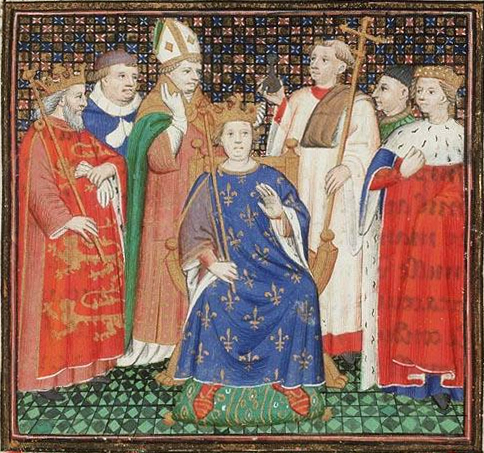 The coronation of King Philip II in the presence of Henry II of England: Master of the City of Ladies, Public domain, via Wikimedia Commons
The anticipated coronation was not a simple formality: it made Philip a full king, even if Louis VII officially remained in power until his death.
In fact, an implicit coregency was established. Philip began to exercise political responsibilities, while the royal entourage — notably great lords and counselors — adapted to this gradual transfer of authority.
🤝 1180: Alliances and Political Consolidation
In this phase of transition, the monarchy also pursued its alliance policy.
On April 28, 1180, Philip married Isabella of Hainaut, daughter of Count Baldwin V of Hainaut.
Isabella’s dowry — comprising notably territories in Artois (Arras, Saint-Omer, Aire, Hesdin) — constituted a non-negligible territorial contribution to the crown.
A few weeks later, on May 29, 1180, Isabella was in turn crowned queen at Saint-Denis, reinforcing the symbolic and political dimension of the union.
⚰️ September 18, 1180: The Death of Louis VII
On September 18, 1180, Louis VII died after more than forty years of reign.
The transmission of power thus took place without crisis, illustrating the solidity acquired by the Capetian dynasty since the eleventh century.
🏛️ A Defining Legacy
His reign appears as a phase of consolidation and maturation, between the work of recovery undertaken by Louis VI and the decisive affirmation of royal power under Philip II Augustus.
Louis VII’s reign appears contrasted.
On the territorial plane, he suffered major reversals:
- loss of Aquitaine (1152)
- rise of the Plantagenet Empire
However, his action remained essential:
- maintenance of Capetian authority against a more powerful rival
- strengthening of the king’s religious and symbolic role
- consolidation of the royal domain
- preparation of a stable succession
🧠 Key Points
- 1137: union with Eleanor, initial apex of Capetian power
- 1142: Vitry, moral shock and political crisis
- 1147–1149: failure of the Second Crusade
- 1152: loss of Aquitaine, major turning point of the reign
- 1154: birth of the Plantagenet Empire
- 1164–1174: rivalry with Henry II and the Becket affair
- 1179: anticipated coronation of Philip
- 1180: death of Louis VII, smooth succession