


Philip I: Enduring in Feudal France (1060-1108)
p51060 à 1108
In 1060, Henry I dies: his son Philip inherits the crown, but not dominant power. The king exercises his authority mainly over a compact domain centered on the Ile-de-France, while the great territorial princes possess considerable military and fiscal resources.
Philip I’s reign thus appears as one of stabilization and continuity: consolidating the dynasty, playing on rivalries between princes, avoiding isolation, and preserving the idea of a royal authority standing above feudal powers.
🔍 Zoom - 1060-1067: The Regency and the Key Role of Baldwin V
I. 👶 1060-1067 - A Child King, a Stabilizing Regency
In August 1060, Philip becomes king when he is only about 7 to 8 years old. In a feudal context, a royal minority is a critical moment: it can encourage aristocratic coalitions and weaken central authority.
The regency is led by Anne of Kiev, his mother, and above all by Baldwin V of Flanders, one of the most powerful princes in the kingdom. His role is decisive: he guarantees political stability and limits the ambitions of the great lords.
Between 1063 and 1065, no major crisis occurs. This relative stability is in itself a political success:
- control of the royal domain is maintained
- no coalition succeeds in asserting itself against the crown
- the royal institutions, though limited, continue to function
 Death of Baldwin V: William of Tyre, Public domain, via Wikimedia Commons
In 1067, the death of Baldwin V marks the end of the regency. Philip, now an adolescent, begins to exercise power personally.
Moreover, the first years of the reign unfold in a West marked by peripheral conflicts: in 1064, an expedition led in Spain by Aquitanian princes results in the capture of Barbastro, illustrating the expansion of Christian warfare against Muslims even before the Crusades.
II. 🌍 1066-1087 - Normandy Becomes an Anglo-Norman Power
The English succession crisis begins in January 1066, at the death of King Edward the Confessor, who leaves no direct heir. Several claimants oppose one another:
- Harold Godwinson, elected king of England
- William of Normandy, claiming a promise of succession
- Harald Hardrada, king of Norway
The year is marked by a succession of decisive battles:
- 20 September 1066: Gate Fulford, Norwegian victory
- 25 September: Stamford Bridge, Harold repels the Norwegians
- 14 October: Hastings, William defeats and kills Harold II
 Battle of Hastings in 1066: Museum of Fine Arts of Caen, Public domain, via Wikimedia Commons
On 25 December 1066, William is crowned king of England at Westminster.
This conquest profoundly transforms the political balance:
- all English land becomes the king’s property by right of conquest
- a strongly centralized feudal order is established
- Normandy now has considerable resources
In 1066, the conquest of England by William of Normandy durably changes political balances.
 Territorial domains of William the Conqueror around 1087: William Robert Shepherd, Public domain, via Wikimedia Commons
An unprecedented phenomenon appears: a vassal of the king of France becomes a king himself, at the head of a rich and structured kingdom. Normandy now possesses two complementary territorial bases.
In the short term, William does not immediately take advantage of the king’s minority: he is absorbed by the conquest and organization of his new kingdom.
But in the medium term, the situation becomes problematic for the Capetian monarchy. William appears as a sovereign more powerful than his suzerain.
Faced with this situation, Philip I adopts an indirect strategy:
- exploit internal divisions within the Anglo-Norman camp
- support local oppositions
- avoid any direct confrontation
Between 1071 and 1073, and again in the following years, the king intervenes diplomatically in the internal conflicts of Normandy and England.
🔍 Zoom - 1066: A Vassal Becomes King of England
In 1087, William’s death leads to the division of his possessions among his sons. This division temporarily weakens the Anglo-Norman world as a whole, but Philip fails to derive lasting gains from it.
In the following years (1067-1069), William has to face numerous revolts in England. He temporarily leaves the island, entrusting power to his representatives, but quickly returns to suppress the uprisings.
The repression is especially violent in the north of the kingdom (1069-1070), where he carries out a policy of devastation known as the harrying of the North in order to break all resistance.
These troubles temporarily limit William’s ability to act against the king of France, offering Philip I a strategic respite.
🔍 Zoom - 1087: William’s Death and Anglo-Norman Division
III. 🏗️ 1068-1080 - Consolidating the Royal Domain and Playing the Balance of Power
In the years 1067-1080, Philip I’s action remains unspectacular, but it is structurally important. The king does not seek conquest, but rather to gradually strengthen his position in a kingdom dominated by powerful princes.
A notable territorial advance is made with the acquisition of the Gatinais (around 1068), a strategic region between Paris, Orleans, and Sens. Obtained from the count of Anjou, Fulk Rechin, this extension strengthens the coherence of the royal domain and consolidates the Capetian political axis.
🔍 Zoom - The Gatinais: Consolidating the Paris-Orleans Axis (around 1068)
At the same time, princely balances evolve quickly, especially in the north of the kingdom.
In 1071, Philip intervenes in Flanders to support Count Arnulf III. The expedition ends in failure: on 22 February 1071, at the battle of Cassel, the royal army is defeated by Robert the Frisian, who establishes himself as the new count of Flanders.
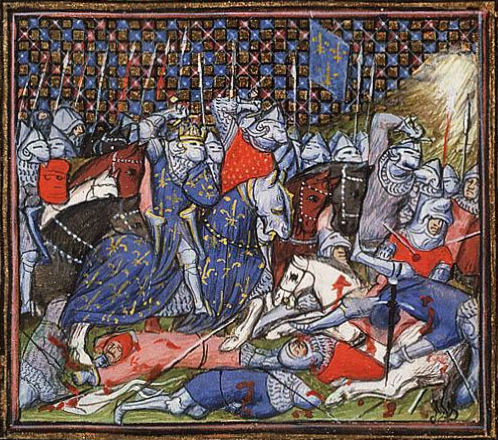 Illustration of the battle of Cassel: Virgil Master (illuminator), Public domain, via Wikimedia Commons
This episode reveals the king’s military limits, but also his capacity to adapt. As early as 1072, Philip chooses a diplomatic solution: he marries Bertha of Holland, stepdaughter of Robert the Frisian, and effectively recognizes his power. This policy stabilizes the region despite the defeat.
At the same time, the king pursues an indirect strategy against Anglo-Norman power. He prefers alliances and targeted interventions to direct confrontation.
When Robert Curthose, son of William the Conqueror, rebels (around 1076-1080), Philip supports him. This policy aims to weaken Normandy from within, without committing royal forces to a risky war.
🔍 Zoom - 1076-1080: Robert Curthose and Capetian Strategy
Finally, in 1077, an important territorial event strengthens the Capetian position: after the withdrawal of Count Simon of Vexin, his lands are divided between the king and the duke of Normandy. The French Vexin falls to Philip, constituting a strategic gain against Normandy.
Thus, in the 1070s, the Capetian monarchy does not yet dominate the kingdom, but gradually asserts itself through:
- targeted territorial acquisitions (Gatinais, Vexin)
- pragmatic diplomacy (Flanders)
- opportunistic alliances (Anjou, Norman opponents)
The reign follows a logic of managed balance, in which the king acts less through force than through the play of power relationships.
IV. 💍 1092-1095 - Marital Scandal, Reform, and Weakened Authority
In 1092, Philip I repudiates Bertha of Holland and unites with Bertrade of Montfort, who is already married. This decision immediately provokes a political and religious scandal.
 Fulk IV of Anjou and Bertrade of Montfort (right), Bertrade and King Philip I of France (center), Queen Bertha in a castle tower (left) - Source: Chronicles of Saint-Denis (or of France), British Library, Royal 16 G VI f. 271, Public domain, via Wikimedia Commons
The affair breaks out in a context marked by the Gregorian Reform, which aims to strengthen Church discipline, combat illicit unions, and assert papal authority over princes. As early as 1092, Bishop Ivo of Chartres publicly condemns this union. He is imprisoned, then released under papal pressure.
In 1094, Philip still tries to control the situation by convening a council at Reims, but the affair turns against him. On 16 October 1094, at the council of Autun, the king is excommunicated in the name of Pope Urban II.
This excommunication has major consequences:
- it weakens the king’s prestige
- it reduces his capacity for arbitration
- it accentuates the contrast between the Church’s moral affirmation and the monarchy’s political fragility
 Pope Urban II at the council of Clermont in 1095. Miniature from Sebastien Mamerot’s Passages d’outremer - Source: Jean Colombe, Public domain, via Wikimedia Commons
In 1095, the council of Clermont renews this condemnation within a broader framework that also condemns simony, clerical marriage, and bigamy.
The conflict with the Church does not make the monarchy collapse, but it greatly reduces the king’s room for maneuver at the very moment when the pope appears as the great moral authority of Latin Christendom.
🔍 Zoom - 1092: Bertrade of Montfort, Excommunication, and Reform
V. ✝️ 1095-1100 - Crusade, Princes, and the King’s Marginalization
The council of Clermont (1095) is a major turning point. Pope Urban II, present in the kingdom for several months, preaches the First Crusade there at the close of the assembly, on 27 November.
 Pope Urban II preaches the First Crusade at Clermont - Source: Fondazione Cariplo via Wikimedia Commons
The appeal meets with considerable response in the French principalities. The kingdom’s great lords occupy a central place in the expedition:
- Raymond of Saint-Gilles, count of Toulouse
- Robert Curthose, duke of Normandy
- Stephen of Blois
- Robert of Flanders
- Godfrey of Bouillon and Baldwin
 Map of the routes of the First Crusade: Miki Filigranski, via Wikimedia Commons
The kingdom of France thus appears as one of the main starting points of the crusade. Yet the king remains in the background. His excommunication and marital crisis prevent him from playing a leading role in a movement launched on his own territory.
This situation is revealing: at the moment when Latin Christendom mobilizes, it is the princes, not the monarchy, who occupy center stage.
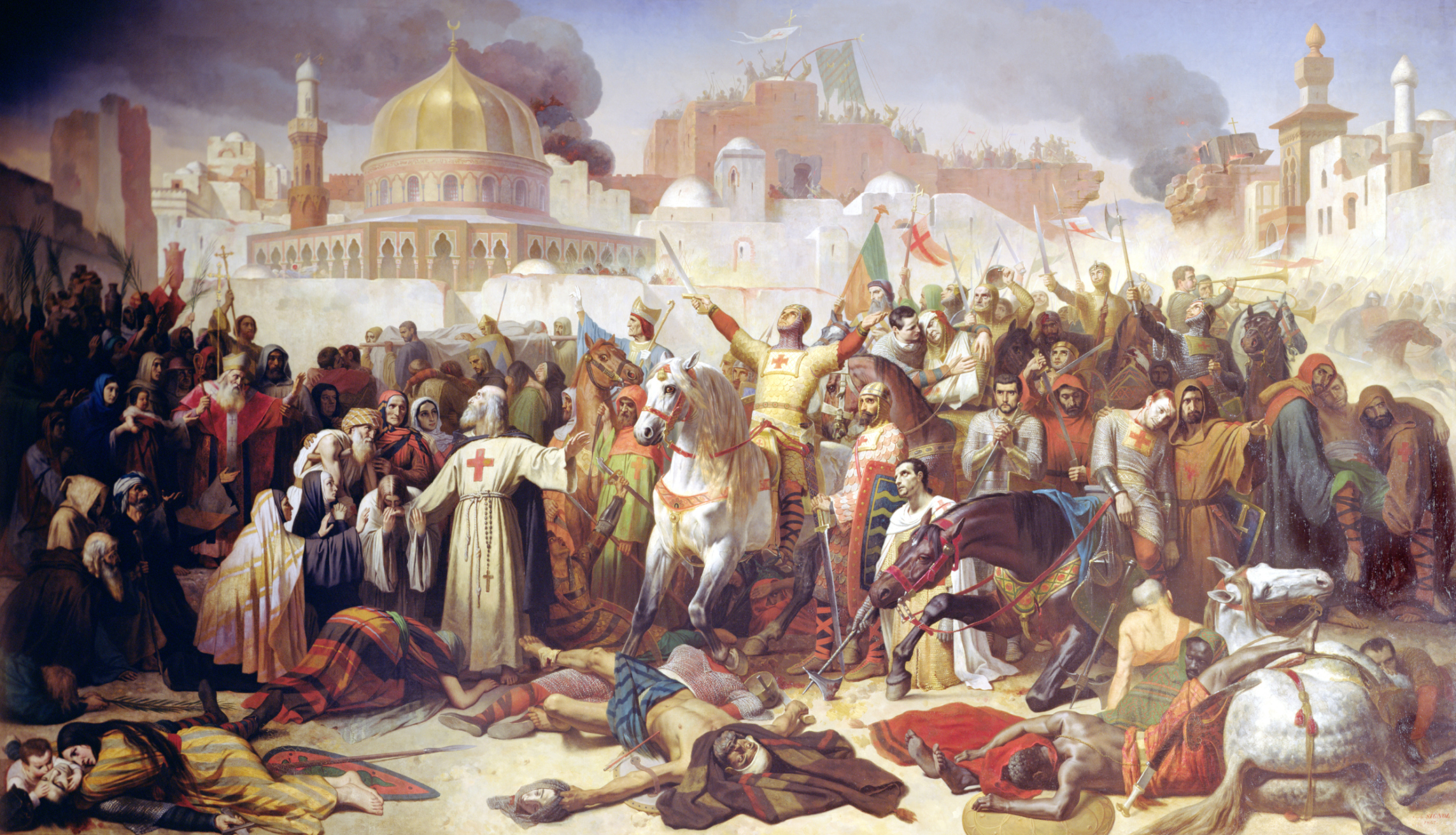 The capture of Jerusalem (1099): Emile Signol, Public domain, via Wikimedia Commons
Between 1096 and 1099, the People’s Crusade and then the princes’ crusade cross the Byzantine Empire, take Nicaea, win the battle of Dorylaeum, besiege Antioch, and then capture Jerusalem in 1099. The victory leads to the foundation of the Kingdom of Jerusalem.
For Capetian France, the event is important in several respects:
- it strengthens the international prestige of several princes of the kingdom
- it temporarily diverts part of aristocratic violence toward the East
- it highlights, by contrast, the relative weakness of the royal role
Thus, the First Crusade increases the prestige of the French nobility without directly strengthening the monarchy. It confirms that, under Philip I, feudal France is politically dominated by its great princes more than by its king.
🔍 Zoom - 1095-1099: The First Crusade and the France of Princes
VI. 👑 1100-1108 - End of the Reign, a New Anglo-Norman Situation, and Preparing the Succession
From 1100 onward, the political situation in the West shifts once again. The accidental death of William Rufus, king of England, leads to the accession of his brother Henry I Beauclerc to the throne, while Robert Curthose keeps Normandy.
This division prolongs rivalries within the Anglo-Norman world. In 1101, Robert Curthose lands in England, but the conflict is quickly settled by the treaty of Alton, confirmed at Winchester: Robert recognizes Henry as king of England in exchange for an annual pension. This peace nevertheless remains fragile.
For Philip I, these divisions constitute a limited opportunity. The Anglo-Norman complex remains powerful, but it is no longer unified. The Capetian monarchy can thus hope to avoid excessive pressure on its frontiers.
At the same time, the king continues at times to strengthen his domain. In 1101, the viscount of Bourges, Odo Arpin, sells his possessions to Philip in order to finance his departure on crusade. This operation allows the crown to extend its influence in Berry.
 Philip I buying the county of Bourges from Count Odo Arpin - Source: Digitization carried out by France, Toulouse, Bibliotheque de Toulouse, via Wikimedia Commons
From the beginning of the 1100s, the figure of the heir to the throne becomes more important. Louis, the king’s son, already leads military interventions in the name of the monarchy. In 1102, he fights in particular in the region of Reims against Ebles of Roucy, accused of violence and the plundering of churches. The end of the reign thus begins to sketch a gradual transition toward a more active exercise of Capetian power.
The most important change comes in 1106, when Henry I Beauclerc wins the battle of Tinchebray against his brother Robert Curthose. Normandy is then reunited with the crown of England. This victory reconstitutes a strong Anglo-Norman power that will long dominate the balance of power with the French monarchy.
 Battle of Tinchebray (1106): Master of Rohan, Public domain, via Wikimedia Commons
At the same time, Philip I gradually settles his conflict with the Church. In 1104, at the council of Paris, he obtains absolution with Bertrade of Montfort after penance, even if their union remains politically sensitive. Then, in 1106, the council of Guastalla marks an important evolution: the king of France and his associated son accept leaving the election of bishops to the cathedral chapters, provided they retain a right of consent. This position, close to the solutions defended by Ivo of Chartres, makes it possible to avoid in the kingdom the brutal confrontation that the Empire is then experiencing over investitures.
In 1107, Pope Paschal II crosses Francia and meets Philip I and Louis at Saint-Denis. Relations between royalty and the papacy are then largely appeased. That same year, the breaking of Louis VI’s betrothal with Lucienne of Rochefort, decided at the council of Troyes, shows that the heir to the throne already occupies a leading political place.
When Philip dies on 29 July 1108, the succession takes place without major crisis. The king leaves a monarchy still limited in its means, but stabilized:
- the Capetian dynasty is firmly rooted
- the transition to Louis VI is already underway
- the royal domain has been consolidated by small increments
- the balance with the Church has largely been restored
The reign therefore ends without spectacular brilliance, but with one essential achievement: the crown has endured, despite the power of the princes, Anglo-Norman pressure, and religious crises.
🔍 Zoom - 1108: The Succession, Louis VI, and the Legacy of the Reign
🧠 Key Takeaways
- 1060: Philip I inherits a feudal and fragmented kingdom
- 1060-1067: a stable regency ensured by Baldwin V
- 1066: the birth of a dominant Anglo-Norman power
- 1068-1080: gradual consolidation of the royal domain
- 1087: Anglo-Norman division, a limited opportunity
- 1092-1100: religious crisis and the king’s weakening
- 1095: crusade, marginal role of the king
- 1108: succession secured, dynasty consolidated
Image Credits
-
Philip I of France: Gillot Saint-Evre, Public domain, via Wikimedia Commons
-
Death of Baldwin V: William of Tyre, Public domain, via Wikimedia Commons
-
Coup of Kaiserswerth: Anton von Werner, Public domain, via Wikimedia Commons
-
Battle of Hastings in 1066: Museum of Fine Arts of Caen, Public domain, via Wikimedia Commons
-
Territorial domains of William the Conqueror around 1087: William Robert Shepherd, Public domain, via Wikimedia Commons
-
Illustration of the battle of Cassel: Virgil Master (illuminator), Public domain, via Wikimedia Commons
-
Philip I repudiates Bertha and marries Bertrade: Chronicles of Saint-Denis (or of France), British Library, Royal 16 G VI f. 271, Public domain, via Wikimedia Commons
-
Council of Clermont: Jean Colombe, Public domain, via Wikimedia Commons
-
Pope Urban II preaches the First Crusade at Clermont: Fondazione Cariplo, CC BY-SA 3.0 https://creativecommons.org/licenses/by-sa/3.0, via Wikimedia Commons
-
The capture of Jerusalem (1099): Emile Signol, Public domain, via Wikimedia Commons
-
Map of the routes of the First Crusade: Miki Filigranski, CC BY-SA 4.0 https://creativecommons.org/licenses/by-sa/4.0, via Wikimedia Commons
-
Philip I buying the county of Bourges from Count Odo Arpin - Source: Digitization carried out by France, Toulouse, Bibliotheque de Toulouse, Ms 512 and the CNRS, CC BY-SA 4.0 https://creativecommons.org/licenses/by-sa/4.0, via Wikimedia Commons
-
Battle of Tinchebray (1106): Master of Rohan, Public domain, via Wikimedia Commons