
The Pont du Gard, Jewel of the Nîmes Aqueduct
From Caesar's Conquest to Roman Gaul · FROM 50 BC TO THE FALL OF ROME
The main chapter describes, in section III, the Romanization of Nemausus under the reign of Augustus. No monument better illustrates the technical capacity of the Roman administration to permanently transform the Gaulish territory than the Pont du Gard, a single link — but the most spectacular one — in an aqueduct fifty kilometres long.
📏 An Engineer’s Challenge
The Nîmes aqueduct draws water from the Eure spring, near Uzès, and channels it to the city by gravity alone, without any pump. Over its entire course of more than fifty kilometres, the total drop in elevation does not exceed some fifteen metres, requiring Roman surveyors to maintain an average gradient of less than 30 centimetres per kilometre — a precision that presupposes topographical surveys of exceptional rigour for the period, carried out without modern measuring instruments.
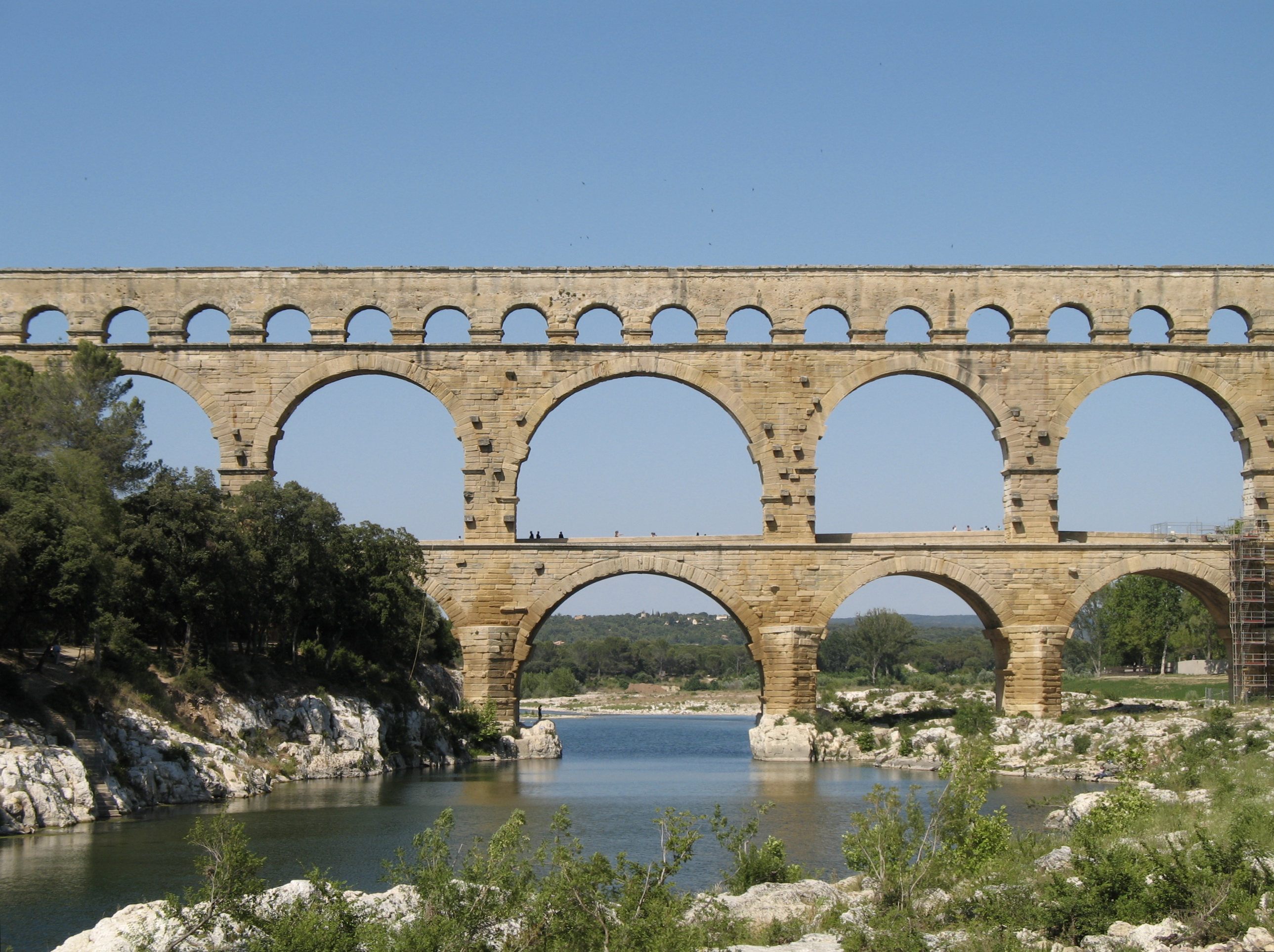
The Pont du Gard allows this channel to cross the Gardon valley. The structure stacks three rows of arches: six at the lower level, which bear most of the load, eleven at the middle level, and thirty-five at the top, where the channel itself runs. It rises to just over forty-eight metres, making it the tallest bridge-aqueduct Rome ever built. The stone blocks, cut from local limestone, are assembled without mortar: it is their sheer weight, combined with the precision of the cutting, that ensures the structure’s stability.
Caption: The Pont du Gard, bridge-aqueduct crossing the Gardon valley — Marc Ryckaert, CC BY 2.5, via Wikimedia Commons
🔍 A Long-Misdated Monument
For centuries, tradition attributed the construction of the aqueduct to Agrippa, during his stay in Gaul around 19 BC, making the Pont du Gard a direct contemporary of the great Augustan works described in the main chapter. This dating long seemed consistent with Agrippa’s role as a builder elsewhere — notably the road network radiating from Lyon.
Modern archaeological excavations have, however, revised this account: coins recovered during the work, as well as the study of construction techniques and quarry marks, place the building of the structure instead in the mid-first century AD, under the reign of Claudius. Agrippa’s name remains associated with the aqueduct project in principle, but the bridge visitors see today would thus date from a generation, or even two, after the Augustan era covered by this chapter — a useful reminder of the caution needed when facing traditional attributions, here corrected by archaeology rather than by the texts.
🧠 Key Points
- The Pont du Gard is but one link in an aqueduct more than fifty kilometres long, supplying Nemausus (Nîmes) by gravity alone.
- The structure stacks three levels of arches (6, 11, and 35) and rises to more than forty-eight metres, without any mortar.
- Long attributed to Agrippa around 19 BC, it is now dated by archaeology to the mid-first century AD, under Claudius.