
From Caesar's Conquest to Roman Gaul
Environ -50 à 0
As the previous chapter ends, the Gallic War proper has just come to a close: organized resistance is crushed, Aquitaine has submitted, and the Roman Senate has celebrated Caesar’s victory with twenty days of unprecedented supplicationes. Gaul ceases to be a collection of independent peoples. But its history does not stop at this conquest: it enters instead a period in which its fate becomes even more closely bound up with the political upheavals of Rome itself.
This chapter follows this dual transformation. On one hand, Gaul becomes, in spite of itself, both a theatre and a resource for the Roman civil wars, which follow one another relentlessly from the crossing of the Rubicon to the accession of Augustus. On the other, once this political instability is overcome, Gaul undergoes a methodical administrative reconstruction, moving from the status of a freshly conquered territory to that of an integrated, structured, and durably pacified province.
This narrative is thus dominated by a marked temporal contrast: some twenty years of turmoil, during which Gaul bears the consequences of rivalries playing out elsewhere first, followed by a generation of methodical construction, during which it becomes, on the contrary, a model of provincial integration for the rest of the Empire.
Five phases structure this account. The first is that of the civil war of 49 BC, with its most significant episode for Gaul: the siege of Massalia. The second follows the political convulsions that separate Caesar’s assassination from the accession of Augustus. The third is that of the great administrative and urban reorganization undertaken under the new imperial regime. The fourth is the stabilization of the long-uncertain Rhine frontier. The fifth, finally, is that of the political integration of the Gaulish elites themselves, symbolized by the Sanctuary of the Three Gauls.
This chapter closes the period of Gaulish Antiquity opened several centuries earlier, and opens that of a fully Roman Gaul — a Gaul whose cities, monuments, and ways of life would bear, for centuries to come, the imprint of this transformation begun under Augustus.
I. 49 BC: Gaul in the Roman Civil War
On 10 January 49 BC, Caesar crossed the Rubicon, a small river marking the legal limit of his command, at the head of the Thirteenth Legion alone. This gesture, so irreversible in its consequences that tradition credits him with the words “Alea jacta est” — “the die is cast,” though there is no absolute certainty about the exact phrase spoken — triggered the civil war against Pompey and the Roman Senate. Gaul, barely pacified after eight years of war, constituted for Caesar a decisive asset in this new conflict: seasoned troops, abundant resources, a rear base he hoped would remain loyal.

Caption: Caesar crosses the Rubicon (Adolphe Yvon, 1875, Musée des Beaux-Arts d’Arras) — public domain, via Wikimedia Commons
It was in this context that Massalia, a city founded by Phocaean settlers nearly six centuries earlier, had to choose its side. It sided with Pompey: it welcomed within its walls Domitius Ahenobarbus, one of Caesar’s principal opponents, and entrusted him with the city’s defence. This choice, for a city whose history had long rested on cautious diplomatic autonomy amid the surrounding powers, proved disastrous.
Caesar entrusted the land siege to his legate Trebonius — who notably had a six-storey siege tower built at the foot of the ramparts — and the naval blockade to Decimus Brutus, while he himself went to fight the Pompeian legates in Spain. Two naval battles turned decisively in Rome’s favour, with the Massaliote fleet largely destroyed or captured. The siege dragged on from April to the end of September, before the exhausted city finally surrendered.
Caesar, out of regard for Massalia’s ancient friendship with Rome, spared the city itself: no plundering was permitted. But the terms imposed remained harsh — loss of its fleet, of most of its colonies (it retained only Nice and the Stoechades islands), and of its commercial privileges. Attached to the province of Narbonensis, the city saw its name Romanized to Massilia: after nearly six centuries of a history until then marked by a remarkable capacity to preserve its independence, Massalia ceased permanently to exist as an autonomous city-state.
II. 44 to 27 BC: From Civil Wars to the Birth of the Empire
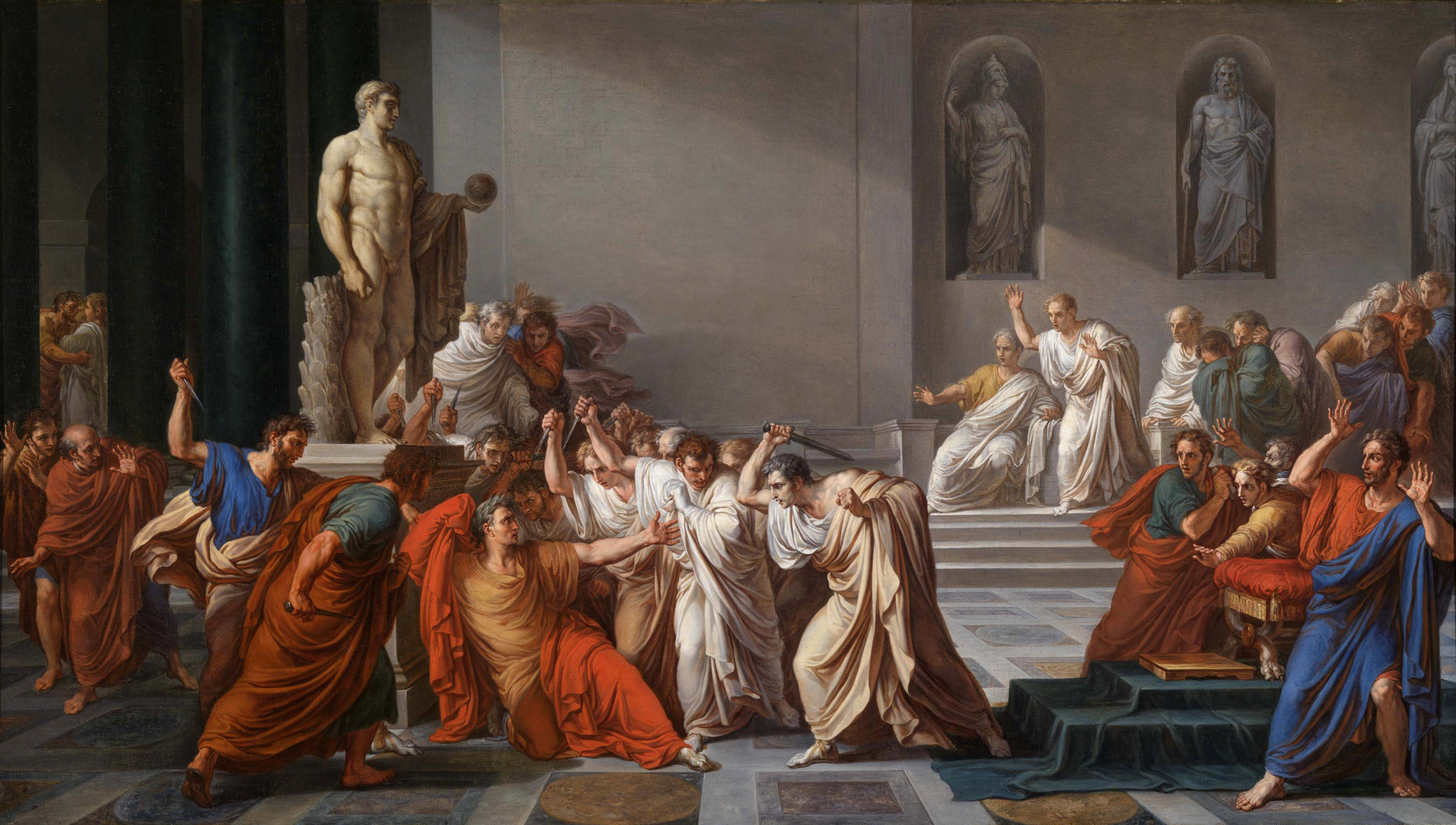
On the Ides of March, 44 BC, Caesar was assassinated by a group of senators led by Brutus and Cassius. Among the conspirators was Decimus Brutus — the very man who had commanded Caesar’s fleet during the siege of Massalia. He immediately seized the governorship that had been promised to him, Cisalpine Gaul. When Mark Antony in turn claimed this province, Decimus Brutus refused to yield it; besieged at Mutina, he was relieved only in April 43 BC, by the new consuls and by the young Octavian, Caesar’s great-nephew and adopted son. But the victory was short-lived: abandoned by his supporters after an ally defected to Antony’s camp, Decimus Brutus tried to flee across Gaul to join Caesar’s other assassins. He was captured and executed in the autumn of 43 BC, among the Sequani, on the orders of a Gaulish dynast allied with Antony — an ending that closes, with a certain irony, the thread opened a few years earlier at Massalia.

Caption: The Death of Caesar (Jean-Léon Gérôme, 1867, Walters Art Museum) — public domain, via Wikimedia Commons
On 11 November 43 BC, a second triumvirate brought together Antony, Octavian, and Lepidus, who immediately divided the Roman provinces among themselves: Antony received Gallia Comata (long-haired Gaul) and Cisalpine Gaul, Lepidus received Gallia Narbonensis and the Iberian provinces, and Octavian received Africa, Sicily, Corsica, and Sardinia. Gaul thus escaped, for the time being, any direct control by Octavian. The following year, at Philippi (42 BC), the triumviral armies eliminated Brutus and Cassius, but the understanding between the victors soon began to crack: Octavian gradually established himself in the West, while Antony, increasingly tied to Queen Cleopatra of Egypt, dominated the East.
These years of political upheaval show that the pacification of Gaul, achieved only a few years earlier, remained fragile. In 39/38 BC, Octavian entrusted the government of Transalpine Gaul to his loyal lieutenant Agrippa; the latter suppressed a revolt of the Aquitani, fought several Germanic peoples, and became the second Roman general, after Caesar himself, to cross the Rhine. He settled the allied tribe of the Ubii on the left bank of the river — the founding act of what would become Cologne — before returning to Rome, where this success earned him the consulship in 37 BC.
The rivalry between Octavian and Antony culminated in the naval battle of Actium, in 31 BC, where the fleet of Antony and Cleopatra was crushed.
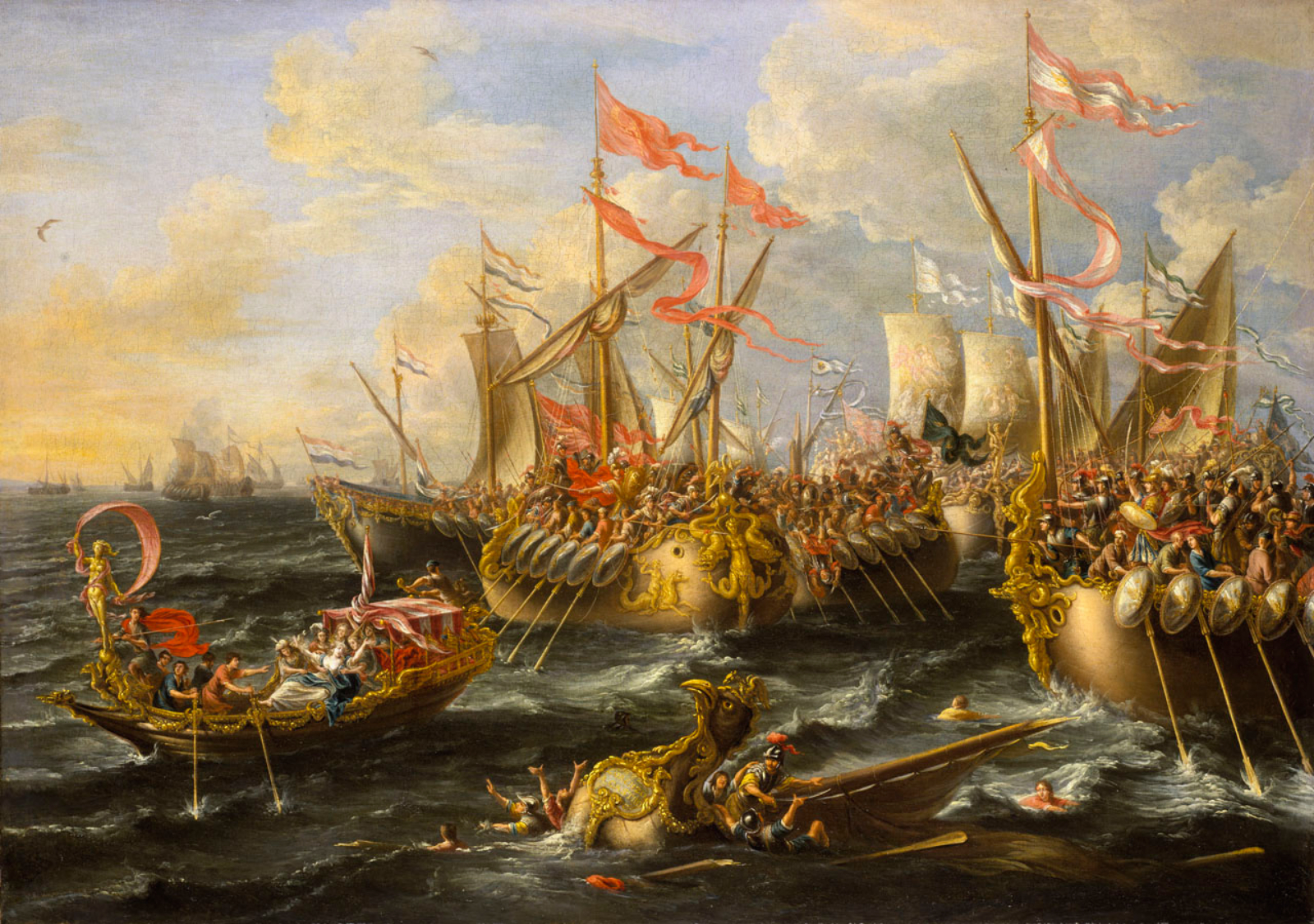
Caption: The Battle of Actium (Laureys a Castro, 1672, National Maritime Museum, London) — public domain, via Wikimedia Commons
The following year, Octavian took Alexandria; Antony and Cleopatra took their own lives, putting an end to all organized opposition. In 27 BC, the Senate granted Octavian the title of Augustus: the Roman Republic, undermined for decades by civil wars, gave way to a new regime, the Principate — and Gaul, now unified under a single authority, entered a decisive period of reorganization.
III. Under Augustus: Administrative Organization and Urbanization
Long-haired Gaul, hitherto governed in a largely improvised manner, was reorganized into three new provinces — Aquitania, Lugdunensis, and Belgica — which were added to Narbonensis, already in place for more than a century. The exact date of this reorganization remains debated among historians, for lack of unambiguous sources: some place it around 27/25 BC, others around 16/13 BC, corresponding to two different stays of Augustus on Gaulish soil. What is, on the other hand, well attested is the launch, as early as 28 BC, of the first census ever conducted in Gaul — an indispensable prerequisite for any regular taxation.
At the heart of this new arrangement lay Lugdunum, present-day Lyon, whose history begins well before Augustus: the city was founded on 9 October 43 BC by Munatius Plancus, governor of Long-haired Gaul, on the Senate’s orders, to resettle Roman colonists driven out of Vienne by the Allobroges. First named Colonia Copia Felix Munatia, it then took the name Copia Lugdunum, before becoming, after the Augustan reorganization, the common capital of the Three Gauls.
🔍 Zoom – Baths, Theatres, and Amphitheatres: Gallo-Roman Urban Life
This wave of urbanization was accompanied, elsewhere, by the relocation of traditional centres of power. Augustodunum (Autun) was founded around 16/13 BC to replace Bibracte as the capital of the Aedui — a mark of recognition for this people, Rome’s oldest and most steadfast ally in Gaul. The transfer nonetheless remained gradual: Bibracte was not completely abandoned until between 20 BC and the turn of the era, and the occupation of Autun only truly intensified under Tiberius’s reign. The city, destined for considerable renown, would later earn the nickname soror et aemula Romae — “sister and rival of Rome.”
Further south, Nemausus (Nîmes) illustrates another face of this Romanization. Between 27 BC and 10 AD, the city minted a famous coinage: a crocodile chained to a palm tree crowned with laurels, paired with the portraits of Augustus and his son-in-law Agrippa, symbolizing Egypt vanquished at Actium. The frequently advanced hypothesis of a colony of battle veterans settled at Nîmes is in fact confirmed by no ancient source — a point that calls for caution about what this coinage precisely documents.

Caption: Dupondius of the colony of Nemausus, portraits of Augustus and Agrippa on the reverse of the chained crocodile — Siren-Com, CC BY-SA, via Wikimedia Commons
🔍 Zoom – The Pont du Gard, Jewel of the Nîmes Aqueduct
From 27 BC, upon Augustus’s return from a stay in Narbonensis, Agrippa was tasked with laying out a road network centred on Lugdunum. According to Strabo, four major roads radiated from it: one toward Aquitania and the Santones country, one toward the Rhine, one toward the Ocean, and the last toward Narbonensis — straight, paved roads, marked with milestones indicating distances. This network, conceived as much as a military tool as an administrative and commercial one, made Lyon the true nerve centre of Roman Gaul.
Securing these routes also required pacifying the mountain ranges they crossed. Between 25 and 14 BC, several campaigns subdued the last independent Celto-Ligurian peoples of the Alps, who until then had been able to extort tolls from or obstruct traffic between Italy and Narbonensis. This victory was celebrated around 7/6 BC by a colossal monument, the Tropaeum Alpium, erected at La Turbie, at the highest point of the Via Julia Augusta: its inscription lists forty-four defeated Alpine peoples, completing the securing of the route between Rome and the whole of the Gauls.

Caption: Remains of the Tropaeum Alpium, La Turbie — José Luiz Bernardes Ribeiro, CC BY-SA 3.0, via Wikimedia Commons
🔍 Zoom – Lutetia, a Roman City of Middling Size
IV. The Rhine, from an Unstable Frontier to an Organized Limit
In 16 BC, a coalition of Germanic peoples — the Sicambri, Usipetes, and Tencteri — crossed the Rhine after capturing and crucifying Romans on their own lands. The governor of Long-haired Gaul, Marcus Lollius, marched to meet them with the Fifth Legion, Alaudae. His cavalry, sent ahead as scouts, fell into an ambush set by the Tencteri; taking advantage of the confusion, the Germans surprised and massacred the legion itself, which lost its eagle. The episode entered history under the name clades Lolliana, the “Lollian disaster.”
This defeat left a lasting mark on Roman minds — the loss of a legionary eagle remained, in the Roman mindset, a humiliation of particular gravity — but modern historians today largely agree in downplaying its real military significance. No serious danger then threatened Gaul itself, and Lollius most likely recovered the lost eagle afterward. As soon as Lollius and Augustus gathered their forces in response, the Germans withdrew of their own accord, sued for peace, and handed over hostages: the episode’s impact was thus, in essence, less military than political and symbolic.
This episode nonetheless convinced Augustus to stabilize the Rhine frontier durably through a permanent military presence rather than through occasional expeditions: legions were henceforth stationed there continuously, supported by fortified camps spread along the river.
Between 12 and 9 BC, Drusus, Augustus’s stepson, led from Gaul a series of campaigns into Germania, employing a strategy close to the one Caesar himself had used in Gaul: devastating the resources of resisting peoples rather than systematically seeking pitched battle. He had a canal dug, the fossa Drusiana, linking the Rhine to the North Sea, to support his land operations with a fleet. The high point of these campaigns was reached in 9 BC, when Drusus reached the Elbe — a river he did not, however, cross, probably owing to the growing distance from his supply lines. On the way back, he died from the effects of a fall from his horse; his brother Tiberius then took over command of operations in Germania, confirming the role Gaul now played as a logistical base and military reservoir for the whole of the Empire’s northern frontier.
V. 12 BC: The Sanctuary of the Three Gauls and the Pax Romana
On 1 August 12 BC, a federal sanctuary was inaugurated at the confluence of the Rhône and the Saône, at Lugdunum. Sixty Gaulish cities sent representatives, gathered in an annual council presided over by a federal priest, the sacerdos Romae et Augusti — charged with rendering joint worship to Rome and to the emperor. The first holder of this office was an Aeduan, Caius Julius Vercondaridubnus: a choice that was far from incidental, given that this people had, for nearly a century and a half, cultivated the status of a privileged ally of Rome — down to the honorific title of fratres consanguinei that it had obtained well before the Caesarian conquest itself.
🔍 Zoom – Gallo-Roman Society, Between Integration and Resistance

Caption: Remains of the Amphitheatre of the Three Gauls, where the council of the sixty Gaulish cities met each year — John Samuel, CC BY-SA 4.0, via Wikimedia Commons
This imperial cult, celebrated each year before the assembled Gaulish delegations, fulfilled a precise political function: it allowed the local aristocracy to publicly display its loyalty to the emperor, while preserving, through this federal council, a form of collective representation that the conquest had not entirely erased. It was an effective compromise, in which integration into the Empire did not require the complete disappearance of a distinct Gaulish identity, but rather its transformation into a recognized cog of the imperial system.
This institution formed part of a broader movement of stabilization that Gaul experienced as it approached the turn of the era. Provincial administration, established under Augustus, now functioned routinely; taxation, once irregular, rested on a stable census; the Rhine frontier, long uncertain, had become an organized limit, guarded by permanently stationed legions. The great insurrections that had marked the last century of independent Gaul now belonged to the past.
It is this conjunction — stable administration, integrated economy, secured frontiers, elites bound to imperial power — that historians would later come to call the Pax Romana. It was not an absolute or static peace, but a lasting phase of relative stability, upon which the prosperity of Roman Gaul could be built in the decades that followed.
🧠 Key Points
- In 49 BC, Gaul was drawn into the Roman civil war: Massalia, having sided with Pompey, lost its independence after a long siege, while being spared from plunder by Caesar.
- Between 44 and 27 BC, Roman political upheavals (Caesar’s assassination, the second triumvirate, Actium) left Gaul fragile — an Aquitanian revolt had to be suppressed by Agrippa as early as 39/38 BC — before the accession of Augustus.
- Under Augustus, Long-haired Gaul was reorganized into three new provinces, while Lugdunum, Augustodunum, and Nemausus embodied the new faces of Roman urbanization, linked by Agrippa’s road network.
- The Rhine frontier, shaken by the clades Lolliana (16 BC), became a stable and fortified limit thanks to the campaigns of Drusus, who reached the Elbe in 9 BC.
- On 1 August 12 BC, the Sanctuary of the Three Gauls at Lugdunum institutionalized the political integration of the Gaulish elites, under the presidency of a first Aeduan priest — a powerful symbol of the emerging Pax Romana.