
Gallo-Roman Society, Between Integration and Resistance
From Caesar's Conquest to Roman Gaul · FROM 50 BC TO THE FALL OF ROME
The main chapter describes the establishment, under Augustus, of the administrative and urban framework of Roman Gaul. This reorganization deeply transformed the Gaulish social order: the local aristocracy found new avenues for advancement there, while slavery and the status of women followed their own logics. This successful integration did not prevent, in the decades that followed, episodes of resistance that serve as a reminder that the Pax Romana described in section V was by no means a unanimous or definitive consent.
🏛️ The Gaulish Aristocracy, New Relays of Roman Power
The Gaulish elite quickly understood the advantage of collaborating with Rome rather than opposing it. Former tribal chiefs became municipal magistrates, adopted Latin and the toga, and funded the construction of public monuments in their home cities — a mechanism of euergetism that secured them local prestige and Roman recognition. Roman citizenship, granted first to this elite before spreading more widely, opened up significant legal and fiscal privileges, extending and formalizing the logic of alliance already at work with the Aedui, described in section V of the main chapter.
⛓️ Slavery and the Status of Women
The prosperity of Roman Gaul rested in part on slave labour. The first slaves of the Augustan era were largely former prisoners from the Gallic War; afterward, slavery perpetuated itself through birth or debt. Employed on large agricultural estates or in mines, some particularly skilled slaves could nonetheless be freed and become influential freedmen.
The status of Gaulish women, meanwhile, was reshaped at the meeting point of two legal traditions: Celtic customs, which had granted them relatively broad autonomy, gradually gave way to Roman law, placing women under the authority of their father or husband. Archaeology suggests, however, that many Gallo-Roman women continued in practice to manage property, businesses, or agricultural estates.
🗡️ From Isolated Resistance to Successful Integration
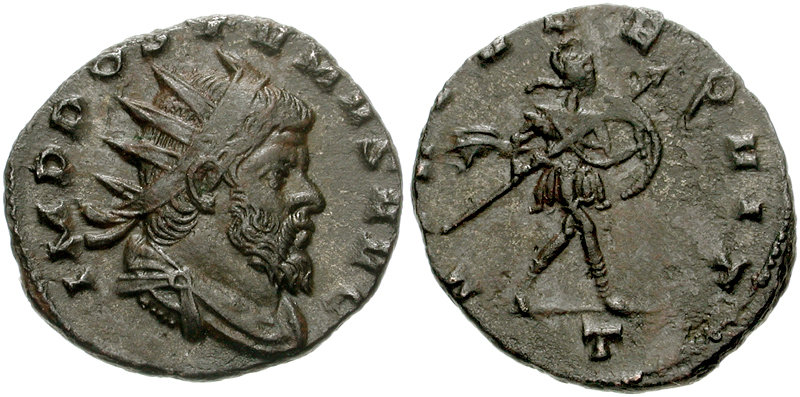
Gaulish integration into the Empire did not happen without friction. In 21 AD, a revolt led by Julius Sacrovir, an Aeduan notable, and Julius Florus, a Treveran, broke out against the weight of Roman taxation and the debt it caused among provincial elites; it was quickly crushed by Roman legions. Nearly two and a half centuries later, between 260 and 274, a phenomenon of an entirely different scale occurred: taking advantage of a generalized crisis in the Roman Empire, the usurper Postumus founded a separate “Gallic Empire,” equipped with its own administration and its own coinage, before his successors were finally reabsorbed into the Empire by Aurelian.
Caption: Antoninianus of Postumus, founder of the Gallic Empire (260–269) — Classical Numismatic Group, CC BY-SA 2.5, via Wikimedia Commons
These two episodes, widely separated in time and different in nature — a limited tax revolt in one case, a lasting political secession in the other — show that Gaul’s integration into the Empire, however successful over the long term, was never immune to tension or occasional rupture.
🧠 Key Points
- The Gaulish aristocracy quickly integrated into Roman power through citizenship and municipal magistracies, extending the logic of alliance already forged with certain peoples before the conquest.
- Gallo-Roman society rested in part on slave labour, while the status of women was reshaped between Celtic traditions and Roman law.
- In 21 AD, the revolt of Sacrovir and Florus, driven by fiscal pressure, was quickly crushed.
- Between 260 and 274, the Gallic Empire of Postumus shows, much later, that Gaulish integration into Rome did not rule out major political ruptures in times of generalized crisis for the Empire.