

Philip III the Bold: Capetian Continuity and Mediterranean Crises (1270–1285)
1270 à 1285
The death of Louis IX before Tunis in 1270 opens a new stage in Capetian history. With the accession of Philip III, the French monarchy remained solidly established, but entered a period marked by different challenges from those of the previous reign. The new king inherited a kingdom strengthened by territorial acquisitions, by the development of royal administration, and by the exceptional prestige attached to the figure of his father, soon to be elevated to sainthood.
Succeeding Louis IX was a political as much as a symbolic challenge. Philip III, known as the Bold, did not merely receive the crown: he took his place in the shadow of a sovereign whose reign already embodied, for contemporaries, an ideal of Christian justice and Capetian majesty. His government was therefore first and foremost one of dynastic continuity, while also having to respond to new realities.
The reign of Philip III was marked by the continued extension of the royal domain, by the closer integration of several southern principalities, and by a gradual shift in major challenges towards the Mediterranean world. The ambitions of the Capetian house in Italy, the actions of Charles of Anjou, relations with the papacy, tensions with Aragon, and the unstable balances of Latin Christendom gave this period a distinctive character.
Before his accession, Philip already occupied an important place within the dynasty. Married in 1262 to Isabella of Aragon, he was the father of several sons, among them the future Philip IV the Fair. His sobriquet of “the Bold” referred less to exceptional political energy than to the personal bravery and chivalric valour attributed to him by chroniclers.
The reign of Philip III thus appears as a period of transition between two major moments in Capetian history: it prolonged the work of monarchical consolidation accomplished under Louis IX, while preparing, through its dynastic, territorial and diplomatic choices, the more profound transformations that would mark the government of Philip the Fair.
I. 1271–1274: Philip III’s Accession and Recomposition of the Kingdom
The new king Philip III the Bold was consecrated at Reims on 15 August 1271. This coronation, coming after the difficult return from the Tunis crusade and the bereavements that had struck the royal family, gave full legitimacy to the Capetian succession. At the same time, Philip III inherited a political context profoundly transformed by the disappearance of several leading princes.
 Coronation of Philip III of France: public domain, Via Wikimedia Commons
On 25 August 1271, following the deaths of Joan of Toulouse and Alphonse of Poitiers, the County of Toulouse, Poitou and Auvergne reverted to the crown. This union constituted a major turning point: it considerably strengthened the royal domain and accelerated the integration of the southern lands into the Capetian ensemble. In Toulouse, the capitouls recognised the new king’s authority from 1 September, while the county’s nobility swore homage in October 1271. The incorporation of this inheritance into the royal domain helped draw the France of oc and the France of oïl closer together.
 Castle of Foix: Krzysztof Golik, CC BY-SA 4.0 https://creativecommons.org/licenses/by-sa/4.0, via Wikimedia Commons
This takeover quickly translated into action on the ground. In 1272, Philip III intervened against noble resistance in the Midi. Between 3 and 5 June, royal troops besieged and took the castle of Foix, and Count Roger-Bernard was taken prisoner. Capetian administration was then put in place in the newly united territories, notably with the appointment of Eustache de Beaumarchès as the first royal seneschal of Toulouse and the Albigensian lands.
 Marie of Brabant and the trouvère Adenet le Roi: Émile Bayard, Public domain, via Wikimedia Commons
In 1274, Philip III married Marie of Brabant, consolidating new princely alliances. The same year, he also acquired the county of Nemours. At the Second Council of Lyon (1274), Pope Gregory X received ambassadors from the ilkhan Abaqa and attempted to coordinate joint action with the Persian Mongols and Byzantine Emperor Michael VIII Palaiologos against Muslim powers in the Near East. The union of the Greek and Latin Churches was proclaimed at Lyon on 29 June 1274, though it remained fragile.
 Map of the Comtat Venaissin (Papal States) in 1789 and the adjacent French provinces: Paul Vidal de La Blache (1845-1918), Public domain, via Wikimedia Commons
In 1274, Philip III definitively ceded the Comtat Venaissin to the Pope, reinforcing the papacy’s territorial presence in the Rhône valley. In November 1273, the canonisation inquiry of Louis IX opened — a sign of the political and religious importance taken on by the figure of the former king. The new reign thus opened in the prestigious shadow of Saint Louis, whose memory contributed to legitimising dynastic continuity.
II. 1276–1284: Mediterranean Tensions and the Rise of the Aragonese Crisis
During the later years of Philip III the Bold’s reign, the Capetian monarchy remained solidly installed in the kingdom, but found itself increasingly drawn into the Mediterranean crises provoked by the expansion of the Angevin house. This period was also marked by religious tensions, decisions affecting Jewish communities, and dynastic developments that prepared the following reign.
1276–1277: Religious Tensions, Court Affairs and Capetian Authority
In 1276, Charles of Anjou ordered the release in Provence of relapsed Jewish converts arrested by the Inquisition, illustrating the complexity of relations between princely power, ecclesiastical justice and religious minorities.
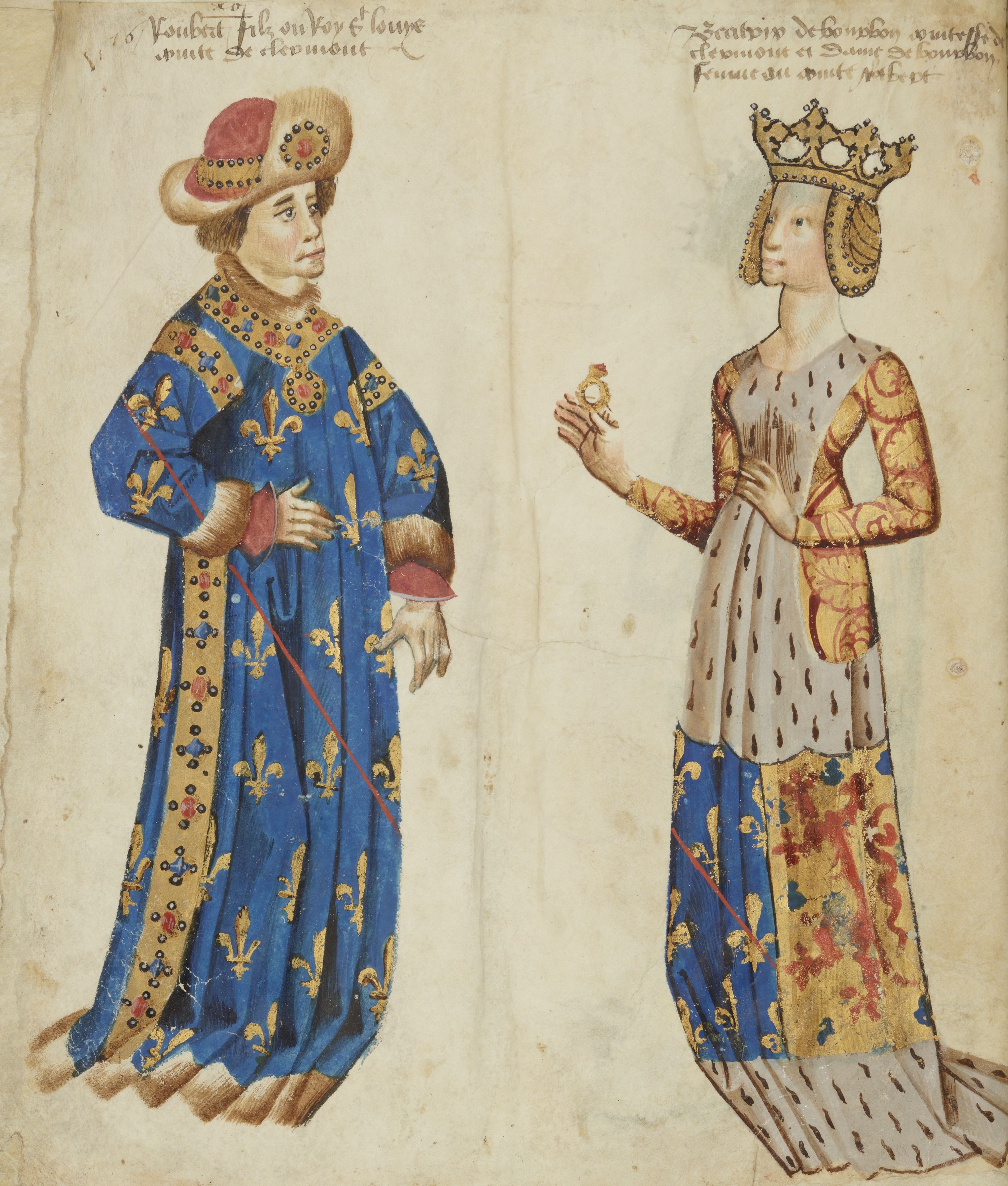 Sons of King Robert of Clermont and Beatrice: Unknown author, Public Domain, Via Wikimedia Commons
Shortly after, Robert of France, Count of Clermont-en-Beauvaisis and sixth son of Louis IX, married Beatrice of Bourbon. This union carried lasting dynastic importance, since the future House of Bourbon would descend from this branch.
In 1277, the Bishop of Paris, Étienne Tempier, condemned several philosophical theses associated with Latin Averroism and certain positions from the reception of Aristotle, illustrating the doctrinal tensions running through the University of Paris, the kingdom’s principal intellectual centre.
Philip III also intervened as arbitrator in the conflict known as the War of the Cow of Ciney, a bloody dispute that laid waste to some sixty villages in the Condroz, killing around 15,000 people — proof of the prestige still granted to the Capetian monarchy beyond its own borders.
The royal court was struck by a serious political affair with the execution, on 30 June 1277, of Pierre de La Brosse, former chamberlain and royal favourite, accused of having contributed to the death of Prince Louis, the king’s eldest son by Isabella of Aragon.
 The execution of Pierre de la Brosse: British Library, Public domain, via Wikimedia Commons
On 8 September 1278, the Paréage of Andorra was signed between the Bishop of Urgell and the Count of Foix, fixing their respective rights over this Pyrenean territory — an agreement whose effects endure to the present day.
1279–1281: Balance with England and Angevin Setbacks in the East
On 23 May 1279, the Treaty of Amiens settled a dispute between the Capetian monarchy and the English crown: Philip III returned the Agenais to Edward I of England, in continuity with the policy of compromise engaged since the agreements concluded under Louis IX with the Plantagenets.
In 1280, the Balkan ambitions of Charles I of Anjou suffered a setback with the defeat of his troops before Berat, in Albania, at the hands of Byzantine forces. This failure compromised Angevin projects in the Balkans and revealed the limits of their eastern expansion.
1282–1284: The Sicilian Vespers and the Rise of Tensions with Aragon
 The Sicilian Vespers (1282): Davide Mauro, CC BY-SA 4.0 https://creativecommons.org/licenses/by-sa/4.0, via Wikimedia Commons
A major turning point came in 1282 with the uprising of the Sicilian Vespers. On 30 March, in Palermo, the Sicilian population revolted against Angevin domination and massacred many Frenchmen. The movement, supported by Peter III of Aragon and favoured by Byzantine diplomacy, rapidly brought down the domination of Charles of Anjou over the island of Sicily.
Charles of Anjou was forced to abandon Sicily to Aragon, though he retained the kingdom of Naples. In the kingdom, Philip III continued his policy of enlarging the royal domain: in 1282 he acquired the county of Guînes, and in 1284, upon the death of Peter I of Alençon, the county of Chartres reverted to the crown.
In 1283, a new ordinance on Jews, issued at Corbeil, restricted their residence to the largest localities, provoking a wave of emigration. Pope Martin IV declared Peter III deposed and attributed the Aragonese crown to Charles of Valois, Philip III’s second son, providing a pontifical legal basis for a future French intervention.
In 1284, the most significant dynastic event of the reign occurred: the marriage of the future Philip IV the Fair to Joan of Navarre, bringing the kingdoms of Navarre and Champagne to the French crown. The same year, however, the Angevins suffered a heavy naval defeat in the bay of Naples, where Charles II of Anjou was beaten and captured.
III. 1285: The Aragonese Crusade and the Death of Philip III
In 1285, the Sicilian crisis led to a direct French intervention in the Iberian Peninsula. The Pope, having attributed the crown of Aragon to Charles of Valois, pressed for an expedition against Peter III. Philip III personally led the Aragonese Crusade.
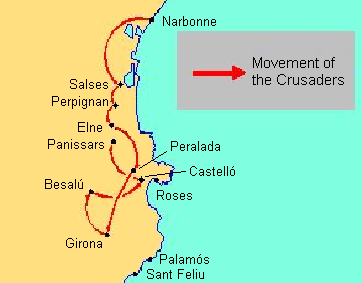 The route of the Aragonese Crusade: Srnec, Public domain, via Wikimedia Commons
Setting out in spring 1285, the French army entered Roussillon then advanced into Catalonia. The expedition ran into serious logistical and sanitary difficulties. Aragonese resistance, combined with the successes of the Catalan fleet commanded by Roger de Lauria, rapidly compromised the enterprise. On 3–4 September 1285, the French fleet was defeated at the Battle of Formigues.
 Battle of Formigues: Anonymous artist, Public domain, via Wikimedia Commons
Weakened by disease, probably malaria, Philip III ordered the retreat. The king died at Perpignan on 5 October 1285 during his army’s withdrawal. His death ended a fifteen-year reign marked by the continuity of Capetian work, but also by the monarchy’s growing entanglement in Mediterranean and Angevin affairs.
His son succeeded him as Philip IV the Fair, opening a new phase of Capetian history characterised by an even more pronounced strengthening of royal authority.
🧠 Key Points to Remember
- Philip III’s accession (1271) came with a decisive territorial gain
- The canonisation process of Louis IX (inquiry opened 1273, proclaimed 1297)
- Philip III’s reign was marked by deepening entanglement in Mediterranean and Angevin affairs
- The Sicilian Vespers (1282)
- The marriage of Philip the Fair to Joan of Navarre (1284)
- The Aragonese Crusade (1285)