

Philip IV the Fair: State, Taxation and Conflict with the Papacy (1285–1314)
1285 à 1314
The accession of Philip IV the Fair, in 1285, opens one of the most remarkable phases in the history of Capetian monarchy. Grandson of Louis IX and son of Philip III the Bold, the new king inherits a kingdom more vast, better administered and more solidly structured than in the time of his predecessors. Under his reign, French monarchy reaches an unprecedented degree of power, while entering a period of particularly intense political, financial and religious tensions.
The reign of Philip IV first continues the work of the Capetians. The royal domain has been considerably extended since the time of Philip Augustus, the administration has strengthened, royal justice advances, and monarchical authority tends to impose itself against feudal powers. But this consolidation is now accompanied by a clearer will toward centralization, sovereign affirmation, and control of the kingdom’s resources.
Nicknamed “the Fair” because of his appearance and the majesty that emanates from his person, Philip IV appears to chroniclers as a sovereign of great dignity, silent, distant and deeply attached to the greatness of the crown. His reign is less marked by the personal ideal of sanctity that surrounds Louis IX than by the rise of a more demanding, more administrative and more conflictual monarchical state.
Under Philip the Fair, royalty successively confronts great princes, Flemish cities, the papacy, and then the Order of the Temple. It also develops new means of government, relying on legists, more specialized officers and more ambitious, often contested taxation. The kingdom thus experiences a period of expansion of royal authority, but also of growing tensions around taxation, war and the very definition of the king’s power.
The reign of Philip IV thus constitutes a turning point. It extends the Capetian growth begun in the 12th and 13th centuries, while already announcing the political mutations of the late Middle Ages: affirmation of sovereignty, more frequent recourse to administrative writing, conflicts with universal authorities, and growing weight of the royal state in the life of the kingdom.
I. 1286–1291: Accession, First Arbitrations and Recompositions of the Capetian World
The first years of Philip IV the Fair’s reign are marked by the consolidation of his authority, the continuation of diplomatic balances inherited from the previous reign, and profound upheavals in the Mediterranean and Eastern spaces. Crowned at Reims on January 6, 1286, the new king continues Capetian tradition, while having to assert his position against neighboring powers and the consequences of Angevin policy in Italy and the Mediterranean.
 Homage of Edward I to Philip the Fair: Jean Fouquet, Public domain, via Wikimedia Commons
At the beginning of the reign, relations with England remain a central issue. Edward I travels to the continent in 1286 and comes to recognize his feudal dependence to the king of France for his continental possessions; this diplomatic sequence results, in August 1286, in an agreement concerning notably Quercy and Saintonge, which strengthens the Capetian position in the Southwest. At the same time, the assembly of States of Provence at Sisteron illustrates the institutional vitality of the Provençal space, closely linked to the interests of the House of Anjou.
The following years see the continuation of the Sicilian crisis arising from the Sicilian Vespers. In 1287, despite some initial Angevin successes in Sicily, Aragonese naval superiority is confirmed, notably with the victory of Roger de Lauria at Castellammare. The Treaty of Oloron, concluded in summer 1287 with the mediation of Edward I, seeks to organize a settlement around the question of Charles II of Anjou, held by Aragon since 1284; his liberation does not occur until 1288, and his coronation as king of Naples in 1289 does not end the conflict between Angevins and Aragonese.
 Signing of the Treaty of Oloron between emissaries of the king of France, England, and Alfonso III of Aragon in 1287: José Serra y Porson, Public domain, via Wikimedia Commons
On the internal front, the beginning of the reign is also marked by decisions concerning minorities and the kingdom’s resources. In 1290, King Edward I’s edict of expulsion drives out the Jews of England before November 1, including those from his Aquitanian lands, causing displacements toward Languedoc, Navarre and Castile. At the same time, Philip the Fair confirms the privileges of the clergy and strengthens his economic grip by acquiring the salt marshes of Peccais, near Aigues-Mortes, an important resource for taxation and salt commerce.
The year 1291 marks a major turning point for Latin Christendom. On May 18, the Mamluks take Acre after a siege of about forty days; the citadel held by the Templars falls in turn on May 28. In the months that follow, the last Frankish strongholds on the Levantine coast are evacuated or destroyed. The fall of Acre commonly marks the end of the Christian Kingdom of Jerusalem on the Asian continent; henceforth, the Latins of the East retain only Cyprus as their main foothold, while the Hospitallers withdraw there.
 The Defense of Acre during the Siege of 1291: Dominique Papety, Public domain, via Wikimedia Commons
At the same time, Western Mediterranean affairs continue to occupy an important place. The Peace of Brignoles, concluded in February 1291 after negotiations at Tarascon, seeks to stabilize relations between Alfonso III of Aragon, Charles II of Anjou and Philip IV. In France, the king also shows growing attention to the kingdom’s financial resources: on May 1, 1291, Lombard merchants and bankers are arrested and ransomed under accusations of usury. The same year, he authorizes the city of Cahors to levy a passage fee intended to finance the construction of the Pont Neuf. At this time finally, William of Nogaret, future principal advisor of the reign, still teaches law at the University of Montpellier.
Thus, between 1286 and 1291, the reign of Philip the Fair opens with a phase of installation still largely inherited from the Capetian equilibrium of the 13th century, but already crossed by tensions that will mark his entire government: rivalry with England, weight of Angevin affairs, growing attention to fiscal resources, and questioning of the Latin order in the Orient.
II. 1292–1295: Guyenne Crisis, Royal Affirmation and First Tensions with the Papacy
At the beginning of the 1290s, the reign of Philip IV the Fair enters a more conflictual phase. The monarchy strengthens its means of action, extends its intervention in several regions of the kingdom and finds itself progressively drawn into a confrontation with England over Guyenne, while the financial needs of war begin to open a first crisis with the papacy.

Quarrel between French and English Sailors at Bayonne: Edouard Zier, Public domain, via Wikimedia Commons
In 1292, the king takes Lyons under his protection, at the request of some of its inhabitants, and affirms more clearly the Capetian influence, even though the definitive attachment of the city to the kingdom does not occur until 1312. The same year, incidents at Bayonne between French and English sailors open a maritime crisis destined to escalate into broader political confrontation between the two crowns.
This rise in tensions is accompanied by an effort to organize naval forces. Beginning in 1292-1293, Philip the Fair establishes at Rouen the Clos aux galées, the kingdom’s first permanent royal arsenal, intended to provide the monarchy with more stable maritime infrastructure. This creation testifies to a Capetian state now concerned with having military means more directly controlled by the crown.
In 1294, using maritime violence of previous years as a pretext, Philip IV pronounces the seizure of the Duchy of Aquitaine on May 19, which triggers the War of Guyenne between France and England. The conflict quickly exceeds the simple Gascon framework and provokes a vast play of alliances: Edward I seeks support in the Empire and in northern principalities, while the French monarchy relies notably on Scotland and on several princes favorable to Capetian policy.
The British dimension of the crisis increases further when John Balliol, king of Scotland, breaks with Edward I. This evolution prepares the Franco-Scottish rapprochement that takes form in the middle of the decade. At the same time, the election of Boniface VIII at the end of 1294 introduces a major new actor: the pope intends to defend the Church’s prerogatives against monarchies seeking to tax the clergy to finance war.
The year 1295 sees the monarchy’s financial needs more clearly assert themselves. Philip IV carries out a major monetary mutation, striking coins less rich in precious metal while maintaining their nominal value, which provokes the first great monetary crisis. He also strengthens his control over the kingdom’s resources: he removes the Parisian Templars from guarding the royal treasury, transferring it to the Louvre, pressures holders of precious vessels through sumptuary measures, and seeks to increase fiscal revenues.
The same year, the king concludes with John Balliol a defensive alliance treaty, at the origin of the Auld Alliance between France and Scotland. This rapprochement is directly inscribed in the war against England. At the same time, Peter Flote emerges in the foreground as one of the monarchy’s principal servants, at the moment when a government increasingly marked by the influence of legists is being established around the king.
III. 1296–1297: Conflict with Boniface VIII and Extension of War to Flanders
In 1296, the war against England and its allies further increases the French monarchy’s financial needs. To maintain the army, Philip IV intends to levy a tithe on the clergy without papal authorization. This policy provokes direct confrontation with Pope Boniface VIII, who publishes, on February 25, 1296, the bull Clericis laicos, forbidding sovereigns from taxing ecclesiastical property without prior agreement of the Holy See.
The king responds by prohibiting the export of money from the kingdom, which directly affects transfers to Rome. This first trial of strength between the papacy and the French monarchy does not yet result in definitive rupture, but it already reveals the opposition between the pope’s universal pretensions and the affirmation of more autonomous royal sovereignty. It constitutes one of the first great ideological confrontations of the reign.
In the same context, war extends to the British Isles. In 1296, Edward I crushes the Scots at Berwick and then at Dunbar, deposes John Balliol and opens the First War of Scottish Independence. For France, the Scottish alliance remains nevertheless an important diplomatic lever against England.
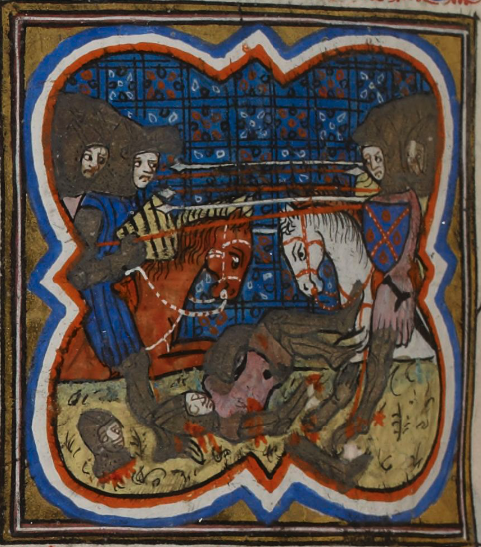 Battle of Furnes (1297): Unknown 14th-c. French artist, Public domain, via Wikimedia Commons
The crisis takes on new dimensions in 1297 when Count Guy of Dampierre more openly engages Flanders in the English camp. Philip the Fair reacts militarily: the French army captures Lille after a summer siege, then wins the Battle of Furnes on August 20, 1297, which allows the king to occupy part of western Flanders. Lille’s capitulation is followed by the sovereign confirming its privileges, according to the usual practice of Capetian monarchy toward conquered cities.
The same year also marks a temporary lull with the papacy: on August 11, 1297, Boniface VIII canonizes Louis IX, a gesture that temporarily helps ease relations with the French court. Finally, a truce is concluded with England on October 9, 1297, without however definitively resolving the underlying causes of the conflict. The War of Guyenne, the Flemish question and the quarrel with the papacy thus remain open and will continue to structure the reign in the years to come.
IV. 1298–1300: Internal Reforms, Diplomatic Pacification and Resumption of the Flemish Question
At the end of the 13th century, the reign of Philip IV the Fair enters a phase of internal consolidation, while the monarchy seeks to stabilize several diplomatic fronts opened in previous years. In 1298, the king promulgates an ordinance abolishing serfdom in his new southern provinces, a measure that fits into the policy of integrating recently attached territories to the royal domain.
The same year, the development of the Capetian South also translates into the founding of new towns. On August 1, 1298, the town of Marciac is created by a paréage contract signed at Toulouse, illustrating the extension of administrative and seigneurial control in the Southwest.
In 1299, the Treaty of Montreuil-sur-Mer restores peace between France, England and Flanders. By this agreement, Philip the Fair returns Guyenne to the king of England, while retaining certain advantages acquired during the conflict. However, this peace remains fragile, as tensions between the Capetian crown and the County of Flanders remain keen.
At the same time, the French monarchy pursues active diplomacy on the continent. The Conference of Vaucouleurs, in December 1299, brings Philip IV and Albert of Habsburg closer together against Pope Boniface VIII, a sign of increasingly poor relations between the French monarchy and the papacy.
The year 1300 marks both a resumption of operations in Flanders and an important moment for Western Christendom. Pope Boniface VIII indeed proclaims the jubilee year, which enjoys immense success and strengthens Rome’s prestige. But in the northern kingdom, the 1297 truce ends and royal forces resume the offensive. Charles of Valois intervenes in Flanders; Ghent surrenders, and Count Guy of Dampierre is captured. However, the Flemish question remains far from resolved.
V. 1301–1302: The Quarrel with Boniface VIII and the Affirmation of Royal Sovereignty
Beginning in 1301, the conflict between Philip the Fair and Boniface VIII becomes open. The affair of Bernard Saisset, bishop of Pamiers, plays a triggering role. Accused of treason, he is brought before the Parliament at Senlis, which provokes vigorous papal protest. Behind this trial looms an essential question: can the king of France judge a bishop in the temporal affairs of the kingdom?
The king and his counselors respond with growing affirmation of the monarchy’s independence in temporal matters. Royal propaganda then mobilizes jurists and legists, while the papal court denounces the encroachments of Capetian power. On December 5, 1301, the bull Ausculta fili affirms the superiority of papal power and commands the king to submit to the Holy See’s injunctions.
Philip IV responds with vigor. In February 1302, the bull is solemnly burned in Paris, a highly symbolic gesture. A few weeks later, the king convokes to Notre-Dame de Paris, on April 10, 1302, the first assembly of the States General of the realm. Clergy, nobility and representatives of good towns manifest their support for the king against the pope. This assembly marks an important stage in the kingdom’s political history: it illustrates the monarchy’s growing capacity to publicly mobilize the country’s forces around the defense of the crown.
In parallel, Philip IV also seeks to limit abuses of ecclesiastical jurisdictions. From 1301, then again by ordinance, he more strictly regulates the action of the Inquisition, whose struggle against heresy must pass more under the control of bishops. This policy participates in the same general logic: restrict encroachments by outside or competing authorities on the kingdom’s government.
VI. 1302–1303: Flemish Uprising, Courtrai Defeat and Radicalization of Papal Conflict
 Matins of Bruges: Master of the Policraticus of Charles V, Public domain, via Wikimedia Commons
As the quarrel with the papacy worsens, the situation deteriorates brutally in Flanders. On May 18, 1302, the Matins of Bruges see Flemish guilds massacre French royal agents present in the city. The uprising takes on general proportions and transforms into open war against Capetian domination.
On July 11, 1302, the French army suffers a resounding defeat at Courtrai against Flemish municipal militias. This battle, called the Battle of the Golden Spurs, constitutes a major shock: French chivalry is crushed by urban and artisanal footmen. The event deeply strikes contemporaries and reveals the limits of Capetian military power when it encounters solidly organized communal forces.
 Battle of the Golden Spurs: Anonymous, Unknown author, Public domain, via Wikimedia Commons
At the same time, the conflict with Boniface VIII reaches its climax. On November 18, 1302, the bull Unam Sanctam affirms with greatest clarity the universal superiority of papal power, including in the temporal order. In response, the king’s counselors, among them William of Nogaret, intensify their ideological offensive against the pope, presented as tyrannical, even heretical.
 The Pope Boniface VIII Captured by William of Nogaret: Unknown, French School, Public domain, via Wikimedia Commons
The year 1303 sees this crisis result in direct confrontation. Despite some attempts at diplomatic readjustment, notably with the Empire or with England, the rupture with the pope becomes irreversible. On September 7, 1303, during the Outrage of Anagni, agents of Philip the Fair, led by William of Nogaret, seize Boniface VIII. The episode provokes immense reverberations throughout Christendom: for the first time, a pope is publicly humiliated by the men of a Western sovereign.
Boniface VIII, liberated shortly after, dies in the following weeks. Without immediately resolving the quarrel, the Outrage of Anagni marks a decisive turning point in the history of relations between the French monarchy and the papacy. It symbolizes the rising power of a Capetian state now ready to confront papal authority frontally in the name of its sovereignty.
Climatic Crises, Political Mutations and New Fiscal Practices
These years are also marked by several fundamental developments. Chroniclers report, for 1303, a particularly harsh winter followed by strong summer drought, an episode sometimes related to the beginning of the Little Ice Age in older historiography.
On the financial front, the monarchy develops new instruments of assessment. In 1303 appears the fouage, a tax distributed by hearth, that is by household, which announces the gradual broadening of royal taxation beyond traditional feudal obligations. This evolution accompanies the strengthening of a monarchical state more demanding in resources, notably to support war and diplomatic action.
The entire period 1298–1303 thus appears as a decisive moment in the reign of Philip the Fair. The monarchy affirms its will to centralization and sovereignty, but at the cost of open conflicts with Flanders, with the papacy and with several social and political forces of the kingdom and Western Europe.
VII. 1304–1305: Resumption in Flanders and New Papal Situation
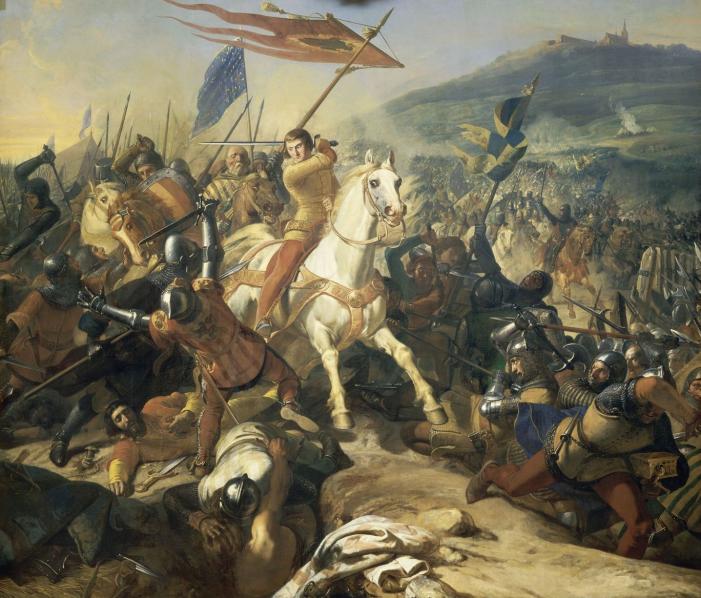 The Battle of Mons-en-Pévèle (1304): Charles-Philippe Larivière, Public domain, via Wikimedia Commons
After the reversals suffered in Flanders at the beginning of the 1300s, the Capetian monarchy resumes the offensive. On August 18, 1304, Flemish militias are defeated by Philip IV the Fair’s army at the Battle of Mons-en-Pévèle. Without definitively ending Flemish cities’ resistance, this victory allows the king to partially restore his authority in the region and subsequently negotiate from a position of strength.
This military resumption results in the Treaty of Athis-sur-Orge of June 23, 1305, by which Flanders must cede to the crown several important places, notably Lille, Douai and Béthune. The agreement consolidates a strengthening of the royal domain in the northern kingdom, even if the Flemish question remains open on the political and fiscal front.
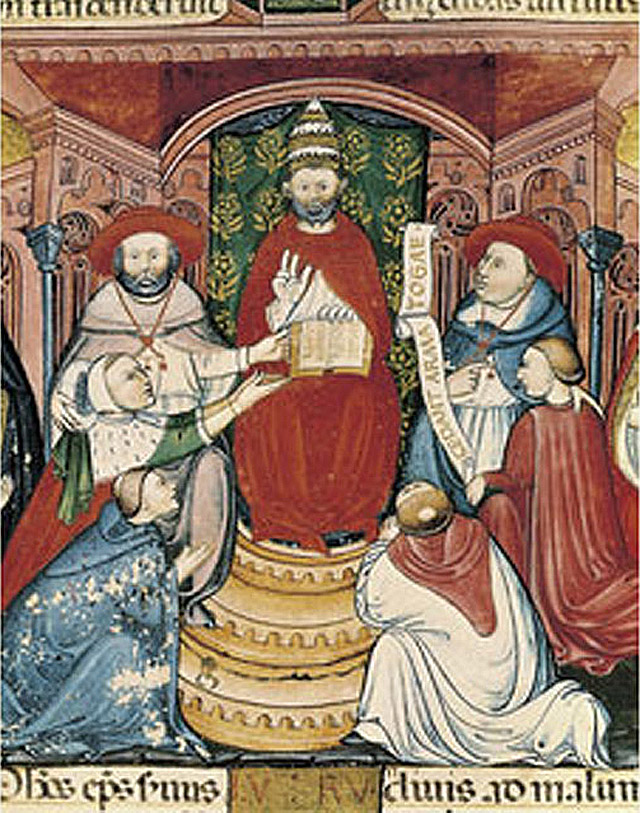 Clement V Rome Palatine Library: Unknown derivative work by JPS68, Public domain, via Wikimedia Commons
The year 1305 is also marked by a major event for relations between France and the papacy. On June 5, Archbishop of Bordeaux Bertrand de Got is elected pope as Clement V. His election, favored by the influence of Philip the Fair, opens a new phase in the history of the Latin Church; his pontificate is closely linked to the expectations of the French monarchy, and he is at the origin of the lasting establishment of the papacy in the Rhodanian space and then in Avignon from 1309 onward.
The coronation of Clement V, celebrated at Lyons on November 14, 1305, is marked by a spectacular accident: the collapse of a stand causes several deaths and injuries among the attendants. This episode strikes contemporaries at the very moment when a pontificate destined to play a decisive role in the reign’s affairs opens.
At the same time, the Capetian dynasty continues to organize its succession. With the death of Jeanne of Navarre, in 1305, her eldest son Louis, heir to the French crown, becomes king of Navarre as Louis I. A few months later, on September 23, 1305, he marries Margaret of Burgundy, strengthening the bonds between the Capetian house and the kingdom’s princely aristocracy.
VIII. 1306–1307: Internal Hardening, Expulsions and Opening of the Templar Affair
The years 1306 and 1307 are marked by a clear hardening of royal policy within the kingdom. In a context of strong financial, social and religious tensions, Philip IV multiplies measures of constraint against various groups or institutions, while strengthening the state’s control over the realm.
On June 21, 1306, the king orders the expulsion of Jews from France and the confiscation of their property. This decision fits into a broader policy of resource capture, in a kingdom where the monarchy seeks to face the costs of war and growing financial needs. The expelled disperse notably toward Spain and other neighboring lands.
The same year, social tension increases in the capital. On December 30, 1306, a revolt breaks out in Paris against rising rents and the effects of monetary mutations. The king must take refuge within the Temple’s enclosure, while the house of Stephen Barbette, held responsible by public opinion for monetary alterations, is burned. In reaction, royal power strikes the ringleaders hard: several are hanged in January 1307, and professional guilds are temporarily suspended.
At the same time, Philip IV continues to regulate the kingdom’s institutions. The University of Orléans is founded on January 27, 1306, becoming an important center for teaching Roman law, a discipline particularly useful to administrative monarchy and royal legists.
The year 1307 finally opens one of the reign’s most celebrated episodes. After several months of tension between the crown, the papacy and the Order of the Temple, William of Nogaret becomes keeper of the seals, then the king orders, on October 13, 1307, the simultaneous arrest of Templars throughout the kingdom. The operation notably targets Grand Master James of Molay and marks the beginning of the long trial of the order, accused of heresy and soon destined for suppression.
 Master of Boucicaut Clement V and Philip the Fair: Master of Boucicaut, Public domain, via Wikimedia Commons
This initiative fits into a context where Clement V, elected two years earlier, still seeks to spare the French monarchy while preserving papal authority over religious orders. James of Molay’s refusal of a merger project between Templars and Hospitallers further isolates the order at the moment when Capetian power decides to strike it.
IX. 1308–1310: Capetian Dynasty, Avignon Papacy and Religious Hardening
Between 1308 and 1310, the reign of Philip IV the Fair is marked by the consolidation of the Capetian house’s dynastic alliances, by strengthening French influence over the papacy and by an intensification of religious repression. These years also see the Templar Affair enter a decisive phase, while royal authority continues to assert itself in the provinces and institutions of the realm.
In 1308, the Capetian dynasty strengthens several of its political bonds. On January 25, Edward II of England marries Isabella of France, daughter of Philip the Fair, at Boulogne; she is then crowned in London on February 24. The same year, on February 2, Charles of France, future Charles IV the Fair, marries Blanche of Burgundy. These unions strengthen French monarchy’s position in the major princely balances of Western Europe.
The Templars question nonetheless occupies the foreground. In February 1308, Clement V attempts to reserve the conduct of proceedings to the papacy. In reaction, Philip IV convokes the States General, assembled at Tours from May 5 to 15, 1308, which express support for royal policy against the Order of the Temple. After hearing several order members, the pope must finally allow the inquisitorial procedure to proceed, which confirms the French monarchy’s political ascendancy in the affair.
At the same time, the Inquisition continues its action in the South. In March 1308, the first auto-da-fé is organized at Toulouse by inquisitor Bernard of la Guionie, in the struggle against the last centers of Catharism in Languedoc. This persistence of repression shows that, despite the movement’s ancient decline, heresy remains an issue of religious and political control in southern provinces.
The year 1309 is dominated by a major change in the history of the Latin Church. On March 9, Clement V settles in Avignon, opening the period known as the Avignon Papacy. This displacement of the effective center of papal government toward the Rhone valley greatly strengthens French influence over the papacy, even though it remains legally distinct from the monarchy. The same year, the pope also recognizes the election of Henry VII as king of the Romans, seeking to reorganize the political balance among Empire, papacy and Western monarchies.
In France itself, Philip IV continues to exercise his role as dynastic arbitrator. On October 9, 1309, during the first Artois Trial before the Court of Peers, he rules in favor of Mahaut of Artois against the claims of her nephew Robert III of Artois. This judgment confirms royal justice’s weight in settling major feudal disputes.
The year 1310 finally marks an aggravation of religious repression. On May 12, 1310, fifty-four Templars are burned near Paris after being condemned as relapsed; the event gives the Templar affair a spectacular and dramatic dimension. The same year, on May 31, the Inquisition burns the mystic Marguerite Porete at the Grève square, accused of doctrinal deviation through her work The Mirror of Simple Souls. These executions translate the increasing harshness of control exercised by ecclesiastical and royal powers over forms of religious or spiritual dissidence.
Between 1308 and 1310, the reign of Philip the Fair thus appears at a moment of full political intensity. Matrimonial alliances strengthen the dynasty’s position, the papacy’s settlement in Avignon permanently alters relations between France and the Church, and the Templars affair reveals how far Capetian monarchy can go in the joint use of law, political pressure and religious repression.
X. 1311–1312: Council of Vienne, Suppression of the Temple and Strengthening of the Royal Domain
The years 1311 and 1312 constitute the culmination of several major conflicts of Philip IV the Fair’s reign. The monarchy consolidates its position against the papacy, obtains the disappearance of the Order of the Temple and pursues the extension of the royal domain, while the Council of Vienne marks an important stage in relations between the king of France and the Church.
On April 27, 1311, by the bull Rex gloriae, Pope Clement V settles part of the contentious issues arising from the Outrage of Anagni: William of Nogaret and Sciarra Colonna obtain absolution, while formal condemnation of Boniface VIII is avoided. This compromise allows the pope to spare the French monarchy without explicitly disavowing his predecessor.
The Council of Vienne opens on October 16, 1311. Officially convoked to address Church reform, the Templar question and crusade projects, it is strongly influenced by the king of France’s pressure. Philip IV notably wished to obtain a condemnation of Boniface VIII’s memory, but Clement V manages to avoid this trial by concentrating debates on the Temple’s fate. The council also adopts several reform measures and encourages the development of Oriental studies in universities, with a view to better knowledge of Eastern Christendom’s and the Muslim world’s languages.
This sequence results, in 1312, in the official suppression of the Templars. By the bull Ad providam, published on May 2, 1312, Clement V suppresses the Order of the Temple and assigns its property in principle to the Hospitallers of Saint John of Jerusalem. The decision, already prepared politically by the French monarchy, is subsequently confirmed in the kingdom by Philip the Fair’s letters patent.
The same year, the Capetian monarchy records several territorial successes. On April 10, 1312, by the Treaty of Vienne, Lyons is attached to the kingdom of France, which further strengthens the Capetian position in the Rhone valley. A few months later, on July 11, Lille, Douai and Béthune are definitively returned to the king of France by the Treaty of Pontoise, consolidating gains obtained after the Flemish conflicts of the early century.
At the same time, the dynasty pursues its matrimonial policy. In July 1312, Philip of Valois, future Philip VI, marries Jeanne of Burgundy, a union destined to play an important role in the dynastic recompositions of the following decades. These political and territorial successes give the image of a monarchy having reached a very high degree of power, capable of imposing its views on princes, cities and even the papacy itself.
XI. 1314: Dynastic Crisis, War Taxation and End of the Reign
The year 1314 is one of the most dramatic of Philip IV the Fair’s reign. It is marked both by the bloody denouement of the Templar affair, by a resonant dynastic scandal, by new fiscal mobilization and by the sovereign’s unexpected death, which closes a reign of nearly thirty years.
 Execution of James of Molay: unkno, Public domain, via Wikimedia Commons
On March 18, 1314, James of Molay, last grand master of the Order of the Temple, and Geoffrey of Charney, are burned in Paris as relapsed after retracting their confessions. This spectacular execution constitutes the final act of the Templar affair and deeply strikes contemporaries. While some traditions give legendary details or diverge on the exact date, March 18, 1314 is the date most often retained by general syntheses.
A few weeks later breaks out the Tower of Nesle Affair, which directly touches the royal family. The king’s daughters-in-law are accused of adultery with the d’Aunay brothers; the latter are executed in particularly brutal conditions, while the compromised princesses are imprisoned. This scandal deals a serious blow to the dynasty’s moral prestige and darkens the sovereign’s last years. It will weigh heavily on forthcoming successions, already fragilized by the premature death or absence of male heirs among several of the king’s sons.
The same year also sees the disappearance of Clement V, dead on April 20, 1314. His disappearance opens a period of uncertainty at the head of the Church, at the very moment when the kingdom of France pursues a policy of firmness in fiscal and territorial matters. On August 1, 1314, Philip the Fair assembles the States General in Paris. The assembly decides the annexation of Flanders and votes the levying of a direct tax, the taille, intended to finance the conquest. This decision marks an important stage: for the first time, the royal state seeks to impose a direct levy on the entire kingdom’s scale.
But this will toward consolidation encounters growing resistance. In the reign’s final months appear noble and political tensions that announce troubles at the beginning of the next reign. On November 29, 1314, Philip IV the Fair dies suddenly. His eldest son succeeds him as Louis X the Stubborn, already king of Navarre since 1305. With this succession, Champagne, linked until then to the person of the queen of Navarre, is definitively reunited to the French crown.
Philip the Fair’s death ends one of the most powerful and most conflictual reigns of Capetian monarchy. Under his government, the kingdom experienced strong administrative centralization, an unprecedented affirmation of royal sovereignty and major confrontations with the papacy, England, Flanders and the Order of the Temple. But this power is also accompanied by growing fragility: fiscal tensions, dynastic scandals and succession uncertainties open a new phase of Capetian history.
Key Points to Remember
🎯 Key Numbers
- 1285: Accession of Philip IV the Fair
- 1291: Fall of Acre, end of the Christian Kingdom of Jerusalem in Asia
- 1294: Beginning of the War of Guyenne, seizure of the Duchy of Aquitaine
- 1296: Bull Clericis laicos, first confrontation with Boniface VIII
- 1297: Battle of Furnes, occupation of western Flanders
- 1302: Outrage of Anagni, culmination of conflict with Boniface VIII
- 1312: Suppression of the Order of the Temple, Treaty of Vienne (Lyons to the realm)
- 1314: Execution of James of Molay, Tower of Nesle Affair, king’s death
- 29 years: Duration of the reign (1285-1314)