

Louis X the Quarrelsome: Dynastic Crisis and Reforms Under Pressure (1314–1316)
1314 à 1316
The accession of Louis X, known as the Quarrelsome, in 1314, opens a new phase of Capetian history, marked both by dynastic continuity and by the first fragilities of the direct line. The eldest son of Philip IV the Fair and already king of Navarre since 1305, Louis inherited a powerful monarchy, highly centralized and engaged in multiple political, fiscal, and social tensions.
His accession to the throne occurred in a delicate context. The end of the reign of Philip the Fair left a kingdom strengthened administratively and territorially, but also traversed by profound discontent: protest against royal taxation, tensions with the nobility, the Flemish question still unresolved, and dynastic scandals that had durably tarnished the image of the royal family. The new king therefore had to strengthen his authority while responding to a need for appeasement.
Nicknamed “Le Hutin” (the Quarrelsome, or the Contentious), Louis X is traditionally presented as a sovereign with a more lively and unstable temperament than his father. His reign, very short, left him with only limited margin to impose a lasting political direction. He was above all confronted with the immediate legacy of Philippian monarchy, whose tensions he had to manage without having enough time to fundamentally restructure the kingdom’s equilibrium.
The government of Louis X was thus dominated by several major challenges: internal pacification, relations with the realm’s great lords, the Flemish question, as well as the situation of Navarre, which he personally united with the French crown. His reign was also distinguished by some important decisions, notably the ordinance asserting that “according to the law of nature, everyone must be born free”, often remembered as a symbolic milestone in the evolution of the serf condition in the kingdom.
Brief and unfinished, the reign of Louis X the Quarrelsome nonetheless constitutes an important stage. It inaugurates the series of short reigns of the last direct Capetians and announces the succession difficulties that would mark the following years, until the extinction of the direct male line in 1328.
1315: Political Concessions, Social Reforms, and Difficulties of the Early Reign
The year 1315 constitutes the true beginning of Louis X the Quarrelsome’s personal reign. Confronted with a monarchy weakened by tensions accumulated under Philip the Fair, the new king first sought to appease the discontent of the principalities, nobles, and cities, while asserting his authority through several decisions of symbolic scope. His government thus oscillated between political concessions, reforms inspired by royal authority, and military difficulties.
On March 19, 1315, Louis X promulgated the Charter to the Normans. Through this text, he recognized several guarantees specific to Normandy: maintenance of the competencies of the Norman Exchequer, respect for local customs regarding military service and aids, as well as periodic control of royal agents. This charter, granted in a context of appeasement after the tensions of the end of the previous reign, became one of the great provincial texts in Norman history and long remained invoked as a symbol of the province’s liberties.
 The Execution of Enguerrand de Marigny: Alphonse de Neuville, Public domain, via Wikimedia Commons
The spring of 1315 was also marked by two very different events, but equally revealing of the beginning of the reign. On April 30, Enguerrand de Marigny, the principal servant of Philip the Fair, was hanged at the gibbet of Montfaucon under pressure from a part of the nobility hostile to the former government. On the same day, Margaret of Burgundy, the king’s first wife, died in prison, compromised in the affair of the Tower of Nesle. This disappearance allowed Louis X to contract a new marriage a few months later.
 The Execution of Margaret of Burgundy (Tower of Nesle affair): Anonymous, artist-lithographer, CC0, via Wikimedia Commons
The reign of Louis X remains especially associated with the edict of July 3, 1315, in which the king asserted that “according to the law of nature, everyone must be born free”. This text targeted serfdom in the royal domain and provided for the emancipation of serfs in exchange for financial compensation. Its practical scope remained limited, as it did not apply immediately throughout the kingdom and often presupposed the purchase of liberty, but it nonetheless constituted an important milestone in the history of personal freedom in France.
 « According to the Law of Nature, Everyone Must Be Born Free »: Edme-Théodore Bourg, CC0, via Wikimedia Commons
In the same spirit of reorganization, Louis X also took several economic and administrative measures. An ordinance on Italian merchants, called Lombards, was promulgated on July 9, while another decision, on July 28, authorized the return of Jews to France for a period of thirteen years, in exchange for payment, while reiterating the prohibition of usury. This measure broke with the expulsion ordered in 1306 under Philip the Fair and responded both to fiscal considerations and to credit needs in the kingdom.
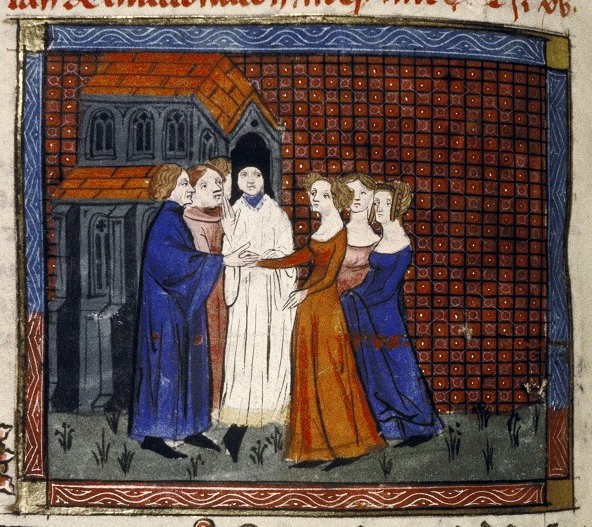 Marriage of Louis X with Clemence of Hungary: Grand Chronicles of France. MS. Douce 217., Public domain, via Wikimedia Commons
On the dynastic level, the king remarried with Clemence of Hungary on August 19, 1315. His coronation was celebrated at Reims on August 24. This double event reinforced the legitimacy of the new reign and also aimed to ensure succession quickly, in a context where dynastic stability had become a central question.
 Campaign of Louis X the Quarrelsome in Flanders: Jean Fouquet, Public domain, via Wikimedia Commons
However, the year was also marked by a military failure. Beginning on July 31, 1315, Louis X launched an expedition against the Flemish. The king joined his troops at Lille in early September, but the campaign fell short, due in particular to logistical difficulties and poor climatic conditions. This unfortunate enterprise showed that the Flemish question, inherited from the previous reign, remained one of the monarchy’s principal unresolved issues.
Finally, the king attempted to intervene on certain sensitive points of economic life. An ordinance of September 25, 1315 was directed against the hoarding of salt, a product essential to daily life and commerce. At the same time, troubles such as the revolt of Sens recalled that the kingdom remained traversed by strong local and social tensions.
Thus, the year 1315 appears as a moment of transition. Louis X the Quarrelsome sought to reconcile gestures of appeasement, assertion of royal authority, and practical responses to the kingdom’s difficulties. But the brevity of his reign and the persistence of political, fiscal, and military tensions limited the scope of this attempt at rebalancing.
The year 1316 brutally ended this reign already marked by instability. While the Flemish campaign had brought no decisive success and the reforms begun the previous year remained incomplete, the premature disappearance of the king opened a new dynastic crisis within the Capetian monarchy.
At the beginning of the year, Louis X remained confronted with the political consequences of his failed expedition against the Flemish. The kingdom remained troubled by the noble and provincial tensions inherited from the end of Philip the Fair’s reign, while the concessions granted in 1315, notably in Normandy, had not been sufficient to fully restore monarchical authority. Royal power therefore remained in a position of fragile equilibrium.
On June 5, 1316, Louis X the Quarrelsome died suddenly at the castle of Vincennes, at approximately twenty-six years of age. Chronicles report that he fell ill after drinking cold wine following a game of jeu de paume, although the exact circumstances of his death remain uncertain. His disappearance, after a reign of barely less than two years, interrupted a policy still hesitant between restoration of royal authority and search for appeasement.
At the moment of his death, Queen Clemence of Hungary was pregnant. While awaiting the birth of the king’s posthumous child, the government of the kingdom was entrusted to his brother Philip of Poitiers, who exercised the regency. This situation opened a period of succession uncertainty all the more grave as the only living child of Louis X was then his daughter Jeanne of Navarre, born from his first marriage with Margaret of Burgundy, whose legitimacy remained weakened by the memory of the Tower of Nesle affair.
On November 15, 1316, the queen gave birth to a son, John I, later called John the Posthumous, who became king at his birth. However, the child survived only a few days and died on November 20, 1316. This double disappearance provoked a major succession crisis: for the first time since the advent of the Capetians, the direct transmission of the crown was seriously threatened by the absence of a durable male heir.
The death of Louis X and then that of his posthumous son thus marked a decisive rupture. They opened the accession to the throne of Philip V the Tall and announced the succession difficulties that would lead, a few years later, to the extinction of the direct male line of the Capetians.
Thus, the reign of Louis X the Quarrelsome, despite some measures that remained celebrated, notably the 1315 ordinance on personal freedom, remained above all that of a sovereign of transition. Too brief to permit a durable reorganization of the kingdom, it inaugurated instead the series of dynastic crises that would profoundly weaken the Capetian monarchy in the years 1316-1328.
📌 Key Points to Remember
- Reign: 1314–1316 (less than 2 years)
- Ordinance of July 3, 1315: “according to the law of nature, everyone must be born free” (emancipation of serfs)
- Charter to the Normans (March 19, 1315): recognition of Norman liberties
- Marriages: repudiation of Margaret of Burgundy (Tower of Nesle affair), marriage with Clemence of Hungary (August 1315)
- Measures: Return of Jews (July 1315), ordinances against usury and hoarding of salt
- Dynastic Crisis: Death of the king (June 5, 1316), birth and death four months later of John I (November 1316)
- Succession: Impossible direct succession opens the succession crisis of 1316–1328
- Balance Sheet: Reign of transition, appeasement without durable reorganization, inaugurates the difficulties of the last direct Capetians