


John II the Good: Captivity, Internal Crisis, and the Treaty of Brétigny (1350–1364)
p51350 à 1364
The death of Philip VI on August 22, 1350, opens a new phase in the reign of the Valois. His eldest son succeeds him under the name of John II, soon to be called the Good. He inherits a kingdom tested by more than a decade of war against England, by the lasting effects of the Black Death, and by an increasingly tense financial and political situation.
The accession of John II does not challenge the legitimacy of the Valois dynasty, now established since 1328, but it occurs in a context of growing fragility. The loss of Calais, the destruction caused by English raids, the demographic weakening of the kingdom, and the persistence of princely tensions make the exercise of power more difficult. The new king must simultaneously continue the war, restore monarchical authority, and maintain the cohesion of the kingdom.
John II appears to the chroniclers as a prince deeply marked by the chivalric ideal. His reign is often associated with a noble and warlike conception of royalty, founded on honor, fidelity, and personal prestige. But this ideal clashes with a harsher political reality: rising fiscal pressure, the growing role of assemblies, the weight of great princes, court rivalries, and the monarchy’s still incomplete adaptation to new forms of warfare.
Under John the Good, the Hundred Years’ War enters a decisive phase. The kingdom must face not only English offensives but also increasingly serious internal difficulties. The reign is marked by major episodes: the rise of Charles of Navarre, the defeat at Poitiers, the king’s captivity, the Paris crisis led by Étienne Marcel, the Jacquerie, and then attempts at monarchical reconstruction.
The reign of John II thus appears as one of the most dramatic of the fourteenth century in France. It continues the difficulties opened under Philip VI, but it carries them to an unprecedented degree of tension. Between chivalric greatness and the weakening of power, it constitutes a pivotal moment in the history of French monarchy, on the threshold of the profound political recompositions that will mark the second half of the century.
I. 1350–1351: John II’s Accession, Kingdom Reorganization, and Renewed Tensions
The beginning of John II the Good’s reign fits into a context of ongoing war, economic fragility, and profound political tensions. Having ascended the throne at the death of Philip VI, the new king seeks to quickly assert his authority, reorganize the kingdom, and seize the initiative against external threats as well as internal disorders.
A few days after the new sovereign’s accession, the war against England continues at sea. On August 29, 1350, at the Battle of the Spaniards at Sea, the English fleet commanded by Edward III wins a victory over a Castilian fleet allied with the French and commanded by Charles of La Cerda. This confrontation confirms the growing importance of the English Channel and maritime routes in the Franco-English conflict.
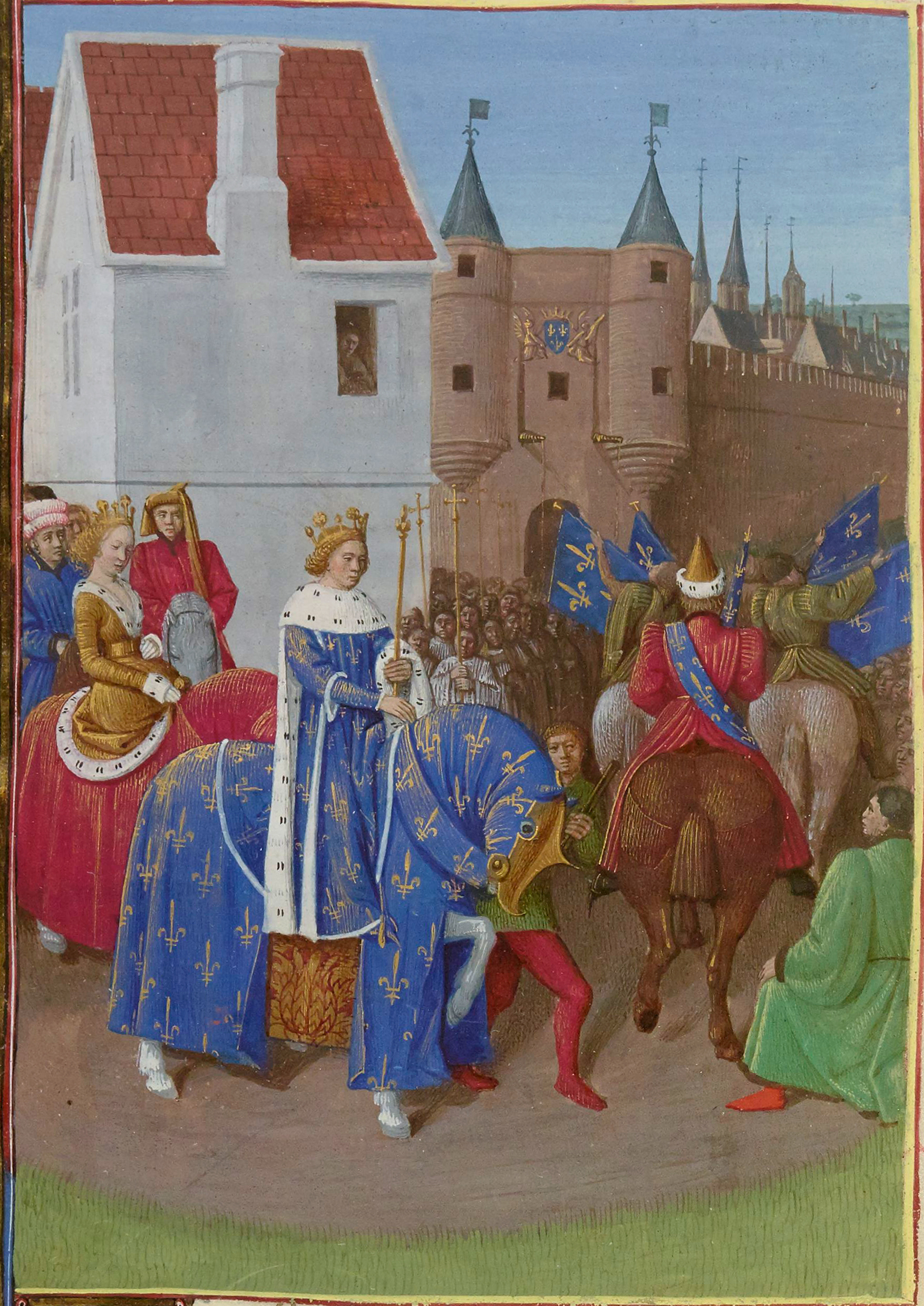 Entry of John II the Good into Paris: Grandes Chroniques de France, illuminated by Jean Fouquet, Tours, circa 1455-1460 Paris, Public domain, via Wikimedia Commons
On September 26, 1350, John II is crowned at Reims, at the same time as his wife Jeanne of Boulogne. This coronation gives full legitimacy to the new reign, in a kingdom tested by military defeats, demographic crisis, and financial difficulties of previous years.
The beginning of the government is also marked by a spectacular show of firmness. On November 19, 1350, the constable Raoul II of Brienne, count of Eu and Guînes, is arrested and then executed by order of the king on charges of high treason. A great lord of the north of the kingdom, heir to an essential military position, Raoul had just returned from English captivity, having been captured during the campaign of 1346. His return immediately aroused the court’s suspicion.
The exact motives for his condemnation remain poorly known, as the matter is handled in great opacity. Several rumors claim that he had negotiated his liberation by making excessive concessions to the English, perhaps by promising the place of Guînes, or even by recognizing Edward III as king of France. Whatever the precise charges against him, his rapid execution shows John II’s determination to strike hard at the beginning of his reign and to signal that no rank, not even that of constable, protects from disgrace.
This decision, brutal and long debated, reveals both the harshness of the new power and the climate of suspicion that reigns then at the highest levels of state. In a kingdom weakened by war and the defeats of the previous reign, the loyalty of great lords becomes a central question, and the king clearly intends to remind everyone that loyalty to the crown can tolerate no ambiguity.
The reign also begins in a context of persistent economic tensions. A famine strikes Flanders between 1350 and 1351, while the Black Death continues to extend its effects throughout Northern Europe, reaching Sweden, Greenland, and Iceland. Even when the epidemic temporarily recedes in some regions, its demographic, social, and economic consequences remain profound.
In 1351, John II seeks to strengthen the framework of the kingdom. On January 30, an ordinance on the trades of Paris regulates wages, working hours, and the discipline of workers. The text aims especially to combat idleness, limit labor mobility, and prevent workers from leaving their workshop too freely to obtain better wages. This measure fits into the context of a labor market disrupted by the effects of the plague and the scarcity of the active population.
On April 30, 1351, the king creates the commissioners of war, tasked with better organizing the military needs of the monarchy. This decision testifies to an effort at administrative rationalization in a kingdom where war becomes more durable, more costly, and more demanding in terms of organization.
 The Combat of the Thirty: Octave Penguilly L’Haridon, Public domain, via Wikimedia Commons
On the military front, the year remains marked by the continuation of combat, notably in Brittany, where the War of Succession has opposed since 1341 the supporters of Charles of Blois, backed by the French monarchy, to those of John of Montfort, supported by England.
On March 27, 1351, the famous Combat of the Thirty takes place between the places of Josselin and Ploërmel. It is less a decisive battle than an agreed combat between two groups of champions chosen from each camp, one led by John of Beaumanoir for the Blois faction, the other by Robert Bemborough for the Montfort faction. Victory goes to the supporters of Charles of Blois. The episode, widely celebrated by chroniclers, is mainly remembered as an exemplary manifestation of the chivalric ideal, more than as a military turning point in the war.
A few months later, on August 14, 1352, the Battle of Mauron shows the much harsher and more strategic face of the Breton conflict. An Anglo-Breton army, notably commanded by Walter Bentley, faces a Franco-Breton army favorable to Charles of Blois, led by Guy II of Nesle. The victory of the Montfort camp confirms that Brittany remains one of the main fronts of Franco-English rivalry and that the Breton War of Succession fully fits within the larger framework of the Hundred Years’ War.
At the same time, the monarchy seeks to combine war and diplomacy. On February 12, 1351, Charles II of Navarre marries Jeanne, daughter of John II. This matrimonial alliance initially seems to strengthen the ties between the French crown and the house of Navarre, but it will not prevent the subsequent rise of tensions between the king and his son-in-law.
From summer onward, hostilities resume more directly between France and England. In August 1351, John II retakes Saint-Jean-d’Angély, before a new truce is concluded on September 11. This alternation of local offensives and temporary suspensions of combat shows that the war remains still discontinuous, without either side being able to impose a lasting solution.
Finally, on November 6, 1351, John II founds the Order of the Star, also called the order of the knights of Notre-Dame de la Noble House. Through this creation, the king seeks to exalt the chivalric ideal around his person and strengthen the nobility’s loyalty to the crown. The initiative reveals the importance John II attaches to the symbolic representation of royalty and the restoration of monarchical prestige after the difficulties of the previous reign.
Thus, between 1350 and 1351, the reign of John II the Good opens under the sign of a double ambition: to restore the authority of royal power within the kingdom and to reaffirm the military and political dignity of the monarchy against England. But this will to recovery is exercised in a context still profoundly unstable, where war, economic crisis, and princely tensions continue to weigh heavily on the kingdom.
II. 1354–1355: The Navarrese Crisis, Royal Concessions, and the Affirmation of the Estates
The years 1354 and 1355 see John II the Good’s reign enter a more unstable phase. While the war against England resumes in the background, the king must face a grave political crisis provoked by Charles II of Navarre, called Charles the Bad, whose ambitions, shifting alliances, and dynastic proximity to the royal house make him a particularly dangerous opponent.
The breaking point comes on January 8, 1354, with the assassination of Charles of La Cerda, constable of France and the king’s favorite, by men of the king of Navarre. The murder takes place at L’Aigle, in Normandy, in a context of acute rivalry between the two men. Charles of Navarre feels notably aggrieved by the favor given to La Cerda, to whom John II had awarded lands that the Navarrese considered as falling within his rights. Far from denying the crime, Charles quickly assumes his role in the affair and immediately seeks to use the threat of an English alliance to force the king to negotiate.
 King John II the Good receives the submission of Charles II of Navarre: Merry-Joseph Blondel, Public domain, via Wikimedia Commons
This strategy proves effective. On February 22, 1354, the Treaty of Mantes officially reconciles John II and Charles the Bad, very much to the latter’s advantage. The king of Navarre obtains important territorial concessions and a form of political pardon, without his loyalty being truly assured. This agreement manifests both the momentary weakness of the monarchy against a turbulent great prince and the complexity of the political game of the time, where the English threat allows Charles of Navarre to extract considerable advantages.
Meanwhile, other recompositions affect the margins of the kingdom. On August 28, 1354, ten cities of Alsace form the Decapolis, an urban league intended to defend their privileges against princely powers, notably the Habsburgs. Even if this event primarily concerns imperial territory, it testifies to the political transformations of the world neighboring the Kingdom of France, where cities seek to preserve their autonomy in a context of seigniorial and dynastic tensions.
The year 1355 is likewise marked by a combination of border tensions, regional troubles, and growing financial needs. On January 5, the Treaty of Paris concluded with the count of Savoy, Amadeus VI, clarifies the border between Savoy and the Dauphiné, recently drawn into the French sphere. This settlement participates in the stabilization of the kingdom’s Alpine borders. In the South, the revolt of Robert of Duras against the queen Joan of Naples and Provence further revives Provençal disorders, before the insurgent is finally forced to capitulate.
But it is especially on the internal plane that 1355 prepares the great crises to come. Facing the demands of war against England, John II must obtain new resources. On December 2, 1355, he convenes in Paris the Estates General of the langue d’oïl to solicit subsidies. The assembly grants exceptional aid, but this concession is accompanied by increasingly marked political demands from the representatives of the kingdom. Around figures like Étienne Marcel and Robert Le Coq, a bourgeois and reformist opposition begins to assert itself against the monarchical government.
This development announces the great political crisis of 1356–1358. The Great Ordinance, drawn up at the end of 1355 and then promulgated in March 1357, aims to more strictly limit the king’s action, notably in financial and administrative matters. Inspired in spirit by the idea of greater control of royal power, it constitutes one of the clearest signs of the strengthening of the Estates and Parliament at the heart of the war. Without yet calling the monarchy itself into question, it shows that the kingdom is entering a phase where military weakness, fiscal pressure, and princely ambitions combine to shake royal authority.
Thus, between 1354 and 1355, the reign of John II the Good is dominated by a double weakening. Externally, the war against England remains threatening; internally, the activism of Charles the Bad and the rising political demands of the Estates General reveal the limits of royal power. These tensions announce the far graver trials that the kingdom will have to face in the years to come.
III. 1356: The Arrest of Charles the Bad, the Disaster of Poitiers, and the Opening of the Political Crisis
At the beginning of the year, royal power still seeks to strengthen its dynastic and territorial control. On January 6, 1356, the Dauphin Charles becomes Duke of Normandy, giving him a prominent position in one of the most sensitive spaces of the kingdom, in the immediate proximity of Navarrese and English zones of influence. At the same time, internal political tensions remain acute, notably around Charles the Bad, king of Navarre, whose ambition and intrigues worry the court.
The breaking point comes on April 5, 1356. At Rouen, John II has Charles II of Navarre, called Charles the Bad, arrested by surprise, a prince particularly dangerous to the monarchy: king of Navarre, count of Évreux, powerful Norman lord, he is also a close relative of the royal family and can claim Capetian descent. Since the assassination of the constable Charles of La Cerda in 1354, for which he is held responsible, his relations with the king have continued to deteriorate despite superficial reconciliations.
In early 1356, John II is warned of new Navarrese intrigues and suspicious contacts with the English. Taking advantage of a meeting of the Norman nobility at the castle of Rouen, where Charles is present at the Dauphin’s invitation, the king appears in arms and orders his arrest. Several of his principal supporters are seized and executed shortly after.
 Arrest of Charles the Bad by King John in 1356: Antoine Rivoulon, Public domain, via Wikimedia Commons
The affair, spectacular, reveals the extreme tension that now opposes the king to this great prince, both a close relative of the royal family and leader of a powerful noble network, especially in Normandy. The arrest of Charles the Bad does not pacify the kingdom; it contributes instead to radicalizing part of the aristocracy and fueling lasting contestation of royal government.
On the institutional plane, contestation also extends to the kingdom’s assemblies. On March 24, 1356, the Estates of the langue d’oc, assembled in Toulouse, in turn vote, following the assemblies of the north, a great ordinance aiming to more strictly regulate royal action. In a context of costly war and increasing taxes, these demands reflect the kingdom’s elites’ desire to control fiscal policy, officers, and government more closely. They announce the political crisis that will fully unfold after the king’s capture.
Meanwhile, the war against England resumes with vigor. In parallel to operations conducted in the West by the Duke of Lancaster, who begins in October 1356 the Siege of Rennes within the framework of the Breton War of Succession, the main danger comes from the southwest. Edward of Woodstock, called the Black Prince, leads from Aquitaine a great raid across the kingdom. John II then decides to block his way and seek decisive battle.
The encounter takes place near Poitiers on September 19, 1356. The battle results in a catastrophe for the French monarchy. As at Crécy ten years earlier, French chivalry encounters an English army better organized, solidly positioned, and backed by its archers. John II the Good fights personally with great courage, but he is finally captured along with many lords and knights. The defeat at Poitiers is immediately perceived as a national disaster; it strikes an enormous blow to the military prestige of the Valois and deprives the kingdom of its sovereign in the midst of war.
 Sketch for the Battle of Poitiers: Eugène Delacroix, Public domain, via Wikimedia Commons
The capture of the king immediately opens a new phase of the conflict. The Dauphin Charles assumes the regency and attempts to maintain royal authority in a disoriented kingdom. As early as October 17, 1356, the Estates General are assembled in Paris. The delegates take advantage of the weakness of power to demand profound reforms and assert their political role further. Around the provost of merchants Étienne Marcel, an urban and reformist opposition begins to structure itself against the princely government. This dynamic marks the beginning of the great Paris political crisis of 1356–1358.
The year is also marked by other significant developments. On October 1, 1356, Robert of Fiennes becomes constable of France, in an effort at military reorganization after the king’s capture. At the University of Paris, a quarrel between the Picard nation and the English nation finally recalls how much the Franco-English conflict now weighs even in scholarly and student circles. Thus, in 1356, France enters simultaneously into a military crisis, a de facto dynastic crisis, and an internal political crisis. This triple shift makes this year one of the most decisive moments of John II the Good’s reign.
IV. 1357–1358: The Great Crisis of the Kingdom, Between Reform, the Parisian Revolution, and the Jacquerie
From the beginning of 1357, the Dauphin Charles, charged with government in the absence of his father, must convene the Estates General in Paris. Assembled on February 5, they intend to take advantage of the monarchy’s weakness to impose a reform program. On March 3, 1357, under the impulse of the provost of merchants Étienne Marcel, the Great Ordinance is promulgated, a vast reform text that provides notably for stricter control of subsidies by the Estates, the addition of a council to the Dauphin, and the removal of some compromised royal counselors. This attempt does not yet call the monarchy itself into question, but it tends to profoundly transform its functioning in favor of a government more closely watched by the kingdom’s representatives.
 Charles V the Wise and Étienne Marcel: Unknown, Public domain, via Wikimedia Commons
The same spring, the war marks a relative pause. On March 23, 1357, after John II’s capture at Poitiers, a new truce is concluded at Bordeaux between the captive king and the Black Prince. John II then leaves for England, where he remains captive for several years. In Brittany, by contrast, combat continues: on July 5, 1357, the Siege of Rennes, led by the Duke of Lancaster, fails, and the city’s resistance contributes to keeping the Breton conflict in stalemate. Later traditions associate Bertrand du Guesclin with this defense, whose reputation begins then to assert itself.
 Bertrand du Guesclin during the Siege of Rennes, 1357: Histoire de France en cent tableaux by Paul Lehugeur. A. Lahude, Paris, c. 1883., Public domain, via Wikimedia Commons
The political crisis changes dimension in autumn. On November 9, 1357, Charles the Bad, detained since his arrest at Rouen in 1356, is freed by a coup by his supporters. His return to Paris on November 29 is triumphal. Étienne Marcel, who sees in him a possible counterweight to the Dauphin’s authority, favors his rapprochement with the Parisian reformist movement. Under this pressure, the Dauphin grants him pardon, restitution of his goods, and an indemnity. From then on, the crisis ceases to be merely institutional: it also becomes an open struggle between princely factions, urban power, and royal government.
In January 1358, a first Treaty of London is concluded between John II and Edward III concerning the royal ransom and possible territorial concessions. This plan, judged extremely burdensome for the kingdom, further fuels discontent. In Paris, tension reaches its peak on February 22, 1358. That day, Étienne Marcel’s supporters invade the palace where the Dauphin resides and assassinate before his eyes the marshals John of Conflans and Robert of Clermont. The provost then imposes the presence of bourgeois representatives on the prince’s council. This episode, of exceptional violence, makes the Parisian movement a true urban revolution directed against princely government. The Dauphin nevertheless manages to leave the capital at the end of March and seeks to reconstitute around him a party of monarchical loyalty.
 Confrontation of the Provost of Merchants Étienne Marcel against the Dauphin Charles, the royal marshals are killed: Lucien-Étienne Mélingue, Public domain, via Wikimedia Commons
In this climate of disintegration of power, at the end of May 1358, the Great Jacquerie erupts. Starting from the Beauvaisis and Brie, the peasant revolt spreads rapidly in several rural areas of the north of the kingdom. The insurgents target castles, lords, and their families, in a context aggravated by the ravages of war, the destruction of armed companies, and the collapse of central authority. The movement, associated with the name William Carle, finds occasional support among some bourgeois and in Étienne Marcel’s camp, without however resulting in a stable alliance between Paris and the countryside.
 Peasants slaughtering a nobleman: French: Illumination. Chronicles of Froissart.English: Illuminated manuscript. Froissart’s Chronicles., Public domain, via Wikimedia Commons
The seigniorial reaction is swift and brutal. In early June 1358, as the Great Jacquerie reaches its maximum extension, the insurgents, joined by Parisian elements favorable to Étienne Marcel, attempt to seize Meaux, where part of the Dauphin Charles’s family has taken refuge.
 As they attempt to take the fortress of the market of Meaux where the family of the Dauphin Charles is entrenched, the jacques and their Parisian allies are surprised by a charge of chivalry by Gaston Phébus and John of Grailly (June 9, 1358): Jean Froissart, Chronicles, Flanders, Bruges, 15th c., folio 226, verso (BNF, ms. Français 2643) - Loyset Liédet, Public domain, via Wikimedia Commons
On June 9, they are dispersed by a cavalry charge led notably by Gaston Fébus and John of Grailly. At the same time, other aristocratic forces, led notably by Charles the Bad, crush the jacques at the Battle of Mello. These two reverses open the way to repression of extreme violence, which kills several thousand and breaks the peasant insurrection in just a few days. The kingdom’s crisis is not yet over, however, as Parisian agitation continues around Étienne Marcel.
 Assassination of Étienne Marcel: Loyset Liédet, Public domain, via Wikimedia Commons
The denouement comes during the summer. Étienne Marcel, increasingly compromised by his rapprochement with Charles the Bad, gradually loses the support of some Parisians. On July 31, 1358, he is killed by John Maillard, a supporter of the Dauphin. Two days later, on August 2, the Dauphin Charles re-enters Paris and regains control of the capital. The monarchy is not yet restored in all its strength, but the revolutionary moment is broken. It is also in this context that the chronicler Richard Lescot brings forward the Salic Law, used to retroactively justify the exclusion of women from succession and, thereby, the legitimacy of the Valois.
Thus, between 1357 and 1358, the Kingdom of France traverses a crisis of exceptional scope. To external war are added the imprisonment of the king, the political contestation of the Estates General, the Parisian insurrection, the peasant revolt, and the murky game of Charles the Bad. In this trial, the Dauphin Charles learns the exercise of power; his ability to retake Paris and gradually restore monarchical authority already announces the style of government he will deploy later under the name of Charles V.
V. 1359–1360: Refusal of the Treaties of London, Edward III’s Raid, and the Peace of Brétigny
The year 1359 opens in a climate of profound disorganization. Chronicles report a very harsh winter, severe enough to freeze the Rhine for several weeks at Mainz, before it is followed by prolonged rains and floods. In the Kingdom of France, already weakened by the defeat at Poitiers, John II’s captivity, and the troubles of 1358, monarchical authority remains very fragile.
 Ravages of the Great Companies in France during the Hundred Years’ War: Master François, Public domain, via Wikimedia Commons
This weakness favors the action of routiers and great companies, these groups of fighters often from former French or English armies, now without stable employment or regular pay, who live off the country. They multiply plundering, ransoms, fires, and violence against populations. On March 10, 1359, Auxerre is thus sacked by the men of English captain Robert Knolles, one of the most feared leaders of the time. From Brittany to Burgundy, Knolles leads devastating raids, while Arnaud of Cervole, called the Archpriest, acts in Berry and Nivernais with comparable brutality.
 The Grand Ferré: Pouazity3, CC BY-SA 4.0 https://creativecommons.org/licenses/by-sa/4.0, via Wikimedia Commons
This chronic insecurity is not limited to great military operations. In many regions, rural communities and small places must improvise their own defense. It is in this context that the figure of the Grand Ferré appears, a Picard peasant famous for his resistance against Anglo-Navarrese routiers at Longueil-Sainte-Marie in 1359. His episode, amplified by chroniclers and then by later national memory, illustrates how war overflows far beyond the framework of royal armies to directly reach villages, markets, and ordinary populations.
Thus, at the beginning of 1359, France is not only threatened by English offensives or by ongoing diplomatic negotiations: it is also being undermined internally by the circulation of armed bands that thrive on the central power’s weakening. This diffuse violence contributes to making the Hundred Years’ War not only a war of princes, but also a daily trial for the kingdom’s populations.
At the same time, peace negotiations undertaken around the captive king result in a new plan extremely harsh for France. On March 24, 1359, the second Treaty of London, also called the Endenture, provides for even more extensive territorial concessions than those previously considered. But this text is rejected in France. On May 25, 1359, the Estates General refuse to ratify the conditions accepted by John II, deeming that they would excessively compromise the kingdom’s integrity. This refusal confirms the resistance policy conducted by the Dauphin Charles, who prefers to continue the struggle rather than accept losses deemed humiliating.
Amidst this crisis, the Dauphin also seeks to neutralize internal tensions. The Treaty of Pontoise, concluded in August 1359 with Charles II of Navarre, aims to temporarily restore an agreement between the two princes. Charles the Bad publicly renounces certain immediate claims, while the regency attempts to restore a form of political unity against the English threat. This agreement, however, remains fragile and largely dictated by the imminence of a new enemy campaign.
Indeed, in autumn 1359, Edward III decides to resume the offensive to force the French to accept the rejected treaty. He disembarks on the continent and launches a new raid, one of whose major objectives is to have himself crowned king of France at Reims, the traditional site of Capetian coronation. On December 4, 1359, he besieges Reims, but the city resists and supply becomes difficult. The siege is finally raised in January 1360, without decisive result. This failure is important: Edward neither manages to impose a rival coronation nor to break the avoidance strategy conducted by the Dauphin, who stubbornly refuses pitched battle.
At the beginning of 1360, the English campaign continues nonetheless with great brutality. After the failure before Reims, the English army descends toward the Paris region. On March 31, 1360, Edward III installs his headquarters near Saint-Germain-lès-Arpajon and directs the investment of Paris. Several nearby localities are occupied, plundered, or ravaged in the process. But the Dauphin Charles persists in a scorched earth strategy: avoid battle, strengthen fortified places, exhaust the enemy, and let attrition of time, supply, and climate do their work. This prudent but effective policy eventually seriously weakens the English army.
The turning point of the campaign comes during the famous Black Monday, on April 13, 1360. As the English army withdraws toward Beauce, a violent hailstorm falls upon it, causing heavy human and material losses. The event strikes contemporaries deeply, who often see in it a sign of divine providence. Without being the only cause of the opening of new negotiations, this episode clearly helps convince the English that the campaign cannot be pursued indefinitely under favorable conditions.
 1365: France after the Treaties of Brétigny and Guérande: The author could not be automatically identified. It is believed to be: Aliesin (given the copyright claim)., CC BY-SA 3.0 http://creativecommons.org/licenses/by-sa/3.0/, via Wikimedia Commons
Discussions then resume rapidly and result in the Peace of Brétigny, concluded on May 8, 1360. This treaty ends the first phase of the Hundred Years’ War. Its clauses are very harsh for France: Edward III obtains, in full sovereignty, a significantly enlarged Aquitaine — notably comprising Guyenne, Gascony, Poitou, Saintonge, Limousin, Quercy, Rouergue, and other territories — as well as Calais, Guînes, and Ponthieu. In exchange, he renounces the immediate claim to the crown of France. John II’s ransom is set at three million gold crowns, and two of his sons must be delivered as hostages to guarantee the agreement’s execution.
The treaty is ratified at Calais in October 1360, and John II regains freedom shortly after. The settlement, however, does not restore internal peace. The great companies, which neither the French monarchy nor the Black Prince can truly control, continue to ravage several provinces. The same year, the monarchy also proceeds to various reorganizations: the Parliament tends to assert itself more as a specialized section of the Council in judicial matters, while the ordinance of December 1360 creates the franc à cheval, a new gold coin struck in the context of settling the royal ransom. Finally, at year’s end, the companies seize Pont-Saint-Esprit, proof that the signing of peace does not end insecurity.
Thus, between 1359 and 1360, the Kingdom of France traverses a decisive sequence. The refusal of a treaty deemed unacceptable, the Dauphin’s prudent resistance, the failure of English coronation at Reims, and the Black Monday climatic catastrophe ultimately lead to a heavy but temporary compromise. The Peace of Brétigny closes the first period of the Hundred Years’ War, without resolving the conflict’s underlying causes or fully restoring monarchical authority over a kingdom exhausted by war, ransoms, and devastation.
VI. 1361–1363: Plague, Great Companies, and Territorial Recompositions
The last effective years of John II the Good’s reign are marked by the persistence of crises that have struck the kingdom since the defeat at Poitiers. The plague reappears in the early 1360s, while the great companies continue to ravage several regions of the kingdom. At the same time, the monarchy pursues a policy of territorial reorganization, notably in Burgundy, as the war against England enters a new phase.
In 1361, a new outbreak of plague strikes several major European centers, notably Paris, Avignon, and London. This resurgence confirms that the catastrophe opened in 1348 has not disappeared and continues to weigh heavily on the kingdom’s demographics, economy, and social structures.
The same year, the Burgundian question takes on new importance. At the death of Philip of Rouvres, last Capetian Duke of Burgundy, the duchy reverts to the crown. John II resumes possession of it before transmitting it in 1363 to his younger son Philip the Bold. This decision founds a new princely apanage destined to play a major role in the history of the late Middle Ages.
 The Burgundian State under Duke Philip the Bold between 1363 and 1404: Marco Zanoli, CC BY-SA 4.0 https://creativecommons.org/licenses/by-sa/4.0, via Wikimedia Commons
In 1362, the internal military situation remains very concerning. On April 6, the Late-Comers, one of the most feared great companies, crushes the royal host commanded by James of Bourbon at the Battle of Brignais, near Lyon. This defeat illustrates the monarchy’s persistent impotence in controlling armed bands that live off the country on the margins of truces and treaties. Other captains, like Seguin of Badefol, continue their plundering and occupation operations, showing that war continues in the form of diffuse and almost autonomous violence.
 Battle of Brignais (1362). The French army is defeated by the Great Companies, bands of mercenaries ravaging France during the Hundred Years’ War: Jean Froissart, Public domain, via Wikimedia Commons
The same year, the Franco-English conflict reorganizes itself politically. On July 19, 1362, Edward III erects Guyenne as the Principality of Aquitaine and entrusts its government to his son Edward of Woodstock, the Black Prince. This choice manifests the English determination to permanently structure their continental possessions and give them stronger political coherence.
Faced with these disorders, the monarchy tries to react. The Estates General of Amiens, assembled at the end of 1362, grant subsidies to fight the great companies. At the same time, the Dauphin Charles is entrusted with a larger political role in the langue d’oïl countries, a sign that monarchical succession is already being prepared in practice.
Thus, between 1361 and 1363, John II’s reign appears marked by a double difficulty: on one hand, the resumption of demographic crises and the chronic insecurity caused by the companies; on the other, the necessity to redefine the kingdom’s territorial and dynastic balance. These years directly prepare the transition of 1364, which opens a new phase of war and monarchy.
VII. 1364: The Death of John II, the Victory of Cocherel, and the Transition to Charles V
The year 1364 constitutes a pivotal moment in the kingdom’s history. It opens in a context still marked by the rigors of climate and the disorders of war. Chronicles report a particularly long and harsh winter of 1363-1364, with the prolonged freezing of several great rivers, including the Rhine, the Seine, the Loire, the Rhône, and the Garonne. This exceptional harshness of natural conditions adds to the difficulties arising from war, ransoms, and the persistent action of armed companies.
In spring, military activity resumes in Normandy. Bertrand Du Guesclin, already in full ascendancy, leads several operations against places held or threatened by the Navarrese faction. On April 7, he besieges Mantes; on April 9, he seizes Rolleboise; then on April 11, he attacks Meulan. These actions testify to a more methodical strategy of reconquest and securing the river valleys, while Charles the Bad’s influence remains strong in several zones of the northwest of the kingdom.
But the major event of the year is first the death of John II the Good. Returned voluntarily to London after his son Louis of Anjou, held as hostage under the Brétigny treaty, escaped, the king dies on April 8, 1364. His body is returned to France and buried at the basilica of Saint-Denis on May 7. This episode contributes durably to establishing the image of a sovereign attached to chivalric honor, but whose reign ends in a kingdom profoundly tested by war and crises.
 The Battle of Cocherel. At the top right, representation of Charles V’s coronation: Guillaume Fillastre, Order of the Golden Fleece, Public domain, via Wikimedia Commons
A few days after the royal funeral comes a decisive success for the Valois faction. On May 16, 1364, at the Battle of Cocherel, near Évreux, Bertrand Du Guesclin defeats the troops of Charles the Bad and their English allies. This victory has considerable political scope: it breaks the military influence of the king of Navarre in the kingdom, durably removes him from French affairs, and consolidates the authority of the new sovereign. As a reward, Du Guesclin receives the county of Longueville, which marks his entry among the great servants of the monarchy.
A few days later, on May 19, 1364, the Dauphin is crowned at Reims under the name of Charles V. His accession opens a new phase of the Hundred Years’ War. Very quickly, the new king sets about restoring monarchical authority and stabilizing the instruments of government. On September 3, the coin is reorganized with the creation of the franc à pied, which replaces the franc à cheval; this measure fits into a broader policy of financial recovery and stricter control of the kingdom.
However, the war continues on other fronts. On September 29, 1364, the Battle of Auray ends the great military phase of the Breton War of Succession. Charles of Blois dies there, while Bertrand Du Guesclin, engaged in his camp, is taken prisoner. John of Montfort thus prevails and firmly establishes himself in Brittany, even if the final settlement of the conflict will require further negotiations. Charles V will ultimately obtain Du Guesclin’s release in exchange for ransom, proof of the importance now given to this captain in the royal apparatus.
 The Battle of Auray (1364). The French army is defeated by the Great Companies, bands of mercenaries ravaging France during the Hundred Years’ War: Pierre Le Baud, Public domain, via Wikimedia Commons
Thus, 1364 closes John II the Good’s reign while opening that of Charles V in paradoxical circumstances. The monarchy emerges weakened by the captivity of the deceased king, the territorial losses of Brétigny, and the disorders of the companies, but it immediately regains a principle of firmer direction thanks to the victory of Cocherel and the accession of a sovereign destined to profoundly reorganize the kingdom. This pivotal year marks therefore less a simple succession than a true change of phase in the history of the Valois.
🧠 To Remember
- 1350–1364: John II the Good’s reign is marked by war, plague, financial difficulties, and political crises.
- 1350–1351: The beginning of the reign combines assertion of royal authority, military reorganization, and continuation of combat, notably in Brittany.
- 1354–1356: The crisis provoked by Charles the Bad durably weakens the kingdom and nourishes aristocratic divisions.
- 1356: The defeat at Poitiers and John II’s capture open a major crisis for the monarchy.
- 1357–1358: The Estates General, Étienne Marcel, and the Jacquerie plunge the kingdom into a grave political and social crisis.
- 1359–1360: The refusal of the Treaties of London, Edward III’s raid, and the Peace of Brétigny impose a precarious peace and heavy losses on France.
- 1361–1363: The plague’s return, the ravages of the great companies, and territorial recompositions, notably in Burgundy, prolong the reign’s disorders.
- 1364: The death of John II, the victory of Cocherel, and the accession of Charles V open a new phase for the Valois.