


Charles V the Wise: Reconquest, State, and the Western Schism (1364–1380)
p51364 à 1380
The accession of Charles V in 1364 opens a new phase in the history of the Valois. Son of John II the Good, he reaches the throne after years of war, royal captivity, political crises, and social disorder that had deeply weakened the kingdom. His reign thus stands in direct continuity with the ordeals experienced between Poitiers, the Great Ordinance, the Jacquerie, and the peace of Brétigny, but it also marks the beginning of a spectacular recovery of the French monarchy.
Unlike his father, Charles V does not primarily embody an ideal of chivalric bravery. The sources and historiography portray him instead as a king of prudence, political calculation, and government. His nickname, the Wise, refers less to a moral image than to a way of ruling: distrust of risky battles, more systematic reliance on experienced captains, close attention to finances, administration, and royal legitimacy. Under his authority, the crown returns to a more methodical practice of power, often contrasted with the imprudence of the previous reign.
The beginning of his reign comes in a still highly unstable context. The kingdom remains threatened by the great companies, by the ambitions of Charles the Bad, by the territorial consequences of the treaty of Brétigny, and by the English presence firmly established at Calais and in Aquitaine. Yet the first successes of 1364, notably at Cocherel, already show that the Valois monarchy can regain the initiative. From then on, Charles V undertakes to restore royal authority, reorganize institutions, and gradually reconquer much of the land lost in previous decades.
His reign is also that of a more administrative and more learned monarchy. Charles V surrounds himself with competent counselors, gives broad place to law, strengthens the instruments of government, and encourages book culture at court. This political and intellectual dimension helps make his reign a central moment in the Capetian-Valois reconstruction after the disasters of the mid-fourteenth century.
The reign of Charles V thus appears as a turning point: it does not end the Hundred Years’ War, but it reverses its course for a time. Under his government, the French monarchy recovers part of its authority, cohesion, and effectiveness. With him, the Valois cease to be a dynasty weakened by contestation and become, at least temporarily, the architects of a durable recovery of the kingdom.
I. 1365–1368: Pacifying the Kingdom, the Great Companies, and the Resumption of War
The first years of Charles V’s reign are dominated by a double necessity: restoring royal authority within the kingdom and preparing revenge against England without exposing France to a new military catastrophe. The king therefore first seeks to stabilize the major conflicts opened under previous reigns, neutralize turbulent princes, and rid the kingdom of the great companies, those bands of mercenaries that have ravaged the land since the peace of Brétigny.
 Illustration of the Treaty of Guerande: Adolphe Rouargue, Public domain, via Wikimedia Commons
The first success of this policy is diplomatic. On April 12, 1365, the Treaty of Guerande ends the first phase of the War of the Breton Succession. John of Montfort is recognized as Duke of Brittany under the name John IV, but he must pay homage to the king of France. For Charles V, the agreement is a political victory: although the French-backed claimant, Charles of Blois, had been killed at Auray in 1364, the monarchy preserves the principle of its suzerainty over the Breton duchy. That same year, the monarchy also settles its dispute with Charles II of Navarre through a treaty concluded in March, temporarily easing the quarrels born around the succession of Burgundy and the Norman possessions.
At the same time, the king must face the kingdom’s most pressing problem: the great companies. In 1365, these armed bands still ravage the Ile-de-France, Normandy, Languedoc, and the whole Midi. Pope Urban V issues, on June 9, 1365, a bull condemning their abuses, while Avignon itself must pay them money to avoid pillage. Unable to crush them everywhere by force, the authorities often try to buy their departure. Thus Seguin de Badefol, who notably holds Anse and then other positions in the south of the kingdom, leaves certain strongholds only after major negotiations and payments. This inability to directly protect the population underlines the persistent limits of the monarchy despite the energy of the new reign.
In the same spirit, Charles V supports strategies of displacement rather than frontal confrontation. Part of the companies is encouraged to leave the kingdom and be employed elsewhere. This policy takes shape around the Castilian expedition, which diverts part of these fighters to the Iberian Peninsula while also serving French diplomatic interests. The idea is simple: use the routiers abroad rather than endure them at home. It is in this framework that Bertrand Du Guesclin, already crowned with prestige after Cocherel, emerges as one of the main instruments of royal policy.
In 1366, Du Guesclin enters Barcelona at the beginning of the year, while the Franco-Castilian intervention is organized in favor of Henry of Trastamare against his half-brother Peter I of Castile, called the Cruel. Henry is crowned at Burgos on April 5, 1366, after the rapid advance of his supporters. For Charles V, the operation pursues several goals at once: weakening an ally of the English, creating a future Castilian partner, and keeping dangerous companies outside the kingdom. At the same time, the death of Arnaud de Cervole, assassinated in May 1366, shows just how unstable these mercenary leaders remain, difficult to control even when they temporarily serve royal interests.
On the domestic front, the reign also continues its work of reorganization. John IV of Brittany performs simple homage to the king of France in December 1366, confirming the integration of the Breton settlement into the feudal order of the kingdom. At the same time, Charles V works to restore finances and the means of defense. In 1367, an ordinance levies subsidies for the general defense of the kingdom and contributes to the establishment of a more supervised and more permanent army. This marks an important stage: rather than depending solely on feudal levies and improvised emergency measures, the monarchy seeks to build more stable military instruments.
The Castilian expedition nevertheless suffers a major setback. On April 3, 1367, at the Battle of Najera, Du Guesclin is defeated and captured by the forces of Peter the Cruel, supported by the Black Prince and John of Gaunt. This defeat allows Peter to temporarily regain the throne of Castile. But the English success is misleading: the campaign financially ruins the Black Prince and weighs heavily on English Aquitaine, while Henry of Trastamare quickly rebuilds his forces. By autumn 1367, he crosses the Pyrenees again and resumes the offensive.
This reversal prepares the great turning point of 1368. Taking advantage of the growing discontent of the Aquitanian lords against the Black Prince’s taxation, Charles V chooses to regain the initiative against England. On June 30, 1368, he decides to resume the war at the appeal of the count of Armagnac and the lord of Albret, who challenge the justice exercised in Aquitaine by the English prince. A few months later, on November 20, 1368, the Treaty of Toledo seals the alliance between France and Henry of Trastamare against England. This alliance, soon strengthened by the commitment of the Castilian fleet on France’s side, is one of the great diplomatic successes of the beginning of the reign. It opens a new phase of the Hundred Years’ War, in which Charles V intends to methodically recover the territories lost under John II.
II. 1369–1370: War Resumed, the Castilian Alliance, and the Valois Military Recovery
The year 1369 begins in a context still darkened by the return of the plague in Europe, which continues to weigh on societies and on the military capacities of kingdoms. Politically, however, the moment favors the French crown. In Aquitaine, discontent against the Black Prince’s taxation and English justice deepens. On January 15, 1369, Cahors rises against English occupation, and a few weeks later its consuls swear to support the king of France, affirming that even under English domination the city had never ceased to maintain a deep attachment to the kingdom. This attitude is not isolated: in spring, hundreds of towns and castles of the former principality of Aquitaine turn toward Charles V and acknowledge his authority.
In this context, the king of France chooses to act through law as much as through war. On January 25, 1369, Edward III is summoned to appear before the king of France in Paris, in his capacity as Duke of Aquitaine and therefore as a vassal for his continental possessions. His refusal to answer this summons gives Charles V the feudal basis necessary to officially relaunch the war. The Estates General, gathered in Paris on May 9, approve the resumption of hostilities. A few months later, on November 30, 1369, the king pronounces the confiscation of Aquitaine, reaffirming that the English duke has failed in his obligations and that his lands must revert to the crown.
 The death of King Peter I of Castile: Arturo Montero y Calvo, Public domain, via Wikimedia Commons
The resumption of the war then benefits from decisive diplomatic support: that of Castile. In March 1369, Henry of Trastamare and Bertrand Du Guesclin win the Battle of Montiel against the supporters of Peter I of Castile, until then supported by the English. A few days later, on March 23, Peter the Cruel is killed, and Henry II of Trastamare establishes himself on the throne of Castile. This victory profoundly transforms the strategic balance of the conflict: France now has a major ally both at sea and on land, capable of threatening England with its fleet and supporting Valois policy in Iberia.
That same year, Charles V also consolidates the dynastic position of his house. On June 19, 1369, his brother Philip II the Bold, Duke of Burgundy, marries Margaret of Male, heiress to the county of Flanders. This union, of considerable importance, prepares the future entry of Flanders into the sphere of influence of the Valois dukes of Burgundy. In the immediate term, Philip the Bold takes part in the war in Normandy and Poitou, even if the king, faithful to his cautious strategy, sometimes orders him to dismiss his troops rather than risk a badly prepared confrontation.
 Clock of Charles V on the Tour de l’Horloge, before restoration: Siren-Com, CC BY-SA 3.0 https://creativecommons.org/licenses/by-sa/3.0, via Wikimedia Commons
The year 1370 confirms this French rise in power. While the kingdom continues its effort of institutional reconstruction, with the installation of the first public clock in the royal palace of Paris, the laying of the first stone of the Bastille, and the foundation of the College of Beauvais, the war intensifies in the southwest. On August 24, 1370, Limoges surrenders to the king of France. But the city is soon retaken by the Black Prince, who seizes it on September 19 and carries out bloody repression against the garrison and French supporters. The episode leaves a lasting impression on contemporaries and illustrates the persistent brutality of the conflict.
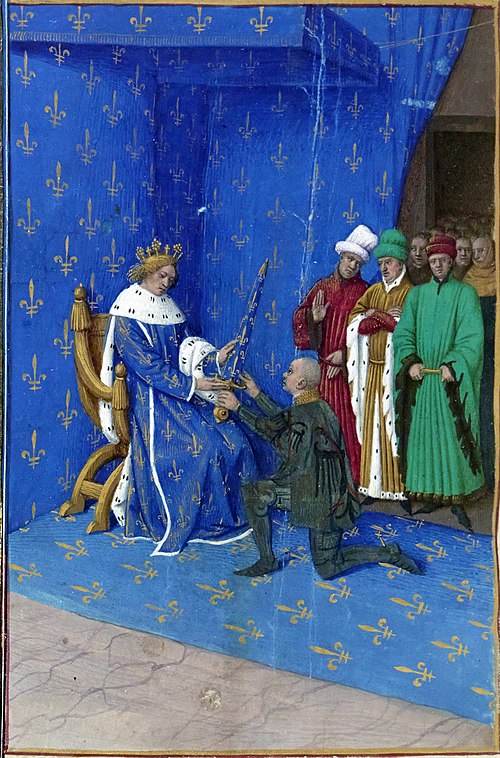 Bestowal of the sword of constable on Bertrand du Guesclin: Jean Fouquet, Public domain, via Wikimedia Commons
Despite this local English recovery, the strategic advantage increasingly shifts to the French side. On October 2, 1369, Bertrand Du Guesclin is appointed constable of France. This appointment symbolizes the new way of waging war desired by Charles V: less chivalric display, more patience, mobility, and efficiency. Charged with driving out the English without seeking major frontal battles, Du Guesclin becomes the chief instrument of reconquest. A few weeks later, on December 4, 1370, he wins the Battle of Pontvallain against the English troops of Robert Knolles, who had ravaged the Ile-de-France, the West, and Brittany. This is a major victory: it ends a large English chevauchee, restores confidence to the kingdom, and demonstrates the effectiveness of the new French command.
 Battle of Pontvallain: Loyset Liedet, Public domain, via Wikimedia Commons
Thus, between 1369 and 1370, the Hundred Years’ War clearly changes rhythm and direction. Through the combination of reaffirmed feudal legitimacy, skillful diplomacy, the Castilian alliance, and the command of Du Guesclin, Charles V launches a gradual reconquest that strongly contrasts with the disasters of the time of John II. The Valois monarchy ceases to be on the defensive: it now regains the initiative.
III. 1371–1372: Reconquest of the West, the Naval Triumph of La Rochelle, and England’s Retreat
In 1371, operations in Poitou, Aunis, and Saintonge show the growing effectiveness of the method of war desired by Charles V. On March 15, the English suffer a defeat at Bressuire, and the reconquest continues through a series of sieges that weaken their regional implantation. This progress is neither spectacular nor immediate, but it wears down enemy garrisons and gradually reduces the space actually controlled by supporters of the king of England in the west of the kingdom. At the same time, the king seeks to stabilize other fronts: the Treaty of Vernon, concluded between March 25 and 29, 1371, provisionally settles the conflict with Charles the Bad, while in June the siege of Metz reminds all that the eastern margins of the kingdom also remain crossed by princely and urban tensions.
The war nevertheless continues in west-central France. At the end of summer 1371, the English and several Poitevin barons seize Moncontour, proof that the French reconquest remains fragile and locally contested. Despite these resistances, the general dynamic gradually turns in favor of the Valois, because English authority suffers both from the scattering of its forces and from the growing dependence of its continental positions on maritime communications.
The year 1372 marks a major turning point in this regard. On June 22 and 23, off La Rochelle, the Castilian fleet allied with France destroys or captures most of the English fleet sent to support the continental positions. This naval victory, won against the forces of the Earl of Pembroke, has considerable significance: it cuts England off from part of its means of supply, ruins its ability to reinforce its western strongholds quickly, and gives Charles V a maritime advantage that no king of France had obtained at the start of the war. The siege of La Rochelle, begun in connection with this naval operation, ends with the surrender of the city, accelerating the English retreat throughout the region.
The reconquest then speeds up. On August 7, 1372, Du Guesclin takes Poitiers. Then, in August and September, the French obtain a string of rapid successes: victory before Soubise, the surrender of La Rochelle and Angouleme, followed by the submission of Saint-Jean-d’Angely and Saintes. In a few months, the English presence in the West is sharply reduced. This sequence of operations shows how much the Capetian strategy, founded on the gradual isolation of enemy strongholds and the control of communication routes, proves more effective than seeking frontal battle.
The diplomatic environment nonetheless remains unstable. On March 28, 1372, the Count of Flanders makes peace with England, while on July 10, the Treaty of Tagilde links John of Gaunt and the king of Portugal in a new hostile combination against France and Castile. Likewise, the secret Treaty of Westminster, concluded on July 19, 1372, between John IV of Brittany and Edward III, reveals the persistence of English maneuvering in Brittany, even if this agreement, discovered soon afterward by the French, does not suffice to stop the reconquest already under way. These maneuvers show that the Hundred Years’ War remains a conflict of coalitions as much as a direct struggle between two crowns.
The Black Prince’s Retreat and the Collapse of the Principality of Aquitaine
Finally, the year 1372 ends with an admission of failure from the English camp. On October 5, the Black Prince renounces the principality of Aquitaine, marking the collapse of a political construction established after the treaty of Brétigny. Since 1362, the son of Edward III had governed an enlarged Aquitaine that the English intended to administer as a coherent and broadly autonomous princely state. But this structure had rapidly weakened.
The Castilian expedition of 1367, despite the victory of Najera, had cost the Black Prince dearly and compromised his finances. To cover these expenses, he had tried to impose heavy taxation in Aquitaine, which aroused the hostility of part of the great Gascon lords, notably the counts of Armagnac and Albret. Their appeal to Charles V provided the king of France with the legal foundation necessary to resume the war.
To this internal weakening were added in 1372 the French and Castilian military successes: destruction of the English fleet at La Rochelle, the successive loss of several western cities, and the general retreat of English authority in Poitou, Saintonge, and Aunis. In these conditions, the principality of Aquitaine ceases to be a credible instrument of English domination in southwestern France.
The Black Prince’s renunciation is therefore far more than a symbolic measure: it acknowledges the failure of a policy intended to make Aquitaine into a great princely state under English control. In a few years, Charles V thus succeeds in reversing the balance of power inherited from the disasters of the middle of the century. Without any major battle comparable to Crecy or Poitiers, but through a methodical sequence of operations, alliances, and sieges, the French monarchy regains the initiative on sea and land and begins a lasting reconquest of the kingdom.
IV. 1373–1375: Reconquest of the West, Maritime Organization, and the Truce of Bruges
In 1373, French successes in the West continue. The king rewards the towns returned to his obedience: on January 8, Charles V grants to the mayor, aldermen, and successors of La Rochelle a hereditary and perpetual right of nobility, in recognition of the role played by the city in expelling the English. A few days later, on January 22, he creates the government of Aunis, distinct from Saintonge, reflecting the royal desire to better organize the reconquered territories and strengthen authority there.
On the military field, the campaign of 1373 confirms the English retreat. After the failure of an attempted landing at Saint-Malo in March, Bertrand Du Guesclin wins a victory at Chize on March 21, then secures the capitulation of Niort on March 27, thus assuring the king control of Poitou. At the same time, the position of John IV of Brittany rapidly deteriorates. Recognized as duke by the Treaty of Guerande in 1365, he remains fragile, since a large part of the Breton nobility wishes to preserve the neutrality of the duchy in the war between France and England. Yet John IV, long exiled at the court of Edward III and heavily supported by the English, increasingly appears as the representative of their influence in Brittany. The discovery of the secret Treaty of Westminster concluded with England, followed by the landing of an English army at Saint-Malo in March 1373, provides Charles V with the pretext and legitimacy needed to intervene. Supported by part of the Breton nobility, Bertrand Du Guesclin then campaigns and quickly regains the advantage. Politically as well as militarily isolated, John IV is forced to flee to England at the end of April 1373, leaving Charles V with the advantage in the duchy.
England nevertheless attempts to regain the initiative. Beginning in August 1373, John of Lancaster leads a great chevauchee from Calais to Guyenne. This expedition, one of the most ambitious undertaken by the English camp in this phase of the war, ultimately proves a failure. It exhausts the troops without producing decisive gains and confirms the limits of large-scale rides across enemy territory when they are not followed by durable reconquest. For Charles V, this English failure is an indirect but major success.
The same year, the French monarchy continues its effort of organization. On December 7, 1373, a royal ordinance clarifies the jurisdiction of the admiralty, while Jean de Vienne is appointed admiral of France. This decision is crucial: it shows that reconquest does not rely only on land captains, but also on a more systematic command of naval affairs. Charles V understands that the war against England requires tighter control of the coastline, ports, and maritime communications.
 This illustration shows the main attacks carried out against England by joint Franco-Castilian fleets commanded by Admirals Fernando Sanchez de Tovar and Jean de Vienne between 1374 and 1380 during the Hundred Years’ War: Luis Garcia, CC BY-SA 3.0 https://creativecommons.org/licenses/by-sa/3.0, via Wikimedia Commons
In 1374, the king continues to structure the military and administrative apparatus of the kingdom. On January 13, a new ordinance on the organization of the army extends the reform effort already under way for several years. At the same time, the siege of Saint-Sauveur-le-Vicomte, prepared by Jean de Vienne, mobilizes significant means and illustrates the increasingly methodical character of French reconquest.
The campaign of 1374 also brings new successes in the southwest. On August 21, La Reole surrenders after being besieged by royal forces. At the same time, Aunis is definitively separated from Saintonge, confirming the territorial reorganization undertaken the previous year. Within the kingdom, Charles V also reinforces the framework of monarchy: an ordinance of August 1374 fixes the majority of the king of France at thirteen completed years, while new fortification works are undertaken in Paris. These measures show that military reconquest goes hand in hand with institutional consolidation.
Yet these successes unfold in a difficult context. The plague continues to reappear in Europe, and a famine strikes southern France between 1374 and 1375. War, poor harvests, and epidemics therefore remain the constant backdrop of the reign even as the military situation improves for the Valois.
The year 1375 extends this dynamic while leading to a diplomatic pause. On June 1, Cognac surrenders after the siege led by the Duke of Berry. On July 3, Saint-Sauveur-le-Vicomte in turn capitulates after a long siege that becomes emblematic of French strategic patience. These successes finish reducing several of the most important English positions in Normandy and the West.
However, the exhaustion of both kingdoms and diplomatic mediation ultimately lead to a suspension of hostilities. On June 27, 1375, the Truce of Bruges is concluded between France and England. It does not end the Hundred Years’ War, but it marks the culmination of a phase favorable to Charles V. In a few years, the king has recovered much of the territory lost after Brétigny, restored royal authority in the West, and shown that reconquest can be carried out without a decisive battle, through a policy of sieges, alliances, and the gradual organization of the kingdom.
V. 1376–1378: End of the Truce, Renewed French Offensive, and the Beginning of the Great Western Schism
The years 1376–1378 extend the recovery initiated by Charles V while also giving the reign a more European dimension. As the war against England resumes in a context favorable to France, the monarchy continues strengthening its instruments of government. But these same years also witness the opening of the Great Western Schism, which durably divides Latin Christendom and reshapes alliances among powers.
In 1376, the truce of Bruges is extended until June 24, 1377, still allowing hope for a temporary calming of the Franco-English conflict. At the same time, several institutional developments show that war continues to transform states. In England, the Good Parliament of 1376 demonstrates the growing power of Parliament against the government of Edward III: it secures the prosecution of several royal counselors for corruption, generally regarded as the first recognized use of impeachment; the House of Commons is moreover presided over there by Peter de la Mare, often presented as the first true Speaker. In France, Charles V continues the structuring of the kingdom’s means: an ordinance of September 1376 places the forest of Roumare at the service of naval construction, a sign of the king’s attention to the fleet and strategic resources.
The situation changes profoundly in 1377. The death of Edward III on June 21, followed by the accession of his grandson Richard II, aged ten, opens in England a period of political fragility dominated by the regency of his uncles, foremost among them John of Gaunt. This transition gives France a window of opportunity. Peace negotiations undertaken between April and June fail, and hostilities quickly resume. At the same time, Charles V actively supports the reconquest of the West: Auray falls to Olivier de Clisson in August 1377, while the French advance in Guyenne, notably securing the surrender of Bergerac and then Duras in autumn. A Franco-Castilian fleet also raids the Isle of Wight, illustrating France’s new ability to threaten English coasts thanks to its alliance with Castile. Despite these successes, the renewed war does not immediately lead to a decisive campaign, notably because of England’s internal political difficulties.
The year 1378 opens under the sign of Charles V’s diplomatic prestige. In January, the king receives in Paris Emperor Charles IV of Luxembourg and his son Wenceslas, King of Bohemia. This meeting, marked by a great banquet at the palace of the Cite, underlines the central place now occupied by the French monarchy in the political balances of the West. On the ground, however, Charles V pursues above all a more concrete objective: reducing the last positions of Charles the Bad in Normandy. After the arrest of several of his close supporters, including Jacques de Rue, royal forces led by the Duke of Burgundy, the Duke of Bourbon, the lord of Coucy, and Bertrand Du Guesclin gradually seize his Norman possessions; by the end of June, the king of Navarre retains little more than Cherbourg. This operation almost completely ends his political foothold within the kingdom of France.
At the same time, the Breton situation turns around. On June 20, 1378, John IV of Brittany is summoned to appear before the court of peers; failing to appear, he sees his duchy confiscated. Yet this decision, which at first seems to confirm the success of royal policy, produces the opposite effect in Brittany: a significant part of the nobility and population rejects direct French royal control and soon recalls the exiled duke. This episode shows the limits of Capetian-Valois authority in peripheral principalities even at the height of its military successes.
 Great Schism, 1378–1417: @lankazame, Mipmapped, CC BY-SA 3.0 http://creativecommons.org/licenses/by-sa/3.0/, via Wikimedia Commons
The most important event of 1378, however, is religious and European: the beginning of the Great Western Schism. After the death of Gregory XI, who had returned to Rome in 1377, the election of Pope Urban VI is quickly contested by part of the cardinals, mostly French, who claim to have voted under pressure from the Roman crowd. Gathered at Fondi, they elect in September 1378 another pope, Clement VII, who then settles in Avignon. From then on, two papal obediences face each other: one centered on Rome, the other on Avignon. The schism is not merely an ecclesiastical dispute: it divides Europe along lines that are as diplomatic as they are religious. Charles V supports Clement VII, while England aligns behind Urban VI. The fracture between the two crowns is thus doubled by a fracture within Christendom itself.
Thus, between 1376 and 1378, the reign of Charles V reaches a high point of influence. France takes advantage of English difficulties to continue its military gains, reduces the room for action of Charles the Bad, and affirms itself as a central power in western diplomacy. But the opening of the Great Western Schism also reminds us that the end of the fourteenth century is not shaped only by the Franco-English war: it is also marked by a profound crisis in the religious and political unity of Latin Europe.
VI. 1379–1380: The Return of John IV, the Great Western Schism, and the End of Charles V’s Reign
In 1379, Charles V’s Breton policy turns against him. After the confiscation of the duchy pronounced in 1378 against John IV of Brittany, a significant part of the Breton nobility rejects the prospect of direct administration by royal officers. On April 26, 1379, Breton barons gathered at Rennes sign an act of confederation and recall the exiled duke. On August 3, John IV lands at Dinard with English support and quickly reestablishes himself in the duchy. This development shows that French suzerainty in Brittany cannot be exercised durably without the adhesion of local elites. The failure is all the more sensitive because several Bretons who had until then served Charles V rally to their duke returned from exile.
 Revolt of the White Hoods, 1379: Jacques-Joseph Lecurieux, Public domain, via Wikimedia Commons
At the same time, the Flemish crisis resumes. On September 5, 1379, the revolt of the White Hoods breaks out in Ghent against the Count of Flanders. The movement then spreads to Bruges and Ypres, before extending across much of the county. Even if a provisional peace is concluded at the end of the year, the renewed conflict in 1380 shows that Flanders remains one of the major spaces of political and social instability in northwestern Europe. This unrest directly concerns France, both because of the county’s proximity and because of the economic weight of its cloth-making cities.
Unable to impose himself in Rome, Clement VII returns to Avignon on June 20, 1379. Two papal obediences now face each other: that of Rome, supported notably by England, Flanders, several German states, and the Scandinavian kingdoms; and that of Avignon, backed by France, Scotland, and Castile. This schism profoundly transforms the political life of Europe, because it overlays dynastic and territorial rivalries with a durable religious division of Latin Christendom. Charles V resolutely chooses the Avignon party, further reinforcing the opposition between the French monarchy and the English camp.
The year 1380 opens in a still troubled climate. In Languedoc, Louis of Anjou must face the revolt of Montpellier, which he enters on January 20; his administration is nonetheless judged disappointing, and Bertrand Du Guesclin is eventually called upon to play a more direct role in the region. Internationally, on March 1, 1380, an alliance is concluded at Westminster between England and Duke John IV of Brittany, proof that Brittany remains an active stake in the Hundred Years’ War. At the same time, the Italian ambitions of French princes are already taking shape: on June 29, 1380, Joan I of Naples designates Louis I of Anjou as her heir, opening a new field of intervention for the French royal house in the Italian peninsula.
 The death of Bertrand du Guesclin (July 13, 1380): Nicolas-Guy Brenet, Public domain, via Wikimedia Commons
But the great loss of the year for the French monarchy is that of its principal captain. On July 13, 1380, Bertrand Du Guesclin dies during the siege of Chateauneuf-de-Randon in Gevaudan, after having led the reconquest for years in the name of Charles V. His disappearance deeply affects the king and deprives the monarchy of the man who had embodied its military strategy: avoiding ruinous battles, retaking strongholds one by one, harassing the enemy, and methodically reconquering the kingdom.
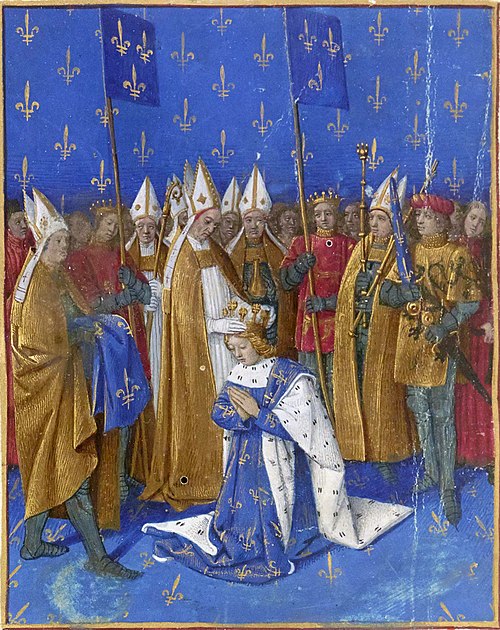 Coronation of Charles VI the Well-Beloved: Jean Fouquet, Public domain, via Wikimedia Commons
A few weeks later, the reign itself comes to an end. Charles V dies on September 16, 1380. By then, the military situation is very different from the one he had inherited in 1364: in France, the English now control only Calais, Cherbourg, Brest, the Bordelais, and the region of Bayonne. The recovery of the kingdom is therefore considerable. His son succeeds him as Charles VI, but since he is still a minor, power passes into the hands of his uncles, notably Louis of Anjou, John of Berry, Philip of Burgundy, and Louis of Bourbon. The young king is crowned at Reims on November 4, 1380, while Olivier de Clisson becomes constable at the end of the month.
Thus, the years 1379–1380 conclude a reign of reconstruction and reconquest, but they also open a period of uncertainty. The monarchy of Charles V has restored much of French authority, but the Breton question remains unresolved, the Great Schism divides Europe, and the new king is a child. The kingdom emerges strengthened from the reign of Charles the Wise, but it also enters a phase in which the weight of princes and crises of government again becomes central.
🧠 Key Takeaways
- 1364: Charles V becomes king after the death of John II; the victory at Cocherel immediately strengthens Valois authority.
- 1365–1368: the king pacifies the kingdom, contains Charles the Bad, fights the great companies, and prepares the resumption of war without risking a catastrophic battle.
- 1369: war against England officially resumes; Charles V relies on the appeals of Aquitanian lords and on the Castilian alliance.
- 1370: Bertrand Du Guesclin becomes constable; the victory at Pontvallain confirms the French military recovery.
- 1372: the naval victory of La Rochelle breaks English maritime power in the West and accelerates the French reconquest.
- 1373–1375: sieges, attrition warfare, and military reorganization allow France to regain the initiative; the Truce of Bruges suspends fighting without settling the conflict.
- 1378: the Great Western Schism durably divides Europe; France supports Clement VII in Avignon, while England supports Urban VI in Rome.
- 1379–1380: despite difficulties in Brittany, the reign ends with a recovered kingdom; at Charles V’s death, the English hold in France only a few major strongholds.
- 1380: the death of Charles V opens the minority of Charles VI; the kingdom is better governed and militarily stronger than it had been in 1364.