

Louis VIII the Lion: Southern Conquests and Capetian Succession (1223–1226)
1223 à 1226
🦁 Louis VIII the Lion: Southern Conquests and Capetian Succession (1223–1226)
In 1223, Louis VIII succeeds Philip II Augustus in a kingdom profoundly transformed. The royal domain has been considerably enlarged, monarchical authority strengthened, and the victory at Bouvines (1214) has given Capetian power lasting prestige.
 Map of France in 1223: Chatsam, CC BY-SA 4.0 https://creativecommons.org/licenses/by-sa/4.0, via Wikimedia Commons
Yet this inheritance remains unstable: the south of the kingdom still largely escapes direct control, and religious tensions linked to the Crusade against the Albigensians continue to structure political relations. The reign of Louis VIII, though brief, represents a decisive phase of territorial consolidation and affirmation of royal suzerainty.
I. 👑 1223 — Accession, Coronation, and First Orientations
On July 14, 1223, upon the death of Philip Augustus, his son succeeds him as Louis VIII. This transfer of power takes place without major contestation, marking an important stage in the consolidation of the Capetian dynasty: hereditary succession now establishes itself as a stabilized principle of the kingdom.
On August 6, 1223, the new sovereign is crowned at Reims, together with his wife Blanche of Castile. The coronation, a religious and political ceremony, confers sacred and public legitimacy upon the king. The association of the queen with this ceremony also underscores the importance of dynastic continuity and the royal couple in the exercise of power.

Coronation of Louis VIII and Blanche of Castile in 1223, from the Grandes Chroniques de France, Bibliothèque nationale de France.
🗺️ Political Continuity and the Reign’s Priorities
From the beginning of his reign, Louis VIII inscribes himself in the continuity of his father’s policy. His action aims to consolidate recent gains and complete the integration of territories still unstable.
His first orientations may be summarized as follows:
- affirmation of royal authority in the West
- submission and effective attachment of Poitou and Saintonge
- continuation of reducing competing influences, notably English
- preparation for intervention in the South, where the situation remains uncertain
The king emerges as a determined sovereign, oriented toward military action and territorial consolidation.
✝️ A Structuring Religious Context
The reign’s beginning is marked by religious issues.
- July 6, 1223: a council assembled at Paris deals with the question of the Albigensians
- November 29, 1223: Pope Honorius III approves the rule of the Order of Friars Minor
These elements testify to a dual movement:
- the Church’s desire to structure the struggle against heresy
- the development of new religious orders, active in preaching and spiritual oversight
In this context, the Capetian monarchy inscribes itself in a close relationship with the papacy, while progressively integrating religious issues into its territorial policy.
🔍 Zoom – 1223: Coronation of Louis VIII and Capetian Continuity
II. ⚔️ 1224 — Collapse of English Positions in the Southwest
In 1224, Louis VIII launches a decisive campaign against the last continental positions of the English. This offensive continues the conquests undertaken under Philip II, but occurs in a particularly favorable context: the English monarchy, led by Henry III, is weakened by the consequences of the Barons’ War (1215–1217) and by still-fragile authority.
⚖️ A Legal Foundation: The Cession of Montfort’s Rights
A determining element precedes the military operations.
- January 14, 1224: Amaury VI of Montfort, unable to maintain his authority in the South against local resistance, cedes to the King of France his rights to:
- the Carcassès
- the Albigenesate
- the county of Toulouse
This cession transfers to the Capetian monarchy the political inheritance of the Albigensian Crusade and provides legal legitimation for royal intervention in the southern kingdom.
It also marks a turning point: the management of the South no longer depends solely on the crusading barons, but becomes a direct matter of the crown.
⚔️ A Rapid and Coordinated Campaign in the West
In parallel, Louis VIII launches an offensive against English possessions in the southwest. The objective is twofold:
- to complete the territorial reconquest begun in 1202
- to deprive England of its continental footholds
The campaign rests on a strategy combining:
- direct military pressure
- rallying of local lords
- progressive isolation of enemy strongholds
The main operation concerns the Atlantic coast:
 Matthew II of Montmorency: Hgdbllr, CC BY-SA 4.0 https://creativecommons.org/licenses/by-sa/4.0, via Wikimedia Commons
- July–August 1224: Siege of La Rochelle, conducted by Matthew II of Montmorency, Constable of France
 The Conquest of La Rochelle: Grandes Chroniques de France. MS. Douce 217., Public domain, via Wikimedia Commons
La Rochelle, a major strategic port, constitutes one of the Plantagenets’ principal footholds. Its fall triggers a chain reaction:
- submission of Saintonge
- rallying of Limousin
- control of Périgord
Capetian progress is facilitated by:
- weakness of English resistance
- lack of coordination among defenders
- interest of local elites in rallying to a now-dominant power
🗺️ A Strategic Recomposition of the Southwest
Following the campaign, English presence is severely reduced. Only Bordeaux remains under the control of the English crown, with the region of Guyenne.
This situation brings about a major economic and commercial recomposition:
- August 30, 1224: Henry III grants a charter to Bordeaux
- the city becomes the principal center for wine trade with England
- it replaces La Rochelle as a nodal point in Atlantic exchanges
This displacement of commercial flows illustrates the rapid adaptation of economic networks to political transformations.
🔍 Zoom – 1224: Poitou, Saintonge, and the Recovery of La Rochelle
III. ⚖️ 1225 — Dynastic Organization and Renewed Crusade
In 1225, Louis VIII pursues a dual policy aimed at securing dynastic succession and seizing the initiative in the South. This year marks a moment of structuring power, both internally and in its relations with the Church.
👑 An Organized Monarchy: Testament and Appanages
On June 12, 1225, the king draws up a testament, a major political document in the construction of Capetian monarchy.
This document notably provides for:
- the attribution of appanages to his younger sons
- the anticipated organization of succession
- the preservation of the royal domain’s integrity
The system of appanages consists of granting territories to younger princes while maintaining their dependence on the crown. It allows for:
- avoiding succession conflicts between heirs
- controlling the ambitions of cadet branches
- maintaining feudal hierarchy to the king’s advantage
This policy reflects an important evolution: the monarchy no longer merely transmits power; it plans for its continuity.
✝️ The Council of Bourges: A Political and Religious Decision
On the religious and diplomatic level, the year is marked by the Council of Bourges, opened November 29, 1225, under the impetus of the papal legate.
This council occurs in a context of stalemate in the Crusade against the Albigensians, launched in 1208 but confronting persistent resistance in the South, notably around Languedoc.
The decisions made are determining:
- official renewal of the crusade
- mobilization of kingdom forces under royal authority
- establishment of specific financing
To support the military effort, the council institutes exceptional fiscal measures:
- levying of tithes on the clergy (one-tenth of revenues)
- extension of the system to other Christian territories
IV. ✝️ 1226 — The Albigensian Crusade and Submission of the South
In 1226, Louis VIII decides to intervene personally in the South, marking a new stage in the transformation of the Crusade against the Albigensians into a royal enterprise.
Since its launch in 1208, the crusade has seriously weakened local powers, without permitting lasting domination. Resistance persists, notably around Languedoc, which embodies southern opposition to Capetian authority and to Church demands.
⚖️ An Intervention Legitimized by the Church
The beginning of 1226 is marked by rising tension between royal power, the papacy, and the lords of the South.
- January 28, 1226: Raymond VII is excommunicated
- January 30, 1226: Louis VIII takes the cross, officially committing himself to the crusade
This decision confers double legitimacy upon the expedition:
- religious, as a struggle against heresy
- political, as affirmation of royal suzerainty
The campaign thus becomes an enterprise where holy war and state-building intermingle.
⚔️ A Methodical Campaign toward Languedoc
The royal army progresses southward in early summer 1226, following the kingdom’s great communication axes. The objective is to secure the roads and submit the strategic cities before reaching the heart of Languedoc.
The principal obstacle lies on the Rhône:
 Siege of Avignon: Levan Ramishvili from Tbilisi, Georgia, Public domain, via Wikimedia Commons
- June 10, 1226: beginning of the siege of Avignon
The city, well fortified and supported by its strategic position, offers prolonged resistance. The siege is characterized by:
- a war of attrition
- the importance of siege engines
- logistical difficulties linked to summer heat and supply
For more than three months, royal forces maintain pressure.
On September 12, 1226: Avignon capitulates
 Submission of Avignon to King Louis VIII: Grandes Chroniques de France, Public domain, via Wikimedia Commons
The capture of the city constitutes a decisive success:
- it opens access to Languedoc
- it breaks a strategic lock on the Rhône
- it triggers the progressive submission of several strongholds and seigneuries
Beyond the military aspect, this victory marks the durable installation of Capetian monarchy in the South.
✝️ A Staging of Royal Power
The religious dimension of the campaign is staged through symbolic gestures.
- September 14, 1226: Louis VIII participates in a solemn procession
- barefoot
- dressed as a penitent
- holding a torch
This ritual manifests:
- the king’s humility before God
- his role as defender of the faith
- the union between political power and religious mission
The Capetian monarchy presents itself as guarantor of Christian order.
🔍 Zoom – 1226: Siege of Avignon and the Albigensian Crusade
V. 🕯️ November 1226 — The King’s Death and Regency
Upon returning from the campaign, Louis VIII falls ill.
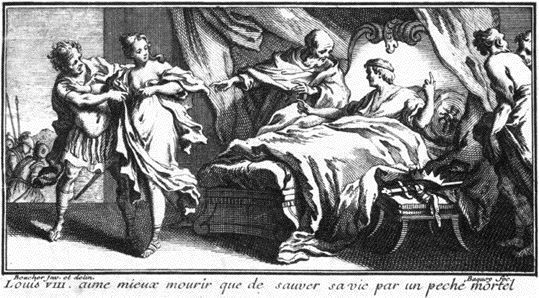 The Death of King Louis VIII: François Boucher, CC0, via Wikimedia Commons
- November 8, 1226: death of the king, probably from dysentery
His passing occurs while the conquest of the South remains incomplete.
The succession is assured rapidly:
- November 29, 1226: coronation of Louis IX at Reims
Power is entrusted to a regency led by Blanche of Castile, assisted by the papal legate. This regency marks a decisive stage:
- maintenance of dynastic continuity
- preservation of territorial gains
- affirmation of the monarchy’s capacity to survive a king’s death
🔍 Zoom – 1226: Death of Louis VIII and the Regency of Blanche of Castile
🔍 Zoom – Blanche of Castile: Governing in the Name of the Child-King
⚖️ A Brief but Decisive Reign
The reign of Louis VIII, limited to four years, plays an essential role in Capetian history.
It allows for:
- completion of the reduction of English possessions on the continent
- progressive integration of the South into the royal sphere
- structuring of dynastic succession
- preparation of the transformations of the reign of Louis IX
Louis VIII thus appears as a sovereign of active transition, prolonging the work of Philip Augustus and opening the way to the monarchical affirmation of the thirteenth century.
🧠 Key Points to Remember
- 1223: stable succession and affirmed Capetian continuity.
- 1224: decisive retreat of England in the southwest.
- 1225–1226: the Albigensian crusade becomes a royal instrument.
- 1226: death of the king and establishment of a stable regency.