

Louis IX (Saint Louis): Regency, Royal Justice and Crusades (1226–1270)
1226 à 1270
In 1226, Louis IX became king while still a child. This early accession could have weakened the monarchy. Yet Capetian power did not waver: it reconstituted itself around a solid regency, an already-structured administrative apparatus, and a dynastic legitimacy now firmly established.
The kingdom inherited from Louis VIII was larger, more coherent and better organised. But this inheritance had to be consolidated: the Midi remained unstable, the great princes were still powerful, and European balances were still fragile.
The reign of Louis IX marks a transformation: the monarchy became judicial, moral and arbitral, rather than merely conquering.
I. 👑 1226–1234 — Regency: Holding the Kingdom
The death of Louis VIII left a minor heir. Power was secured by his mother, Blanche of Castile, who quickly established herself as regent.
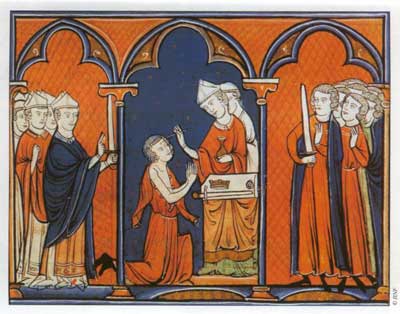 Coronation of Saint Louis (Louis IX of France) at Reims, miniature from the Ordo of the 1250 coronation: Bibliothèque nationale de France, Public domain, via Wikimedia Commons
The coronation of the young king on 29 November 1226 at Reims was organised in haste to prevent any challenge: the aim was to make Louis IX a fully legitimate king before the great lords could intervene.
⚔️ 1227–1230: Feudal Coalitions and Early Resistance
From the very beginning of the regency, the authority of Blanche of Castile was contested by part of the high aristocracy. The minority of Louis IX, the influence of a queen of foreign origin, and the prospect of a strengthened central power fed the anxieties of several great lords, who sought to take advantage of the dynastic transition to recover greater autonomy.
Among the main opponents were:
- Pierre Mauclerc, Duke of Brittany, an ambitious prince already engaged in a policy of independence from the crown
- Thibaut IV of Champagne, whose position was strategic in the east of the kingdom
- Philip Hurepel, Count of Boulogne, legitimised son of Philip Augustus
- Enguerrand III of Coucy, one of the most powerful barons in the north of the kingdom
This opposition did not form a homogeneous bloc. Each of these princes primarily pursued his own interests: some sought territorial advantages, others sought influence over the young king’s government, still others aimed to prevent the regent from consolidating Capetian authority. This diversity of objectives limited the coalition’s cohesion.
 Detail of a miniature depicting Blanche of Castile and King Louis IX in the Moralized Bible of Toledo, known as the Bible of Saint Louis: The Morgan Library & Museum, Public domain, via Wikimedia Commons
As early as February 1227, Blanche of Castile managed to exploit these divisions. On 20 February, Thibaut IV of Champagne abandoned the camp of the malcontents and paid homage to the regent. A few weeks later, on 16 March 1227, the Treaty of Vendôme marked the submission of the counts of Brittany and La Marche. Through a combination of negotiations, targeted concessions and shows of firmness, the regent prevented a single durable coalition from forming against her.
The contestation did not disappear, however. At the end of 1227, a new revolt of great vassals broke out. The opponents of Blanche then sought to deal a decisive blow to the regency by attempting to seize the young king near Montlhéry. Such a capture would have allowed them to control the person of the sovereign directly, and thus to govern in his name. The attempt failed thanks to the regent’s swift response, which allowed her to protect her son and preserve the continuity of royal power.
In this crisis, the support of the Church and the towns played an essential role. Prelates, committed to dynastic stability, supported the legitimacy of the young king. Urban communities, in particular that of Paris, also mobilised in favour of the monarchy. This support showed that Capetian power was no longer based solely on traditional feudal loyalties: it also benefited from the backing of collective actors who saw in the monarchy a factor of order and protection.
The years 1227–1230 thus appear as a first ordeal for the regency. They revealed both the persistent fragility of monarchical authority in the face of the great princes and the new capacity of the crown to overcome these crises by relying on political, ecclesiastical and urban networks.
🌍 England and External Threats
The regency of Blanche of Castile had not only to contain internal revolts: it also had to face a permanent external threat, that of an offensive return by the Plantagenets. Despite the losses suffered since the reign of Philip Augustus, the English monarchy had not renounced re-establishing itself on the continent.
In 1227, Henry III of England began to exercise power personally. His government surrounded itself with advisers and favourites from the continental sphere, notably from Poitou, a region where networks of loyalty to the former Plantagenet domains still existed. This orientation fed the hope of a revival of English influence in the west of the kingdom of France.
The French situation appeared, on the surface, favourable to such an enterprise. King Louis IX was still a minor, the regency was contested by several great princes, and certain principalities in the West, in particular Brittany, remained zones of instability. For Henry III, the supposed weakness of the Capetian government could offer the opportunity to re-open the question of the possessions lost by his predecessors.
 Pierre de Dreux, known as Mauclerc: Vladimir Renard, CC BY-SA 4.0 https://creativecommons.org/licenses/by-sa/4.0, via Wikimedia Commons
It was in this context that the rapprochement with Pierre Mauclerc, Duke of Brittany, took place. Hostile to Blanche of Castile and wishing to preserve his freedom of action, he found in the English alliance a means of putting pressure on the regency. The understanding between the king of England and the Duke of Brittany raised the risk of a combined offensive capable of placing the Capetian monarchy in a pincer movement between internal revolts and foreign intervention.
In 1230, Henry III landed at Saint-Malo. The operation aimed to support his Breton allies, reignite feudal opposition, and, more broadly, to test the solidity of the regency. However, this attempt did not lead to a genuine reconquest.
Several factors explain this failure:
- the absence of a general uprising in favour of the king of England
- the weakness of lasting local support
- Blanche of Castile’s capacity to prevent the junction between internal opposition and external offensive
- the difficulty for Henry III of turning a landing into a deep campaign into French territory
The English intervention thus retained a limited character. It alarmed the regency, but did not succeed in overturning the balance of power. The Capetian monarchy avoided a major external war at the very moment it was still facing aristocratic resistance within the kingdom.
🧩 1229: The University Crisis and Reorganisation of the Midi
The year 1229 constituted a pivotal moment at the start of Louis IX’s reign: two distinct crises — one in Paris, the other in the Midi — illustrated both the internal tensions of the kingdom and the growing capacity of the Capetian monarchy to manage them.
🏛️ Paris: A Major University Crisis
In Paris, the situation deteriorated at the start of the year.
- February 1229 (Mardi Gras): a brawl broke out between students and townspeople in a tavern
- the intervention of royal sergeants caused the deaths of several students
This episode immediately triggered a reaction from the University of Paris, then in the process of full institutional formation. Masters and students denounced an attack on their privileges and their special legal status.
In response:
- March 1229: a general strike was called
- courses were suspended
- many masters departed for other intellectual centres (notably Oxford)
For more than two years, Paris was deprived of part of its intellectual activity, affecting its prestige and its role as a major university centre.
The crisis led to a decisive papal intervention:
- 1231: the bull Parens scientiarum promulgated by Pope Gregory IX
This founding text:
- placed the University under the direct protection of the Pope
- recognised its institutional autonomy
- granted it the right to suspend teaching in the event of a conflict
The University of Paris thus became an autonomous corporation, endowed with a legal status recognised throughout Christendom.
⚖️ The Midi: End of a War Cycle
At the same time, the situation in the Midi underwent a decisive transformation.
In 1229, the signing of the Treaty of Meaux-Paris (12 April) marked a decisive stage in the integration of the Midi into the Capetian kingdom, bringing a major phase of the Albigensian Crusade to a close.
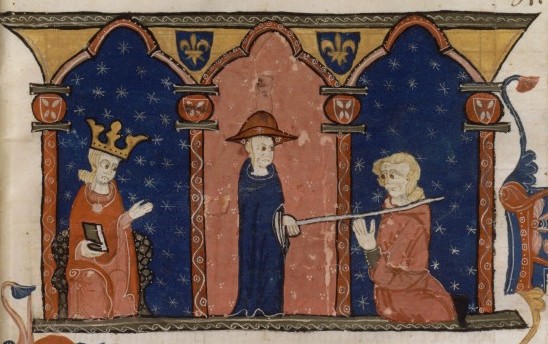 The Count of Toulouse Raymond VII submitting to King Louis IX: Unknown author, Public domain, via Wikimedia Commons
Concluded between Saint Louis and Raymond VII, Count of Toulouse, the agreement imposed several structural provisions:
- recognition of royal suzerainty by the Count of Toulouse;
- cession of territories to the crown;
- demolition of fortifications;
- commitment to combat heresy under ecclesiastical supervision.
The treaty also provided a dynastic solution designed to ensure the lasting integration of the County of Toulouse:
- marriage of Jeanne of Toulouse to Alphonse of Poitiers, son of Louis VIII;
- planned reversion of the territories to the crown in the absence of a direct heir.
This arrangement allowed an immediate annexation to be avoided while guaranteeing, in time, the county’s attachment to the royal domain.
In parallel, Capetian presence was affirmed in the region:
- establishment of a royal administration;
- development of structures of oversight;
- founding of the University of Toulouse, designed to guide doctrinal formation in the context of the fight against heresy.
Thus the Midi evolved progressively:
- from a politically autonomous space;
- toward a territory integrated into the orbit of Capetian power.
The treaty of 1229 thus constituted a turning point in the territorial construction of the kingdom of France, transforming military domination into lasting political integration.
🎓 Toulouse: An Instrument Against Heresy
In this context, the creation of the University of Toulouse served a precise objective.
Founded at the instigation of the papacy, it aimed to:
- train clerics capable of combating Cathar doctrines
- disseminate orthodox teaching
- strengthen intellectual and religious supervision over the Midi
The university thus became a political as much as an intellectual tool.
⛪ Religion, Heresy and Social Control
The regency of Blanche of Castile took place in a context of strengthened religious oversight across the kingdom and Western Christendom. The fight against heresy, already engaged at the start of the thirteenth century, was now prolonged through more structured legal, institutional and social instruments.
⚖️ Managing Minorities: The Jewish Question
As early as 1227, the Council of Narbonne imposed measures targeting Jewish communities:
- obligation to wear the rouelle, a distinctive vestimentary sign
- restrictions on movement during certain Christian festivals, notably Holy Week
These provisions responded to a dual logic:
- marking the religious separation between Christians and non-Christians
- preventing social tensions and popular violence
At the same time, ecclesiastical authorities reminded that Jews should be protected against abuses, revealing an ambivalent policy combining discrimination and protection.
🔍 1231–1233: Birth of the Papal Inquisition
Faced with the persistence of movements deemed heretical, in particular Catharism, the papacy established a more structured and centralised apparatus of repression in the early 1230s.
In 1231, Pope Gregory IX organised the fight against heresy across Latin Christendom. This policy took concrete form in 1233 with the appointment of the first papal inquisitors, most often drawn from the mendicant orders, particularly the Dominicans, charged with the mission of seeking out, interrogating and judging persons suspected of heresy.
This new institution, referred to in texts as the Inquisitio hereticae pravitatis, was distinguished by several characteristic features. It rested on a systematic enquiry procedure into religious beliefs and practices, on an increased centralisation under papal authority, and on the use of specialised tribunals.
The creation of the Papal Inquisition thus marked an important evolution in the fight against heresy. This fight was no longer solely a matter for bishops within the diocesan framework, but became a permanent, specialised institution, directly supported by the papacy.
🕸️ An Expanding Judicial Network
The Inquisition gradually took root in the regions most affected by religious dissent. Its principal centres of activity included Toulouse, a major hub of Catharism, Montpellier, an important intellectual and commercial crossroads, and Avignon, situated at the junction of the kingdom of France and the papal sphere.
In these cities and their jurisdictions, ecclesiastical tribunals were progressively established to seek out and repress heresy. Their work comprised the interrogation of suspects, the collection of testimonies, the instruction of cases and the pronouncement of sentences.
The functioning of this apparatus also depended on the support of secular power. The royal power provided essential assistance, notably through partial financing of operations, through the provision of forces responsible for carrying out punishments, and through the relay of its local administrative agents.
The Inquisition thus appeared as the result of a close cooperation between the Church and political powers, combining religious authority, specialised judicial procedures and the support of secular authorities.
⚔️ 1231–1234: Stabilisation and End of the Revolts
From 1231, Blanche of Castile’s regency entered a phase of stabilisation. After several years of tensions, the great feudal coalitions that had contested royal authority gradually disintegrated, lacking lasting coordination and facing the firmness of Capetian power.
🕊️ 1231: Truce and Retreat of the Opposition
A turning point came in 1231 with the conclusion of agreements designed to calm the main centres of revolt that had arisen at the start of Blanche of Castile’s regency.
On 4 July 1231, a three-year truce was concluded at Saint-Aubin-du-Cormier between the regent and Pierre Mauclerc, Duke of Brittany. This agreement marked a shift in the balance of forces between the crown and the princes leagued against Capetian power.
From this date, the great princes, increasingly isolated, progressively renounced direct confrontation. The coalitions hostile to the regent gradually disintegrated, for lack of lasting coordination and in the face of the firmness of royal policy.
Blanche of Castile’s strategy combined several means of action: targeted concessions, in the form of rents, guarantees or restitutions; military pressure when the situation required it; and a sustained diplomatic activity designed to prevent any reconstitution of feudal leagues.
This policy avoided a general resumption of the conflict and favoured the progressive return of the great vassals into the orbit of the Capetian monarchy.
🏰 Strengthening of Capetian Authority
The progressive disappearance of the great feudal coalitions did not correspond to a simple return to the previous equilibrium but to a lasting modification of the balance of power in favour of the crown.
Royal power emerged strengthened from this period of troubles. The monarchy further affirmed its role as arbiter of conflicts, consolidated the networks of loyalty organised around the crown, and benefited from increased support from towns and the Church, which saw in it a factor of political and social stability.
In parallel, the regency relied on institutions in the process of consolidation. The royal administration was further structured, the local relays of power (such as bailiffs and provosts) saw their role reinforced, while royal justice continued its development.
The kingdom thus tended no longer to appear solely as a juxtaposition of feudal principalities, but as a space increasingly subject to the central authority of the Capetian monarchy.
👑 1234: End of the Regency and Royal Majority
The year 1234 marked a decisive step in the reign of Louis IX, with the end of the regency exercised by his mother, Blanche of Castile, since the death of Louis VIII in 1226.
Having reached the age to govern, the young king entered a new phase of his reign. This transition was symbolically reinforced by his marriage to Margaret of Provence, celebrated on 27 May 1234 at Sens.
 Marriage of Louis IX and Margaret of Provence. Miniature from the Life and Miracles of Saint Louis by Guillaume de Saint-Pathus, workshop of Jean Pucelle, public domain, via Wikimedia Commons.
This union had a dual significance. On the dynastic level, it contributed to ensuring the continuity of the Capetian line. On the political level, it strengthened the monarchy’s ties with Provence and, more broadly, with the southern principalities.
From 1234, Louis IX began to exercise royal authority personally. However, in the early years of his government, Blanche of Castile retained important influence in the conduct of the kingdom’s affairs.
⚖️ A Successful Transition
The period 1231–1234 constituted the culmination of the regency:
- feudal revolts had been contained
- external threats neutralised
- royal authority consolidated
The Capetian monarchy demonstrated its capacity to survive a royal minority without collapsing, confirming its evolution toward a more stable and institutionalised power.
This stabilisation prepared the personal reign of Louis IX, who would be able to rely on a pacified kingdom to develop a monarchy founded on justice, piety and arbitration.
II. ⚜️ 1235–1243: Affirmation of Louis IX’s Reign and New Tensions
Between 1235 and 1243, the reign of Louis IX entered a new phase, marked by the consolidation of monarchical authority, the continuation of religious tensions, and the reorganisation of feudal balances in several principalities of the kingdom.
🔄 1235: Political Recompositions and Religious Tensions
The year 1235 was marked by several significant developments in the peripheral spaces of the kingdom. On 16 January, the Duke of Brittany John I the Red married Blanche of Champagne, daughter of Count of Champagne Thibaut IV, thereby strengthening ties between two great principalities.
In the Midi, the religious situation remained tense. On 6 November, the Dominicans were expelled from Toulouse, a sign of the persistent resistance to inquisitorial action in a region still deeply marked by the aftermath of the crusade against the Albigensians.
In the north of the kingdom, the comital power in Flanders, weakened, multiplied concessions in favour of the great cities. Joan of Flanders confirmed the communal charter of Lille, in a context where the Flemish cities, enriched by trade, saw their political weight grow. The same period was also marked by a regulation of tournaments at the round table of Hesdin, illustrating the growing oversight of noble practices.
On the intellectual level, these years also corresponded to the blossoming of the University of Paris, where Bonaventure pursued his studies under the direction of Alexander of Hales.
✍️ 1236–1237: Personal Exercise of Power and Dynastic Consolidation
25 April 1236 marked the effective beginning of the personal government of Louis IX, after the years of regency dominated by Blanche of Castile. She nonetheless remained a central figure of Capetian power, as evidenced by the founding of the Abbey of Maubuisson at Pentecost 1236, a Cistercian establishment destined to become one of the great royal monasteries.
The same year, on 10 June 1236, the Council of Tours recalled the prohibition on Christians killing Jews, striking them or pillaging their goods, testifying both to the vulnerability of Jewish communities and to the Church’s desire to curb the violence of which they were victims.
 Thomas II of Savoy, second husband of Joan of Constantinople, count of Flanders by marriage: Johanna, Countess of Flanders and Hainaut (c. 1194-1244) (depicted), Public domain, via Wikimedia Commons
In 1237, several events underlined the recomposition of feudal relations. On 2 April, Thomas II of Piedmont became Count of Flanders through his marriage to Joan of Flanders. On 7 June, Robert of Artois received the County of Artois as an apanage from his brother Louis IX, according to a practice that allowed the monarchy to reward princes of the blood while maintaining their insertion within the Capetian order.
This logic of integration also affected Brittany: on 16 November 1237, John I the Red paid homage to the king of France in Paris, marking the strengthening of the vassal bond between the duchy of Brittany and the crown. This development accompanied the gradual withdrawal of Pierre Mauclerc, who in effect ceded the governance of the duchy to his son who had come of age.
🔥 1237–1240: Resistance to the Inquisition and Religious Hardening
In the Midi, the implementation of the Inquisition continued to provoke fierce opposition. On 24 July 1237, inquisitors excommunicated the viguier and the consuls of Toulouse, accused of having refused to carry out sentences pronounced against heretics. Shortly afterwards, Raymond VII of Toulouse obtained the suspension of the Inquisition in his territories for four years, effective from October 1237.
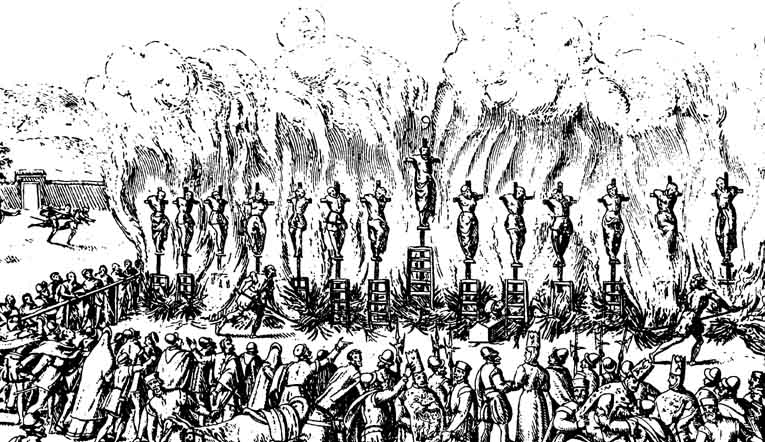 Illustration of an auto-da-fé in the Middle Ages: Bibliothèque nationale de France, Public domain, via Wikimedia Commons
In parallel, the years 1239 and 1240 were marked by a hardening of religious repression. In May 1239, a major auto-da-fé took place at the château du Mont Aimé, where 183 men and women found guilty of heresy were put to the flames. This episode illustrated the scale taken by inquisitorial repression in certain regions of the kingdom.
In 1240, the policy toward Jewish communities became more severe in several principalities. On 10 April, Duke John I the Red promulgated an edict of expulsion of Jews from Brittany at Ploërmel. The same year, from 12 June, the great disputation on the Talmud opened in Paris, in the presence of Christian theologians and Jewish representatives. On 25 June, the controversy was held before Louis IX and Blanche of Castile. At the end of the procedure, the Talmud was condemned, a prelude to its public burning in 1242.
💎 1239–1241: Monarchical Prestige and Extension of the Royal Domain
The years 1239 to 1241 were also marked by a strengthening of Capetian monarchical prestige. In February 1239, Louis IX acquired the County of Mâcon, thereby continuing the extension of the royal domain by purchase.
On 11 August 1239, the king welcomed at Villeneuve-l’Archevêque the Crown of Thorns of Christ, a prestigious relic acquired from the Latin Empire of Constantinople. Its preservation soon motivated the construction of the Sainte-Chapelle in Paris, designed to magnify the sacred character of Capetian royalty. In the same movement of territorial consolidation, Nuno Sanche of Roussillon sold to Louis IX the strongholds of Puylaurens and Quéribus, two strategic fortresses in the Midi.
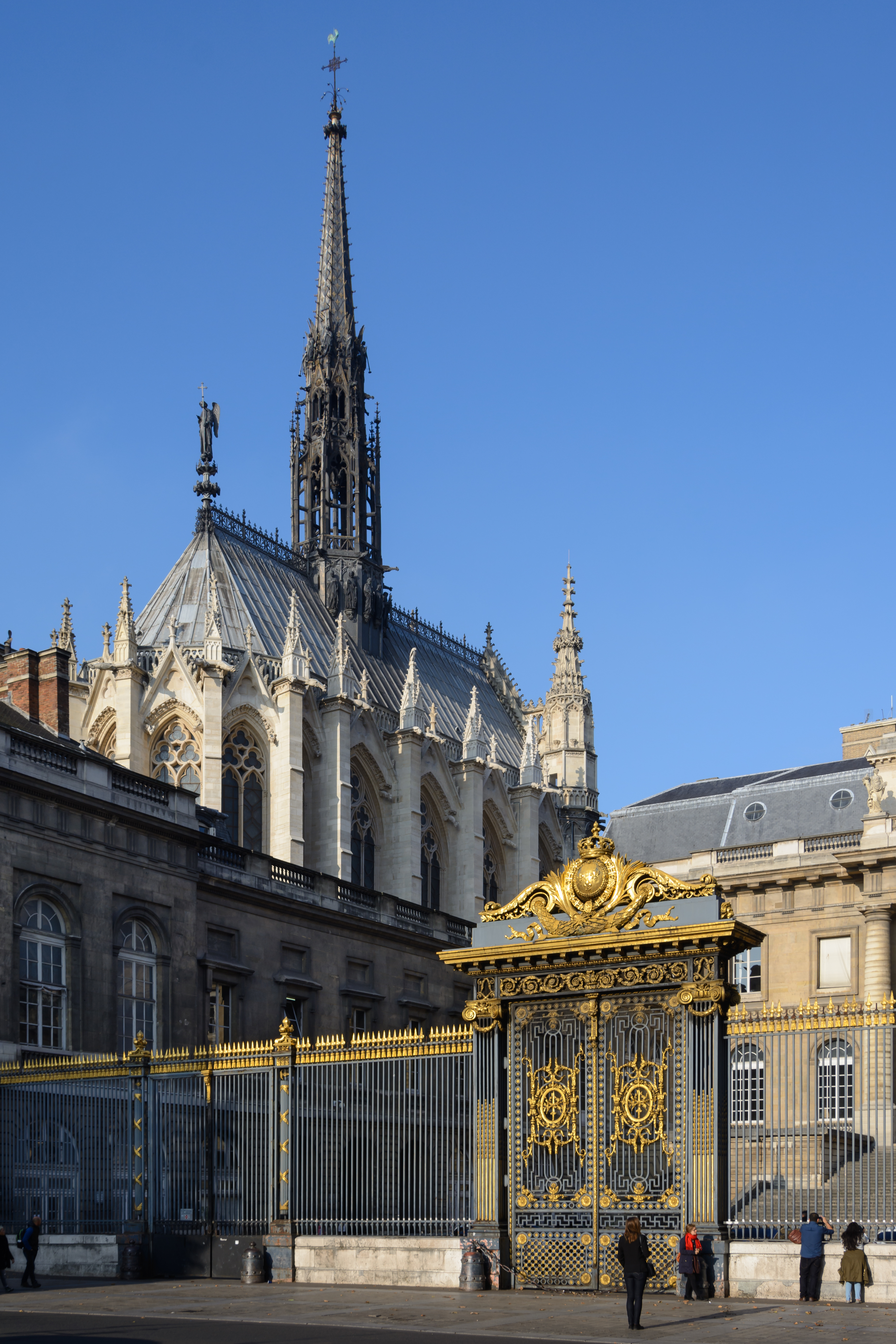 Sainte-Chapelle in Paris: Uoaei1, CC BY-SA 4.0 https://creativecommons.org/licenses/by-sa/4.0, via Wikimedia Commons
In 1241, the king held a great court at Saumur at which he invested his brother Alphonse with the counties of Poitou and Auvergne, and with Albi. This decision provoked new tensions with several great lords, anxious about the strengthening of Capetian presence in the West and the Midi.
⚔️ 1241–1243: Princely Revolt, Pacification of the Midi and Resumption of the Inquisition
The investiture of Alphonse of Poitiers fuelled a new coalition hostile to the monarchy. The Count of La Marche, Hugh of Lusignan, and Raymond VII of Toulouse entered into revolt with the support of the king of England Henry III. This opposition led, in 1242, to a resumption of the conflict against Capetian power.
In April 1242, Raymond VII rose up again. On 28 May, four inquisitors were massacred at Avignonet, a major episode in southern resistance to the religious and political order imposed since the end of the Albigensian Crusade. In response, Raymond VII was excommunicated on 6 June.
The conflict ended with the Peace of Lorris, concluded on 30 October 1242 between the king of France and the Count of Toulouse. Ratified in January 1243, the treaty consecrated the submission of Raymond VII to Louis IX, soon imitated by the Count of Foix and the Viscount of Narbonne. The agreement broadly confirmed the provisions of the Treaty of Paris of 1229 and prepared more clearly still the integration of the County of Toulouse into the royal domain.
In the same diplomatic context, a five-year truce was negotiated on 7 April 1243 by Blanche of Castile with the king of England Henry III, following the latter’s failure in the coalition of 1241–1242. By this agreement, Henry III ceded the île de Ré to the French crown, while the king of France retained Guyenne as far as the Gironde.
The religious question nonetheless remained acute in the Midi. On 18 April 1243, Raymond VII of Toulouse, in conflict with the inquisitors who had excommunicated him, brought his complaints before the Council of Béziers. A few months later, on 10 July, Pope Innocent IV issued briefs ordering the continuation of the repression of Cathar heresy. The Dominicans were then definitively confirmed in their central role within the Inquisition.
The same year, Bonaventure entered the Franciscan order, after his studies at the University of Paris, in a context of full flourishing of the mendicant orders within Latin Christendom.
🏛️ Symbolic Construction of the Capetian Monarchy
The same period saw the beginning of construction of the Sainte-Chapelle of Paris, undertaken from 1242 under the direction of Pierre de Montreuil. By its architecture as much as by its function as a dynastic reliquary, the building expressed the rise of a Capetian monarchy now consolidated politically as much as symbolically.
🌍 Elements External to the Kingdom
Certain contemporary events, while not belonging directly to the internal history of the kingdom, were part of the broader context of Latin Christendom. Pope Gregory IX launched calls to crusade in favour of the Latin Empire of Constantinople in 1235 and then 1237, which remained largely without effect. In 1240, the advance of the Mongols in Eastern Europe, marked by the devastation inflicted on several principalities of southern Russia, also contributed to feeding anxieties in the Christian world.
III. ✝️ 1245–1254: The Seventh Crusade
Between 1245 and 1254, the reign of Louis IX was dominated by the preparation, conduct and immediate consequences of the Seventh Crusade. Conceived as a great expedition directed against Egypt, then considered the strategic centre of Muslim power in the Near East, this crusade lastingly mobilised the political, financial and military resources of the Capetian monarchy.
⛵ 1245–1248: Preparation of the Expedition
 The Council of Lyon: Innocent IV - Council of Lyon - 002r detail, Wikimedia Commons, source: Syracuse University Library, Department of Special Collections.
At the Council of Lyon opened on 28 June 1245 by Pope Innocent IV, the preaching of the crusade was relaunched. Louis IX, already committed to this project, confirmed his intention to personally lead an expedition to the East. The kingdom, pacified and prosperous, then offered the sovereign the means to assemble men, funds and ships for the enterprise.
 Meeting of Saint Louis, King of France, and Pope Innocent IV, at Lyon, in 1248: Louis-Jean-François Lagrenée 1773, Public domain, via Wikimedia Commons
The financing of the crusade rested notably on a levy of tithes on the clergy, while recruitment touched a large part of the kingdom’s nobility. On 16 October 1245, many lords were summoned to parliament in Paris and several took the cross in imitation of the king.
Logistical preparations continued in the following years. In 1246, Louis IX hired ships from Genoa and Marseille to ensure the transport of the crusader army. The departure finally took place from Aigues-Mortes, a port specially developed by the Capetian monarchy to open the kingdom a direct access to the Mediterranean.
 Departure of Louis IX for the crusade: Unknown author — Chroniques de France ou de saint Denis., Public domain, via Wikimedia Commons
On 25 August 1248, Louis IX embarked for the crusade with his wife Margaret of Provence. The army reached Cyprus on 7 September and wintered there until spring 1249. During the king’s absence, Blanche of Castile once again exercised the regency of the kingdom.
🌊 1248–1249: Cyprus, Mongol Contacts and the Conquest of Damietta
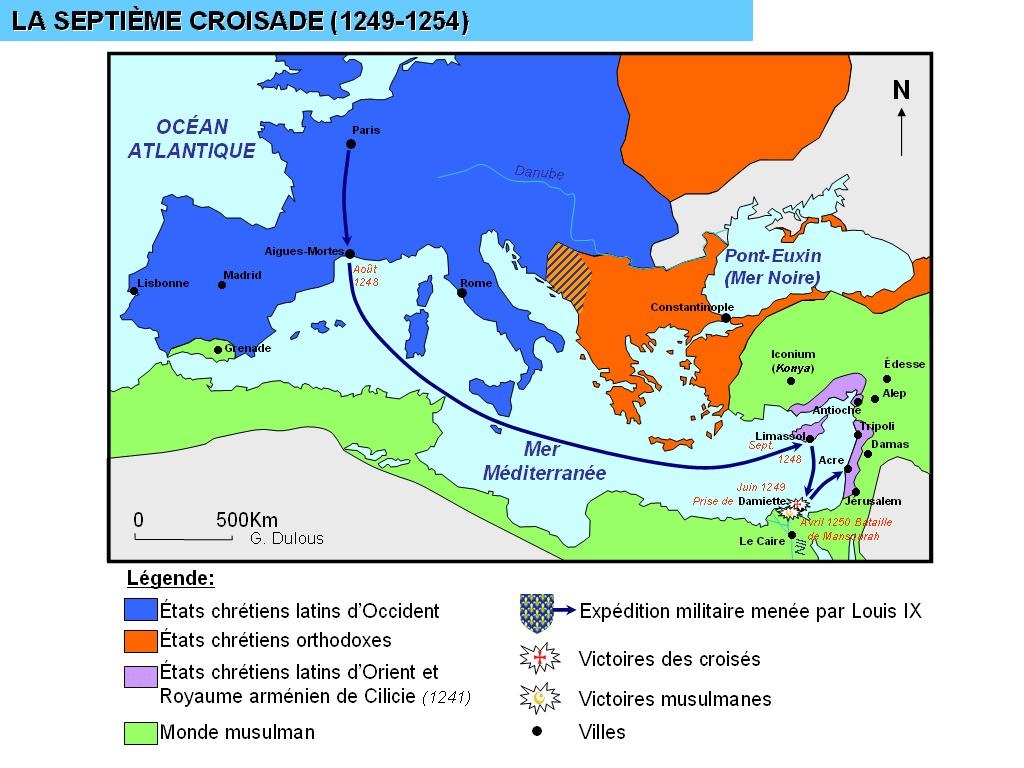 Route of the Seventh Crusade: Guilhem06, CC BY-SA 3.0 https://creativecommons.org/licenses/by-sa/3.0, via Wikimedia Commons
During his stay in Cyprus, Louis IX prepared the Egyptian campaign while seeking to establish contacts with the Mongols. The king hoped to obtain their conversion to Christianity or, failing that, an alliance against the Muslim powers of the Near East. In December 1248, a Mongol delegation was received in Cyprus; these exchanges maintained the hope of a rapprochement, without leading to a concrete agreement.
On 27 January 1249, the Dominican Andrew of Longjumeau was sent as ambassador to the great khan. This mission was part of a series of diplomatic attempts made by the king of France toward the Mongol world.
 Conquest of Damietta: Vincent of Beauvais, Public domain, via Wikimedia Commons
On 30 May 1249, the crusader army left Cyprus and landed in Egypt. On 5 June, it took Damietta, abandoned by its defenders. This initial success seemed to confirm the relevance of the Capetian strategy of striking Egypt before hoping to reconquer the main holy places.
 Saint Louis, King of France, receiving ambassadors from the Prince of the Assassins: Nicolas-Guy Brenet, Public domain, via Wikimedia Commons
However, despite proposals attributed to the Ayyubid sultan, the crusaders continued their march inland toward Cairo. This decision committed the expedition to a much more difficult campaign.
⛓️ 1250: Mansourah, Defeat and the King’s Captivity
The Frankish advance became bogged down in the Nile delta. On 8 February 1250, at the Battle of Mansourah, the crusader vanguard commanded by Robert of Artois, the king’s brother, penetrated the city but was quickly isolated and destroyed in the enemy counter-attack. Robert of Artois was killed in the fighting.
 Count of Anjou in the battle of Mansourah: Gustave Doré, Public domain, via Wikimedia Commons
On 11 February, a new Egyptian offensive was repulsed, but the crusader army remained in a critical situation. Exhausted, weakened by disease and cut off from its bases, it could no longer sustain its effort.
On 6 April 1250, the expedition capitulated. Louis IX was taken prisoner along with part of his troops. His captivity was a major event, both for its resonance throughout Christendom and for the image of piety and resignation that later accounts attached to the sovereign.
 Capture of Saint Louis: Maître de Fauvel, Public domain, via Wikimedia Commons
On 6 May 1250, the king obtained his release in exchange for the restitution of Damietta and the payment of a very heavy ransom for the survivors of the crusader army. Shortly afterwards, on 13 May, he made for Acre.
🕊️ 1250–1254: Remaining in the Holy Land and Eastern Diplomacy
Rather than returning immediately to France, Louis IX chose to remain in the Holy Land until 1254. From Acre, he sought to consolidate the positions still held by the Latins of the East. He had the fortifications of several coastal towns restored, notably Acre, Caesarea, Jaffa and Sidon, and attempted to restore a degree of cohesion among the various Frankish principalities.
 William of Rubruck setting out to meet the Mongols: Unknown artist, Public domain, via Wikimedia Commons
The king simultaneously continued his policy of contacts with the Mongols. In 1253, the Fleming William of Rubruck was sent to the great khan. His mission, which took him as far as Karakorum, illustrated the king of France’s persistent desire to seek Eastern support against Muslim powers, even if these embassies did not result in the hoped-for alliance.
Diplomatically, Louis IX also sought to preserve the interests of the Latin states of the East through negotiation. In 1252, he concluded with the Mamluks the Treaty of Caesarea, which notably provided for the liberation of the last crusader prisoners and offered the prospect of certain territorial advantages. This agreement, however, had no lasting effect.
On 24 April 1254, the crusaders embarked at Acre for the return. The eastern sojourn of Louis IX thus ended after several years devoted to the defence of Frankish positions, regional diplomacy and the search for new alliances.
📜 Legacy of the Expedition
The Seventh Crusade ended in military failure. The taking of Damietta led to no lasting advantage, the Egyptian campaign turned to catastrophe and the king himself experienced captivity. Yet the expedition played a major role in building the image of Louis IX. His piety, perseverance, refusal to immediately abandon the Holy Land and personal commitment to the crusading ideal contributed greatly to the reputation for holiness which attached to him even during his lifetime.
The crusade also marked the more distinct opening of the Capetian monarchy to the diplomatic stakes of the Latin East and the Mongol world. By its scope, it constituted one of the major episodes of the reign of Louis IX before his return to France and the great phase of administrative and judicial reforms that opened from 1254.
IV. ⚖️ 1254: Return from Crusade and Reorganisation of the Kingdom
The return of Louis IX in 1254 marked an important step in his reign. After several years spent in the East, first in the course of the Seventh Crusade then in the Latin states consolidating their defences, the king returned to the kingdom of France in a context profoundly altered by the disappearance of his mother, Blanche of Castile.
Since the king’s departure for the crusade in 1248, Blanche of Castile had once again exercised the regency. Her death, on 27 November 1252, deprived the Capetian monarchy of the main figure of authority who had remained at the head of the kingdom in the sovereign’s absence. Louis IX, informed of this loss the following spring, was deeply affected. This event probably contributed to strengthening the necessity for his return to France, even though he chose to remain in the Holy Land for a little longer before coming home.
On 7 September 1254, Louis IX made his entry into Paris. His return opened a new phase of his government, now more focused on the domestic affairs of the kingdom. The experience of the crusade, the king’s captivity in Egypt and the difficulties encountered in the East seemed to reinforce his desire to exercise a more rigorous, more moral and more directly justice-oriented power.
From the end of that year, this reorientation was translated into an important enterprise of reform. In December 1254, the king promulgated a great ordinance aimed at improving the government of the kingdom. This text was part of the continuity of the enquiries already undertaken before his departure to correct abuses committed by royal agents in the provinces.
The ordinance sought to better regulate the action of the king’s officials and to affirm the moral requirements attached to the exercise of power. It aimed notably to limit administrative exactions, to strengthen oversight over bailiffs and seneschals, and to advance a more orderly conception of royal justice.
Under the reign of Louis IX, the bailiffs in the north and the seneschals in the Midi and West saw their role progressively defined. They exercised justice in the king’s name, collected revenues from the domain, transmitted royal orders and ensured the relay of central authority in the provinces. Their closer supervision participated in the strengthening of the Capetian state.
The return from crusade also corresponded to a flourishing of royal justice. Appeals addressed to the king’s tribunal multiplied, to the relative detriment of seigneurial jurisdictions. Faced with the increase in the number of cases, certain members of the King’s Council specialised further in judicial functions, contributing to the progressive affirmation of the Parlement of Paris. It was at this time that the registers of judgements later called the Olim began.
In Paris, the king further strengthened public order, notably through the creation of the chevaliers du guet (watch knights), responsible for nocturnal policing. This measure illustrated the royal will to better oversee urban life in the kingdom’s capital.
The reign of Louis IX is also associated with a lasting image of a king as judge. Tradition holds that he sometimes personally administered justice, notably under an oak tree at Vincennes, an image destined to become one of the most celebrated symbols of his government. Without exhausting in itself the reality of Capetian power, this representation conveys the importance acquired under his reign by the ideal of a monarchy founded on equity, moral reform and the peace of the realm.
The return of 1254 was therefore not merely the end of an eastern expedition. It inaugurated a new phase of the reign, marked by the consolidation of royal institutions, the development of the king’s justice and the more distinct affirmation of a Capetian monarchy concerned with good government.
V. 🏰 1255–1260: Consolidation of the Kingdom, End of Catharism and Diplomatic Affirmation
During the years 1255 to 1260, the reign of Louis IX was marked by the consolidation of Capetian authority, by the completion of the repression of southern Catharism, by the diplomatic affirmation of the kingdom vis-à-vis its neighbours, and by important intellectual and religious developments.
🎓 1255–1256: Teaching, Dynastic Alliance and End of the Last Cathar Centres
In 1255, the University of Paris, then considered one of the main intellectual centres of the Latin West, inscribed the complete works of Aristotle in its curriculum. This decision testified to the growing place of Aristotelian thought in higher education and in the theological debates of the time.
The same year, on 6 April, Isabella of France, daughter of Louis IX, married Thibaut V of Champagne at Melun. This union reinforced the ties between the Capetian monarchy and one of the kingdom’s main principalities.
 Château de Quéribus: BlueBreezeWiki, CC BY-SA 3.0 https://creativecommons.org/licenses/by-sa/3.0, via Wikimedia Commons
In the Midi, the fight against heresy continued. On 8 May 1255, the Council of Béziers decided to send reinforcements to the constable of Carcassonne, Pierre d’Auteuil, engaged in the siege of the Château de Quéribus. This fortress, one of the last refuges of Occitan Catharism, finally fell in 1256, after the capture of Chabert de Barbaira by Olivier de Termes. Around the same time, the fall of Niort-de-Sault, during the summer of 1255, also marked the disappearance of the last organised strongholds of Cathar dissent in the Midi.
 The silver tree-fountain from which koumis flowed, made at Karakorum by Parisian goldsmith Guillaume Boucher around 1250, as reproduced on a Mongolian banknote in 1995 based on Rubruck’s description and an 18th-century engraving: Bank of Mongolia, Public domain, via Wikimedia Commons
On the diplomatic and intellectual level, the return of William of Rubruck to Acre on 15 August 1255 provided Louis IX with a detailed report on Central Asia and the Mongol world. This testimony enriched Western knowledge of the peoples of the East and extended the diplomatic efforts undertaken by the king toward the Mongols.
⛪ 1257: Rise of the Mendicant Orders and Provençal Affirmation
The year 1257 was marked by the election, on 2 February, of Bonaventure of Bagnoregio as minister general of the Franciscans, after the resignation of John of Parma. In an order traversed by tensions over the interpretation of evangelical poverty, Bonaventure played a decisive role in restoring unity. His doctrinal and institutional action earned him the status of “second founder” of the order. He also contributed to integrating certain contributions of Aristotelianism into a theological tradition largely marked by Augustinianism.
In the Mediterranean Midi, on 2 June 1257, a new treaty between the Count of Provence and the city of Marseille greatly reduced the latter’s autonomy. This development was part of the progressive strengthening of comital authority in Provence, now held by Charles of Anjou, brother of Louis IX.
🤝 1258–1259: Diplomatic Settlements with Aragon and England
 Angevin Empire: IvanBondarev, CC BY-SA 4.0 https://creativecommons.org/licenses/by-sa/4.0, via Wikimedia Commons
The years 1258 and 1259 saw the Capetian monarchy strengthen its position through diplomacy. On 19 January 1258, Charles of Anjou acquired the County of Vintimille, continuing his expansion of influence in the western Mediterranean and the Alpine spaces.
On 11 May 1258, Louis IX concluded with James I of Aragon the Treaty of Corbeil, which fixed the border between the two kingdoms south of the Corbières. By this agreement, the king of France renounced his earlier claims on Catalonia, while the king of Aragon gave up his feudal rights over several territories in the Midi. The treaty clarified relations between the two monarchies in a lasting way and helped stabilise the kingdom’s southern border.
The same year, the king also concluded a major agreement with England. By the Treaty of Paris of 1258, confirmed and refined in subsequent years, Henry III of England renounced claims to several of the former continental possessions lost by the Plantagenets, notably Normandy, Anjou, Touraine, Maine and Poitou, in exchange for the restitution or confirmation of certain territories in the South-West.
On 4 December 1259, following this agreement, Henry III rendered liege homage to Louis IX. This ceremony symbolically consecrated the feudal superiority of the king of France, while putting an end to an old dispute between the Capetians and Plantagenets. The Capetian monarchy thereby confirmed its dominance over the principal conquests made since the reign of Philip Augustus, while seeking a lasting peace with England.
⚖️ 1259–1260: Royal Justice and Oversight of the Nobility
The end of the decade was also marked by the affirmation of the king’s judicial role. The trial of Enguerrand of Coucy, held in 1259, illustrated the growing capacity of the monarchy to judge the great lords of the kingdom and to intervene in affairs that had previously belonged almost exclusively to feudal justice.
In 1260, this evolution was even more clearly manifested in the domain of public peace. Louis IX prohibited judicial duels, the bearing of arms, and private wars. These measures reflected a desire to limit noble violence and to reserve to royal power the growing monopoly of judicial arbitration and maintenance of order.
✝️ 1260: Religious Reforms and Angevin Expansion
On 23 May 1260, Bonaventure of Bagnoregio promulgated at Narbonne the constitutions of the Franciscan order. This text defined a middle path between the most rigorous and the most lenient interpretations of the rule of Saint Francis, helping to delay the division of the order.
At the same time, Charles of Anjou pursued his policy of expansion into northern Italy and subdued Piedmont, thereby extending the influence of the Capetian house beyond the Alps. Without belonging directly to the royal domain, this advance reinforced the weight of the Capetian dynasty in Mediterranean political balances.
📊 Assessment of the Period
Between 1255 and 1260, the reign of Louis IX thus appeared as a period of consolidation. The disappearance of the last Cathar centres, the rise of Capetian diplomacy, the stabilisation of relations with Aragon and England, and the development of a more active monarchy in the judicial domain all testified to a general strengthening of royal authority.
In parallel, the intellectual flourishing of the University of Paris and the growing role of the mendicant orders placed the kingdom of France at the heart of the great religious and doctrinal developments of Western Christendom.
VI. ⚜️ 1262–1270: Capetian Affirmation, Angevin Expansion and the Last Crusade
Between 1262 and 1270, the reign of Louis IX was marked by the consolidation of monarchical authority, by the affirmation of the power of the Capetian house in the Mediterranean through the action of Charles of Anjou, and by the preparation and then the launching of the Eighth Crusade. This period also saw the strengthening of the instruments of royal government, both in the monetary, judicial and normative domains.
💍 1262–1263: Dynastic Alliances and Strengthening of Royal Authority
On 28 May 1262, the heir Philip, future Philip III the Bold, married at Clermont Isabella of Aragon, daughter of James I of Aragon. This marriage strengthened the ties between the Capetian monarchy and the crown of Aragon, in continuation of the policy of stabilisation pursued in the Midi since the Treaty of Corbeil.
The same period was marked by new tensions in Provence. In 1262, the city of Marseille rose up again against Charles of Anjou, the king’s brother and Count of Provence, with the support of several Provençal lords. The revolt was finally suppressed, and a treaty concluded on 13 November 1262 restored the regime imposed in 1257, while disarming the city. This development illustrated the progressive reduction of urban autonomies in the face of Angevin princely power.
The strengthening of royal authority was also expressed in the monetary domain. By the Ordinance of Chartres of 11 March 1263, Louis IX more firmly affirmed the pre-eminence of the royal currency, whose currency was recognised throughout the kingdom, while its imitation was prohibited. This policy participated in the economic unification of the kingdom and the strengthening of the king’s sovereign prerogatives.
🌍 1264–1266: Louis IX’s Arbitral Prestige and the Rise of Charles of Anjou
The prestige of Louis IX then extended beyond the kingdom’s borders. On 23 January 1264, through the Dit d’Amiens, he delivered an arbitration in the conflict between Henry III of England and his rebellious barons around Simon de Montfort. The king of France sided with the English sovereign by declaring the Provisions of Oxford unacceptable. This decision did not end the conflict, since the barons subsequently won the Battle of Lewes in May 1264, before being definitively crushed at Evesham in 1265.
 Saint Louis mediator between the King of England and his barons: Georges Rouget, Public domain, via Wikimedia Commons
At the same time, the rise of Charles of Anjou profoundly modified Mediterranean balances. In 1265, the Pope effectively offered him the crown of Sicily; he was invested at the Lateran then crowned king with Beatrice of Provence in Rome in January 1266. On 26 February 1266, the victory of Benevento over Manfred of Hohenstaufen opened the kingdom of Naples and Sicily to him. The Capetian house thereby extended its influence well beyond the kingdom of France, through an Angevin branch now solidly established in southern Italy.
 Charles of Anjou and Beatrice of Provence: Antoine de Ruffi, 1655., Public domain, via Wikimedia Commons
This same phase was also marked, in France, by the continuation of monetary reforms. The ordinance of 1 November 1265 further limited seigneurial coin-striking and favoured the circulation of the gros tournois, a silver coin destined to enjoy wide success in commercial exchanges.
📜 1267–1269: Juridical Radiance, Social Oversight and Preparation for the Crusade
From 1267, the rise of Charles of Anjou continued in Italy, notably with his entry into Florence as imperial vicar for Tuscany, then with his victory of Tagliacozzo in 1268 over Conradin, the last major representative of the Hohenstaufen. This victory secured Angevin domination in the Mezzogiorno, at the cost, however, of a severe government in the conquered territories.
In France, the final years of the reign also saw important normative activity. The composition of the Livre des métiers (Book of Trades) by Étienne Boileau, towards the end of Saint Louis’s reign, constitutes one of the first major collections of regulations relating to Parisian trades. This text testified to the growing desire of royal power to oversee urban economic activity and to organise trade communities more strictly.
 Sketch for the hearing room of the Paris Commercial Court: Paul-Louis Delance, Public domain, via Wikimedia Commons
The period was also marked by several religious and moral measures. In 1269, in conformity with prior conciliar decisions, Louis IX required Jews to wear a distinctive yellow badge. The same year, he ordered the more rigorous application of prescriptions against blasphemy. These measures were part of a Christian conception of royal power, concerned with both moral order and religious unity.
In the intellectual domain, the years 1268–1269 also saw the return and Parisian teaching of Thomas Aquinas, then engaged in the controversies aroused by Latin Averroism. The University of Paris thus remained one of the great doctrinal centres of Western Christendom at the end of Louis IX’s reign.
In parallel, the king prepared a new overseas expedition. In 1269, he once again had ships hired from Genoa and Marseille in preparation for the Eighth Crusade, proof that the crusading ideal remained at the heart of his political and religious vision.
🕯️ 1270: The Eighth Crusade and the Death of Louis IX
In 1270, Louis IX personally led a new crusade. On 18 July, he landed with his army near Tunis and laid siege to the city. The exact reasons for this strategic choice have been variously interpreted, but the expedition quickly turned to failure, due to disease, the exhaustion of the army and the absence of decisive results.
On 25 August 1270, Louis IX died before Tunis. His death ended a reign of more than forty years, during which the Capetian monarchy had affirmed itself as a political, judicial and religious power of the first order in the medieval West. His son succeeded him immediately under the name of Philip III the Bold.
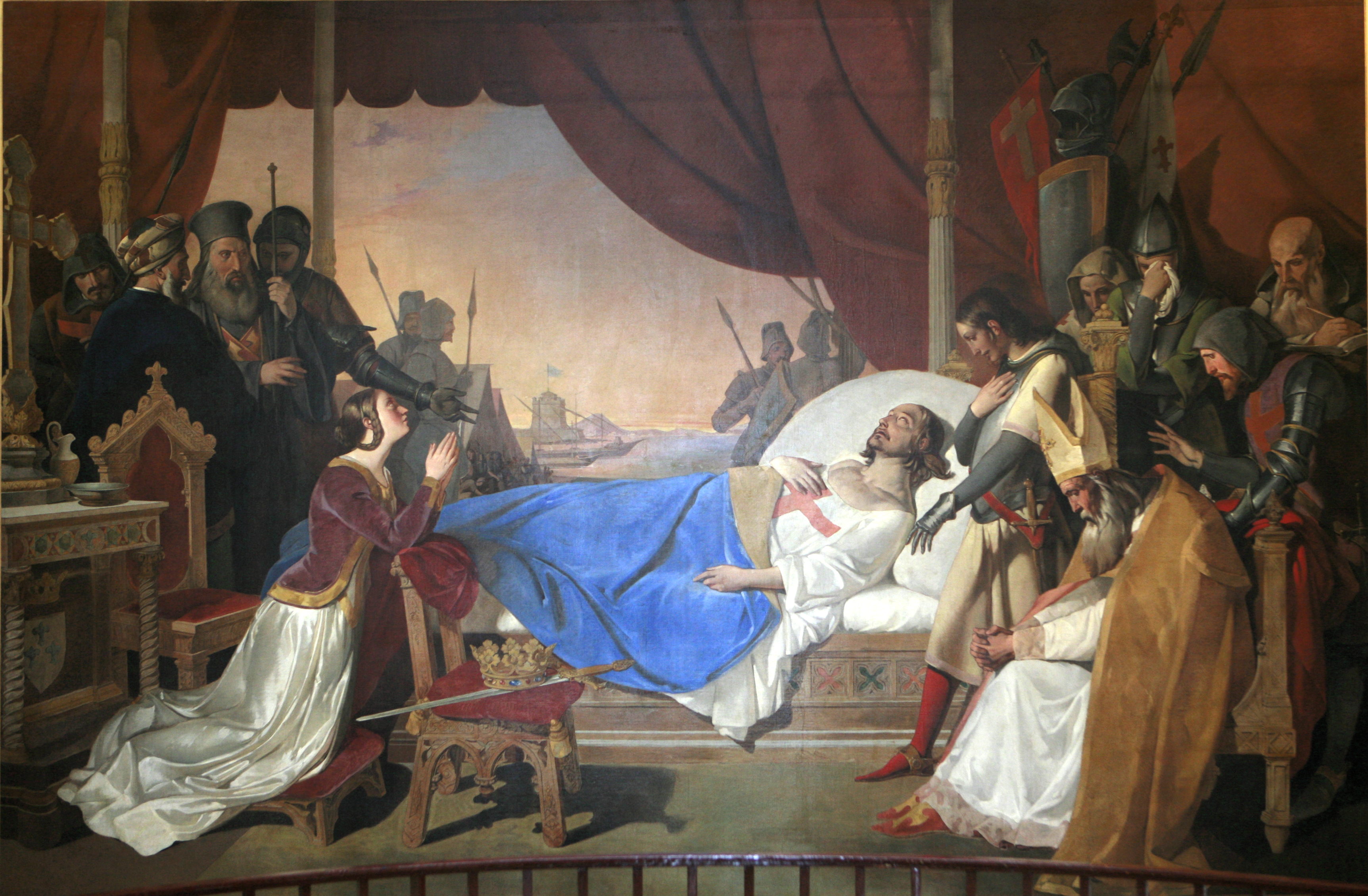 The death of Saint Louis: collection of the Museum of Fine Arts of Brest, Public domain, via Wikimedia Commons
After the king’s death, the expedition was quickly wound up. The Treaty of Tunis, concluded in October 1270, allowed the withdrawal of the troops, notably under the influence of Charles of Anjou, whose Sicilian interests were directly affected. During the return, the fleet of Philip III was struck by a storm at Trapani. The disappearance of Louis IX thus opened a new phase of Capetian history, marked by dynastic continuity but also by the end of the reign of the most prestigious of all Capetian sovereigns.
🧠 Key Points to Remember
- The regency of Blanche of Castile (1226–1234) secured a critical succession: royal authority held against feudal coalitions.
- Louis IX transformed monarchy from conquest to justice: ordinances, inquisitors, arbitrations.
- The Seventh Crusade (1248–1254) was a military failure but a political and symbolic construction of royal sanctity.
- The great diplomatic settlements of 1258–1259 (Corbeil with Aragon, Paris with England) locked in the Capetian territorial gains of Philip Augustus.
- The monetary reform (gros tournois, 1262) and judicial reform (ban on private wars, 1260) advanced the idea of a unified, governed kingdom.
- Death before Tunis in 1270 transformed a military failure into a founding myth: the canonisation of Louis IX in 1297 consecrated this image.