


Louis VI: The King Against the Lords (1108–1137)
p51108 à 1137
In 1108, following the death of Philip I, his son Louis VI ascends to the throne. The coronation is organized quickly at Orléans to prevent any challenge to his authority. The Capetian monarchy is now firmly established for the long term, but its power remains limited: the king exercises direct authority over a restricted domain, centered on the Île-de-France, while the great principalities — Normandy, Flanders, Aquitaine — possess superior military and financial resources.
 The coronation of Louis VI: The Great Chronicles of France (Master of Fauvel), Public domain, via Wikimedia Commons
The beginning of his reign is marked by a clear priority: to reassert royal authority within the Capetian domain. Louis VI pursues an active policy aimed at securing the territories under his direct control and limiting the powers of local lords.
🔍 Zoom – 1108: Entry into reign and the challenges of the domain
I. ⚔️ 1108–1115 — Pacifying the Royal Domain
From the start of his reign, Louis VI must face a dual challenge: containing the ambitions of the great princes and restoring order within his own domain.
At the same time, the political context is evolving: in the south, the county of Toulouse changes hands with the departure of Bertrand de Saint-Gilles for the Orient, leaving power to Alphonse Jourdain. Meanwhile, the kingdom experiences notable intellectual dynamism marked by figures such as Peter Abelard, whose teaching in Paris contributes to the intellectual influence of the capital.
⚔️ 1109–1113: Conflicts in the Vexin and military affirmation
Beginning in 1109, Louis VI is confronted with the power of Henry I Beauclerc, king of England, who seizes the castle of Gisors, a strategic point in the Vexin.
The king reacts by mobilizing several great lords:
- the count of Flanders
- the count of Blois
- the count of Nevers
- the duke of Burgundy
A confrontation occurs near Neaufles-Saint-Martin. Louis VI proposes direct combat, which Henry refuses. After limited but favorable skirmishes for the French, a truce is concluded around March 1109, without permanently resolving the conflict.
The war continues until the Treaty of Gisors (1113), which consolidates a compromise: Louis VI recognizes certain Norman positions, particularly in Maine and Brittany.
This episode illustrates a constant of the reign: the king acts militarily, but must contend with opponents often more powerful than himself.
⚔️ 1110–1112: Struggle against the lords of Île-de-France
At the same time, Louis VI pursues continuous action against the lords of the royal domain.
In 1110, he obtains the submission of several of them, notably:
- Philip of Montlhéry, his half-brother
- several local lords of Île-de-France
He also grants charters, such as to Mantes, to strengthen urban communities and stabilize the territories.
 Louis VI grants the Parisians their first charters: Jean-Paul Laurens, Public domain, via Wikimedia Commons
The war against rebellious lords remains intense, however:
- in 1111, Robert of Meulan attacks Paris
- the king wages campaigns against Hugh of Puiset (1111–1112)
- reprisals are violent: zones of the royal domain are devastated
 The king in battle: A History of France in One Hundred Engravings by Paul Lehugeur. A. Lahude, Paris, c. 1883.
The same year, the conflict widens: the count of Flanders Robert II dies in combat alongside the king near Meaux, proof of the direct involvement of the monarchy in princely struggles.
⚔️ 1112–1115: Progressive consolidation
In 1112, the communal revolt in Laon results in the assassination of bishop Gaudry, revealing the social and political tensions of the kingdom.
At the same time, the religious movement strengthens: Bernard of Clairvaux enters Cîteaux, marking the rise of the Cistercian movement.
After the 1113 treaty, the king can focus more on the royal domain.
In 1115, Louis VI marries Adelaide of Savoy, strengthening his alliances. He then conducts a campaign against Thomas of Marle, a particularly violent lord, and seizes several of his fortresses.
 Louis VI and his army besiege the fortress of Castillon: Émile Bayard, Public domain, via Wikimedia Commons
During the siege of Amiens, the king is even wounded, testifying to his personal commitment in military operations.
In total, between 1108 and 1115, Louis VI does not wage a single war but conducts a series of coordinated actions aimed at:
- securing the roads
- reducing the autonomy of the lords
- asserting a concrete royal presence
This phase constitutes the foundation of Capetian recovery.
II. 🏙️ 1110–1120 — Cities, the Church, and the Framing of Power
Parallel to military action, Louis VI relies on cities and the Church to strengthen his authority.
The king confirms or grants several communal charters, notably to Noyon, Mantes, and Beauvais, which he subjugates after a long siege. This policy aims to stabilize territories and create local relays favorable to the monarchy.
These developments, however, are accompanied by tensions. In 1112, the commune of Laon rises against its bishop, triggering a major crisis requiring royal intervention.
The Church plays a central role as well. The reign corresponds to a period of religious renewal:
- development of schools (Paris, Melun, Corbeil)
- growing influence of masters such as Peter Abelard
- expansion of the Cistercian movement with Bernard of Clairvaux
The king participates in this movement by supporting religious institutions, notably the abbey of Saint-Victor of Paris, which he endows in 1113.
This alliance between royal power, the Church, and cities constitutes a key element in the stabilization of the kingdom.
III. ⛪ 1116–1122 — Religious Reforms and Royal Affirmation
The reign of Louis VI takes place in a context of profound religious renewal, marked by doctrinal tensions and growing royal involvement in ecclesiastical affairs.
Beginning in 1116, the preacher Henry of Lausanne is driven out of the Mans after stirring up troubles. He subsequently spreads ideas similar to those of Peter of Bruys, condemned as heretical.
The Church reacts through the multiplication of councils:
- in 1118, the council of Toulouse preaches the crusade in Spain
- in 1119, a new council condemns doctrines deemed deviant
The same year, Louis VI participates in the Council of Reims (1119), presided over by Pope Callistus II, in the context of the Investiture Controversy.
In 1121, Abelard’s theological treatise is condemned at the Council of Soissons, illustrating the Church’s increased control over intellectual debates.
In this context, the Capetian monarchy progressively asserts its role. The first occurrence of the title “King of France” (rex Franciae) appears in a letter from Louis VI, a sign of major symbolic evolution.
IV. ⚔️ 1119–1124 — From Brémule to Mobilization of the Kingdom
Despite progress within the royal domain, Louis VI remains confronted with adversaries more powerful than himself, foremost among them Henry I Beauclerc, king of England and duke of Normandy.
In 1119, the king supports Norman opponents to Henry and directly confronts Anglo-Norman power in the Battle of Brémule. The French army is defeated. This defeat highlights the military limitations of the Capetian monarchy against an adversary with superior resources.
 Louis the Fat in the Battle of Brémule: Henri Félix Emmanuel Philippoteaux, Public domain, via Wikimedia Commons
However, several years later, the situation evolves. In 1124, the threat of intervention by Emperor Henry V triggers general mobilization around the king. Louis VI calls on the great princes to join him, and they respond. Faced with this show of unity, the emperor renounces invading the kingdom.
 Oriflamme in the Basilica of Saint-Denis: Guilhem Vellut from Paris, France, CC BY 2.0 https://creativecommons.org/licenses/by/2.0, via Wikimedia Commons
This episode constitutes an important moment in the reign: the king now appears as the rallying point of the kingdom. The recourse to the Oriflamme of Saint-Denis reinforces this symbolic and political dimension further.
V. ⚖️ 1122–1127 — Royal Affirmation and Princely Interventions
From 1122 onward, the reign takes on a new dimension with the rise of Suger, elected abbot of Saint-Denis, who becomes one of the king’s principal advisors.
 Suger elected abbot of Saint-Denis: Justus van Egmont, Public domain, via Wikimedia Commons
Louis VI strengthens his role as arbitrator by intervening in regional conflicts. He notably wages campaigns in Auvergne against the local count in conflict with the bishop of Clermont:
- expedition in 1122
- new intervention in 1126, with the siege of Montferrand

Siege of Clermont by French troops (Louis VI the Fat receives the homage of Bishop Aimeric): Chronicles of Saint-Denis, Public domain, via Wikimedia Commons
These actions illustrate the king’s growing role as a guarantor of order between lay and ecclesiastical powers.
At the same time, territorial balances evolve:
- in 1125, the county of Champagne passes to Theobald IV of Blois
- Maine is attached to Anjou (1126)
In 1127, the situation in Flanders provokes direct royal intervention. Following the assassination of Count Charles the Good.
 This painting depicts the funeral of Charles the Good, count of Flanders, celebrated in Bruges in 1127 following his assassination: Jan Van Beers, Museum of Fine Arts, City of Paris - Via Wikimedia Commons
Very popular, Charles was quickly considered a martyr and a saint.
Following his death, Louis VI imposes William Clito as the new count.
This intervention shows an important evolution: the king no longer merely arbitrates, he actively imposes his political choices in the principalities.
VI. ⚔️ 1128–1130 — Princely Crises and Assertion of Power
At the end of the 1120s, the kingdom experiences new tensions.
In 1128, a revolt breaks out in Flanders against William Clito, supported by Louis VI. The movement rapidly spreads to the major cities, fostering the emergence of Thierry of Alsace as a competing claimant.
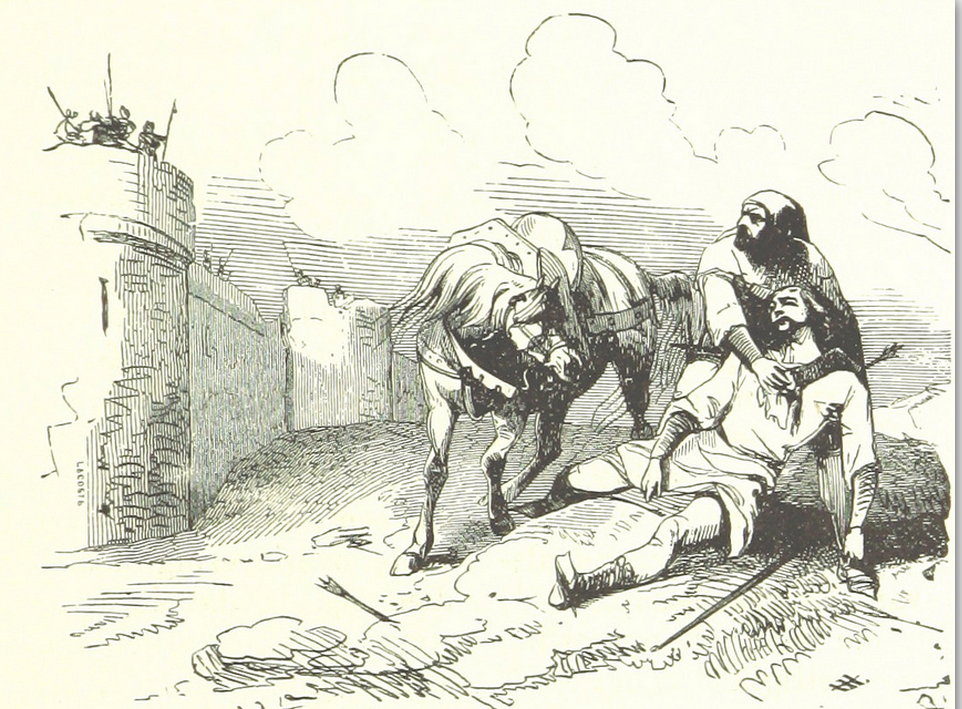 William Clito seriously wounded during the siege of Alost - Author: MOKE, Henri Guillaume. Contributor: HUBERT, Eugène Ernest. Published in 1885, Brussels Via Wikimedia commons
During the siege of Alost, William Clito is seriously wounded and dies in July 1128. His death leads to the collapse of the faction supported by the king of France and allows Thierry of Alsace to establish himself durably as count of Flanders.
This episode illustrates the limits of Capetian influence in the great principalities: despite direct intervention, the king cannot permanently control the political evolution of such a strategic territory.
At the same time, political transformations accelerate:
- marriage of Matilda the Empress to Geoffrey Plantagenet birth of the future Plantagenet power
On the religious front, the Council of Troyes (1129) officially recognizes the Order of the Temple, illustrating the growing importance of religious institutions in society.
Louis VI continues his policy of dynastic consolidation:
- in 1129, he associates his son Philip with the throne
⚔️ 1130: The End of Brigand Lords
In 1130, the king wages a decisive campaign against Thomas of Marle, an emblematic figure of feudal violence.
 Hanging of the supporters of Thomas of Marle: Bibliothèque nationale de France, Public domain, via Wikimedia Commons
Wounded during the siege of Coucy, Thomas dies shortly after.
This episode marks a turning point: the monarchy manages to eliminate one of the kingdom’s most turbulent lords, confirming the success of the pacification policy launched in 1108.
VII. 👑 1131–1137 — Succession, European Balances, and the End of the Reign
From the early 1130s, the question of succession becomes central. In 1131, the accidental death of the heir Philip forces the king to reorganize dynastic succession. His second son, Louis the Young, is crowned at Reims on October 25, 1131, during his father’s lifetime, in the presence of Pope Innocent II. This practice, inherited from the first Capetians, prevents any challenge.
At the same time, the political balances of the West evolve. In England, the succession question opens following the death of the royal heir. The barons swear an oath to Matilda the Empress, daughter of Henry I Beauclerc, but the situation remains unstable.
In 1135, the death of Henry I triggers a major crisis: Stephen of Blois is crowned king of England, opening a period of civil war. This instability permanently weakens the Anglo-Norman world, the principal adversary of the Capetians.
Louis VI exploits these developments carefully. In 1137, he meets Stephen of Blois and reaches an agreement maintaining a certain balance. Stephen’s son, Eustace, does homage to the king of France for Normandy, affirming the theoretical superiority of the Capetian sovereign.
In parallel, the monarchy continues its internal action:
- intellectual development with the teaching of Abelard and Peter Lombard in Paris
- strengthening of religious institutions, notably under the impetus of Suger
- diffusion of urban models such as the Charter of Lorris, which structures communal franchises
Finally, a major dynastic event occurs in 1137: the marriage of Louis VII to Eleanor of Aquitaine (July 25), which brings the crown a considerable territorial complex in the southwest of the kingdom.
 Marriage of Louis VII and Eleanor of Aquitaine: Author Anonymous via Wikimedia Commons
A few days later, on August 1, 1137, Louis VI dies.
The succession proceeds without crisis. The new king inherits:
- a consolidated royal domain
- strengthened authority in the north of the kingdom
- but also new territorial and political challenges linked to the integration of Aquitaine
🔍 Zoom – 1137: Eleanor’s marriage and Capetian heritage
🧠 Key Points to Remember
- 1108: Accession of Louis VI, royal power limited
- 1108–1115: Pacification of the royal domain
- 1110–1120: Support from cities and the Church
- 1119: Defeat at Brémule against England
- 1124: Mobilization against the emperor
- 1137: Succession assured
The reign of Louis VI marks an important step: the king does not yet dominate the kingdom, but he reestablishes effective authority within the Capetian domain and durably strengthens the monarchy.
Image Credits
-
Portrait of Louis VI the Fat: Merry-Joseph Blondel, Public domain, via Wikimedia Commons
-
The coronation of Louis VI: The Great Chronicles of France (Master of Fauvel), Public domain, via Wikimedia Commons
-
Louis VI grants the Parisians their first charters: Jean-Paul Laurens, Public domain, via Wikimedia Commons
-
The king in battle: A History of France in One Hundred Engravings by Paul Lehugeur. A. Lahude, Paris, c. 1883. Online: https://gallica.bnf.fr/ark:/12148/bpt6k992639v/
-
Louis the Fat in the Battle of Brémule: Henri Félix Emmanuel Philippoteaux, Public domain, via Wikimedia Commons
-
Oriflamme in the Basilica of Saint-Denis: Guilhem Vellut from Paris, France, CC BY 2.0 https://creativecommons.org/licenses/by/2.0, via Wikimedia Commons
-
Suger elected abbot of Saint-Denis: Justus van Egmont, Public domain, via Wikimedia Commons
-
Louis IV and his army besiege the fortress of Castillon: Émile Bayard, Public domain, via Wikimedia Commons
-
Siege of Clermont by French troops (Louis VI the Fat receives the homage of Bishop Aimeric): Chronicles of Saint-Denis, Public domain, via Wikimedia Commons
-
The funeral of Charles the Good, count of Flanders, celebrated in Bruges in 1127 following his assassination: Jan Van Beers, Museum of Fine Arts, City of Paris - Via Wikimedia Commons