

Francis I: The Knight King and the French Renaissance (1515–1547)
1515 à 1547
The reign of Francis I opened with a brilliance few French sovereigns had known at their outset. Crowned at Reims three weeks after the death of Louis XII, the new king, only twenty years old, immediately took up the Milanese question in which his two predecessors had successively failed, and won it in his very first campaign at Marignano, erasing within a few months the humiliation of Novara. This dazzling victory, joined to the legend of his chivalric knighting by Bayard, at once fixed the image under which posterity was to remember this reign: that of a “knight king,” enamoured of military glory and panache, heir to a world still largely medieval in its values.
This triumphant entrance onto the stage nonetheless masked a more ambiguous inheritance. Francis I came into a kingdom enlarged and consolidated by a century of monarchical policy, but also into an already long-standing dynastic rivalry with the House of Habsburg, soon embodied in the person of a truly formidable adversary: Charles V, whose election to the head of the Holy Roman Empire in 1519 turned the Italian rivalry into a personal and European confrontation destined to dominate most of the reign. Against him, Francis I had to make do with unstable alliances — Henry VIII’s England, the papacy, the German Protestant princes, and even the Ottoman sultan himself — none of which ever proved solid enough to durably tip the balance of power.
The dominant dynamic of these thirty-two years was thus one of an almost continual swing between brilliance and ordeal. Peaks of glory — Marignano, the splendour of the Field of the Cloth of Gold, the victory at Ceresole — were answered by equally spectacular falls: the betrayal of the Constable of Bourbon, the disaster at Pavia and the king’s own captivity in Madrid, the repeated loss, reconquest, and further loss of the Milanese. Far from exhausting the monarchy, this chronic instability instead revealed its capacity to recover after each setback, carried forward by leading political figures — Louise of Savoy, Anne de Montmorency, or the unexpected architects of the Peace of the Ladies, Louise of Savoy and Margaret of Austria themselves.
Beyond the battlefields and the negotiating tables, the reign was marked by more lasting achievements. Royal patronage, embodied by the settling of Leonardo da Vinci at Amboise, the founding of the Collège royal, and the development of Fontainebleau and Chambord, anchored the new forms of the Italian Renaissance in France. The kingdom’s administration was likewise profoundly transformed by the Ordinance of Villers-Cotterêts, which made French the language of the law and established the first civil registers. Yet this same period also saw the religious question grow increasingly grave: from the Affair of the Placards, which ended the king’s initial tolerance of the new ideas, to the massacre of the Vaudois of the Luberon in 1545, the reign gradually shifted from a relatively easy coexistence to a repression whose ominous gravity the Wars of Religion, a generation later, would fully reveal.
Francis I died at Rambouillet on 31 March 1547, after a reign of exceptional length for his time, leaving his son Henry II a France whose borders had withstood three successive invasions, but whose Italian ambition, never satisfied despite so much blood shed, remained entire. This chapter traces this course in seven stages: the initial triumph and the emerging imperial rivalry, the disaster at Pavia and the price of liberation, the diplomatic reconstruction of the Peace of the Ladies, the flourishing of royal patronage, and then the twin movement of renewed war and religious hardening that closes, on a note as dark as the first had been brilliant, one of the most contrasted reigns in the history of France.
I. 1515–1516: The Accession of Francis I and the Triumph of Marignano
The death of Louis XII, on 1 January 1515, brought to the throne his cousin and son-in-law Francis of Angoulême, aged twenty, who was crowned at Reims as early as 25 January 1515 under the name Francis I. The young king did not have to wait long to assert his intentions: heir, like his two predecessors, to dynastic rights over the duchy of Milan through his grandmother Valentina Visconti, he immediately laid claim to this possession, then held by Maximilian Sforza with the support of Pope Leo X and the Swiss cantons. The resumption of the Milanese question, abandoned in disaster by Louis XII two years earlier at Novara, thus became the first act of the new reign — Francis I finding in Venice and Genoa allies willing to support his cause against the Swiss occupier.
In the summer of 1515, the king gathered a considerable army near Grenoble, some thirty to forty thousand strong, with artillery exceptional for the time, numbering by some estimates sixty to a hundred pieces. Aware that the Swiss firmly held the usual Mont-Cenis pass, Francis I chose to surprise them by taking the secondary Argentière pass, deemed impassable for artillery and consequently left unguarded. The engineer Pedro Navarro, in charge of the sapping works, had the roads widened with explosives to allow the cannon through — a logistical feat accomplished in barely a few weeks. This bold detour caught the enemy completely off guard: in early September, the French army emerged by surprise into the Stura valley, and Bayard, scouting ahead, captured the commander of the papal forces, Prospero Colonna, in the middle of a meal, along with part of his cavalry.
The decisive clash came on 13 and 14 September 1515 on the plain of Marignano, a few kilometres south of Milan, where the French army and its Venetian allies confronted the Swiss mercenaries who had come out to defend the city. The first day of fighting, which lasted until midnight, nearly turned to disaster when a square of seven thousand Swiss pikemen came close to seizing the French artillery; Francis I personally charged at the head of two hundred men to restore the situation. In the early morning of the 14th, fighting resumed with unprecedented violence: the French artillery, commanded by the seneschal of Armagnac, inflicted heavy losses on the Swiss ranks, and the arrival of Venetian reinforcements finally tipped the battle. In sixteen hours of fighting spread over two days — an exceptional duration for the period — the clash left between sixteen and twenty thousand dead, and demonstrated decisively the superiority of field artillery over Swiss infantry, until then considered invincible for over a century.
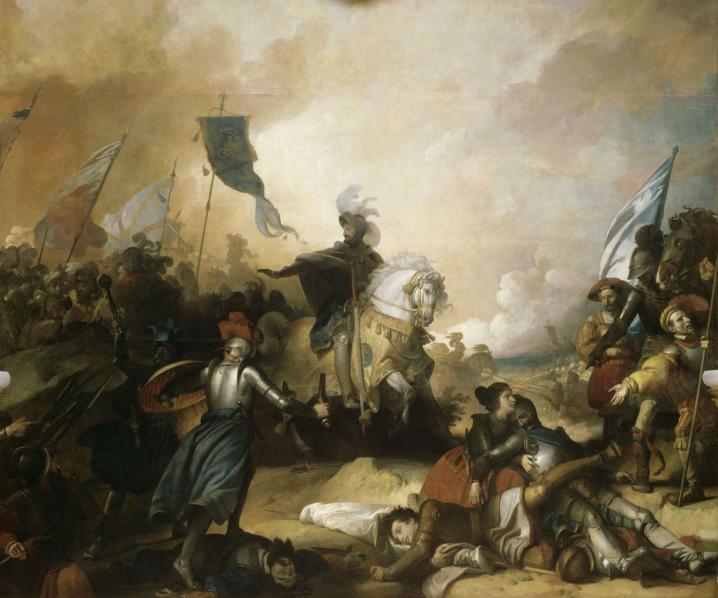 The Battle of Marignano, 14 September 1515: Alexandre-Évariste Fragonard, Public domain, via Wikimedia Commons
It was in the night between the two days of battle that the reign’s most famous episode is said to have taken place: exhausted by the fighting, Francis I reportedly slept a few hours on a simple gun carriage before being knighted the next morning by Bayard himself, the “knight without fear and beyond reproach,” in a gesture heavy with chivalric symbolism. This scene, recorded by the chronicler Symphorien Champier, has prompted contrasting interpretations among historians: some see it as a partly embellished episode, intended to obscure the truly decisive role of the Constable of Bourbon in the victory — the very man who, eight years later, was to betray the king and side with Charles V. Authentic or not in every detail, the anecdote durably fixed the image of the “knight king” at the dawn of his reign.
 Francis I Knighted by Bayard at the Battle of Marignano: Louis Ducis, Public domain, via Wikimedia Commons
The reverberations of the victory were immense throughout Christendom. As early as 13 October 1515, Pope Leo X, now convinced of the young king’s military power, made peace and recognised Francis I as the legitimate duke of Milan, Parma, and Piacenza. A meeting held at Bologna in December 1515 deepened this rapprochement further: the king renounced there the Pragmatic Sanction of Bourges of 1438, which limited papal authority over the Church of France, in exchange notably for a crusading project championed by the pope — a project that was never to materialise. This understanding was sealed on 18 August 1516 by the signing of the Concordat of Bologna, negotiated on the French side by Chancellor Antoine Duprat: henceforth, the king of France held the right to appoint bishops and abbots of the kingdom himself, subject only to subsequent papal confirmation — a text that was to durably govern relations between the crown and the papacy until the French Revolution. A few months later, on 29 November 1516, a “perpetual peace” was signed at Fribourg with the Swiss cantons, defeated but durably respected: they undertook never again to fight against the king of France, becoming instead one of the principal sources of mercenaries in his service for centuries to come. Thus, less than two years after his accession, Francis I had not only erased the humiliation of Novara, but had also established his authority on solid diplomatic and religious foundations, destined to durably shape the French monarchy.
II. 1517–1520: Imperial Rivalry and the Failure of the Field of the Cloth of Gold
While France still savoured the diplomatic fruits of Marignano, an event of an altogether different nature was unfolding across the Rhine: on 31 October 1517, the Augustinian monk Martin Luther posted his ninety-five theses against the sale of indulgences at Wittenberg, a gesture that, in the following decades, was to profoundly upend Western Christendom and, by extension, the kingdom of France itself. For the moment, however, this religious agitation remained in the background of more immediate diplomatic events. On 14 October 1518, the signing of the Treaty of London seemed to open a new era of universal peace in Europe: championed by the great humanists of the age, such as Erasmus and Thomas More, and orchestrated on the English side by Cardinal Thomas Wolsey, this non-aggression pact united France, England, Spain, and the Holy Roman Empire in a mutual pledge of assistance. Henry VIII agreed to restore Tournai to France for six hundred thousand gold écus, and the two crowns sealed their rapprochement with the promise of a marriage between the three-year-old dauphin of France and Mary Tudor, Henry VIII’s four-year-old daughter. A solemn meeting was soon to crown this understanding — but events decided otherwise.
On 12 January 1519, the death of Emperor Maximilian I opened a succession whose stakes far exceeded Germany alone. Francis I, still basking in the prestige of Marignano, put himself forward as a candidate for the imperial crown, mindful of the danger France would face were his rival Charles of Habsburg — already master of Spain, Naples, the Low Countries, and vast American possessions — to be elected. There followed, in the spring of 1519, an electoral bidding war of unprecedented scale: the two contenders competed to buy the votes of the seven electors of the Holy Roman Empire, Francis I paying in cash from his immediate resources, while Charles, financially less well-off, relied on bills of exchange drawn on the wealthy Augsburg bankers of the Fugger family, payable only after the vote. This strategy of credit proved decisive: on 28 June 1519, Charles was unanimously elected King of the Romans by the Diet of Frankfurt, at only nineteen years of age. For Francis I, this personal setback carried considerable strategic weight: France now found itself caught in the grip of a sovereign reigning simultaneously over Spain, southern Italy, the Low Countries, and soon the Empire itself — a feared encirclement that was to dictate the kingdom’s foreign policy for decades.
In this context of nascent rivalry, the plan for an Anglo-French meeting envisaged since the Treaty of London regained full relevance: now actively seeking an alliance capable of counterbalancing Charles V’s new power, Francis I arranged with Henry VIII a meeting of unprecedented splendour. From 7 to 24 June 1520, between the English castle of Guînes and the French town of Ardres, near Calais, was held the meeting that became famous as the Field of the Cloth of Gold, so dazzling were the two courts’ hangings and garments, woven with gold thread, to contemporaries. The festivities, whose cost exceeded two hundred thousand livres, continued for more than two weeks: tournaments, jousts, banquets, and sporting displays punctuated this meeting between two young sovereigns equally eager for splendour and prestige. One anecdote remained particularly famous: during a friendly bout of Breton wrestling, Francis I easily threw Henry VIII, causing the latter a humiliation from which he never quite recovered for the rest of the meeting.
 The Field of the Cloth of Gold, 1520: Anonymous (English school), Public domain, via Wikimedia Commons
This display of ostentation, far from favouring the sought-after understanding, paradoxically contributed to its failure. On 25 June 1520, the two delegations parted without having signed the alliance treaty France had hoped for, Henry VIII confining himself to vague pledges of friendship. The true setback only became apparent a few days later, when the king of England, leaving Calais, secretly met his nephew Charles V at Gravelines: there, the emperor, more modest and more attentive in his manner than Francis I had been, managed to win back Henry VIII’s trust and permanently turn him away from a French alliance. The Field of the Cloth of Gold, for all its magnificence, thus proved to have been merely a decoy on the English side, and confirmed, after three years of diplomatic manoeuvring, France’s growing isolation in the face of the coalition taking shape between England and the Empire. On 23 October 1520, the coronation of Charles V at Aachen formally sealed this new European order, setting the stage for the now inevitable military confrontation between the two rival sovereigns.
III. 1521–1526: War, Bourbon’s Betrayal, and the Disaster of Pavia
The failure of the Field of the Cloth of Gold and the diplomatic isolation that followed made war inevitable. As early as 1521, hostilities opened simultaneously on several fronts: in the north, Robert III de La Marck launched an offensive on the Meuse; in the south, an army led by André de Foix attempted, unsuccessfully, to reconquer the kingdom of Navarre on behalf of Henry II of Navarre; and in the Ardennes, Bayard, besieged at Mézières by the imperial forces of Franz von Sickingen and Philip I of Nassau, resisted victoriously through an extremely violent siege, refusing to surrender despite weeks of bombardment. These first engagements, scattered and inconclusive, nonetheless heralded the scale of the conflict that was, over five years, to test the French power reconquered since Marignano.
The military turning point came the following year. On 29 April 1522, the French army commanded by Marshal Odet de Foix was crushed at the Battle of Bicocca, near Milan, by the troops of Francesco II Sforza and Prospero Colonna — the very general already captured by surprise by Bayard during the Marignano campaign seven years earlier. This defeat forced France to evacuate the Milanese entirely, once again ceded to the Sforza. At the same time, a matter of apparently private concern soon came to disrupt the course of the war: widowed since 1521, the Constable Charles de Bourbon, the kingdom’s first officer and, fourteen years earlier, a victor alongside the king himself, was stripped by Louise of Savoy, Francis I’s mother, of a substantial part of his late wife’s inheritance. Deeply humiliated by this treatment and increasingly isolated at court, Bourbon began secret negotiations with Charles V before taking the decisive step in September 1523: he openly rebelled, entered the emperor’s service, and offered to lead an outright armed rebellion against his former king. This betrayal, coming from one of the kingdom’s highest-ranking dignitaries, a former comrade-in-arms of Francis I at Marignano and at the legendary knighting, deeply struck contemporaries and was to weigh heavily on the rest of the conflict.
The year 1524 completed the collapse of French positions in Italy. Forced to hastily recross the Alps, the king’s troops had to abandon even their artillery in a disastrous retreat; it was in the course of this debacle that Bayard, mortally wounded, met his death on 30 April 1524 — legend has it that his former comrade-in-arms, the Constable of Bourbon, now in the enemy camp, came to salute him respectfully in his final moments, a scene laden with bitter irony, reuniting for an instant the loyal knight and the traitor. In July of the same year, the Spanish troops commanded by Bourbon invaded Provence, bringing the war onto the kingdom’s own soil for the first time. Francis I, refusing to yield before these accumulated setbacks, nonetheless recrossed the Alps as early as October 1524 and retook Milan without a fight — but soon met with the stubborn resistance of the neighbouring stronghold of Pavia, which he undertook to besiege.
This siege was to end in the most resounding disaster of the reign. On the night of 23 to 24 February 1525, the imperial relief army, short of resources and with nothing left to lose, managed to breach the enclosing wall of the Mirabello park. Repelled at first by the French, roused in time, it benefited from a fatal chain of events: Francis I, unwilling to stand aside from a victory he believed already won, personally charged at the head of his cavalry against the German landsknechts — a chivalrous gesture that forced his own gunners to cease fire, for fear of hitting their king. The enemy immediately seized this respite to regroup: the Spanish arquebusiers, exploiting the marshy ground in which the French cavalry became bogged down, methodically cut down the royal ranks. In little more than an hour, the French army, twenty-eight thousand strong, was annihilated: between eight and fourteen thousand dead, against fewer than a thousand on the imperial side, taking with it nearly the entire fighting nobility present, including Marshals La Trémoille, La Palice, and Bonnivet. Wounded and unhorsed, Francis I continued to fight amid his fallen companions until surrender became unavoidable; he was taken prisoner by the viceroy of Naples, Charles de Lannoy. That same evening, he wrote to his mother Louise of Savoy, who had become regent in his absence, the now-famous words: “Of all things, nothing remains to me but honour, and my life, which is safe” — a phrase posterity was to condense into the even more pithy formula: “All is lost, save honour.” This capture of a king of France on the field of battle had had no precedent since that of John II the Good at Poitiers, in 1356.
 Francis I Taken Prisoner at the Battle of Pavia, 24 February 1525: Maarten van Heemskerck (attribution), Public domain, via Wikimedia Commons
Transferred a few days later to Spain, to Madrid, Francis I remained captive there for nearly a year, treated with the consideration due to his rank but entirely deprived of freedom; a serious illness, which struck at the end of 1525, briefly raised fears for his life. Charles V, refusing any negotiation on equal terms, kept up constant pressure on his prisoner, until obtaining, on 14 January 1526, the signing of the Treaty of Madrid: Francis I renounced all his Italian claims, ceded Burgundy to Spain, gave up his sovereignty over Flanders and Artois, and undertook to marry Eleanor of Austria, the emperor’s sister, as a guarantee of his commitments — his two eldest sons, including the dauphin, to be handed over as hostages in his place. This treaty, extracted under the most humiliating conditions imaginable for a king of France, closed a five-year cycle of relentless war, marked by the loss of Italy, the betrayal of a constable, the death of a hero, and the capture of the sovereign himself — but its very harshness suggested that, once the king was back on French soil, it would be no more respected than so many other agreements extracted under duress had been in their time.
IV. 1526–1529: The Repudiation of the Treaty of Madrid and the Peace of the Ladies
Released on 17 March 1526 after nearly a year of captivity, Francis I set foot again on French soil with the firm intention of not bowing to the most humiliating clauses of the treaty he had been forced to sign.
 The Return of Francis I to France at the Bidassoa (1526): Alexandre Millin du Perreux, Public domain, via Wikimedia Commons
Backed by the Parlement of Paris, he refused to carry out the restitution of Burgundy to Charles V, arguing that a commitment extorted under duress from a prisoner could have no binding legal value. This repudiation, as clever as it was risky, transformed within a few weeks the personal matter of his captivity into a fresh conflict of European scale: as early as 22 May 1526, Francis I sealed at Cognac an alliance with Pope Clement VII, the Republic of Venice, the Duchy of Milan, and Florence, forming the League of Cognac, a coalition intended to contain the now overwhelming power of the emperor in Italy.
This coalition, however, proved fragile within the first months of its existence. On 20 September 1526, Cardinal Pompeo Colonna, having gone over to the imperial cause, unleashed his troops on Rome itself, forcing a besieged pope to temporarily break with the League by signing a truce with the Empire. This respite, however, was not enough to avert an even greater disaster. Unpaid for weeks and without legitimate command after the death of their leader, the imperial troops — many of them German landsknechts won over to the ideas of the Reformation — converged in 1527 on the papal city itself. On 6 May 1527, the imperial army, led by the Constable of Bourbon — the very same traitor whose defection had precipitated the disaster of Pavia two years earlier — launched its assault on Rome. Bourbon was killed in the very first moments of the fighting, struck by an arquebus shot while scaling the ramparts; deprived of its leader, the imperial army, now utterly unrestrained, poured through the city in an act of plunder of unprecedented violence that was to last nearly a year, until February 1528. The pope, who took refuge for six months in the Castel Sant’Angelo, was ultimately forced to capitulate. The Sack of Rome deeply shocked the whole of Europe, including Charles V himself, who had never desired such devastation and withdrew in prayer upon learning the news.
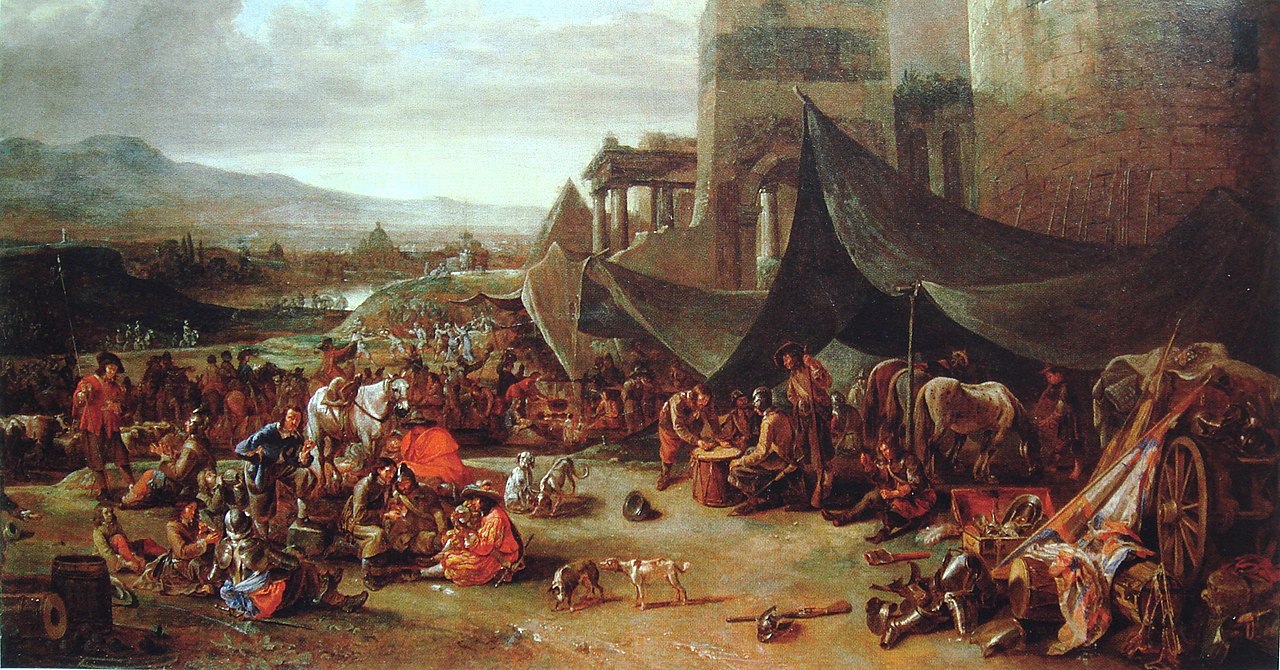 The Sack of Rome, 1527: Johannes Lingelbach, Public domain, via Wikimedia Commons
Despite this dramatic context, France failed to translate the general outrage into military success. It was not until January 1528 that it fully committed to the conflict, laying siege to Naples; but the sudden defection of an allied Genoese admiral, combined with an epidemic that decimated the French ranks, forced the king’s army to capitulate as early as 15 August 1528. The following year confirmed this strategic quagmire: on 21 June 1529, a fresh defeat occurred at Landriano, where the Count of Saint-Pol was taken prisoner along with his chief officers, forcing the discouraged French troops to recross the Alps once again. After eight years of almost uninterrupted war, marked by the loss of Italy, the betrayal and death of a constable, the capture of a king, and the horror of the Sack of Rome, both sides found themselves equally exhausted, financially as well as militarily.
It was in this climate of general weariness that, from 5 July 1529, a negotiation of an unprecedented kind opened. Rather than let their sons and nephew pursue a fruitless confrontation, two powerful women took the peace negotiations at Cambrai into their own hands: Louise of Savoy, Francis I’s mother and regent of the kingdom during her son’s absences, and Margaret of Austria, Charles V’s aunt and regent of the Low Countries for twenty years. The two women had known each other since childhood — Margaret had even, as a young girl, been betrothed to Charles VIII, and raised for a time at the court of Anne of Beaujeu — and were thus able to conduct their negotiations with a candour their respective sons would surely never have permitted between themselves. After a month of negotiations, on 3 August 1529, the Treaty of Cambrai was signed, remembered in history as the Peace of the Ladies: Francis I definitively renounced his claims to Milan and Naples, while Charles V abandoned his claim to Burgundy; the king of France undertook to pay a ransom of two million five hundred thousand écus and to marry Eleanor of Austria, the emperor’s sister, while his two sons, hostages since 1526, at last regained their freedom. More lenient than the Treaty of Madrid it replaced, this peace, negotiated by two princesses, closed a cycle of war opened eight years earlier, and was to offer Francis I, at least for a few years, the respite he needed to turn his attention to other horizons — notably those of patronage and the French Renaissance.
 The Peace of the Ladies, Treaty of Cambrai, 1529: Francisco Jover y Casanova, Public domain, via Wikimedia Commons
V. 1530–1534: Patronage, Humanism, and the Turning Point of the Affair of the Placards
 Francis I Receiving a Book from Its Author: Noël Bellemare and François Clouet, Public domain, via Wikimedia Commons
The Peace of the Ladies at last gave Francis I the respite he needed to give full measure to an ambition that had driven him since the beginning of his reign: to make his kingdom a centre of learning and creation equal to the Italian courts that had so fascinated him. In March 1530, he founded the Collège royal, the direct ancestor of today’s Collège de France, originally endowed with only five chairs — two in Greek, two in Hebrew, and one in mathematics — but conceived as a space of free teaching, free from the rigid framework of the Sorbonne and open to the new knowledge brought by humanism. This institutional creation accompanied an artistic patronage already well under way for over a decade: the king had drawn to his court, as early as 1516, the aging Leonardo da Vinci, settled at Clos Lucé near Amboise until his death in 1519.
 Francis I Receiving the Last Breaths of Leonardo da Vinci: Jean-Auguste-Dominique Ingres, Public domain, via Wikimedia Commons
The king later welcomed other Italian artists, such as Benvenuto Cellini and Primaticcio.
 Francis I in the Studio of Benvenuto Cellini: Francesco Podesti, Public domain, via Wikimedia Commons
This taste for the arts also found expression in stone: work on the château of Chambord, begun as early as 1519, and the development of Fontainebleau, destined to become the birthplace of the first French Mannerism, gave the reign a lasting architectural imprint, matching the image of an enlightened sovereign that Francis I sought to cultivate.
Family and dynastic affairs likewise marked these years of recovered peace. In July 1530, in accordance with the terms of the Peace of the Ladies signed the previous year, the king’s two sons, hostages in Spain since 1526, were at last freed; that same month, Francis I, a widower since the death of Claude of France in 1524, married Eleanor of Austria, sister of his great rival Charles V, a union that likewise sealed the commitments made at Cambrai. His coronation took place in March 1531. A few months later, on 22 September 1531, Louise of Savoy died — the king’s mother and twice regent during his absences, the very woman who had overseen the government of the kingdom after Pavia and negotiated, with Margaret of Austria, the peace that bore their name. Her death closed an essential chapter of the reign, so heavily had her political influence weighed, since 1515, on the great directions of the monarchy. In October 1533, another union was quietly preparing the dynastic future: the king’s second son, Prince Henry, married Catherine de’ Medici, niece of Pope Clement VII — a marriage whose historical importance was only to become apparent much later, when unforeseen circumstances would bring the young couple to the throne.
This period of domestic stability also allowed Francis I to pursue a religious diplomacy of remarkable pragmatism for a Catholic sovereign. In May 1532, he concluded the Treaty of Scheyern with the Lutheran princes of Germany, not hesitating to seek their support against Charles V despite the theological differences separating them from Rome. This political flexibility found an echo even within the king’s closest circle: his own sister, Margaret of Navarre, held a pronounced sympathy for the new evangelical ideas, and a network of scholars gathered around her in Paris served as its discreet relay. It was in this context that, in November 1533, the still obscure figure of the young jurist Jean Calvin emerged, forced to flee Paris after being suspected of having inspired a university address with all too openly reformist overtones. Until then, France had thus seemed destined for a relatively easy coexistence between official Catholicism and the new ideas, under the rather benevolent eye of a king more concerned with politics and art than with theological controversy.
This fragile balance broke sharply in the night of 17 to 18 October 1534. Protestants, under the pen of the Neuchâtel pastor Antoine Marcourt, posted under cover of darkness placards of unprecedented virulence against the Catholic mass, not only in Paris but also in several provincial towns — Blois, Rouen, Tours, Orléans. The gesture, already audacious in its scope, crossed a line nothing could excuse in the king’s eyes: one of these placards was found on the very door of the royal bedchamber, at the château of Amboise, turning a religious provocation into a personal affront and a direct threat to the sovereign’s security. The Affair of the Placards thus brutally ended the policy of conciliation Francis I had maintained until then towards Lutheran ideas; the king, deeply shaken, was henceforth to embark on a repression that was to durably mark the final years of his reign, foreshadowing the confessional tensions that would set France ablaze a few decades later.
VI. 1535–1539: Religious Appeasement, the Eighth Italian War, and Villers-Cotterêts
The repression triggered by the Affair of the Placards was not to continue without nuance. As early as July 1535, the Edict of Coucy diplomatically suspended the wave of persecution begun a few months earlier, going so far as to offer a royal pardon to repentant Protestants. This about-face, revealing the fluctuations that were henceforth to characterise the reign’s religious policy, formed part of a broader diplomatic strategy: that same year, Francis I signed with Suleiman the Magnificent a treaty known as the “Capitulations,” granting France protection for Catholics within the Ottoman Empire and trading rights in the ports of the Levant. This alliance with the Muslim sultan, considered scandalous by a large part of Christendom, was above all intended to weaken Charles V by placing an eastern threat on Austria — a diplomatic pragmatism already illustrated a few years earlier by the king’s rapprochement with the German Lutheran princes.
The peace restored since Cambrai was nonetheless to break down again at the end of 1535. The death of Francesco II Sforza, Duke of Milan, who died heirless on 1 November, immediately revived French claims to the Milanese: while Charles V granted the vacant duchy to his own son Philip, Francis I claimed the inheritance for one of his younger sons. From early 1536, a French army of forty thousand men invaded Savoy and Piedmont, seized Turin, but halted at the Lombard border without daring to threaten Milan directly. This offensive, though limited in its ambitions, was to have lasting territorial consequences: Savoy remained French until the treaties of Cateau-Cambrésis, twenty-three years later. In response, Charles V retaliated in June by invading Provence in turn, seizing Aix-en-Provence; but the Constable Anne de Montmorency, recently promoted to that office, opposed the invader with a scorched-earth tactic that deprived his army of all supplies. Refusing to attack the powerful fortress of Avignon, the Spanish were finally forced to leave French territory in September, without having fought a single battle — the second invasion of the kingdom repelled during this reign, this time without a decisive engagement.
At the very heart of this campaign, a personal bereavement struck the king hard. On 10 August 1536, the Dauphin Francis, the sovereign’s eldest son, died suddenly at the château of Tournon, aged eighteen, after a fainting spell following a glass of iced water. Contemporary rumours, later taken up by the poet Malherbe in his verse, suggested poisoning ordered by Charles V himself — a thesis today dismissed by most historians in favour of a natural cause, but one that reflects the deep mutual distrust then prevailing between the two sovereigns. This unexpected death made the king’s second son, Henry, the new heir to the crown, quietly preparing, though no one could yet guess it, the advent of a reign to come.
The war, deprived of a decisive stake after the failure of the invasion of Provence, was not to drag on indefinitely. The new pope, Paul III, anxious to reconcile the two Catholic sovereigns in the face of the shared Protestant threat, worked actively for a mediation that resulted, on 18 June 1538, in the signing of the Peace of Nice: France retained there its conquests in Savoy and Piedmont, but formally renounced its claims to Milan. A few weeks later, on 15 July 1538, Francis I and Charles V met in person at a meeting at Aigues-Mortes, a striking scene of reconciliation between two rivals whose confrontation had nonetheless marked, for twenty years, the very history of Europe — from the Field of the Cloth of Gold to Pavia, from the Sack of Rome to the Peace of the Ladies. The two sovereigns pledged there to unite against the danger they both saw in the spread of Protestantism.
 Francis I Receiving Emperor Charles V at Aigues-Mortes, 1538: Charles-Nicolas Cochin the Elder, Public domain, via Wikimedia Commons
It was in this climate of relative appeasement that Francis I signed, between 10 and 25 August 1539 at Villers-Cotterêts, one of the most enduring legislative acts of his entire reign. Drafted by Chancellor Guillaume Poyet, the Ordinance of Villers-Cotterêts, made up of one hundred and ninety-two articles, henceforth imposed the use of French, rather than Latin, in acts of justice and administration, while establishing the keeping of parish registers of baptisms and burials — the direct forerunners of modern civil registration. Far removed from the military or diplomatic splendours that had punctuated the preceding sections, this administrative ordinance, still partly in force today through its articles 110 and 111, which have never been repealed, embodied another facet of the reign of Francis I: that of a sovereign concerned with consolidating, through law and language, the lasting unity of his kingdom.
VII. 1540–1547: The Ninth Italian War, the Massacre of the Vaudois, and the Death of the King
The religious appeasement begun by the Edict of Coucy was not to withstand the renewed tensions for long. On 1 June 1540, Francis I signed the Edict of Fontainebleau, the first edict of systematic proscription against Protestants: henceforth, religious crimes escaped the jurisdiction of ecclesiastical courts, deemed too slow and too lenient, in favour of the royal courts, charged with prosecuting and judging Lutherans with a new severity. A few months later, on 18 November 1540, the Parlement of Provence issued the Arrêt of Mérindol, sentencing to death in absentia eighteen Vaudois inhabitants of that town and ordering the destruction of their villages — a sentence that, for lack of immediate execution, lay dormant for nearly five years, before resurfacing under far more dramatic circumstances.
The rivalry with Charles V, barely eased by the meeting at Aigues-Mortes, could not remain extinguished indefinitely. In July 1542, the assassination of two French ambassadors by the imperial governor of the Milanese gave the king a pretext for a fresh break: on 12 July 1542, Francis I declared war on the emperor, ending a truce that had nonetheless been concluded for ten years. This Ninth Italian War, the reign’s last, saw the Franco-Ottoman alliance, forged some years earlier, deployed once again: in 1543, the corsair Barbarossa was received with great pomp at Marseille, and a combined Franco-Ottoman operation seized Nice while Luxembourg fell into French hands.
 Barbarossa’s Fleet Wintering at Toulon, 1543: Matrakçı Nasuh, Public domain, via Wikimedia Commons — the fleet wintered at Toulon, a port near Marseille where it was received that same year
That same year, in a very different register, the Sorbonne drew up twenty-five articles of faith to which the king gave the force of law, affirming notably transubstantiation and the cult of the Virgin — a further sign of a general doctrinal hardening. On the military front, France achieved on 14 April 1544 its last great success of the reign: at Ceresole, in Piedmont, the young and inexperienced François de Bourbon, Count of Enghien, won a resounding victory over the imperial troops of Alfonso d’Ávalos, after fighting of rare intensity — a victory, however, with no strategic sequel, as the king had immediately to strip this victorious army to face a far more pressing threat.
This threat took shape the following summer: while France triumphed in Italy, Charles V, allied with Henry VIII, invaded Champagne and came dangerously close to Paris, while English troops laid siege to Boulogne. As in 1524 and 1536, the kingdom thus found itself directly threatened on its own soil; but the long sieges of Saint-Dizier and Boulogne sufficiently delayed the advance of the allied forces for the emperor — short of money to pay his mercenaries and pressed by the Ottoman advance in Hungary as much as by the resistance of the Lutheran princes in Germany — finally to resolve to negotiate. On 18 September 1544, the Treaty of Crépy-en-Laonnois was signed: Burgundy remained French, but nothing was settled in substance, Milan remaining in Spanish hands; the treaty further provided for the marriage of the king’s younger son, Charles of Orléans, to a daughter or niece of the emperor, a union meant to durably seal the peace. This plan, however, was to come to nothing: the young prince’s unexpected death, in September 1545, rendered the clause void and left the treaty without its most solid foundation — a fresh dynastic bereavement striking the king, after that of the Dauphin Francis nine years earlier.
It was in this climate of a reign’s end, between victories without sequel and repeated bereavements, that the darkest episode of this entire history occurred. Between 12 and 19 April 1545, on the king’s own orders, Baron Jean Maynier d’Oppède, first president of the Parlement of Aix, led against the Vaudois of the Luberon an expedition of unprecedented violence: twenty-four villages were destroyed, some three thousand people killed in barely five days, hundreds of men sent to the galleys, women raped and then executed, and the confiscated lands resold cheaply to finance the operation itself. The village of Cabrières, the last bastion of Vaudois resistance, was destroyed on 19 April. Informed of the scale of the massacre, Francis I, far from disavowing it, officially approved its principle on 8 August 1545, invoking the Vaudois’ refusal to pay the tithe — a justification that scarcely convinced European Protestant opinion, Calvin and Farel foremost among them, but one that testifies to the final hardening of a reign long marked by greater tolerance. The Massacre of Mérindol, as it came to be called after the name of the principal village destroyed, directly foreshadowed the Wars of Religion that were to bloody France some fifteen years later.
The king’s last years were also marked by a gradual physical decline. Since the late 1530s, Francis I had suffered from a chronic vesico-perineal fistula that had forced him to give up riding for his travels, as well as from recurring bouts of fever. In February 1547, while staying at the château of Rambouillet, he was struck by a fresh feverish attack; his condition, at first deemed unremarkable by his physicians — anxious, for reasons as much political as medical, to reassure a court that had already been worried for several years about the sovereign’s health — deteriorated rapidly, until, on 20 March, he was judged beyond hope. On 31 March 1547, “at two o’clock in the afternoon,” Francis I died at Rambouillet, attended to the last by his chaplain, Pierre du Chastel, Bishop of Mâcon, whose account reports that, as death approached, the king, gradually losing speech and sight, continued to make the sign of the cross on his bed, uttering as his final word only the name “Jesus.” He was fifty-two years old and had reigned for thirty-two years. The autopsy revealed septicaemia complicated by severe kidney failure. Thus ended a reign that had seen France pass from the dazzling triumph of Marignano to the humiliation of Pavia, from the splendour of the Field of the Cloth of Gold to the austerity of Villers-Cotterêts, from the enlightened patronage of the Collège royal to the bloody repression of the Vaudois — a reign as contrasted as any, in the very image of the man who had embodied it, and which now left the crown to his second son, crowned under the name Henry II.
🧠 Key Takeaways
- 1 January 1515: Death of Louis XII, accession of Francis I
- 25 January 1515: Coronation at Reims
- 13–14 September 1515: Victory at Marignano
- Night of 13–14 September 1515: Legendary knighting by Bayard
- 13 October 1515: Papal recognition of Francis I as Duke of Milan
- 18 August 1516: Concordat of Bologna
- 29 November 1516: Perpetual peace with the Swiss
- 31 October 1517: Luther posts his 95 theses at Wittenberg
- 14 October 1518: Treaty of London, short-lived universal peace
- 28 June 1519: Election of Charles V, Francis I’s defeat
- 7–24 June 1520: Field of the Cloth of Gold, failure of the English alliance
- 23 October 1520: Coronation of Charles V, diplomatic isolation of France
- 29 April 1522: Defeat at Bicocca, loss of the Milanese
- September 1523: Betrayal of the Constable of Bourbon
- 30 April 1524: Death of Bayard
- 24 February 1525: Defeat and capture of Francis I at Pavia
- 14 January 1526: Treaty of Madrid, release of the king
- 22 May 1526: Formation of the League of Cognac
- 6 May 1527: Sack of Rome, death of the Constable of Bourbon
- 21 June 1529: Defeat at Landriano
- 3 August 1529: Peace of the Ladies, Treaty of Cambrai
- March 1530: Founding of the Collège royal (future Collège de France)
- July 1530: Marriage to Eleanor of Austria
- 22 September 1531: Death of Louise of Savoy
- May 1532: Treaty of Scheyern with the Lutheran princes
- October 1533: Marriage of Henry and Catherine de’ Medici
- 17–18 October 1534: Affair of the Placards
- July 1535: Edict of Coucy, temporary religious appeasement
- 1 November 1535: Death of Francesco II Sforza, revival of Milanese claims
- Early 1536: French invasion of Savoy and Piedmont
- June–September 1536: Invasion of Provence by Charles V, repelled by Montmorency
- 10 August 1536: Death of the Dauphin Francis
- 18 June 1538: Peace of Nice
- 15 July 1538: Meeting at Aigues-Mortes, reconciliation with Charles V
- 10–25 August 1539: Ordinance of Villers-Cotterêts
- 1 June 1540: Edict of Fontainebleau
- 18 November 1540: Arrêt of Mérindol
- 12 July 1542: Declaration of war on Charles V
- 1543: Ottoman alliance, capture of Nice, Sorbonne’s articles of faith
- 14 April 1544: Victory at Ceresole
- 18 September 1544: Treaty of Crépy-en-Laonnois
- September 1545: Death of Prince Charles of Orléans
- 12–19 April 1545: Massacre of the Vaudois of the Luberon
- 31 March 1547: Death of Francis I, accession of Henry II