


Philip VI of Valois: A New Dynasty, A War Begins (1328–1350)
p51328 à 1350
The accession of Philip VI in 1328 opens a new chapter in French history. With him ends the direct succession of the Capetians, begun in 987 with Hugh Capet, and begins the reign of the Valois branch, descended from Charles of Valois, brother of Philip IV the Fair. His ascension to the throne marks both a dynastic continuity and a major rupture in the history of the French monarchy.
Chosen after the death of Charles IV the Fair, when the direct Capetian line no longer had a male heir, Philip of Valois appeared to the great lords of the kingdom as the closest male relative of the deceased king. His accession confirms the principle that the crown of France could neither be transmitted to women nor through them. This choice notably excluded the claims of Edward III of England, grandson of Philip IV through his mother Isabella of France, and laid the foundations for a dynastic conflict destined to profoundly transform the Western world.
 Map of France in 1328: Cyberprout, CC BY-SA 3.0 https://creativecommons.org/licenses/by-sa/3.0, via Wikimedia Commons
The new king inherited a powerful kingdom, solidly structured by the administrative work of the last Capetians, but facing considerable tensions. The Flemish question remained sensitive, relations with England remained fragile, fiscal policy aroused resistance, and the balance between monarchy, princes, and chartered towns demanded constant attention. Added to this was the paramount issue of legitimacy: Philip VI had to not only govern but also impose the authority of a new dynasty.
The beginning of his reign was still that of a king of continuity, eager to inscribe himself in the Capetian legacy. But feudal rivalries, English ambitions, and transformations in warfare soon drove his government toward a crisis of greater magnitude. Under Philip VI, the French monarchy entered into a period of prolonged confrontations with England, which would soon be called the Hundred Years’ War.
The reign of Philip VI thus occupies a pivotal place. It inaugurates the Valois dynasty, affirms the succession principles forged at the end of the Capetian period, and opens one of the longest conflicts in European medieval history. Through him, the kingdom of France enters a new era, marked by war, by the redefinition of sovereignty, and by the trial of dynastic continuity.
I. 1328–1334: The Advent of the Valois, Consolidation of Power, and Rising Tensions with England
The accession of Philip VI of Valois to the throne in spring 1328 opens a new phase of French monarchic history. After the death of Charles IV the Fair and the birth, a few weeks later, of a posthumous daughter, the great lords of the kingdom confirm the exclusion of women from the succession and entrust the crown to the regent, Philip of Valois, cousin of the deceased king. His accession, officially dated April 1, 1328, marks the end of the direct Capetian line and the opening of the Valois dynasty.
 Coronation of King Philip VI of Valois and Queen Joan of Burgundy by Archbishop William of Trie of Reims (Reims, May 29, 1328): Illuminated manuscript from the 3rd quarter of the 14th century from the Great Chronicles of France (Paris, Bibliothèque nationale de France, MSS Français 10135, folio 412v), Public domain, via Wikimedia Commons
The new king was anointed at Reims on May 29, 1328 by Archbishop William of Trie. His coronation gave full legitimacy to the new dynasty, but it took place in still delicate circumstances. Edward III of England, Duke of Aquitaine and peer of France, did not attend the ceremony, a sign of a political distance that continued to grow. At the same time, Valois, Anjou and Maine were united with the crown, while the king abandoned Navarre to Joan, daughter of Louis X, and to her husband Philip of Évreux, in order to consolidate his own establishment on the throne of France.
The first months of the reign were also marked by a will to strengthen internal stability. The execution, on April 25, 1328, of Peter of Rémi, former treasurer of Charles IV, accused of embezzlement, demonstrated the new power’s determination to distinguish itself from the disorders of the previous reign. A few months later, on August 23, 1328, Philip VI won a decisive victory at Mont Cassel against the Flemish insurgents who had risen against their count, Louis of Nevers. This intervention restored French influence in Flanders and gave the new king a first military success of great symbolic importance. In September 1328, he also ordered a vast census of hearths and parishes throughout the kingdom, an exceptional document for the medieval period, which testifies to a monarchy concerned with better knowing and administering its territory.
 Homage of Edward III to Philip VI of Valois in 1329: BnF, Département des manuscrits, Levan Ramishvili from New Tbilisi, Georgia, Public domain, via Wikimedia Commons
The year 1329 prolonged this phase of relative stabilization. On March 5, Joan II and Philip III of Navarre were crowned at Pamplona, which permanently fixed the separation between the crown of France and that of Navarre. Above all, on June 6, 1329, Edward III rendered homage to Philip VI at Amiens for Guyenne and Ponthieu, in the presence notably of John of Luxembourg, King of Bohemia. This homage seemed to confirm the existing feudal order, but it did not dispel the deep ambiguities in the relationship between the two sovereigns. In the autumn of the same year, the young King of England reversed the guardianship of his mother Isabella and Roger Mortimer; Mortimer was executed in November 1330, while Isabella was removed from power. This personal assumption of control over English government lastingly altered the political balance between the two kingdoms.
 Mortimer Seized by the King: James William Edmund Doyle, Public domain, via Wikimedia Commons
The following years saw the dynastic consolidation of the reign. In 1332, Philip VI emancipated his son John, heir to the throne, and invested him with Anjou, Maine, and the Duchy of Normandy, thus preparing the succession within the new ruling house. The same year, John, future John II the Good, married Bonne of Luxembourg, which further strengthened ties between the Valois and the House of Luxembourg.
At the same time, the king had to arbitrate an important noble conflict: the affair of Robert III of Artois. Since the death of his grandfather Robert II of Artois in 1302, Robert had contested the attribution of the County of Artois to his aunt Mahaut of Artois, and then, after her death, to his cousin Joan II of Burgundy. Already dismissed several times by royal justice, he attempted to relaunch his claim by producing documents that proved to be forgeries. The discovery of this fraud definitively ruined his cause: Robert was sentenced to banishment in 1332 and fell from favor. Fleeing the kingdom and soon welcomed in England, he became one of the bitterest enemies of Philip VI and played an important role in deteriorating relations between the French and English crowns.
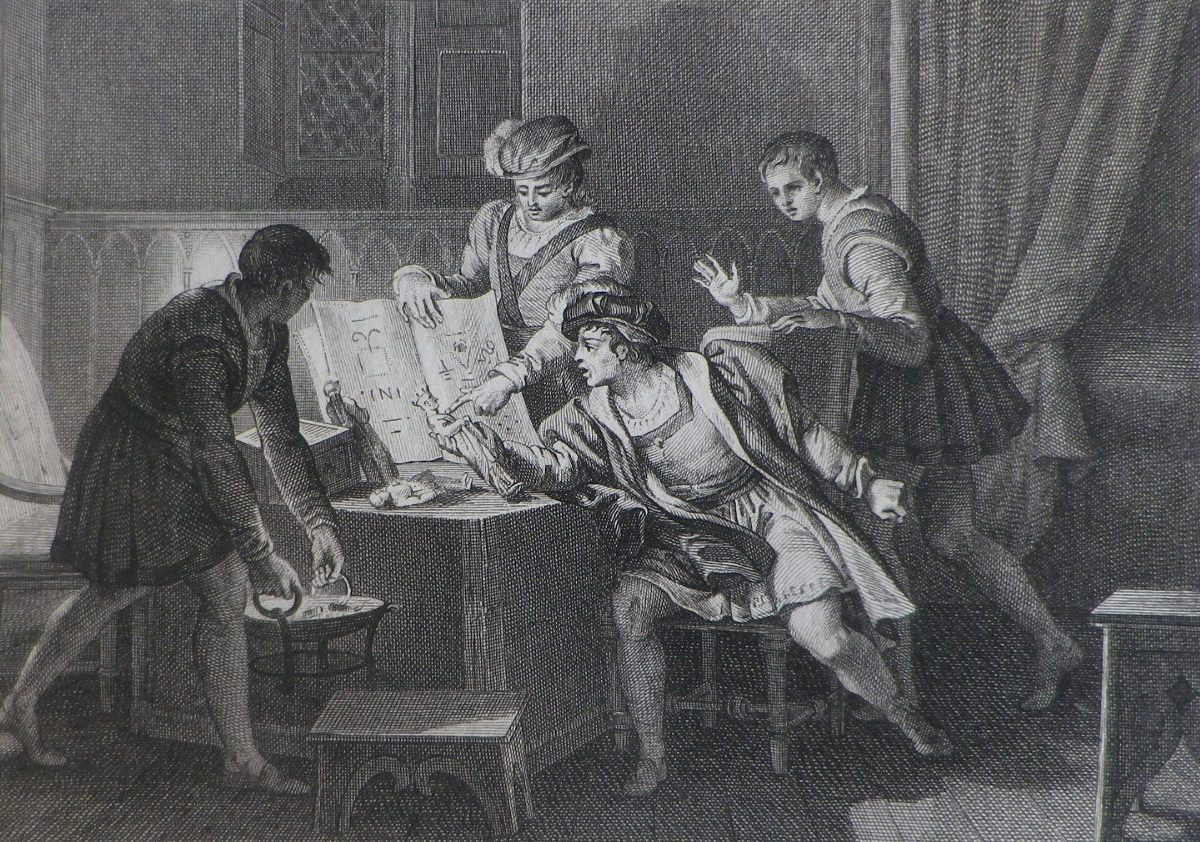 Robert of Artois Attempts to Bewitch the King: Jean-Michel Moreau, Public domain, via Wikimedia Commons
On the intellectual and religious level, the beginning of the reign was not without tensions. A controversy opposed Pope John XXII to some Paris theologians on the subject of the beatific vision. From 1331 onwards, the pontiff maintained in several sermons that the souls of the just did not contemplate God immediately after death, but only after the Last Judgment. This position raised serious objections at the University of Paris, particularly within the Faculty of Theology, attached to the more commonly accepted doctrine of the immediate beatitude of the elect. Supported by the King of France, the University became one of the principal centers of doctrinal resistance to the papal thesis. The conflict illustrates both the intellectual weight of Paris in Latin Christendom and the persistence of tensions between papal authority, theological knowledge, and royal power.
In parallel, the international environment grew tense with the resumption of war in Scotland. On July 19, 1333, Edward III won the Battle of Halidon Hill against the supporters of David II Bruce, strengthening his position north of his realm and partially freeing himself from a threat that had long served as a basis for French diplomacy.
By 1334, the situation had deteriorated more markedly. The rupture between the two crowns was not yet complete, but several converging developments made conflict increasingly probable. One of the most important was the role played by Robert III of Artois. A former close ally of Philip VI, whom he had supported at his accession, Robert had fallen from favor after the failure of his claim to the County of Artois and the discovery of the forgeries produced to support his case. Sentenced to banishment, he ultimately took refuge in England, where he was welcomed by Edward III.
This refuge was of considerable political significance. Robert of Artois was not merely a high-ranking exile: he knew intimately the court of France, its men, its balances, and its weaknesses. Becoming one of the heeded advisors of the King of England, he nurtured in the latter a growing hostility toward Philip VI and encouraged him to take a harder line in the Franco-English dispute. His personal resentment thus joined the already existing tensions surrounding Guyenne, Flanders, and the question of feudal homage.
In the same period, England increased its capacity for action. The government of Edward III levied significant subsidies, a sign of more ambitious financial effort. This increase in fiscal and military power did not yet immediately lead to war, but it revealed that the English monarchy was preparing to support a more offensive foreign policy.
Thus, by 1334, relations between Philip VI and Edward III ceased to be a simple tense feudal relationship and entered a logic of broader confrontation. The welcome extended to Robert of Artois, the aggravation of mutual grievances, and the strengthening of English resources already prepared the diplomatic and political framework for the future Hundred Years’ War.
II. 1336–1337: The Rupture with England and the Start of the Hundred Years’ War
In the mid-1330s, the tensions accumulated between the crowns of France and England resulted in an open rupture. Questions of sovereignty in Guyenne, rivalries of influence in Flanders, economic stakes linked to the trade in English wool, and the dynastic claim of Edward III all converged. Between 1336 and 1337, the conflict thus changed in nature: from a feudal and diplomatic dispute, it became a war of sovereignty destined to last more than a century.
In 1336, Philip VI still contemplated a great crusading enterprise and assembled a fleet at Marseille intended to reach the Holy Land. This project, which fit within a tradition still alive among French sovereigns, was quickly eclipsed by the deterioration of the Western situation. That same year, the creation of the College of Ave Maria at Paris by the royal advisor Jean de Hubant nonetheless testified to the institutional dynamism of the kingdom on the eve of war. At the same time, Edward III sought to weaken the French position in the Low Countries. On October 5, 1336, he prohibited the export of English wool to Flanders. This measure directly struck the Flemish cloth towns, heavily dependent on this raw material, and contributed to triggering a movement of protest led notably by Jacob van Artevelde.
 Jacob van Artevelde Leads a Rebellion in Ghent Against the Counts of Flanders: AnonymousUnknown author, Public domain, via Wikimedia Commons
Flanders thus became a major strategic stake. For the English monarchy, it was a matter of preserving an economic and political lever in a region essential to European textile commerce. For the French crown, it was important to prevent the Flemish towns from permanently tipping into the English sphere of influence. The Flemish crisis transformed a feudal conflict into a large-scale economic and diplomatic confrontation. By the end of 1337, the urban revolution led by Jacob van Artevelde in Ghent strengthened this dynamic further, giving England a valuable partner in the former Low Countries.
The decisive rupture came in 1337. On May 24, Philip VI pronounced the confiscation of Guyenne—or more precisely of the Duchy of Guyenne/Aquitaine held by the King of England—on the grounds that Edward III had failed in his obligations as a vassal. This act is traditionally considered the starting point of the Hundred Years’ War. It was not simply a legal gesture: the Capetian monarchy intended to recall that the Duke of Aquitaine remained, for his continental possessions, subject to the justice and authority of the King of France.
In response, Edward III broke with the existing feudal order. In autumn 1337, he repudiated the homage rendered to Philip VI and claimed the Crown of France as a grandson of Philip IV the Fair through his mother Isabella of France. Even if this claim would not be fully formalized in his titles until somewhat later, it became the political foundation of his opposition to the Valois. Letters of defiance received by Philip VI in early November 1337 gave the rupture a solemn dimension: the Guyenne dispute became an open struggle between two sovereigns who now disputed the legitimacy of royal power itself.
 Map of France in 1330: Aliesin, CC BY-SA 3.0 http://creativecommons.org/licenses/by-sa/3.0/, via Wikimedia Commons
The deeper causes of the war thus appear multiple. Edward III wanted to preserve, even completely free from French overlordship, his continental possessions; he also sought to protect English interests in the cloth towns of Flanders; finally, the dynastic claim offered him a principle of legitimation superior to a mere feudal dispute. For his part, Philip VI could not accept that a foreign prince transform Aquitaine into a fully sovereign possession, nor could he tolerate a challenge to the legitimacy of the Valois on the throne of France.
At the end of 1337, all the elements were thus in place: crisis of vassalage, economic confrontation, play of alliances in the Low Countries, and competing claims to the crown. The Hundred Years’ War thus began not with a great battle, but with a series of political, legal, and diplomatic decisions that transformed an old rivalry into a lasting conflict between the French and English monarchies.
III. 1338–1340: Anglo-Flemish Coalition, Battle of the Sluys
From 1338 onwards, the war engaged between Philip VI and Edward III changed in scale. The conflict no longer opposed merely two sovereigns over Guyenne and dynastic legitimacy: it became a struggle of coalitions, in which Flanders, the Empire, and soon Brittany occupied a determining place. The French monarchy had to face increasingly active English diplomacy, based on economic alliances, feudal ties, and the exploitation of political divisions on the continent.
In Flanders, the rise of Jacob van Artevelde profoundly altered the balance of power. Elected captain of the Ghentians on January 3, 1338, he progressively imposed himself as the political leader of the insurgent Flemish towns, in a context dominated by the crisis of the cloth industry and the dependence of Flemish workshops on English wool. His movement asserted itself in the spring: the French vanguard presented itself before Ghent in April, but the urban dynamic did not break. On April 23, Artevelde prevailed before Biervliet against the forces of Count Louis of Nevers; on April 29, an offensive and defensive alliance united Ghent, Bruges, and Ypres. By summer, the count had to abandon much of Flanders, now largely controlled by the insurgents.
At the same time, Edward III sought support in the Empire. This policy found fertile ground in the growing contestation of papal authority by Emperor Louis IV of Bavaria. The manifesto Fidem catholicam, proclaimed in May 1338, and the decision of the electors assembled at Rhense in July, affirmed that imperial power proceeded from election and not from papal confirmation. This evolution facilitated rapprochement between England and the Empire. On July 22, 1338, Edward disembarked at Antwerp, then met Louis IV at Coblence at the end of August; he soon received the title of Vicar of the Empire. This dignity strengthened his position in the former Low Countries and gave him a broader political base against France.
The year 1339 prolonged this diplomatic recomposition. While the University of Grenoble was founded on May 12, an event revealing the institutional vitality of the kingdom, the northern front hardened further. On December 3, 1339, a treaty was concluded between Edward III and the insurgent Flemish; a few weeks later, the Flemish towns more explicitly admitted his quality as King of France, which gave the anti-Valois coalition new scope. It was no longer merely an economic boost against Philip VI, but a political recognition of his dynastic claim.
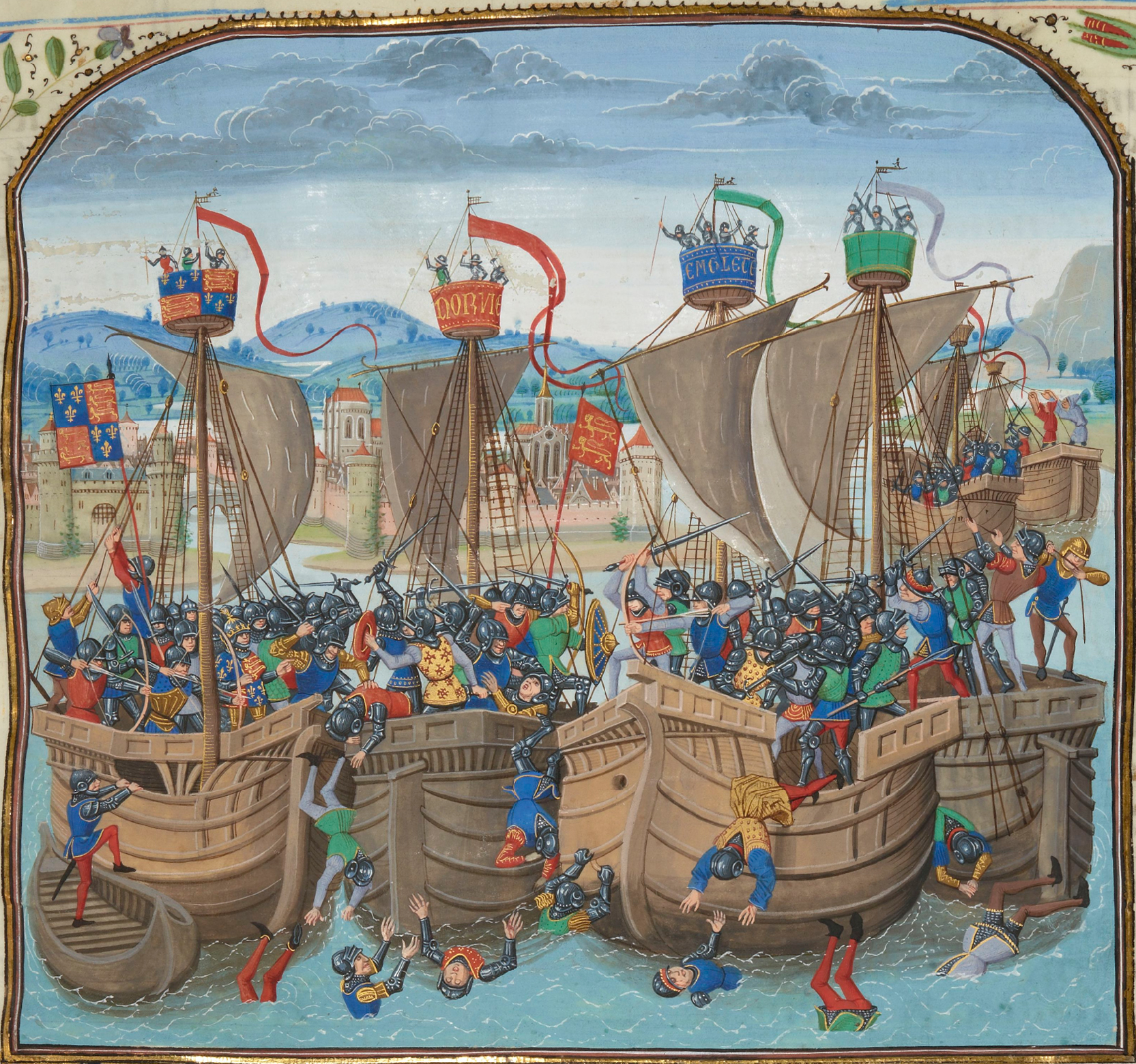 Battle of the Sluys: Loyset Liédet, Public domain, via Wikimedia Commons
The decisive turning point came in 1340. On January 23, at Ghent, Edward III formally took the title of King of France, giving solemn form to a claim already present since 1337. At the same time, Pope Benedict XII offered his support to Philip VI, but this papal backing was insufficient to check the rise of conflict. At sea, France attempted to use its fleet to prevent English landings on the continent. This strategy failed at the Battle of the Sluys on June 24, 1340, where the English navy annihilated the bulk of the French fleet in the outer harbor of Sluys. This defeat was capital: it gave England mastery of the English Channel, secured its communications with the Low Countries, and allowed Edward to disembark his troops more freely.
Strong with this success, Edward III, aided by Flemish contingents, laid siege to Tournai on July 22, 1340. The operation did not result in a decisive victory, but it showed how much the north of the kingdom had become a central theater of war. In this context, Robert III of Artois, taking refuge in England and one of the most ardent anti-French advisors of Edward, suffered a defeat before Saint-Omer on July 26. Despite this isolated setback, Robert of Artois’s presence in the English camp continued to fuel the radicalization of the conflict.
IV. 1341: Opening of the War of Breton Succession
 Entry of John of Montfort into Nantes: Master of the Harvard Hannibal (13…-14…), Public domain, via Wikimedia Commons
That same year, a new theater of war opened in the west of the kingdom with the death, on April 30, 1340, of John III, Duke of Brittany, without direct heir. His disappearance immediately provoked a succession crisis. Two principal claimants faced each other: on one side Jane of Penthièvre, niece of the duke, who asserted the rights of the senior branch by representation, and whose husband, Charles of Blois, was close to the French royal house; on the other John of Montfort, half-brother of the deceased, who claimed the dukedom as the closest male relative. The conflict thus opposed not only two people, but also two conceptions of princely succession.
The question immediately took on considerable political scope. Brittany was a great fief of the kingdom, but it possessed a strong princely identity and a strategic position essential between Channel and Atlantic. In the context of the war between Valois and Plantagenets, neither side could allow the dukedom to tip permanently into the opposing sphere. Charles of Blois, supported by Philip VI, appeared as the candidate of the French party; John of Montfort, understanding quickly that he had little to expect from French royal justice, turned progressively toward England and toward Edward III.
Even before the royal decision, John of Montfort acted with speed. In spring 1341, he took possession of a large number of places in the dukedom and had himself recognized at Nantes, seeking to transform his claim into political reality. This strategy of the accomplished fact aimed to prevent the settlement of the dispute from completely escaping him. But, in placing himself in a logic of personal conquest, he also pushed the King of France to intervene as overlord.
Seized of the dispute, Philip VI ultimately decided in favor of Charles of Blois at the Paris conference in late summer 1341. The Judgment of Conflans, rendered on September 7, recognized the rights of the couple formed by Jane of Penthièvre and Charles of Blois. In return, John of Montfort saw his French fiefs threatened with confiscation. This decision, far from ending the conflict, radicalized it: Montfort refused to submit, left the court, and tipped more clearly into the English camp. The Judgment of Conflans marked the effective opening of the War of Breton Succession.
In the autumn, the French monarchy thus chose military intervention. The Duke of Normandy, future John II the Good, was placed at the head of a substantial army and entered Brittany. After several operations, Nantes was besieged; John of Montfort finally surrendered in early November 1341 and was soon arrested. The French thought they had settled the matter. But this victory remained incomplete, for resistance reorganized around the pretender’s wife, Joan of Flanders, who maintained the Montfortist party and appealed for English help. From then on, the Breton succession no longer fell within a simple feudal dispute: it became a lasting field of confrontation between the two great rival monarchies.
The War of Breton Succession, which lasted until 1364, constitutes thus one of the great parallel conflicts of the Hundred Years’ War. By its duration, by the growing involvement of England, and by the role subsequently played by Joan of Flanders, Charles of Blois, and then John IV of Montfort, it far exceeded the Breton framework and became a major stake in the political balance of the kingdom in the 14th century.
Thus, between 1338 and 1340, the war between France and England fully took on its European dimension. The Anglo-Flemish coalition, the imperial support sought by Edward III, the French naval defeat at the Sluys, and the opening of the Breton conflict show that the confrontation was no longer limited to Guyenne alone. It became a far vaster struggle for the political balance of the northwestern Europe, in which the Valois monarchy had to defend both its dynastic legitimacy, its feudal authority, and its strategic position.
V. 1342–1343: War of Breton Succession, English Intervention, and the Truce of Malestroit
In spring 1342, Charles of Blois pursued his offensive in Brittany. He took Quimper around mid-May, temporarily consolidating the advantage of the Franco-Blois party in the east of the dukedom. It was in this context that tradition has Bertrand du Guesclin, still very young, beginning his military career in the service of Charles of Blois’s camp. At the same time, on May 7, 1342, Peter Roger was elected pope under the name Clement VI. His pontificate fit within the continuity of the Avignon papacy and was characterized by heavily centralized and fiscalized papal government.
 BERTRAND DU GUESCLIN: Artist Alphonse De Neuville, Public domain, via Wikimedia Commons
English intervention took concrete form almost immediately. On May 20, 1342, a first English expedition disembarked at Brest, led by Walter de Masny. In June, this force came to aid Joan of Flanders, besieged at Hennebont by Charles of Blois. The siege, begun at the end of May, ultimately failed after the arrival of English reinforcements by sea and the energetic resistance of the Montfortist camp. This episode gave the Breton war a more clearly Anglo-French scope.
 Siege of Hennebont in 1342: Loyset Liédet, Public domain, via Wikimedia Commons
Brittany thus became a direct objective for Edward III. In summer 1342, Robert III of Artois, taking refuge in England and one of the most hostile advisors to Philip VI, also joined Brittany with English troops. Then, from October 17 to 23, 1342, Edward III disembarked himself at Brest and undertook the siege of Vannes. The west of the kingdom thus established itself as a major front of the war, where Breton, French, and English interests met.
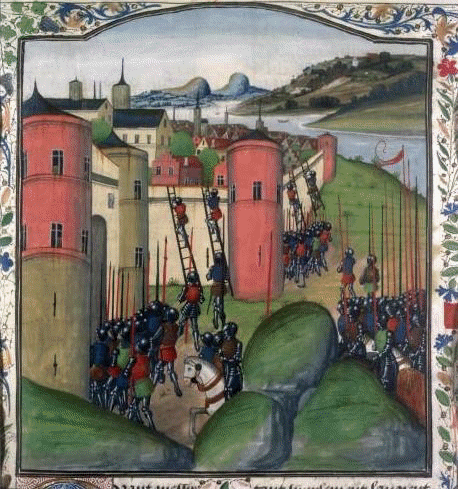 First Siege of Vannes (1342): Jean de Wavrin, Public domain, via Wikimedia Commons
This mounting of dangers ultimately favored papal mediation. Pope Clement VI intervened to obtain a suspension of hostilities, and the Truce of Malestroit was concluded on January 19, 1343 between Philip VI and Edward III. It aimed to interrupt the fighting in the broader framework of the Hundred Years’ War, but it concerned first and foremost Brittany, where neither side had obtained a decisive advantage. The agreement did not settle the Breton succession; it merely provisionally froze the conflict.
The year 1343 was also marked by a strengthening of monarchic action within the kingdom. On March 20, a royal ordinance more firmly established the salt monopoly and a tax on salt, an important measure for royal finances. A few weeks later, on April 23, Philip VI acquired at Vincennes the rights over the Dauphiné; although the province did not effectively enter the direct orbit of the crown until 1349, this operation constituted a major step in Capetian expansion toward the southeast. Finally, on September 1, 1343, John of Montfort was released by the King of France, showing that, despite the war, the Breton question remained partly open to negotiation.
Thus, between 1342 and 1343, the war changed in character. Brittany became a lasting field of confrontation between Valois and Plantagenets, while the Avignon papacy attempted to impose a truce without being able to resolve the underlying causes of conflict. In the same period, Philip VI pursued the financial and territorial strengthening of the monarchy, a sign that war and state-building now advanced together.
VI. 1344–1346: Resumption of War, Breton Crisis, and the Disaster of Crécy
After the Truce of Malestroit, hostilities gradually resumed in the different theaters of war. Between 1344 and 1346, the monarchy of Philip VI had to face a simultaneous aggravation of conflicts in Brittany, Flanders, and the north of the kingdom, while England under Edward III shifted to a strategy of direct offensive on French soil. This period marked a decisive turning point: the war, hitherto mainly diplomatic and regional, became a large-scale military confrontation.
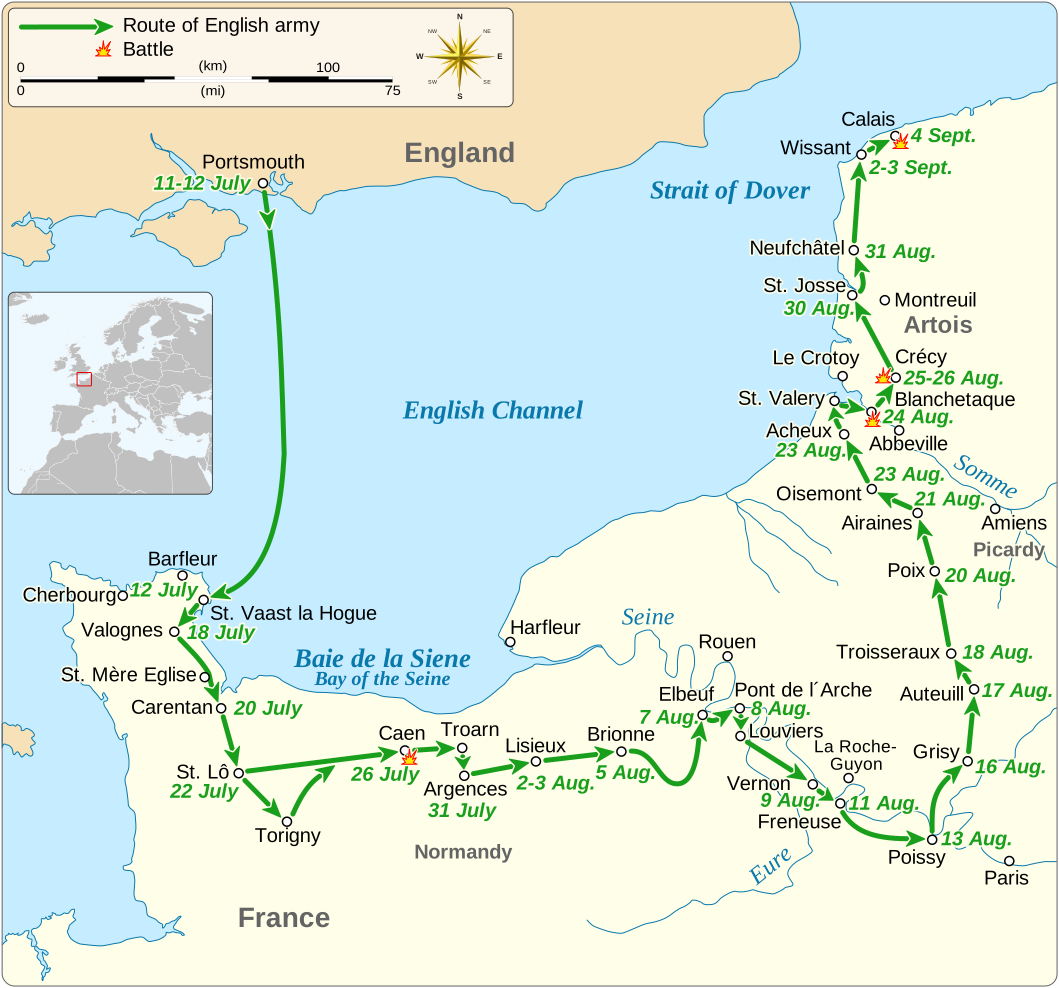 _Map of the Route of Edward III’s Chevauchée of 1346: https://upload.wikimedia.org/wikipedia/commons/a/a8/Map_of_the_route_of_Edward_III’s_chevauchée_of_1346.svg_
In 1344, the War of Breton Succession remained one of the principal foci of conflict. On May 1, Charles of Blois, supported by the French crown, took Quimper, temporarily consolidating his position in the west of the dukedom. The Breton struggle remained closely linked to the Franco-English war: the Charles of Blois party represented the French option, while that of John of Montfort and Joan of Flanders relied increasingly on England. That same year, a royal ordinance more explicitly recognized the right of the Parliament of Paris to submit remonstrances, a sign of the growing importance of this institution in the functioning of monarchic government.
In 1345, the Breton war knew a new intensification. John of Montfort, who had escaped and taken refuge in England, rendered homage to Edward III in March, more clearly sealing the alliance between the Montfortist party and the English monarchy. Shortly after, operations resumed in Brittany. On June 17, 1345, Thomas Dagworth, English captain, won a victory over Charles of Blois at Cadoret, near Josselin. This defeat did not annihilate the French party in Brittany, but it demonstrated the effectiveness of English contingents engaged in the dukedom. In the same period, Flanders remained agitated: social troubles broke out at Ghent and Bruges, and Jacob van Artevelde, an essential figure in the Flemish-English rapprochement, was assassinated in July 1345. Artevelde’s disappearance did not immediately erase the pro-English orientation of the great Flemish towns, but it deprived Edward III of a first-rate political ally. In September, John of Montfort died in turn after a failure before Quimper, leaving the Montfortist cause to his young son, soon defended by his English and Breton supporters.
The year 1346 opened a far broader phase of the conflict. While the war continued in Brittany and several places there suffered raids and sieges, Edward III decided to carry the war directly into the kingdom of France. On July 12, 1346, he disembarked in Normandy at Saint-Vaast-la-Hougue with a substantial army. He then led a vast chevauchée across Normandy and then toward the north, combining plunder, intimidation, and the search for a favorable battle. Towns and villages were devastated in his wake; the objective was at once military, economic, and psychological, for it was a matter of demonstrating the King of France’s powerlessness to defend his own territory.
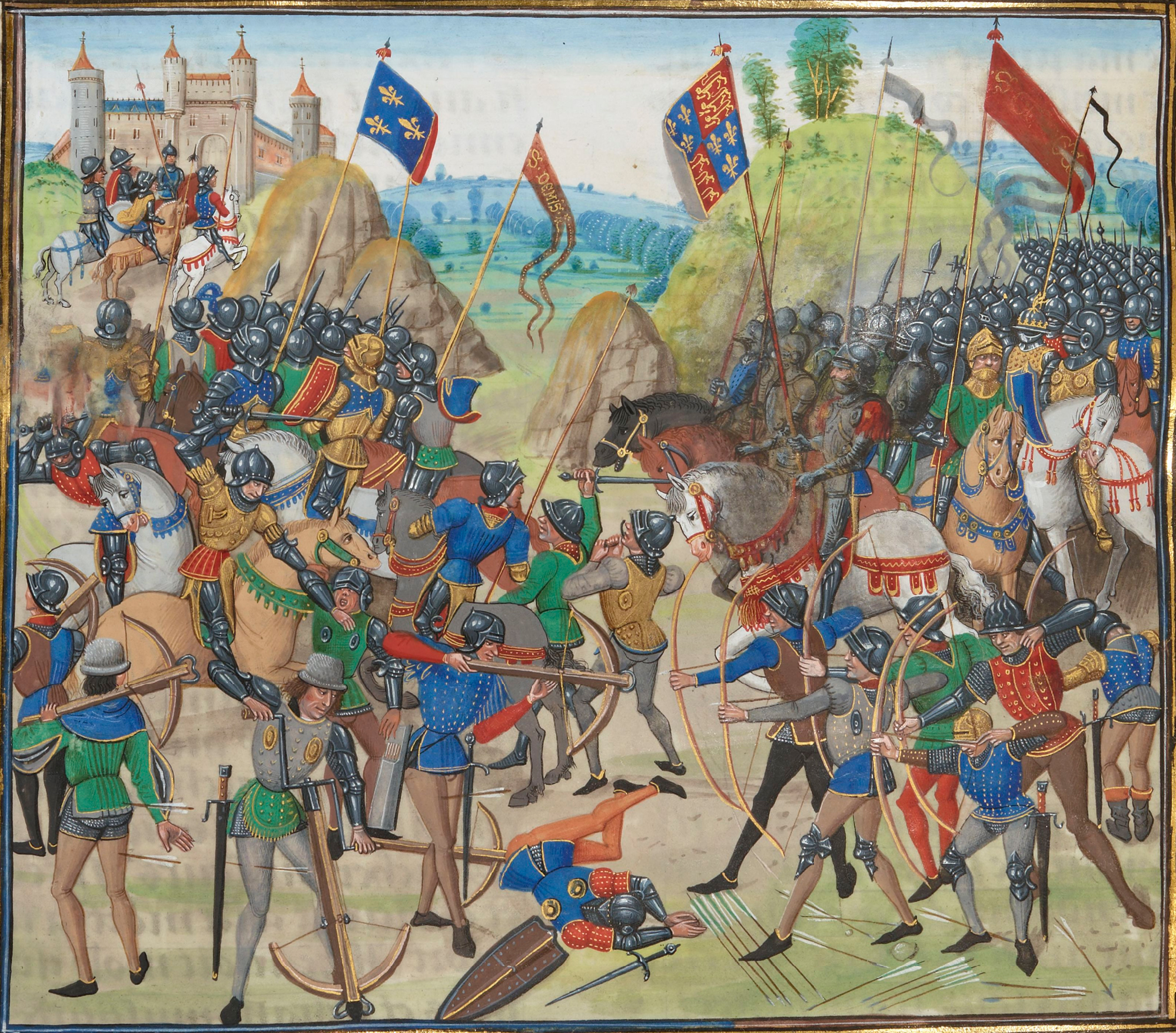 Battle of Crécy: Loyset Liédet, Public domain, via Wikimedia Commons
This campaign resulted in the Battle of Crécy on August 26, 1346, one of the most famous engagements of the Middle Ages. Philip VI, at the head of French chivalry, suffered a heavy defeat against the forces of Edward III and the Black Prince. The English army derived a decisive advantage from its discipline, its choice of terrain, and above all from the massive use of archers, whose fire broke French charges. Some sources also mention the use of bombards, sometimes presented as one of the first uses of artillery on a Western battlefield, although this point remains disputed. The defeat at Crécy dealt a severe blow to the military prestige of the French monarchy.
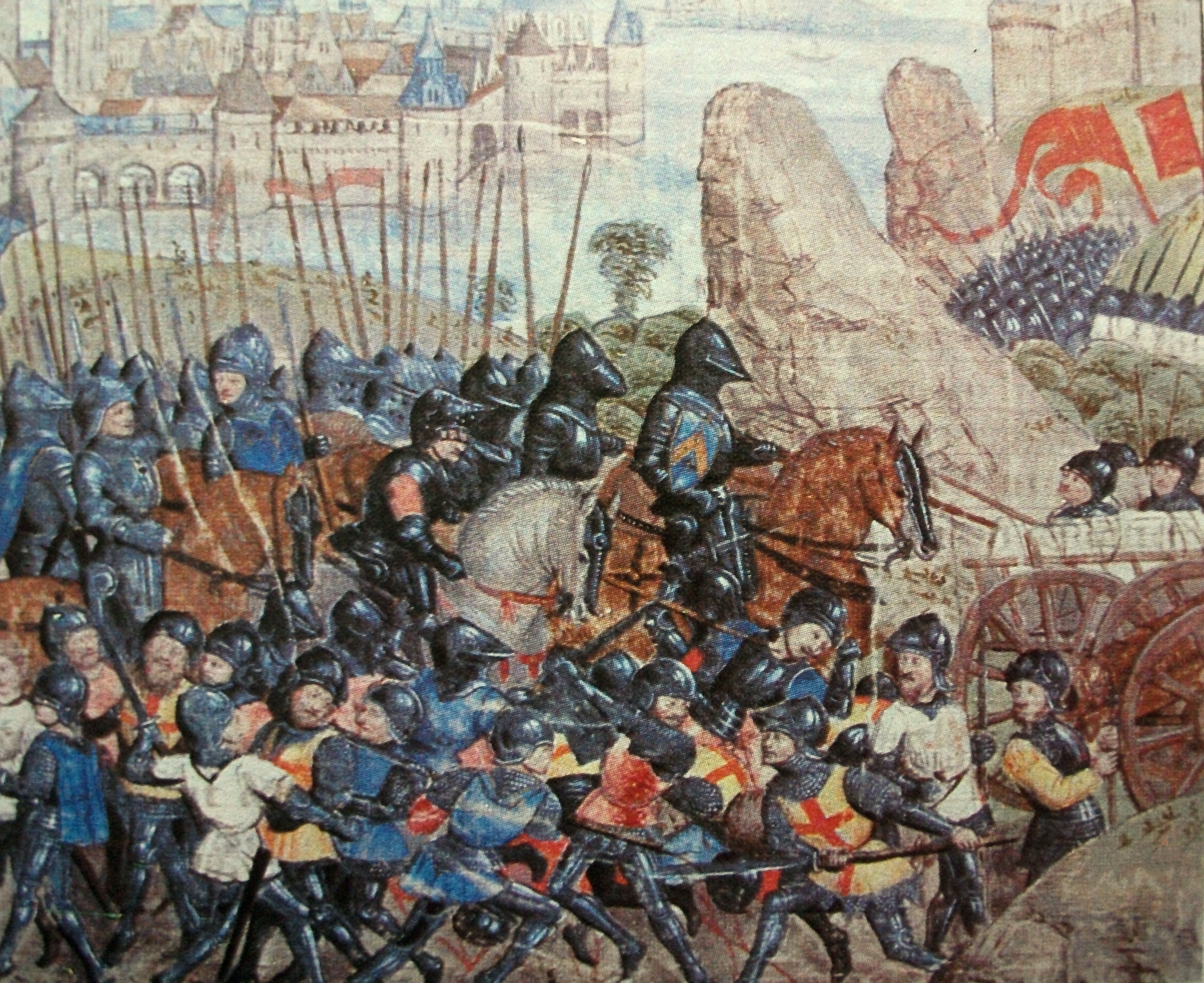 Siege of Calais: H. W. Koch: Illustrierte Geschichte der Kriegszüge im Mittelalter, S. 127, Bechtermünz Verlag See, Public domain, via Wikimedia Commons
In the wake of victory, Edward III undertook the siege of Calais from September 4, 1346. The choice of this place was not fortuitous: Calais offered an ideal foothold on the English Channel, capable of assuring regular communications between England and the continent. The siege, destined to last until 1347, thus became a major strategic stake. During this time, the war also extended to the British Isles: on October 17, 1346, David II Bruce, traditional ally of France, invaded England but was defeated and captured at Neville’s Cross. Thus, at the same moment, France lost both a great battle on its own soil and the immediate military support of its Scottish ally.
The period was also worsened by economic and agricultural difficulties. The years 1346–1347 were marked by poor harvests in several regions of Western Europe, notably in France, England, and Italy. In the context of war, these difficulties further reinforced the vulnerability of populations and royal finances. In parallel, the English court developed a powerful chivalric imagination, symbolized by the festivities organized around Edward III and, soon, by the founding of the Order of the Garter, generally dated between 1346 and 1348. War was thus also accompanied by an ideological and aristocratic staging of English royalty.
Thus, between 1344 and 1346, the war changed profoundly in dimension. Brittany remained an active front, Flanders remained a zone of fragile balance, but it was above all the invasion of Normandy and the defeat at Crécy that revealed the new seriousness of the confrontation. With the siege of Calais, the conflict now settled into the long term and entered a decisive phase of the Hundred Years’ War.
1348: The Black Plague in France and the Crisis of Christian Society
The year 1348 marked a major turning point in the reign of Philip VI. While the war against England continued, it was suddenly eclipsed by the irruption of the Black Plague, a pandemic from the East already reported in Mediterranean ports since 1347. Carried along maritime and commercial routes, it reached Provence at the end of 1347, then devastated most of the kingdom in 1348, before continuing its effects in the following years. At the European scale, mortality was immense: traditional estimates speak of approximately 25 million deaths between 1347 and 1351, although modern assessments vary.
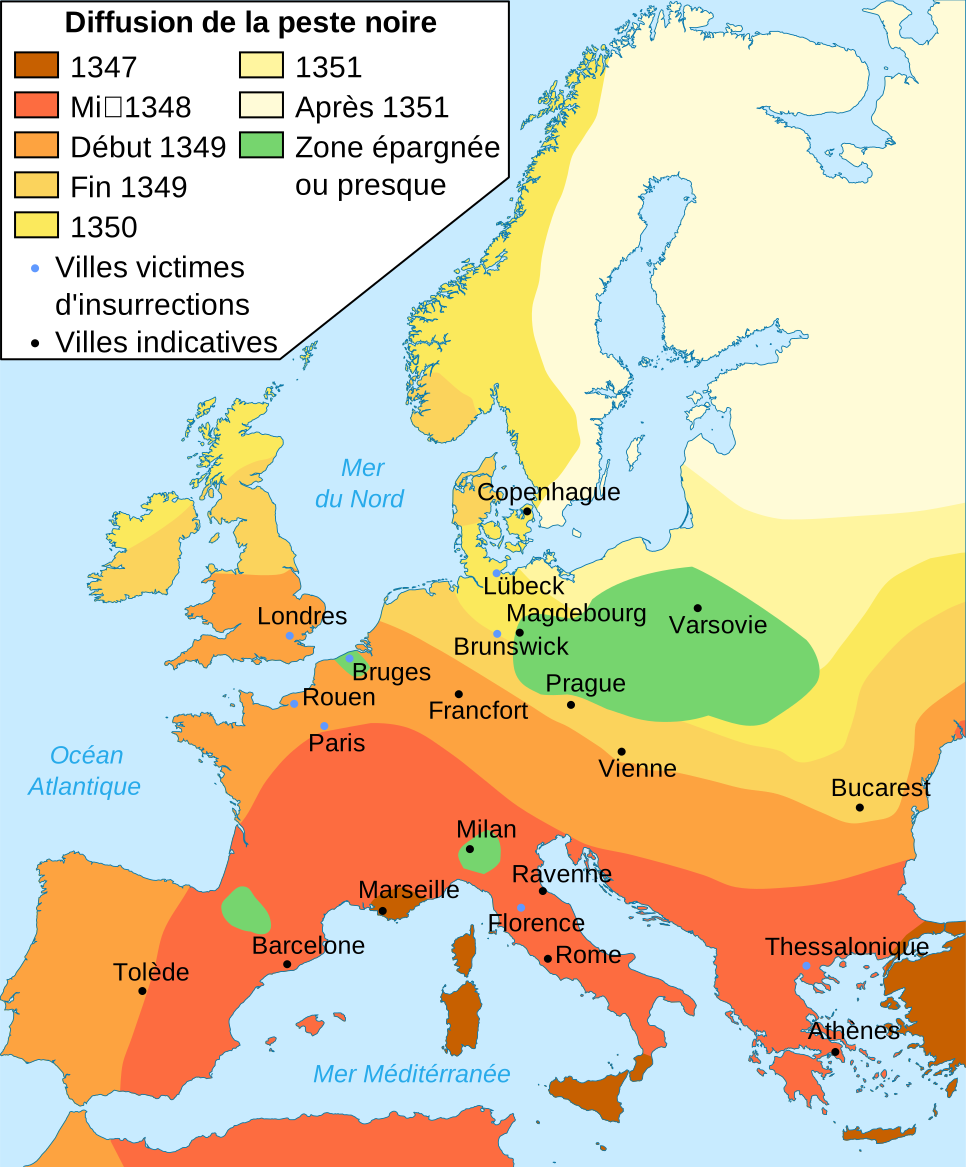 Spread of the Black Plague 1347: FlyingPC, CC BY-SA 3.0 https://creativecommons.org/licenses/by-sa/3.0, via Wikimedia Commons
The progress of the epidemic in France followed major routes of circulation. Starting from Mediterranean ports, it moved up the Rhône valley, struck Avignon, then reached the center and north of the kingdom. Sources agree that it devastated most of France in 1348. The first Parisian mentions appear in late summer, and the disease then reached other western regions, notably Angers in autumn. In a kingdom already weakened by war, the disorganization was brutal: mass mortality, collapse of certain activities, religious despair, and the inability of authorities to stem the plague.
As elsewhere in Europe, the spread of the plague provoked a wave of panics and searches for scapegoats. In Provence, in spring 1348, anti-Jewish riots broke out in several towns. At Toulon, a massacre of Jews was reported on April 13. The synagogue of Saint-Rémy-de-Provence was burned; elsewhere, Jewish communities were attacked, imprisoned, or expelled. In alpine and Rhône regions, Jews were tortured or executed, notably at Serres and Chillon, while accusations spread in Navarre, Castile, and German territories. These violences fit within a broader European movement that struck particularly southern and eastern regions of the kingdom.
The most frequent accusation involved the poisoning of wells. At Chillon, on September 15, 1348, Jews were tortured until they confessed under duress that they had spread the disease by this means. Such “confessions,” obtained in a climate of terror, fed subsequent persecutions. The logic was well known: faced with an incomprehensible catastrophe, medieval societies sought a human and willing cause for a scourge that struck indiscriminately through towns and countryside. The epidemic thus became a revealer of collective fears, religious prejudices, and fragilities of the social order.
The Pope Clement VI, installed at Avignon, nevertheless intervened to attempt to brake these violences. By a bull of summer 1348, then by a second issued on September 26, he recalled that Jews could not be held responsible for a plague reaching even regions where they did not live. These pontifical texts constitute one of the clearest positions of the period against the massacres of Jews linked to the plague. Their effectiveness remained limited, so dominated were large sectors of the population by fear and rumor.
The plague was not limited to the kingdom of France. In Italy, it was already attested at Pisa in early 1348; it then spread to Austria, German territories, and all of Western Europe. At Vienna, mortality was considerable. In several regions, the health crisis was accompanied by earthquakes, local famines, or social disorders, which reinforced the impression of widespread punishment. The epidemic also reached Spain, where certain regions, notably Aragon, suffered very heavy human losses and fresh waves in the following decades.
For France, the consequences were immense. Exact mortality remains difficult to establish, but historical syntheses emphasize that the kingdom was struck on an exceptional scale. The Black Plague lastingly overturned demography, rural economy, seigniorial structures, and the balance of urban communities. It reduced the labor force, disorganized seigniorial levies, weakened religious and administrative oversight, and contributed to putting aside, temporarily, the strictly military stakes of the reign. In 1348, France was thus not only a kingdom at war: it also became one of the great spaces of the demographic catastrophe that transformed Europe in the late Middle Ages.