


Philip II Augustus: The Affirmation of Capetian Power (1180–1223)
p51180 à 1223
Philip is born in 1165. His birth is celebrated as a providential event: Louis VII has awaited an heir for decades, and the child receives the surname “Dieudonné” (God-given). Raised in circles where Champagne and soon Flanders networks matter greatly, he grows up in a world where politics is played through alliances, loyalties, and coronation.
 Philip “God-Given” offered by Heaven to his parents: Great Chronicles of France. Library of Sainte-Geneviève, Ms. 782, fol. 280. via Wikimedia Commons.
🔍 Zoom – 1165–1180: “God-Given”, Anticipated Coronation and Entry into Power
In 1179, Louis VII has his son crowned by anticipation, then gradually entrusts him with governance. In 1180, upon Louis VII’s death, Philip becomes fully king, at age fifteen: he inherits a Capetian monarchy now solid, but facing an immense challenge, the Plantagenet Empire (England, Normandy, Anjou, Aquitaine), which dominates Western equilibrium.
 Map of France in 1180: Zigeuner, CC BY-SA 3.0, via Wikimedia Commons
Philip Augustus’s reign is one of a change of scale: the king no longer merely survives or pacifies his domain. He attacks, he conquers, and he transforms the monarchy into a durable power.
🔍 Zoom – 1180: Accession, First Maneuvers and Priorities
I. ♟️ 1180–1189 — Governing by Balance: Isolating the Plantagenets
At the outset of his reign, Philip II Augustus lacks the means to directly confront major principalities. He thus adopts a prudent and effective strategy, inherited but systematized: divide his adversaries, exploit rivalries, and gradually strengthen the royal domain.
This policy combines diplomatic action, targeted military interventions, and internal reorganization of power.
🧩 A Tangle of Rivalries: Flanders, Champagne and Coalitions
At the beginning of Philip II Augustus’s reign, the political situation of the north is dominated by the power of the count of Flanders, Philip of Alsace, whose possessions and alliances extend beyond France’s boundaries, notably toward the Empire.
The count of Flanders exercises considerable influence over several strategic territories, particularly the Vermandois, whose succession is disputed upon the death of Count Raoul II (1167). Philip of Alsace, close relative of the deceased, claims part of the inheritance, in competition with Capetian rights.
Around the count of Flanders forms an alliance network including:
- the landgrave of Brabant, Godfrey III of Louvain
- the archbishop of Cologne, Philip of Heinsberg
- several princes and lords from the kingdom’s northern margins
This configuration places the French king in a delicate position, facing a coalition capable of intervening both within the kingdom and in imperial space.
⚔️ 1181–1185: Feudal Conflict and Struggles of Influence
The conflict between Philip Augustus and Philip of Alsace develops from 1181 through a series of feudal confrontations over:
- succession rights in the Vermandois
- control of certain strongholds
- political influence over northern principalities
Military operations remain limited, taking the form of:
- localized campaigns
- castle sieges
- sporadic fortification destructions
No decisive battle is fought, but hostilities are continuous.
Simultaneously, the king pursues diplomatic action to isolate the count of Flanders. He relies notably on his marriage to Isabella of Hainaut (1180), which brings him rights over Artois, strengthening his legitimacy in the region.
⚖️ 1185: Treaty of Boves
The conflict ends with the Treaty of Boves, concluded in July 1185, which establishes a compromise between the two parties.
The main provisions are:
-
the Vermandois is divided:
part reverts to the French king, part remains under Flemish influence -
Amienois passes under Capetian control, consolidating the territorial continuity of the royal domain northward
-
Artois, linked to Isabella of Hainaut’s dowry, is confirmed in the royal sphere of influence
The count of Flanders preserves his main positions but must recognize Capetian authority’s expansion.
The Treaty of Boves marks an important step in extending the royal domain northward and reducing the influence of great territorial princes.
Without constituting a decisive military victory, it reflects a progressive rebalancing of power in favor of the Capetian monarchy.
🔍 Zoom – 1185: Boves and Flemish Rivalry
🏛️ 1182–1185: Finance, Administration, and Domain Management
Parallel to these conflicts, Philip Augustus undertakes reorganizing royal power’s functioning.
In 1182, he decides on the expulsion of Jewish communities from the royal domain, accompanied by seizure of their goods. This measure, presented as religious, also serves financial logic: it allows quickly replenishing the royal treasury.
Simultaneously, the king engages in structural reforms:
- in 1184, creation of the corps of baillis, itinerant agents charged with representing royal authority in the domain
- improvement of territorial and judicial management
- affirmation of the king’s direct control over his lands
These innovations mark an essential step:
the Capetian monarchy begins equipping itself with permanent administrative instruments.
The king also acts on space:
- beginning of paving Paris’s streets (around 1185)
- securing roads and trade exchanges
- domain consolidation through acquisitions (ex. Montargis)
 Philip Augustus orders the paving of Paris’s streets: Bernard Gui, Besançon Municipal Library, Public domain, via Wikimedia Commons
Finally, he strengthens internal order:
- in 1183, mercenary bands (Brabancons) are crushed near Châteaudun
- struggle against chronic insecurity linked to brigands
The king appears here as an organizer of the territory and guarantor of public order.
🔍 Zoom – 1184: Baillis and Birth of a Capetian State
🌍 The Plantagenets: The Structural Rival
The main adversary of Philip Augustus remains the Plantagenet Empire, directed by Henry II, whose possessions extend from England to Aquitaine. This territorial ensemble, without equivalent in Western Europe, places the French king in relative inferiority at the outset of his reign.
Against this power, Philip adopts an indirect strategy founded on feudal mechanisms and internal dynasty divisions:
- exploitation of rivalries between Henry II’s sons
- rapprochement with Richard the Lionheart, in opposition to his father
- surveillance of John Lackland’s ambitions
- punctual interventions at the margins (Berry, Vexin)
⚔️ 1188: Gisors and Symbolic Rupture
In January 1188, several assemblies are held between Gisors and Trie-Château, in the Vexin, a border zone between the Capetian domain and Plantagenet Normandy.
Under pressure from the fall of Jerusalem (1187) and the call for the Third Crusade, Philip Augustus and Henry II formally commit to taking the cross, alongside numerous princes.
However, these meetings fail to ease tensions.
A famous incident, known as the “Elm of Gisors” affair, marks the definitive degradation of relations between the two sovereigns.
🌳 The Elm of Gisors: A Feudal Symbol
 Cutting of the Elm of Gisors: Henri Félix Emmanuel Philippoteaux, Public domain, via Wikimedia Commons
Near Gisors stood a large elm, used as a traditional meeting place for the kings of France and England. This tree symbolized:
- a neutral space for negotiation
- feudal balance between the two powers
- mutual recognition of their status
According to chronicles, at an interview in August 1188, a dispute breaks out between the two camps. The French, exposed to the sun while the English stay in the tree’s shade, protest.
Following the incident, Philip Augustus orders the elm to be cut down. The destruction of the tree far exceeds the anecdote:
- it ends a symbolic place of dialogue between the two monarchies
- it marks a rupture in traditional diplomatic usages
- it expresses the French king’s will to no longer recognize an implicit relationship of equality with the English king
This episode is often interpreted as a deliberate political gesture, affirming the Capetian monarchy’s rising power.
⚔️ 1187–1189: Open War and Henry II’s Weakening
The situation turns from 1187 onward, in a context of double crisis:
externally, Jerusalem’s fall to Saladin shakes the West; internally, the Plantagenet Empire is fragilized by tensions between Henry II and his sons.
Philip Augustus exploits this favorable conjunction to launch an offensive against English positions in France.
⚔️ 1187–1188: Offensive in Berry and Territorial Pressure
From 1187 onward, the French king intervenes in Berry, a strategic region between the Capetian domain and Plantagenet possessions.
He conducts a methodical campaign:
- capture of Issoudun
- occupation of Graçay
- siege of Châteauroux
These operations aim to:
- weaken Plantagenet control in the kingdom’s center
- secure the royal domain’s margins
- test Henry II’s capacity to react
A truce is momentarily negotiated under papal legate influence, but it only temporarily suspends tensions.
⚔️ 1188–1189: Alliance with Richard and War Resumption
From 1188 onward, the situation evolves rapidly.
Philip Augustus draws closer to Richard, in open conflict with his father.
This alliance is decisive: it transforms a frontal conflict into a dynastic war within the Plantagenet Empire, in which the French king plays a role of arbiter and active supporter.
Military operations conducted jointly by Philip and Richard are rapid and effective.
- June 1189: capture of Le Mans, an important Henry II residence
→ the city is burned during the English king’s retreat
 Siege of Le Mans by Philip Augustus. Great Chronicles of France. Lyon - Wikimedia Commons
-
progression toward Touraine, the heart of Plantagenet possessions
-
July 1189: capture of Tours, a major political and strategic center
At the same time:
- several lords of Poitou and Brittany defect
- Henry II’s authority progressively collapses
- the English royal army disintegrates
Henry II, already weakened by illness, finds himself militarily outmaneuvered and politically isolated.
⚖️ July 1189: Treaty of Azay-le-Rideau
Forced to negotiate, Henry II accepts the conditions imposed by Philip Augustus.
The Treaty of Azay-le-Rideau (or Treaty of Colombière) marks a major defeat for the English king:
- official recognition of Richard as heir
- homage rendered to the French king
- payment of a large indemnity (approximately 20,000 silver marks)
- restitution or concession of several strategic positions
This treaty consacrates Henry II’s loss of authority over his own empire.
⚰️ July 6, 1189: Death of Henry II
A few days after treaty signing, Henry II dies at Chinon on July 6, 1189.
According to chroniclers, he learns before his death that his youngest son, John Lackland, has also joined the opposing camp, symbolizing the complete collapse of his family and political power.
✝️ 1187–1189: Crusade in the Background
In this context of open war between Capetians and Plantagenets, Eastern events profoundly modify European political equilibrium. Jerusalem’s capture in 1187, consequent to Christian armies’ defeat at the Battle of Hattin, provokes a major shock in the Latin West.
 The Battle of Hattin: Gustave Doré, Public domain, via Wikimedia Commons
The Holy City, held by Latins since the First Crusade (1096–1099), falls to Ayyubid sultan Saladin. The event provokes religious and political mobilization of exceptional breadth, transcending local rivalries.
Facing this situation, Pope Gregory VIII launches a solemn crusade call through the bull Audita tremendi (1187), quickly relayed by Clement III. This call gives rise to the Third Crusade (1189–1192), engaging several major Western European sovereigns.
 Philip Augustus receiving papal messengers calling him to crusade: Great Chronicles of France, 14th century. Paris, National Library of France, via Wikimedia Commons
For Philip Augustus, this crusade intervenes at a strategic moment. While engaged in decisive war against Henry II, then in the progressive collapse of the Plantagenet Empire, the prospect of departure to the Holy Land imposes a temporary reconfiguration of priorities.
💰 The Saladin Tithe and Kingdom Mobilization
To finance the expedition, an exceptional tax is instituted in 1188: the Saladin tithe. Levied on revenues and movable goods, it constitutes one of the first quasi-general taxes in the West.
This measure is accompanied by important logistical organization:
- levying of military contingents
- fleet preparation for transport to the East
- accumulation of financial and material resources
For the French king, these preparations continue the administrative reforms begun at the reign’s outset: the capacity to levy tax and organize territory becomes an essential power lever.
⚔️ 1189: Between Western Victory and Eastern Departure
The year 1189 marks a turning point. After political and military victory over Henry II, then his death in July, Philip Augustus finds himself in a strong position against his new rival, Richard the Lionheart.
However, the crusade commitment imposes a hostilities suspension.
A truce is concluded between Philip and Richard by the Treaty of Nonancourt (1189):
- temporary halt to military operations
- recognition of a status quo pending departure
- organization of the journey to the Holy Land
This agreement does not end rivalry between the two sovereigns, but suspends it.
⚖️ A Parenthesis in Capetian Struggle
The Third Crusade preparation thus opens a particular period in Philip Augustus’s reign.
At the moment when the Capetian monarchy begins gaining advantage over the Plantagenets, the king accepts diverting part of his resources toward an external enterprise.
This situation reveals a double logic:
- religious logic, linked to crusade ideals and Christian pressure
- political logic, where the crusade becomes an instrument of prestige and legitimation
The 1189 truce thus constitutes not lasting peace, but a strategic pause in a confrontation destined to resume upon the sovereigns’ return from the East.
II. ✝️ 1190–1192 — The Third Crusade: Prestige and Absence
In 1190, Philip II Augustus fully engages in the Third Crusade, in a context where religious, political, and dynastic stakes intermingle. The expedition constitutes both an affirmation of royal prestige and a major risk-taking: leaving the kingdom suspends direct Capetian power exercise at the moment when it begins imposing itself against the Plantagenets.
⚰️ March 1190: Royal Mourning and Territorial Consolidation
On March 15, 1190, Queen Isabella of Hainaut dies in childbirth, after giving the king several children, including the future Louis VIII, father of Saint Louis.
This disappearance has major political consequences:
- Artois, brought in the queen’s dowry, is permanently integrated into the royal domain
- dynastic continuity is assured by the birth of an heir
Despite this mourning, Philip continues his departure preparations.
⚖️ June–July 1190: Organizing Departure
On June 24, 1190, Philip Augustus solemnly takes the oriflamme at Saint-Denis, symbol of the king’s commitment in a sacred war.
Before leaving the kingdom, he establishes a government apparatus:
- drafting of the 1190 ordinance-will, organizing regency
- designation of officials charged with ensuring power continuity
- administrative oversight to prevent troubles during his absence
On July 4, 1190, Philip departs from Vézelay, at the same time as Richard the Lionheart, marking the expedition’s beginning.
⚓ 1190–1191: Franco-English Rivalry in the Mediterranean
 Philip Augustus and Richard III meet during the crusade: The Histories of Outremer. Parchment manuscript, Via Wikimedia commons
The journey to the East rapidly reveals tensions between the two sovereigns.
After leaving Vézelay, crusade armies rejoin the Mediterranean via Genoa and Marseille, before wintering in Sicily.
- September 16, 1190: Philip Augustus arrives at Messina
- September 23: Richard arrives
Relations rapidly deteriorate:
- Richard refuses to marry Alice of France, Philip’s sister
- he militarily imposes himself in Sicily, notably at Messina’s capture and pillage (October 1190)
- disagreements appear on local alliances, notably with Tancred of Lecce, Sicily’s king
Despite Philip’s mediation, a compromise is found, but mistrust between the two kings durably installs itself.
⚔️ 1191: Acre, Military Heart of Crusade
- April 20, 1191: Philip Augustus arrives before Acre, besieged by crusaders
 Philip Augustus arriving in Palestine (Acre’s siege), Great Chronicles of France, via Wikimedia Commons
- Richard, delayed, conquers Cyprus in May 1191, which becomes essential logistical base
- July 12, 1191: Acre’s capture, a major crusader victory
 Acre’s submission to Philip Augustus: Merry-Joseph Blondel, Public domain, via Wikimedia Commons
Military cooperation between Philip and Richard is real, but political tensions persist:
- command rivalries
- disagreements on conquered territory management
- strategic divergences
Muslim prisoner executions by Richard in August 1191 further accentuate divisions and mark the conflict’s brutality.
🚢 August 1191: Philip Augustus’s Premature Departure
Barely with Acre’s capture (July 12, 1191) assured, Philip II Augustus chooses to end his direct crusade participation. This decision intervenes in a context where personal, political, and strategic factors combine.
Weakened by illness — probably a dysentery form contracted during the siege — the king is physically diminished. But beyond this element, his departure is primarily explained by European stakes: the sovereign’s prolonged absence poses a risk to the royal domain’s stability, while rivalry with the Plantagenets remains central to his policy.
- August 3, 1191: Philip leaves the Holy Land
- he entrusts operation continuation to the Duke of Burgundy, representing French interests within the crusade army
This departure, criticized by some contemporaries, does not signify total disengagement: Philip maintains an indirect presence and conserves prestige linked to Acre’s capture.
Philip regains the kingdom at year’s end, arriving in Paris on December 27, 1191.
The premature return reflects a clear priority hierarchy. Unlike Richard the Lionheart, who continues the crusade, the French king considers that his action’s essential unfolding must occur in the West.
Several elements motivate this choice:
- the necessity to preserve recent territorial gains against Plantagenet ambitions
- the desire to exploit Richard’s political fragility, still engaged in the East
- the risk of troubles or contestations developing during his absence
The crusade thus appears as an important but secondary episode in a global strategy centered on strengthening Capetian power.
⚔️ 1192–1193: Richard the Lionheart’s Capture
While Philip acts in the West, Richard the Lionheart continues the crusade until 1192, before leaving the Holy Land after a truce concluded with Saladin.
His European return marks an unexpected turning point.
- December 1192: Richard is captured near Vienna by Duke Leopold V of Austria
- he is subsequently handed to Emperor Henry VI
This capture places the English king in a situation of great vulnerability. A heavy ransom is required for his liberation, durably immobilizing English power.
Philip Augustus immediately exploits this situation:
- intensification of contacts with John Lackland, seeking to seize power
- attempts at dismantling the Plantagenets’ continental possessions
- diplomatic actions aiming to prevent Richard’s rapid return
According to some sources, Philip may have even encouraged maintaining his rival in captivity to prolong his strategic advantage.
III. 🧩 1191–1193 — Kingdom’s North: Flemish Succession and Dynastic Security
Philip II Augustus’s return from crusade in 1191 immediately reopens a major file: Flanders’ succession, consequent to Count Philip of Alsace’s death that same year during the crusade.
Flanders then constitutes strategically first-rank space:
- rich and urbanized region
- commercial crossroads between France’s kingdom, the Empire, and northern maritime spaces
- zone of influence disputed between Capetians and Empire-linked princes
The count’s disappearance without direct heir opens a succession crisis liable to provoke major regional conflict.
Several claimants dispute the Flemish inheritance, foremost among them Baldwin V of Hainaut, the deceased’s relative and already solidly established in the region.
Philip Augustus intervenes carefully in this sensitive file. His objective is twofold:
- prevent hostile coalition formation associating Flanders, Empire, and northern principalities
- profit from the situation to strengthen the royal domain
A compromise is finally found:
- Baldwin of Hainaut is recognized as Flanders’ count
- he accepts paying an important financial compensation to the French king
- he recognizes, at least formally, Capetian preeminence
This agreement allows regional stabilization without open conflict, while assuring political and financial benefit to the monarchy.
🗺️ Territorial Reinforcement in the North
Parallel to succession regulation, Philip consolidates his territorial positions methodically.
Several major evolutions intervene:
- the Vermandois is definitely attached to the crown (1191), after a lengthy period of sharing and rivalry
- the Valois is promised to progressive return to the royal domain
- the king obtains strategic places like Péronne, reinforcing his military control over the region
- Artois, from Isabella of Hainaut’s dowry, is administered in the name of prince heir Louis
The kingdom’s north thus becomes an essential support zone in the struggle against the Plantagenets.
🔍 Zoom – 1191–1192: Flemish Succession
💍 1193: Remarriage and Diplomatic Stakes
Despite these territorial successes, the dynastic situation remains uncertain.
Isabella of Hainaut’s death in 1190 left the king widowed, with still-very-young heir:
- prince Louis is only a few years old
- the Capetian dynasty’s continuity rests on a single child
In a political context marked by feudal rivalries and princely ambitions, this fragility represents a real risk.
To secure succession, Philip Augustus proceeds to rapid remarriage.
In 1193, he marries Ingeburge of Denmark, sister of King Canute VI, in an international alliance logic:
 Marriage of Philip Augustus and Ingeburge of Denmark: Vincent of Beauvais, Mirror Historial [Speculum historiale] Via Wikimedia Commons
- opening toward Scandinavian kingdoms
- search for new support against Anglo-Norman and imperial powers
However, immediately following the marriage, the king repudiates his spouse for unclear reasons, invoking a canonical impediment.
This decision opens a major crisis:
- papal opposition to marriage annulment
- diplomatic tensions with Denmark
- remonstration of the king’s matrimonial legitimacy
Philip subsequently attempts contracting a new marriage with Agnes of Meran, aggravating the situation.
🔍 Zoom – 1193–1212: Ingeburge, Agnes, and Papal Interdict
IV. ⚔️ 1193–1204 — The Decisive Opportunity: Plantagenet Crisis and Normandy’s Conquest
From 1193 onward, Philip II Augustus benefits from exceptionally favorable circumstances. Richard the Lionheart’s captivity, then the divisions following within the Plantagenet dynasty, offer the French king the opportunity to transform ancient rivalry into a series of political, feudal, and territorial gains.
His method remains constant: exploit family disputes, intervene in the name of feudal law, isolate diplomatically his adversary, and strike militarily when force ratios permit. Between 1193 and 1204, this strategy produces a major Western equilibrium shift: the Capetian monarchy seizes Normandy and durably weakens English power over the continent.
🗡️ 1193–1194: Richard’s Captivity and First Offensives
Richard the Lionheart’s capture, on the return path from crusade’s end in late 1192, becomes widely known in England at 1193’s outset. This absence provokes political crisis throughout the Plantagenet ensemble.
His brother John Lackland, then in regent position, attempts exploiting the situation to his benefit. Hoping to usurp the throne, he draws closer to Philip Augustus and even declares himself his vassal. But in England, Richard’s supporters, backed by Queen Eleanor of Aquitaine, resist his intrigues. Besieged at Windsor by William the Marshal, John must capitulate and returns to the continent.
Philip, for his part, immediately profits from Richard’s distance to attack Plantagenet positions in Normandy. During 1193, he seizes several places:
- Évreux
- Neubourg
- Le Vaudreuil
- various secondary castles along the Norman border
However, he fails to take Rouen, energetically defended by Robert of Beaumont. Philip’s objective is not yet total Normandy conquest, but methodical erosion of the opposing defensive apparatus.
On April 12, 1193, the castle of Gisors is delivered to him by seneschal Gilbert of Vascoeuil, which constitutes considerable strategic advantage in the Vexin, key region between Capetian domain and ducal Normandy.
Meanwhile, Richard, detained by Duke Leopold V of Austria, is handed on March 23, 1193 to Emperor Henry VI. His liberation becomes the object of lengthy financial and political negotiation. An accord is reached on June 29, 1193 against a heavy ransom.
Despite this still-uncertain situation, Philip signs the July 8, 1193 peace at Mantes with Richard’s envoys. This truce remains provisional: everyone knows war will resume upon the English king’s effective return.
⚔️ 1194–1199: The Duel with Richard the Lionheart
Liberated on February 4, 1194, Richard rapidly regains the initiative. After a second English coronation and brief restoration of his authority within the kingdom, he returns to Normandy in spring. He lands at Barfleur on May 12, 1194, passes through Lisieux, reconciles with his brother John, then resumes struggle against Philip Augustus.
The war between the two sovereigns then takes the form of almost continuous confrontation, mixing:
- fortress sieges
- rapid raids
- diplomatic maneuvers
- truces immediately broken
 Battle of Fréteval: Daniel Vierge, Public domain, via Wikimedia Commons
One of the most striking episodes unfolds on July 5, 1194, at the Battle of Fréteval. Richard there inflicts serious reverses on Philip Augustus and seizes the royal treasure along with part of the archives. The event reveals that war touches not only territories and castles: it reaches royal administrative apparatus too, still in structuring phase. Archive loss indeed pushes Capetian power to better organize record conservation.
Despite this setback, Philip does not renounce. The following years see alternating offensives and negotiations. By late 1195, an accord leaves him several important places:
- Gisors
- Gaillon
- Vernon
These positions open the direct path to Normandy and threaten Rouen.
The January 14, 1196 Treaty of Gaillon attempts to stabilize the situation. But peace remains precarious. Conscious of danger, Richard immediately engages construction of the fortress of Château-Gaillard at Les Andelys, between 1196 and 1197. This stronghold, designed to seal the Seine valley and protect Rouen, becomes the symbol of Plantagenet resistance.
 Château-Gaillard seen from the sky: Sylvain Verlaine, CC BY-SA 3.0, via Wikimedia Commons
Simultaneously, Philip must also monitor the kingdom’s north. In 1197, Count Baldwin of Flanders invades Artois and besieges Arras, forcing the king to intervene. Philip pushes as far as Ypres, ravages Flemish lands, but fails to impose a decisive solution. To the east, Emperor Henry VI’s death in 1197 furthermore opens an uncertain period in the Empire, which Philip seeks to exploit diplomatically.
In 1198, war against Richard resumes with vigor. Richard wins a new victory at Courcelles-lès-Gisors on September 28, 1198, while Philip must also manage the Flemish situation, aggravated by the loss of Saint-Omer and Aire.
 Philip Augustus falling into a trap near Gisors-sur-l’Epte bridge in 1198, illustration by Edmond Morin, after “Histoire populaire de la France” (1862), via Wikimedia Commons.
Under papal pressure, a conference is organized with papal legate Peter of Capua present. It results on January 13, 1199 in a five-year truce between Philip and Richard. This truce resolves nothing fundamentally. It soon becomes moot through a decisive event: April 6, 1199, Richard dies from wounds received at Châlus’s siege.
Richard’s disappearance eliminates the most formidable adversary Philip has encounté during the first part of his reign.
🔍 Zoom – 1193–1199: War against Richard, Fréteval and Châlus
🏰 1199–1202: John Lackland, Arthur of Brittany and Feudal Law as Weapon
Richard’s death opens a succession crisis. Two main claimants emerge:
- John Lackland, the deceased’s brother, supported in several regions of the empire
- Arthur of Brittany, son of Geoffrey Plantagenet and Richard’s nephew, who can assert serious dynastic claim
Philip Augustus immediately exploits this rivalry. In May 1199, he receives Arthur’s solemn homage for several French Plantagenet possessions, notably Anjou, Maine, and Touraine. Through this gesture, he places the young prince under his protection and gains himself a juridical and political means to contest John’s rights.
Simultaneously, John is crowned English king on May 27, 1199. He quickly assures himself control of part of his continental possessions, notably entering Le Mans without difficulty in September.
In autumn, Philip presents himself as Arthur’s protector and militarily intervenes in Maine, with Guillaume of Roches’s support. The campaign, marked by Le Mans’s capture and Lavardin’s siege, shows the Plantagenet succession becomes a directly Franco-French issue. However, English troop arrival forces Philip to withdraw, and Guillaume of Roches briefly attempts to reconcile Arthur with John. The young duke eventually returns to Capetian orbit.
After these confrontations, a compromise with John Lackland is found. It is formalized by the Treaty of Goulet, signed May 22, 1200. This treaty consecrates an important political advantage for Philip:
- John recognizes suzerainty of the French king over his continental possessions
- he cedes the county of Évreux
- peace is reinforced through dynastic rapprochement
In this framework, the marriage of prince Louis, Philip Augustus’s son, to Blanche of Castile, John’s niece, is prepared. The Treaty of Goulet represents a Capetian diplomatic success: John is recognized as Richard’s heir, but at the price of formal recognition of feudal dependence.
This stabilization remains fragile. In Aquitaine, John’s marriage to Isabella of Angoulême provokes lively tensions, notably with the Lusignan house. Philip seizes the opportunity. In his capacity as suzerain, he summons John to appear before court of peers.
On April 28, 1202, John Lackland, absent and defaulting, is condemned. The French court pronounces commise (confiscation) of his French fiefs:
- Normandy
- Maine
- Anjou
- Touraine
- Saintonge
- Poitou
Feudal law becomes here a major political weapon. Philip presents himself not as arbitrary conqueror, but as a suzerain sanctioning a defaulting vassal. This juridical legitimation prepares conquest.
🔍 Zoom – 1199–1202: Goulet, Arthur and Fief Confiscation
🏰 1202–1204: Plantagenet Collapse and Normandy’s Conquest
From 1202 onward, war changes nature. It concerns no longer merely harassing Norman borders, but dismantling the entirety of John Lackland’s continental power.
Philip acts on multiple fronts. In Anjou, Guillaume of Roches takes Angers for the French king on October 30, 1202. John reacts, retakes and pillages the city at 1203’s outset, but overall initiative progressively escapes him.
The decisive factor is Arthur of Brittany’s disappearance. After his failure at Mirebeau in 1202, he is captured by John Lackland. On April 3, 1203, he disappears at Rouen, very probably assassinated on the English king’s order.
 Arthur of Brittany captured by his uncle, John Lackland, Bertrand, Public domain, via Wikimedia Commons.
This event provokes a major political shock:
- in Brittany, revolt against John erupts
- numerous lords detach from the English camp
- John Lackland’s legitimacy is profoundly weakened
Philip Augustus immediately exploits this situation. Arthur’s disappearance allows him to rally his former supporters and present his adversary as a disloyal lord, thus justifying Capetian intervention in the name of feudal law.
From then onward, the Capetian offensive intensifies. In 1203, Philip seizes several Loire valley and Norman margin positions:
- Brissac, captured by Guillaume of Roches
- Saumur, occupied shortly thereafter
- sundry places disorganizing the Angevin and Norman defensive system
But the main objective remains Normandy and especially the Seine’s lock: Château-Gaillard.
🧱 1203–1204: Château-Gaillard and Rouen’s Fall
The siege of Château-Gaillard constitutes one of the most celebrated episodes of the reign. The fortress, built by Richard to defend access to Rouen, is besieged for several months. Philip conducts methodical fortress reduction war, seeking less pitched battle than opposing defensive system collapse.
On March 6, 1204, Château-Gaillard falls after approximately six months’ siege. This victory opens the Seine valley to Capetians and deals a mortal blow to Norman defense.
 An artistic representation of what Château-Gaillard’s 1204 siege looked like. The besieging force, the French, is camped south of the castle, while the fortified town of Petit-Andely is situated north of the castle, in image background. The Seine flows to the west. The besieging army has a siege tower and two catapults.
The campaign continues rapidly:
- May 21, 1204: Caen’s capture
- progression toward the duchy’s principal cities
- encirclement of Rouen, Normandy’s administrative and symbolic capital
Rouen receives from June 1, 1204 on assurance of retaining its rights and customs through a royal charter. Philip thus combines military pressure with political integration: he presents himself not as destroyer, but as new master guaranteeing urban privileges.
 Philip Augustus besieging Rouen: Levan Ramishvili from Tbilisi, Georgia. BL Royal 16 G. VI, f.365v, Public domain, via Wikimedia Commons
After forty days’ siege, Rouen capitulates on June 24, 1204. With this surrender, continental Normandy enters the Capetian sphere.
Conquest continues westward and southward:
- Poitiers’ capture in 1204
- capture of Loches and Chinon in 1205
- operation continuation until the Thouars truce from October 13, 1206 onward
In two years, Philip has thus accomplished what no Capetian before him could achieve: wrenching from the Plantagenets the continental heart of their power.
🔍 Zoom – 1203–1204: Château-Gaillard and Rouen’s Capitulation
V. 🧱 1205–1213 — Consolidating Capetian Expansion: Administration, Crises, and New Frontiers
After 1202–1204’s decisive conquests, Philip II Augustus enters a stabilization phase. The royal domain, considerably enlarged, now requires more structured administration, strengthened political presence, and capacity to resist counter-offensives.
Between 1205 and 1213, the king transforms military successes into lasting domination, while confronting persistent feudal tensions, international crises, and major religious stakes.
🏰 1205–1206: Completing Western Conquest
In 1205’s spring, Philip Augustus conducts a campaign destined to complete control takeover of territories confiscated from the Plantagenets.
On April 10, 1205, after Easter festivities, he assembles a major army and seizes several strategic strongholds:
- Loches, besieged for nearly a year
- Chinon, former Henry II residence
These captures allow the king to assure authority over:
- Touraine
- Anjou
- Maine
- much of Poitou
These territories, confiscated juridically in 1202, now pass under effective royal domination.
This territorial consolidation is accompanied by symbolic power evolution: in June 1205, the royal chancellery first employs the expression regnum Francie (“kingdom of France”), marking increased power unity affirmation.
⚔️ 1206: English Counter-Offensive and Stabilization
In 1206, John Lackland attempts regaining initiative on the continent.
- July 9, 1206: he lands at La Rochelle
- August 1: he seizes Montauban and retakes several Poitou and Anjou positions
- Angers is burned
These operations show Capetian domination remains fragile in recently conquered southern regions.
However, Philip maintains strategic advantage. A two-year truce is concluded on October 26, 1206 at Thouars, temporarily stabilizing the situation.
Simultaneously, the king pursues interior action. An ordinance taken in 1206 frames credit practices by limiting interest rates, testifying to the will for economic and social regulation.
⛪ 1208–1213: English Crisis and Equilibrium Recomposition
From 1208 onward, the international situation evolves in Philip Augustus’s favor.
The English king enters conflict with the papacy over Canterbury archbishop appointment.
- 1208: Pope Innocent III strikes England with interdict
- 1209: John Lackland is excommunicated
These sanctions have major political consequences:
- weakening of English royal authority
- internal kingdom tensions
- diplomatic isolation of John Lackland
In this context, Philip Augustus indirectly benefits, the papacy finding itself in open opposition to his principal rival.
⚖️ 1209: Feudal Reforms and Royal Authority Affirmation
On the interior, Philip strengthens power structures.
In 1209, he promulgates the Villeneuve-sur-Yonne ordinance, which frames fief transmission:
- limitation of liege fief divisibility
- obligation for each heir to directly render homage to their fief’s lord
This measure aims to limit feudal dependence fragmentation and strengthen seignorial hierarchy to royal power’s benefit.
That same year, a kingdom grandees assembly is convened near Sens, notably to examine possible intervention against the Cathars, revealing the king’s increasing involvement in the kingdom’s religious affairs.
🗺️ 1210–1211: Territorial Expansion and Royal Center Affirmation
From 1210 onward, Philip pursues controlled expansion policy.
- Auvergne intervention, with Clermont capture, in a local conflict context between the count and bishop
→ beginning of the region’s progressive integration to the royal domain
In 1211, two major evolutions testify to strengthening Capetian power:
- completion of Paris’s enclosure, begun in 1190, assuring the capital’s protection
- launch of Reims cathedral reconstruction, the royal coronation center’s symbolic core
These elements translate a double dynamic: military consolidation of the kingdom’s heart and monarchy’s central role affirmation in the religious order.
⚔️ 1212: Feudal Tensions and Political Recompositions
In 1212, tensions resume in the north.
Count of Boulogne, Renaud of Dammartin, renders homage to the English king. In reaction, Philip Augustus pronounces the confiscation of Boulogne county, again applying feudal law principles to sanction a vassal deemed disloyal.
At the same time, the kingdom is crossed by religious and popular movements, notably the children’s crusade (1212), testifying to intense spirituality and diffuse religious mobilization in society.
⚓ 1213: England Invasion Project and Diplomatic Reversal
In 1213, Philip Augustus considers carrying conflict directly to England.
- April 8, 1213: vassals assembly at Soissons
- prince Louis is charged with expedition preparation
- major fleet is gathered at Boulogne-sur-Mer
However, the situation rapidly evolves.
- May 15, 1213: John Lackland reconciles with the papacy and accepts becoming the pope’s vassal
→ this decision removes any religious legitimacy to French invasion
The project is abandoned.
Shortly afterward, military situation degrades:
- May 30–31, 1213: Damme naval battle
→ the French fleet is largely destroyed by English attack
 Advance of the English fleet on Damme: James Grant, Public domain, via Wikimedia Commons
Philip then redirects forces toward the continent, notably against his Flemish adversaries.
🏰 December 1213: Auvergne Integration
In December 1213, Tournoël’s castle capture marks a decisive step in the king’s expansion policy.
 Tournoël Castle: Matthieu Perona, CC BY 3.0 https://creativecommons.org/licenses/by/3.0, via Wikimedia Commons
Count Guy II of Auvergne loses most of his possessions, and the region is integrated to the royal domain. Certain lands are entrusted to Guy of Dampierre in life tenure.
 Auvergne County under Guy II: Aavitus, CC BY-SA 4.0 https://creativecommons.org/licenses/by-sa/4.0, via Wikimedia Commons
V. 🛡️ 1214 — Bouvines: The Victory That “Makes a Kingdom”
The Capetian monarchy’s rapid expansion at the 13th century’s outset provokes an exceptional-scale reaction. Around John Lackland forms a coalition associating territorial princes and imperial powers. The year 1214 marks this confrontation’s culmination.
⚔️ February–July 1214: English Offensive and Capetian Counter-Offensive
On February 16, 1214, John Lackland lands at La Rochelle aiming to resume continental foothold and catch Philip Augustus off guard. He rapidly progresses toward the center-west:
- April 3: arrival at Limoges
- April 5: passage through Angoulême, with a maneuver destined to attract French forces southward
The English king seeks to coordinate his action with northern allies, to encircle the Capetian kingdom.
On June 17, 1214, John seizes Angers, marking a temporary success. However, Philip Augustus avoids direct confrontation and entrusts West defense to his son, prince Louis, count of Artois.
The Capetian reaction is rapid and decisive:
- July 2, 1214: at the Battle of La Roche-aux-Moines, prince Louis routs John Lackland’s army
Facing Capetian force resistance and lacking local support, John retreats precipitously to La Rochelle. This defeat deprives the coalition of its southern axis and isolates its northern allies.
Simultaneously, the royal domain strengthens:
- June 14, 1214: upon Eleanor of Vermandois’s death, Vermandois and Valois are permanently integrated to the Capetian domain
⚔️ July 1214: Northern Coalition
Conflict’s center of gravity then shifts toward the kingdom’s north. A coalition forms around Emperor Otton IV of Brunswick, including notably:
- Ferdinand of Portugal, count of Flanders
- Renaud of Dammartin, count of Boulogne
- several Lowlands and Empire princes
On July 20, 1214, the coalition forces regroup at Valenciennes and advance toward Capetian territory.
Philip Augustus decides to engage battle. He gathers:
- the kingdom’s feudal contingents
- his great vassals’ knights
- communal militias, testifying to growing city involvement in military effort
⚔️ July 27, 1214: The Battle of Bouvines
On July 27, 1214, the two armies confront one another at Bouvines, near Lille.
 Philip Augustus at Bouvines: Le Petit Journal, Public domain, via Wikimedia Commons
Philip Augustus, surrounded by his main supporters — including Gaucher III of Châtillon and Matthew II of Montmorency — confronts the coalition troops led by Otton IV.
The battle is characterized by:
- large-scale frontal engagement
- decisive knighthood role
- active communal militia participation
Despite critical moments, notably when the king is briefly threatened in combat, the Capetian army gains advantage.
The outcome is decisive:
- Ferdinand of Flanders is captured
- Renaud of Dammartin is taken prisoner
- the Imperial army is routed
Otton IV flees the battlefield, abandoning his allies.
👑 A Victory of European Consequences
Bouvines’s victory far transcends military framework.
In France:
- it greatly reinforces Philip Augustus’s prestige
- it affirms the king as the kingdom’s force rallying point
- it consolidates Capetian authority against great vassals
On the Imperial level:
- Otton IV loses German support
- Frederick II, already elected Roman king, imposes himself as dominant sovereign
- Philip Augustus implicitly recognizes this shift by having Frederick wear the imperial insignia captured at Bouvines

Frederick II receiving the imperial eagle banner captured from France’s King after Bouvines, 19th century illustration, via Wikimedia Commons.
In England:
- the defeat durably weakens John Lackland
- English barons revolt against him in the following months
Political consequences quickly materialize.
- September 18, 1214: Chinon peace consecrates John Lackland’s defeat
The English king recognizes:
- losses of his Loire north possessions
- Capetian domination over territories conquered since 1202
This peace ratifies the major territorial transformations of preceding years.
⚖️ A Founding Victory
The Battle of Bouvines does not mark a modern centralized state’s birth, but constitutes a major turning point in Capetian monarchy history.
It combines:
- a decisive military victory against an international coalition
- political legitimation of royal power
- broader elite and city adherence to the king’s authority
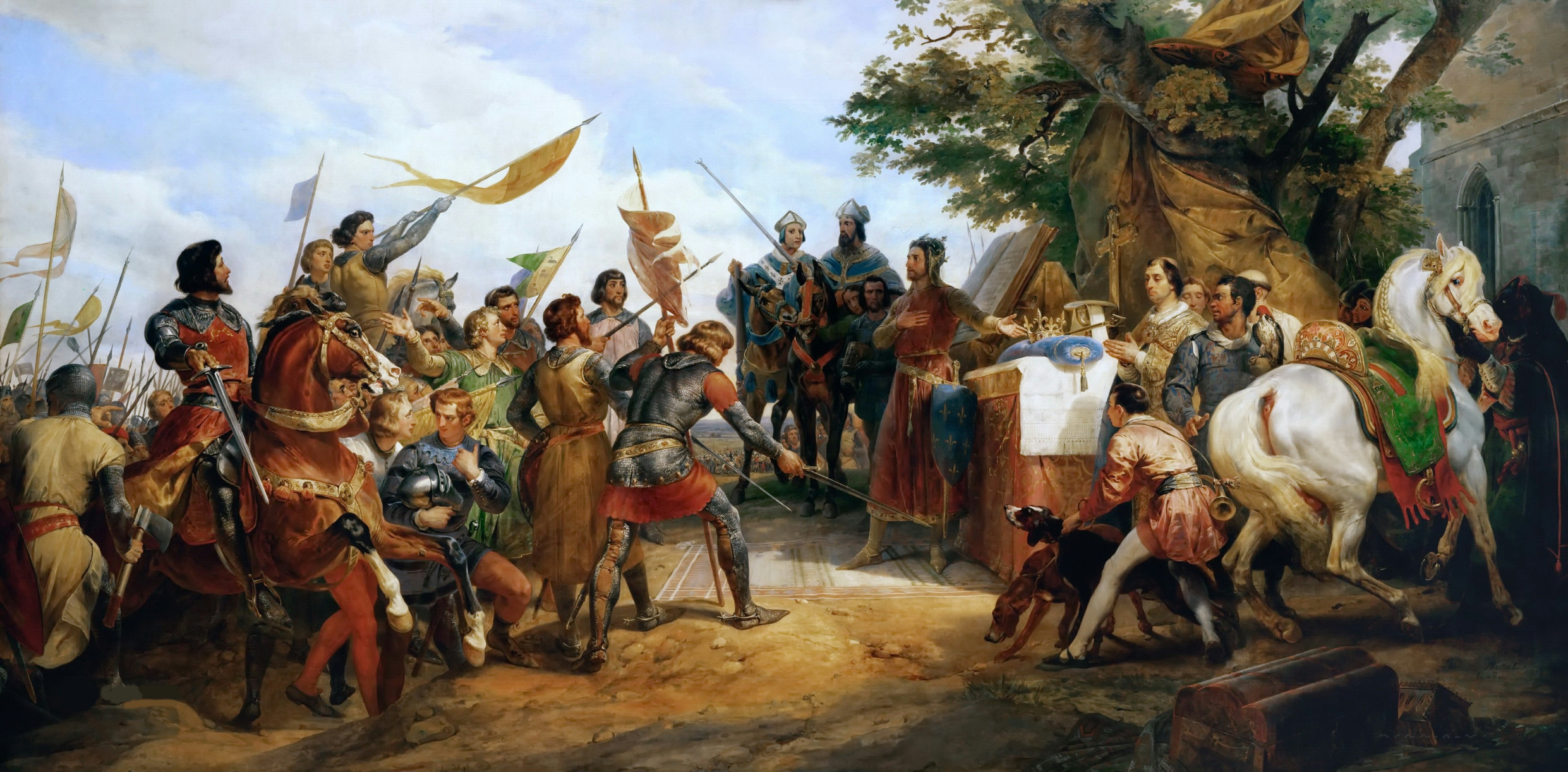 Battle of Bouvines Won by Philip Augustus: Horace Vernet, Public domain, via Wikimedia Commons
From 1214 onward, the Capetian monarchy appears as stabilized power, capable of imposing itself durably against adversaries. Bouvines thus contributes reinforcing the idea of a kingdom united around its sovereign, making major royal authority contestation increasingly difficult.
🔍 Zoom – 1214: Bouvines, Battle and Royal Propaganda
🔍 Zoom – 1213–1214: Damme, La Roche-aux-Moines and War Exit
VI. 🕊️ 1214–1223 — After Victory: Ambitions, Interior Crusade, and Capetian Stabilization
After the 1214 Bouvines victory, the Capetian monarchy attains unprecedented power. Philip II Augustus now dominates the kingdom’s north and west, while his principal adversaries are weakened. However, this victory opens not a period of continuous expansion, but rather a phase of strategic equilibrium, mixing exterior ambitions, military delegation, and interior consolidation.
🛶 1215–1217: English Crisis and Prince Louis’s Expedition
The English situation offers Philip Augustus major political opportunity. John Lackland’s reign is fragilized by deep internal crisis.
In 1215, the English king confronts a baronial revolt:
- June 15, 1215: Magna Carta signature at Runnymede
- limitation of royal arbitrariness and recognition of feudal rights
- lasting rupture between the king and part of the aristocracy
 John Lackland signs Magna Carta: English School (Cassell’s History of England - Century Edition), Public domain, via Wikimedia Commons
Pope Innocent III quickly annuls the charter, triggering the first baronial wars (1215–1217). In this context, certain English barons propose the crown to prince Louis, Philip Augustus’s son.
The French king supports this initiative without personally committing.
- May 22, 1216: Louis lands in England, in Kent
- he seizes London and obtains part of the kingdom’s support
- several strongholds resist nonetheless, notably Windsor and Dover
The situation quickly shifts:
- October 18, 1216: John Lackland’s death
- October 28: young Henry III’s coronation at Gloucester
- establishment of a regency under William the Marshal
This shift strengthens the loyalist camp, supported by the papacy. Louis is excommunicated, fragilizing his position.
In 1217, military situation deteriorates:
- May 20, 1217: Louis’s defeat at the Lincoln battle
- August 24, 1217: French naval defeat at Sandwich (Cinque Ports)
 Battle of Sandwich: Matthew Paris, Public domain, via Wikimedia Commons
Deprived of support and isolated, Louis must renounce:
- September 1217: peace conclusion
- abandonment of English throne claims
This expedition, though promising, concludes in failure. It nonetheless reveals the Capetian monarchy’s capacity for beyond-border intervention, while confirming Philip’s prudence, remaining withdrawn.
🔍 Zoom – 1216–1217: England Expedition, London, Lincoln and Cinque Ports
⚔️ 1215–1221: The Albigensian Crusade
Simultaneously, the Midi is marked by the Albigensian crusade, launched in 1209.
Philip Augustus adopts measured position:
- he supports the enterprise politically
- he avoids prolonged direct involvement
His son Louis participates occasionally:
- 1215: southern campaign alongside Simon of Montfort, passing through Montpellier, Narbonne, and Toulouse
- 1219: Toulouse siege, which fails after several weeks
- 1221: new expedition without decisive results
These interventions illustrate indirect strategy:
the king lets his vassals and heir act, while conserving his forces for principal stakes.
Meanwhile, the Midi remains unstable:
- territorial recovery by local lords
- reconquests conducted by Raymond-Roger of Foix in 1221
- progressive weakening of the initial crusade apparatus
🔍 Zoom – 1208–1221: Cathars, Montfort, Toulouse and Louis Expeditions
🧾 1215–1222: Northern Peace and Kingdom Structuring
After 1214, the kingdom’s north experiences relative stability. Major military conflicts move away from the Capetian domain core, allowing the king to strengthen structures.
Several evolutions testify to this consolidation:
- development of urban and university institutions
- 1215: University of Paris statutes fixed by Robert of Courçon
- elite framing and royal authority affirmation
- Capetian influence extension through successions and alliances
The royal Treasury reaches high level, reflecting revenue from conquests and domain administration.
 Testament of Philip Augustus: Sébastien Mamerot and Jean Colombe, The Passages Outremer, Public domain, via Wikimedia Commons
In 1222, Philip Augustus drafts a will, as his health declines. This document:
- organizes power transmission
- reflects the importance of accumulated resources
- testifies to the will to assure dynastic continuity
🔍 Zoom – 1215–1222: Peace, Successions, Treasury, and Will
⛪ A Kingdom Integrated to European Religious Dynamics
The period is also marked by important religious renewal.
- development of mendicant orders:
- 1217–1221: Franciscan organization
- 1220–1221: Dominican order structuring
These movements testify to profound life spirituality transformation, in which the Capetian monarchy inscribes itself without being directly its initiator.
Moreover, relations between monarchy and papacy, previously strained, are now stabilized, allowing the king to benefit from a more favorable political framework.
⚖️ A Stabilized Monarchy at Reign’s End
Between 1214 and 1223, Philip Augustus seeks no longer merely to multiply spectacular conquests. His action aims above all to:
- consolidate acquired territories
- strengthen administrative structures
- assure dynastic transmission
After more than forty reign years, Philip Augustus dies in July 1223. Exhausted by a final journey, he fades at Mantes. The body is brought back to Paris, and funerals are organized at Saint-Denis. The sovereign’s death is staged with regalia and solemn ritual: it becomes the last public act of sovereignty.
Upon his 1223 death, the France kingdom appears profoundly transformed:
- territorially enlarged
- administratively better organized
- politically more stable
 The Territorial Conquests of Philip Augustus, Between His Accession (1180) and Death (1223): Vol de nuit, CC BY-SA 3.0 http://creativecommons.org/licenses/by-sa/3.0/, via Wikimedia Commons
Succession occurs without major crisis: Louis VIII inherits a more vast kingdom and stronger monarchy, now capable of pursuing Capetian affirmation.
🔍 Zoom – 1222–1223: Reign’s End, Will and Funerals
🔍 Zoom – 1223: Louis VIII Inherits a Transformed Kingdom
🧠 Key Points to Remember
- 1180–1189: Balance strategy, center consolidation, Plantagenet isolation.
- 1190–1192: Crusade, prestige, but continental priority.
- 1199–1202: Arthur/John, Treaty of Goulet, fief confiscation.
- 1203–1206: Château-Gaillard, Rouen’s capitulation, Loire secured.
- 1206–1213: Consolidation (Auvergne, Boulogne, Flanders), gain stabilization.
- 1214: Bouvines, victory and legitimation of the unifying king, war exit.
- 1216–1217: Capetian attempt in England led by prince Louis.
- 1215–1222: Northern peace, interior crusade episodes, finance and transmission.
- 1190–1223: Administration and Paris strengthen a more visible monarchy.
- 1223: Prepared succession, accelerated Capetian dynamic.