

Louis XIII and Richelieu: the assertion of absolutism (1610-1643)
1610 à 1643
On 14 May 1610, the assassination of Henry IV in the rue de la Ferronnerie brought to the throne an eight-year-old child, Louis XIII, under the regency of his mother Marie de Médicis. This premature accession opened a period of uncertainty that the kingdom, barely out of the Wars of Religion, could ill afford: the new king would not exercise real personal power until seven years later, and a full decade more would pass before he found, in the person of a Poitevin bishop destined for the cardinal’s purple, the instrument of government that was to redefine the French monarchy.
The inheritance received by the regent was quickly squandered. The treasury patiently rebuilt by Sully under Henry IV evaporated within a few years into pensions and courtly extravagance, while foreign policy reversed course in favour of a marital rapprochement with Habsburg Spain, the kingdom’s former enemy. This initial fragility was compounded by a chronic instability of power: Italian favourites assassinated, a regent exiled, a hunting companion propelled to the summit of the State only to be carried off by the epidemic he had himself helped spread before Montauban — for nearly two decades the kingdom seemed to drift without firm direction, each political balance proving as precarious as the one before it.
The dominant feature of these thirty-three years was nonetheless, in the end, the very opposite of this initial instability: a king of melancholic temperament and fragile health found, in the alliance with Cardinal Richelieu forged in 1624, the means of an assertion of royal authority unmatched since Henry IV. This alliance, tightened in the ordeal of the Day of the Dupes, when the king chose his minister over his own mother, fed on a constant pragmatism: force when it was required, negotiation when it sufficed, exemplary repression when the high nobility still dared openly to defy the crown.
The reign unfolded along four closely interwoven axes. On the domestic plane, the struggle against the pretensions of the high nobility — from the conspiracies of Chalais and Montmorency to the final one, that of Cinq-Mars — was accompanied by a systematic dismantling of its means of armed resistance, fortified strongholds razed and duels forbidden. On the religious plane, the siege of La Rochelle followed by the Peace of Alès definitively reduced the Protestants to mere subjects without military privileges, closing a cycle of civil wars several decades old. On the external plane, the annexation of Lorraine and then the entry into open war against Spain in 1635 committed France to the Thirty Years’ War, at the cost of the extreme peril of the year of Corbie but in pursuit of the avowed ambition of breaking the Habsburg encirclement. On the dynastic plane, finally, the unhoped-for birth of the dauphin Louis-Dieudonné, in 1638, secured, after twenty-three years of uncertainty, the survival of the House of Bourbon.
This reign thus occupies a pivotal place in the history of the French monarchy: a direct heir to the Henrician pacification, it carried forward the work of reconstructing the State while giving it a new dimension — that of a royal power henceforth freed from any lasting noble or religious counterweight. The almost simultaneous deaths of Richelieu, in December 1642, and of Louis XIII, in May 1643, closed this chapter on one last telling contrast: whereas the regency of 1610 had had to reckon with a council limiting its powers, the one that opened in 1643 for the young Louis XIV asserted itself from the outset as absolute — a sign that Richelieu’s work had, within a single generation, changed the very nature of the French monarchy, and laid the foundations on which the future Sun King would build his own reign.
I. 1610–1615: the regency of Marie de Médicis, the squandering of the inheritance and the failure of the estates-general
On the death of Henry IV, assassinated on 14 May 1610, the regency fell to his wife Marie de Médicis, whom the king had designated as early as 20 March, flanked by a regency council of fifteen members meant to constrain her power. Crowned at Saint-Denis on the very eve of the assassination,
 The Coronation of Marie de Médicis at Saint-Denis: Peter Paul Rubens, Public domain, via Wikimedia Commons
she was confirmed in her charge by a lit de justice held as early as 15 May, while the young Louis XIII, aged eight, ascended the throne; his coronation was celebrated on 17 October 1610 in the cathedral of Reims, symbolically completing the transmission of royal power. In the early period, the regent showed caution: on 22 May, a royal declaration confirmed the Edict of Nantes and the rights of the Protestants, a gesture of continuity meant to reassure a kingdom still marked by the Wars of Religion. This initial caution, however, hardly lasted: very quickly, two Italian favourites, Concino Concini and his wife Léonora Dori, known as Galigaï, established themselves in the queen’s entourage. Appointed councillor of State as early as 26 July 1610, Concini acquired the marquisate of Ancre, the offices of first gentleman of the Chamber and governor of Péronne, Roye and Montdidier, before being raised to the rank of marshal of France on 19 November 1613 — a rise as rapid as it was detested, as shown by the assault he suffered as early as May 1610, when Parisian clerics set upon him in the street.
 Marie de Médicis, Léonora Galigaï and Concino Concini: Charles Laplante, after Alphonse de Neuville, Public domain, via Wikimedia Commons
This rise of the favourites was accompanied by a clean break, both financial and diplomatic, with the Henrician policy. On 26 January 1611, Sully resigned his offices of superintendent of finances and captain of the Bastille, leaving a treasury of 16.5 million livres that the regent’s court quickly squandered on pensions and lavish expenditure; control of affairs then passed to Nicolas de Villeroy, who retained it until 1614. On the external plane, Marie de Médicis abandoned the late king’s anti-Habsburg orientation to draw closer to Catholic Spain: as early as 30 April 1611, a secret treaty signed at Fontainebleau sealed a Franco-Spanish defensive alliance, alarming French Protestants enough that an assembly convened at Saumur, from 27 May to 12 September 1611, to draw up a plan for autonomous political organisation.
This rapprochement found its crowning achievement in a double dynastic marriage. On 29 January 1612, the court officially announced the betrothal of Louis XIII to the Infanta Anne of Austria and that of his sister Élisabeth of France to the Prince of Asturias, the future Philip IV of Spain. The Treaty of Auxonne, signed on 15 February, also settled the borders between the kingdom and Spanish Franche-Comté, while a great carousel held in the Place Royale from 5 to 7 April lavishly celebrated the emerging alliance; the marriage contract was finally signed at Madrid on 22 August 1612. This matrimonial policy also allowed the regent to reassert her authority over a restive nobility: on 23 May 1612, the agreement of Montigny, negotiated by Concini and Villeroy, authorised the return to court of the Prince of Condé and the Count of Soissons, who had been at odds with the crown for several years, in exchange for their acceptance of the Spanish marriages and various territorial concessions.
This purchased noble peace proved precarious. The year 1613 saw tensions realign at court — on 5 January, the Chevalier de Guise assassinated the Baron de Luz in the rue Saint-Honoré, tipping influence towards the pro-Spanish Guise party — before Condé, recalled on 28 May, once again broke with the regent’s government. On 13 January 1614, he left the court without authorisation; on 19 February, he published a manifesto justifying his revolt in the name of the “public good,” rallied the dukes of Bouillon, Longueville, Mayenne, Nevers and Vendôme, and demanded that the Spanish marriages be called into question along with the convening of the estates-general. An attempt to seize Poitiers, between 22 and 27 June, failed in the face of resistance mounted by the townspeople under the leadership of the town’s bishop. Unable to defeat the princes by force, Marie de Médicis had to negotiate: the Treaty of Sainte-Menehould, signed on 15 May 1614, granted Condé 450,000 livres and the governorship of Amboise, comparable compensation to his allies, and above all the convening of the estates-general they demanded — a perilous precedent, in which armed revolt found itself openly rewarded.
Meanwhile, a lit de justice held at the Parlement of Paris had proclaimed, on 2 October 1614, the legal majority of Louis XIII, aged thirteen.
 The Majority of Louis XIII: Peter Paul Rubens, Public domain, via Wikimedia Commons
On 20 October, in a ceremony in which the queen mother symbolically “handed over” the kingdom’s affairs to him, Marie de Médicis nonetheless judged her son “too weak in body and mind” to govern alone, and in practice retained the exercise of power. It was in this ambiguous climate — a legally adult king still kept from affairs of state — that, a week later, the estates-general opened, the last that the French monarchy was to know before 1789.
 Map of France divided into the 12 provinces or governments summoned to the estates-general of 1614: Anonymous, Public domain, via Wikimedia Commons
Convened from 27 October 1614 at the Hôtel du Petit-Bourbon, after three days of fasting and procession, the assembly brought together 464 delegates divided into three orders: 150 for the clergy, including five cardinals and forty-seven bishops, 132 gentlemen for the nobility, and 182 delegates, mostly judicial and financial officers, for the third estate.
 The estates-general convened by Louis XIII, 27 October 1614: Jean Alaux, Public domain, via Wikimedia Commons
The debates came to nothing: the third estate, through the voice of delegates such as Jean Savaron, who described peasants reduced to “grazing on grass like beasts” in Guyenne and Auvergne, proposed recognising the authority of the King of France as a monarch by divine right, independent of that of the pope — a striking foreshadowing of the absolutism to come, but rejected by the clergy and the nobility. The concrete demands of the third estate (reduction of the taille, abolition of the paulette) and of the nobility likewise came to nothing; only the publication of the Council of Trent was granted, and the announcement, on 24 March 1615, of the abolition of the paulette met with the Parlement’s refusal to register it. The assembly disbanded on 23 February 1615 amid this near-total failure, illustrating the inability of the French monarchy to reform itself through representative means. Yet it was within this barren assembly that a twenty-nine-year-old bishop, elected deputy of the Poitevin clergy on 24 August 1614 with the support of the regent’s secretary Denis Bouthillier, drew attention to himself: in his closing speech of 23 February 1615, Armand du Plessis de Richelieu praised the government of Marie de Médicis, attracting an attention that, in the years to come, was to transform the course of the reign.
🔍 Zoom – Louis XIII: portrait of a melancholic king
II. 1615–1617: the Spanish marriage, the second civil war and the assassination of Concini
The alliance negotiated since 1612 at last found its dynastic fulfilment. On 18 October 1615, Louis XIII married Anne of Austria by proxy at Burgos, before the marriage was celebrated in person at Bordeaux on the following 25 November.
 The Marriage of Louis XIII and Anne of Austria: Jean Chalette, Public domain, via Wikimedia Commons
This union, which durably sealed the Franco-Spanish rapprochement, was not enough, however, to appease a nobility still quick to contest the regent’s authority: as early as August 1615, the Prince of Condé took up arms again, opening a second civil war that had settled nothing of what the Treaty of Sainte-Menehould had attempted to buy the previous year. On 6 January 1616, his troops were defeated at Saint-Maixent, in Poitou, by the Duke of Guise, without this military victory bringing the conflict to an end.
Peace returned through negotiation rather than arms: on 3 and 8 May 1616, the Treaty of Loudun put an end to this second civil war, on terms even more favourable to the rebel prince than at Sainte-Menehould, since Condé obtained the presidency of the King’s Council along with a million and a half livres — more than triple the sum granted two years earlier, a sign of the escalating price the crown now had to pay for noble peace. This triumph was nonetheless short-lived: on 1 September 1616, Marie de Médicis, on the advice of her ministers, had Condé abruptly arrested, a spectacular reversal that showed how fragile and reversible the noble peace agreements of this period remained. A few weeks later, on 25 November 1616, a thorough ministerial reorganisation completed this reassertion of control: Richelieu, already noticed at the estates-general, was appointed secretary of State for Foreign Affairs and War, Claude Mangot became chancellor and Claude Barbin took charge of finances — a configuration that contemporaries already referred to, not without irony, as the “Concini ministry,” so heavily did the Italian favourite’s influence weigh on these appointments.
This omnipotence of Concini, now a marshal of France since 1613, provoked growing hostility among the great men of the kingdom. On 2 February 1617, lords assembled at Soissons sent the king a letter openly accusing him of plundering the royal treasury; on 18 February, a royal declaration had to be drafted in the face of three armies raised by the Great against that of the court. It was in this climate of open crisis that Charles d’Albert de Luynes organised the coup that was to overturn the balance of power. Having grown close to the young king through their shared passion for hunting, Luynes had already been entrusted with command of the Louvre in 1615 before being appointed grand falconer of France on 30 October 1616 and governor of Amboise; strengthened by this position, he arranged, on 24 April 1617, the assassination of Concini by Vitry, captain of the guards.
 The assassination of Concini: Maurice Leloir, Public domain, via Wikimedia Commons
Louis XIII, then aged fifteen and a half, immediately took the affairs of State into his own hands; Richelieu, too closely associated with the fallen ministry, was dismissed, while Luynes established himself as the new strongman of the reign. The consequences of this coup unfolded within a matter of weeks: as early as 25 April, Guillaume du Vair became chancellor of France, an office he held until 1621; on 3 May, Marie de Médicis was exiled to Blois; and on 8 July, Léonora Dori, Concini’s wife and the queen mother’s confidante, was beheaded and then burned at the Place de Grève, condemned for the crime of lèse-majesté both divine and human — the charges of witchcraft raised during her trial having served only as a political pretext. Questioned about the hold she exercised over the queen mother, she had answered her judges: “My art is the ascendancy of a strong soul over a weak mind.” Within a few months, the de facto regency that had continued well beyond the king’s legal majority had thus come to a brutal end.
🔍 Zoom – The marriage of Louis XIII and Anne of Austria: a long-delayed union
III. 1617–1621: the government of Luynes, the “war of mother and son” and the first Huguenot campaigns
Having become the strongman of the kingdom, Luynes devoted his first years in power to methodically neutralising the channels of influence still open to Marie de Médicis, now exiled at Blois. In the spring of 1618, he exposed the correspondence that Claude Barbin, the former controller general of finances, still maintained with the queen mother; Barbin was sentenced to banishment on 30 August, a penalty the king commuted to life imprisonment. Richelieu, too closely identified with Marie de Médicis’s camp, was likewise sidelined: exiled to Avignon on 7 April 1618, he did not arrive there until 16 May. This methodical sidelining, however, failed to durably smother the queen mother’s ambition: during the night of 21 to 22 February 1619, she escaped from the château of Blois and joined the Duke of Épernon at Angoulême, opening what became known as the first “war of mother and son.” Hastily recalled, Richelieu arrived at Angoulême on 27 March to negotiate a peaceful resolution, which was found on 30 April with the Treaty of Angoulême: Louis XIII forgave his mother and granted her the governorship of Anjou.
This reconciliation proved, like the previous ones, short-lived. A second conflict broke out as early as 1620: on 10 July, Louis XIII personally marched against the rebellious grandees in Normandy, before the royal army inflicted, on 7 August, a decisive defeat on that of Marie de Médicis at the battle of the Ponts-de-Cé, near Angers. Three days later, on 10 August, the Treaty of Angers sealed a new reconciliation, this time a more lasting one, between the king and his mother. Strengthened by this victory, Louis XIII turned to another matter left pending for decades: the religious status of Béarn, which had remained largely Protestant since the reign of Jeanne d’Albret. Received at Pau on 19 October 1620, he had the Edict of Pau published there the very next day, uniting Béarn, Basse-Navarre and Donezan with the domain of the French crown and re-establishing Catholic worship there.
This gesture, experienced by the kingdom’s Protestants as a direct provocation, precipitated the crisis that had been simmering for years. Meeting at Alès from 6 October to 2 December 1620, a synod of the Reformed Churches adopted the Canons of Dordrecht, marking a doctrinal reorganisation of great scope; then, on 25 December 1620, the Protestant assembly of La Rochelle decided on taking up arms in eight Huguenot “circles” spread across the territory, openly breaking with the crown. The revolt began on 10 February 1621 with the capture of Privas, led by the dukes of Rohan and Bouillon. From 18 April, Luynes and the king personally marched against the Protestant strongholds of the south: the siege of Saint-Jean-d’Angély, from 30 May to 25 June, concluded with the abolition of its municipal privileges and the razing of its fortifications; that of Clairac, from 23 July to 4 August, fell in turn. Appointed constable of France on 2 April 1621, Luynes then began the siege of Montauban from 17 August, mobilising a royal army of 20,000 to 25,000 men backed by 38 cannons against barely 6,000 Huguenot defenders entrenched behind 40 pieces and 32 culverins. The siege, however, turned into a disaster: an epidemic of purpuric fever, probably scarlet fever, ravaged the besieging camp far more surely than the town’s defenders did, causing as many as 8,000 to 15,000 deaths in the royal ranks against about 1,500 on the Montauban side, before Louis XIII resolved to lift the siege in early November. This same epidemic was to carry off Luynes himself a few weeks later, on 15 December 1621, at Longueville. This sudden death closed five years of personal government by the favourite and almost immediately reopened the political stage to Richelieu.
IV. 1621–1624: Richelieu’s irresistible rise, from the death of Luynes to his seizure of the Council
On the death of Luynes, Louis XIII, now resolved to involve himself more closely in the conduct of affairs, refused to bind himself again to a single favourite: he governed with a team of ministers made up of chancellor Nicolas Brûlart de Sillery, his son the Marquis of Puisieux, and Charles de La Vieuville. This collegial government first had to finish the unfinished work of Luynes against the Huguenots. The siege of Montpellier, begun on 31 August 1622, saw its most hard-fought episode on 2 September, when the troops of the Prince of Condé seized the hill of Saint-Denis overlooking the town; the Duke of Rohan, leader of the Protestant resistance, finally resolved to negotiate his surrender on 10 October. The Edict of Pacification of Montpellier, signed on 18 October 1622, put an end to this first Huguenot war, leaving the Protestants only two places of safety: La Rochelle and Montauban — a considerable territorial retreat from the guarantees of the Edict of Nantes.
While this military conflict was drawing to a close, Richelieu was pursuing, on another front, a rise as rapid as it was discreet. On 29 August 1622, he was elected provost of the Sorbonne, consolidating his authority within the ecclesiastical world — an office he honoured by having the college’s buildings and the chapel where he was to be buried after his death rebuilt, a gesture that earned him celebration as a second founder of the institution alongside its medieval founder, Robert de Sorbon.
 Cardinal Richelieu receiving the homage of Robert de Sorbon: Grégoire Huret, Licence CC BY-SA 4.0 https://creativecommons.org/licenses/by-sa/4.0, via Wikimedia Commons
A week later, on 5 September, the pope made him a cardinal, finally granting him the rank that set him apart from mere bishops and ministers. Strengthened by this new prestige, Richelieu worked actively to secure the return to favour of Marie de Médicis, patiently orchestrating her reconciliation with her son and her gradual reinstatement to the King’s Council — a political service that would soon be repaid a hundredfold. The year 1623 still saw a succession of ministerial reshuffles without any single man managing to establish himself lastingly: La Vieuville became superintendent of finances on 21 January, Sillery was confirmed as chancellor two days later, while the Treaty of Paris, signed on 7 February with Savoy, Venice and the Swiss cantons over the Valtelline, already foreshadowed the great questions of foreign policy toward the Habsburgs that would soon come to dominate Richelieu’s ministry.
This leaderless government collapsed abruptly at the start of 1624. On 2 January, Sillery and his son Puisieux were dismissed; Étienne d’Aligre succeeded them as keeper of the seals as early as 6 January. It was in this context of ministerial instability that Richelieu took the decisive step in his rise: on 29 April 1624, it was La Vieuville himself, seeking to secure an ally capable of counterbalancing the influence of Marie de Médicis, who brought him into the Conseil d’en haut, the inner body where the kingdom’s most important affairs were decided — against the advice of the queen mother, who would have preferred to remain its sole mistress. This calculation turned against its author within a matter of months: taking advantage of La Vieuville’s growing unpopularity, who had alienated a good part of the court by seeking to revise the pensions paid to the kingdom’s great men, Richelieu manoeuvred to have him removed. Summoned to Saint-Germain-en-Laye, La Vieuville was arrested on 13 August 1624 on charges of financial malpractice and interned at the château of Amboise; Richelieu then took effective control of the Council, inaugurating a ministry that was to last until his death, eighteen years later.
 Triple portrait of Cardinal Richelieu: Philippe de Champaigne and workshop, Public domain, via Wikimedia Commons
Father Joseph — François Leclerc du Tremblay, a Capuchin friar who became his closest confidant — accompanied him from that date in the exercise of power, to the point that contemporaries soon nicknamed him his “Grey Eminence.” The programme Richelieu set himself, as he was later to summarise it in his Memoirs, held in a single sentence: to “employ all my industry and all the authority it pleased him to give me to ruin the Huguenot party, humble the pride of the great, bring all his subjects back to their duty, and raise his name among foreign nations to the point where it ought to stand” — a four-part programme that the following eighteen years were to set about, methodically, fulfilling.
🔍 Zoom – Richelieu, portrait of a statesman
V. 1624–1629: Richelieu in power, the Chalais conspiracy, the siege of La Rochelle and the Peace of Alès
The first part of Richelieu’s programme, ruining the Huguenot party, quickly found occasion to be put into practice. As early as January 1625, Henri II de Rohan raised Languedoc while his brother Benjamin de Rohan, known as Soubise, seized the islands of Ré and Oléron and, on 17 January, carried out a raid on Blavet, capturing several royal ships. This revolt collapsed on 14 September, when Soubise’s fleet was defeated off the island of Ré, forcing him to flee to England.
 Battle of Saint-Martin-de-Ré: Antoine Crues (publisher), Public domain, via Wikimedia Commons
On another front, the king’s firmness also showed itself towards the Habsburgs: gathered in council at Fontainebleau on 29 September 1625, Louis XIII proved intransigent on the question of the Valtelline, that Alpine lock whose control governed communications between the Spanish and Austrian possessions — a matter destined to resurface in the years that followed.
The second part of the programme, humbling the pride of the great, met its first trial of strength as early as 1626. Angered by the planned marriage between Gaston d’Orléans, the king’s younger brother, and Mademoiselle de Montpensier, several of the kingdom’s great men, led by Marie de Rohan, Duchess of Chevreuse, hatched a plot aiming to assassinate Richelieu and, according to certain confidences, to depose Louis XIII in favour of his brother. Henri de Talleyrand, Count of Chalais, a childhood friend of the king, became so deeply involved that he promised to strike the first blow himself; overcome with remorse, he eventually confided in his uncle, who at once urged him to confess everything. Chalais was arrested at the château of Nantes on 8 July 1626, together with the Vendôme brothers and Marshal d’Ornano; he was beheaded at Nantes on 19 August, the execution, entrusted to an improvised executioner, proving particularly laborious.
 The execution of the Count of Chalais: Jan Luyken, Public domain, via Wikimedia Commons
In the wake of this conspiracy, Richelieu had two ordinances issued, on 6 February and 2 June 1626, forbidding duels on pain of death, followed, on 31 July, by a declaration of Nantes ordering the destruction of all fortresses and town walls not situated on the kingdom’s frontiers — measures intended to durably deprive the high nobility of its means of armed resistance.
There remained the third part, the definitive submission of the Protestant places of safety. The occasion was provided by England itself: on 12 July 1627, a fleet of about a hundred ships and 6,000 soldiers commanded by the Duke of Buckingham landed on the island of Ré to support La Rochelle and lay siege to the citadel of Saint-Martin-de-Ré, defended by Jean de Toiras at the head of 1,200 infantry and 200 cavalry; the English expedition became bogged down, decimated by disease at a rate of forty-five to fifty deaths a week. It was in this context that Richelieu, using as pretext the pact concluded between La Rochelle and England, ordered on 10 September the siege of the town itself; Louis XIII came in person before its walls on 12 October.
 Portrait of Louis XIII at the siege of La Rochelle, in 1628: Anonymous, Public domain, via Wikimedia Commons
Royal troops in turn landed on the island of Ré on 30 October to finish driving off Buckingham, who resolved to re-embark in November after heavy losses. On 30 November, the engineer Clément Métezeau and the Parisian contractor Jean Thirot proposed to Richelieu a work of unprecedented scale: a perpendicular dyke about 1,400 to 1,500 metres long, closing off the harbour channel, which was 1,600 metres wide, 20 metres high, 16 metres wide at the base, built by up to 4,000 workers and soldiers and resting on fifty-nine ships sunk and set in masonry. This feat of engineering cut La Rochelle off from all English maritime relief and sealed, more surely than any assault, the fate of the town.
 Métezeau showing the plans for the La Rochelle dyke to Richelieu, Schomberg and Bassompierre: François Hippolyte Debon, Licence CC BY-SA 4.0 https://creativecommons.org/licenses/by-sa/4.0, via Wikimedia Commons
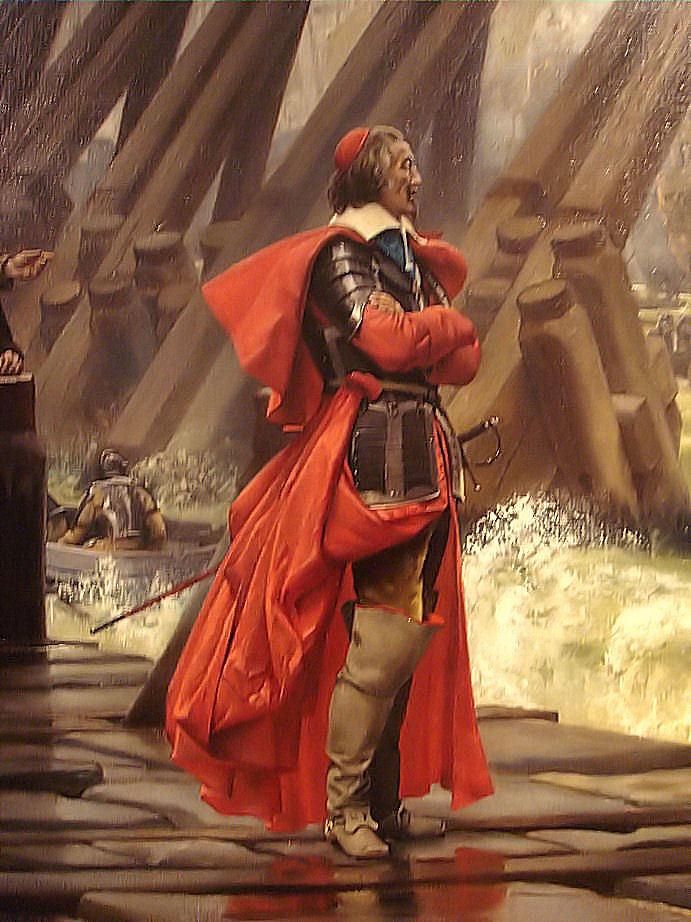 Richelieu on the La Rochelle dyke: Henri-Paul Motte, Public domain, via Wikimedia Commons
The siege then settled into a war of attrition and famine. In May 1628, the besieged, at the end of their resources, resolved to expel the “useless mouths” — women, children, the elderly — who mostly perished for lack of relief; on 2 May, Jean Guiton became mayor of the town and swore to “pierce the heart of the first man who spoke of surrender.”
 Mayor Jean Guiton urges his fellow citizens not to surrender: Pierre-Louis-Omer Charlet, Public domain, via Wikimedia Commons
Two English naval attempts at resupply, one under Lord Denbigh between 11 and 19 May, the other under Lord Lindsey between 28 September and 4 October, failed one after the other before the dyke. The town’s population, about 28,000 strong at the start of the siege, had been reduced to some 5,000 survivors when Guiton and the town council finally resolved, on 26 October 1628, to sue for mercy; royal troops entered the harbour on 1 November, after fourteen months of siege. La Rochelle lost its fortifications and its municipal privileges, but retained freedom of worship. This victory paved the way for an overall settlement: on 28 June 1629, the Edict of Grace of Alès definitively stripped the Protestants of their military privileges — the right to assemble, to hold places of safety — while leaving them freedom of conscience and worship, except in Paris, thereby closing a cycle of revolts opened eight years earlier. A few months later, on 21 November 1629, Richelieu was officially appointed principal minister of State, then made duke and peer of France on 26 November — the institutional consecration of a power that the fall of La Rochelle had, in practice, already established without rival.
VI. 1630–1632: the Day of the Dupes and the Montmorency revolt
With the religious question settled, a new division soon split royal power: that of foreign policy. This division had its origin in Italy: on the death, on 26 December 1627, of Duke Vincenzo II Gonzaga, without direct issue, the succession to the Duchy of Mantua and Montferrat found itself disputed between the junior branch of the Nevers, whom Vincenzo II had himself designated and whom France supported, and that of the Guastalla, backed by Emperor Ferdinand II of Habsburg — Spain and Austria fearing that an ally of France might establish itself on this strategic route leading to the Milanese. Militarily engaged in Italy since February 1630 — the French army had crossed Mont Cenis on 23 February, taken Pinerolo on 22 March and then its citadel on the 30th, before Louis XIII, refusing to hand it back to Spain, officially unleashed war against the Habsburgs on 26 April — this War of the Mantuan Succession now pitted two irreconcilable lines against each other at the summit of the French State. Marie de Médicis and the so-called “dévot” party, concerned above all with preserving peace with Catholic Spain, demanded an end to hostilities; Richelieu, by contrast, intended to continue the struggle against Habsburg encirclement, even if it meant allying with Protestant powers. This Italian conflict found its resolution only the following spring: on 6 April 1631, the Treaty of Cherasco, negotiated under the mediation of the papal legate Jules Mazarin — his first appearance on the French diplomatic stage —, confirmed the Duke of Nevers in possession of Mantua and ceded to France the stronghold of Pinerolo, a strategic gateway to the Po valley.
This underlying disagreement came to a head in the episode that became famous under the name of the Day of the Dupes, on 10 and 11 November 1630. Taking advantage of an illness that had kept the king bedridden for several weeks, Marie de Médicis, joined by Gaston d’Orléans and by Queen Anne of Austria, attempted to wring from Louis XIII, at the Luxembourg Palace, Richelieu’s definitive disgrace.
 Richelieu, Louis XIII and Marie de Médicis on the Day of the Dupes: Maurice Leloir, Public domain, via Wikimedia Commons
The king appeared at first to give way. The next day, 11 November, Richelieu went in person to the Luxembourg to submit his resignation to the queen mother; finding the doors closed to him, he entered by a hidden door and surprised Marie de Médicis and Louis XIII in the midst of conversation. The king, disturbed by this intrusion, withdrew shortly afterwards to his modest hunting lodge at Versailles — long before it became the great château —, where the cardinal joined him to plead his case; at the end of this meeting, Louis XIII changed his mind and chose to keep him in office, dashing at a stroke the hopes of those in Paris who had already believed the minister lost and had come to congratulate him on his anticipated fall, hence the name given to this day. Repression was swift and merciless towards the defeated party: Michel de Marillac, keeper of the seals and the chief political architect of the dévot camp, was arrested as early as 21 November 1630 and died in prison on 7 August 1632, while his half-brother Louis de Marillac, a marshal then at the head of the king’s army in Italy, was likewise arrested in the autumn of 1630; sentenced to death for embezzlement on 8 May 1632, he was beheaded at the Place de Grève two days later. Marie de Médicis herself, exiled to Compiègne on 23 February 1631, left the kingdom for good for the Netherlands on the following 18 July, never to return.
Gaston d’Orléans, the king’s brother and therefore harder to punish, chose the path of open rupture: he left the court for Orléans on 30 January 1631, fled towards Franche-Comté in mid-March, then issued from Nancy, on 30 May, a manifesto hostile to Richelieu, before joining his mother at Brussels on 5 August. Richelieu, however, emerged strengthened from this crisis: made duke and peer on 4 September 1631, he was appointed governor of Brittany on 16 September. The following year, Gaston returned to France determined to fight it out: having secretly married Marguerite de Lorraine on 3 January 1632, he issued on 13 June, from Andelot, a new call to arms, to which Henri II de Montmorency, governor of Languedoc and godson of Henry IV, responded by declaring his support for the cause at an assembly held at Pézenas on 22 July; the two men joined forces at Lunel on 30 July.
This last great revolt of the high nobility against Richelieu’s authority collapsed within a matter of weeks. On 1 September 1632, the rebel army was crushed at the battle of Castelnaudary by Marshal Schomberg; Montmorency, gravely wounded, was taken prisoner there.
 Duke Henri II de Montmorency at the battle of Castelnaudary: Henri Félix Emmanuel Philippoteaux, Public domain, via Wikimedia Commons
Gaston, abandoning his ally to his fate, obtained his own pardon at Béziers on 29 September, before fleeing once again to Brussels on 6 November. Montmorency, for his part, was to receive no leniency: despite calls for clemency from throughout the kingdom, Richelieu remained inflexible, granting the king only that the execution be held behind closed doors rather than in public. Condemned by the Parlement of Toulouse, Henri II de Montmorency was beheaded in the courtyard of the Capitole on 30 October 1632, at thirty-seven; with him the duchy-peerage of Montmorency became extinct, its title passing to his sister Charlotte-Marguerite, Princess of Condé. This execution, the last of so great a lord for armed rebellion, definitively closed the cycle of noble revolts opened fifteen years earlier and finished convincing the French high nobility that no name, however illustrious, any longer placed it beyond the reach of the cardinal’s justice.
VII. 1633–1638: towards open war against the Habsburgs, the year of Corbie and the birth of the dauphin
Consolidated at home, Richelieu could now bring his full weight to bear on the external stage. On 25 September 1633, Louis XIII entered Nancy and had the duchy of Lorraine occupied, the culmination of a series of agreements — the Treaty of La Neuveville of 6 September, then that of Charmes, signed on 20 September by Duke Charles IV of Lorraine — which had preceded this de facto annexation by a few weeks. This coup formed part of a broader strategy of containing the Habsburgs, already begun on 19 April with the renewal of the Treaty of Bärwalde with Sweden, whose army was fighting Emperor Ferdinand II in Germany. The Swedish defeat at Nördlingen, in September 1634, nearly compromised this indirect strategy: Richelieu then affirmed, on 11 September, his determination to “save the Protestant party against the emperor and Spain,” and negotiated as early as 9 October a treaty substituting French garrisons for Swedish ones in the strongholds of Alsace — a growing commitment that left little room left for French neutrality.
This logic led to open rupture. On 8 February 1635, an alliance was concluded with the United Provinces, providing for the future partition of the Spanish Netherlands; then, on 19 May 1635, France officially declared war on Spain, entering directly for the first time into the Thirty Years’ War after years of indirect support for its Protestant allies. The war effort was immediate and massive: as early as July, nine royal armies totalling 134,000 infantry and 26,000 cavalry were raised, while a first victory was won at Avins on 22 May.
This direct engagement, however, exposed the kingdom to unprecedented peril. On 2 July 1636, a Spanish army led by Prince Thomas of Savoy-Carignano and by the formidable cavalry commander Johann von Werth crossed the northern border and invaded Picardy, left without any serious defence; La Capelle surrendered as early as 9 July, then, after the crossing of the Somme at Cerisy on 2 August, Corbie fell in turn on 15 August. Facing the 35,000 men of the Cardinal-Infante Ferdinand, panic gripped Paris: the wealthiest fled south, and Richelieu himself yielded for a moment to discouragement. The memory of this terror left a lasting mark on popular memory — the name of Johann von Werth long served to frighten unruly children. But the mobilisation of Paris, which supplied men and money to raise a relief army behind the cardinal, made it possible to seize back the initiative: on 14 November 1636, French troops retook Corbie, bringing to an end this “year of Corbie” which had for a time brought the kingdom to the brink of disaster.
The end of this dark period closed on a double note of hope. On 10 February 1638, Louis XIII solemnly dedicated the kingdom of France to the Virgin, instituting by this act the processions of 15 August; seven months later, on 5 September 1638, at the château of Saint-Germain-en-Laye, Anne of Austria, after twenty-three years of marriage marked by four interrupted pregnancies between 1619 and 1631, at last gave birth to a son whom his parents named Louis-Dieudonné — the future Louis XIV. The Gazette de France hailed the event as “a marvel arriving when it was least expected”; this birth, seen by many as a miracle, put to rest the dynastic uncertainty that had weighed on the Bourbon crown since the start of the reign. A few months later still, on 18 December 1638, a young Italian diplomat in the pope’s service, Jules Mazarin, already noticed for his role in negotiating the Treaty of Cherasco, became Richelieu’s principal adviser — a collaboration destined to weigh heavily on the ministry’s final years.
🔍 Zoom – Richelieu the builder: intendants, mercantilism and the Académie française
VIII. 1639–1643: the Cinq-Mars conspiracy, the death of Richelieu and of Louis XIII
In the very last years of the reign, a new favourite established himself with the king, with an irony history would soon underscore: Henri Coiffier de Ruzé d’Effiat, Marquis of Cinq-Mars, born on 27 March 1620, the son of a former superintendent of finances and friend of Richelieu, had been introduced at court by the cardinal himself. Commanding a company of the king’s guards in the 1630s, he was appointed grand master of the wardrobe on 27 March 1638 and then grand equerry of France in 1639, thereby becoming the last great favourite of Louis XIII — a protégé of the all-powerful minister, destined to turn against him.
The mainspring of this betrayal owed as much to ambition as to resentment: Richelieu having opposed a marriage that Cinq-Mars desired, the latter conceived a lasting grudge and came to covet the very place of the cardinal beside the king. With the complicity of Louis d’Astarac de Fontrailles, a gentleman well versed in intrigue, he then hatched a plot of unprecedented gravity: on 20 January 1642, Fontrailles set out for Madrid disguised as a hermit, two copies of the treaty sewn into the lining of his doublet, in order to negotiate on behalf of Gaston d’Orléans a secret agreement with Spain, signed on 13 March by the Duke of Olivares. Richelieu, then ill and withdrawn to Arles, obtained a copy of the treaty and thus secured proof of the plot between 11 and 13 June 1642; Cinq-Mars was arrested on 13 June.
 Cinq-Mars surrendering his sword to Louis XIII: Claudius Jacquand, Public domain, via Wikimedia Commons
Tried alongside his friend François-Auguste de Thou, whose actual involvement had in fact been minimal, he was beheaded at Lyon on 12 September 1642, at only twenty-two — the last, and the most intimate, of the conspiracies the cardinal had to foil.
Richelieu was not to survive him long. Having drawn up his will at Narbonne on 23 May 1642 — in it he attested to a personal fortune estimated at between 20 and 22 million livres, the largest in France —, the cardinal, already gravely ill, had to undertake in the autumn a painful journey back to Paris from the south: transported in an enormous litter hung with red and gold damask, fitted out with a bed, a table and a chair, he first went down the Rhône by river before continuing overland, while, from Lyon to Digoin, doors, walls and sometimes entire storeys of houses were pulled down along his route so that his closed litter could be carried directly into his room, without his ever having to leave it.
 Cardinal Richelieu’s State Barge on the Rhône: Paul Delaroche, Public domain, via Wikimedia Commons
Having reached Paris, he received on 2 December a final visit from Louis XIII, to whom he declared: “In taking my leave of Your Majesty, I have the consolation of leaving your kingdom at the highest degree of glory and reputation it has ever attained.” He died on 4 December 1642. The news, though it plunged the king into mourning, was greeted in certain provinces with bonfires of joy, a sign of the persistent unpopularity of a minister whose work of State had weighed heavily on the kingdom. The very next day, 5 December, Mazarin took charge of the royal Council, ensuring immediate political continuity. In his last months of solitary reign, Louis XIII nonetheless carried forward the institutional work of the late cardinal: the powers of the intendants were expanded on 22 August 1642, the principality of Sedan was incorporated into the kingdom on 15 September, and a declaration of 1 December excluded Gaston d’Orléans from the coming regency.
Weakened in turn, Louis XIII arranged for his own succession through a declaration of 20 April 1643, which limited the power of the future regent to a council presided over by Gaston d’Orléans, lieutenant general of the kingdom — a precaution symmetrical to the one Marie de Médicis had faced in 1610, at the opening of this same chapter. The king died on 14 May 1643, probably of inflammatory enterocolitis, leaving the throne to his son Louis XIV, aged five.
 Medal commemorating the death of Louis XIII: Jérôme Roussel, Licence CC0 1.0 https://creativecommons.org/publicdomain/zero/1.0/, via Wikimedia Commons
But history did not repeat itself identically: as early as 18 May, a lit de justice held at the Parlement of Paris annulled the late king’s will and vested Anne of Austria with an absolute regency, without the restrictive council that Louis XIII had sought to impose on her. Relying on Mazarin as her principal adviser, on chancellor Séguier for domestic affairs and on generals Condé and Turenne for the armies, the new regent thus opened, thirty-three years after the death of Henry IV, a new cycle of royal minority — but this time with an authority that no assembly of great men and no royal will would ever again be able to contest.
🔍 Zoom – The Thirty Years’ War: generals and great battles (1635-1643)
🧠 Key takeaways
- 14 May 1610: the assassination of Henry IV brings to the throne Louis XIII, aged eight, under the regency of Marie de Médicis, who quickly squanders the financial and diplomatic inheritance of the previous reign
- 24 April 1617: the assassination of Concini, orchestrated by the favourite Luynes, ends the de facto regency; the king’s personal reign then begins, marked by the “war of mother and son” (1619-1620) and the reunion of Béarn with the crown
- 1624: after the death of Luynes and an unstable ministerial interim, Richelieu establishes himself on the Council, then becomes its undisputed master from August onward; his programme — ruin the Huguenot party, humble the pride of the great, weaken Spain — structures the following eighteen years
- 1627-1628: the siege of La Rochelle, marked by the construction of the famous dyke, breaks the last great Protestant place of safety; the Peace of Alès (1629) strips the Protestants of their military privileges while leaving them freedom of worship
- 10-11 November 1630: the Day of the Dupes sees Louis XIII choose Richelieu over his own mother, causing the definitive exile of Marie de Médicis and the fall of the dévot party; the Montmorency revolt (1632), the last great noble insurrection, ends with his execution despite calls for clemency
- 19 May 1635: France officially declares war on Spain, entering the Thirty Years’ War; the Spanish invasion of Picardy and the panic of the “year of Corbie” (1636) nearly bring the kingdom to its knees before the reconquest
- 5 September 1638: after twenty-three years of dynastic uncertainty, the birth of the dauphin Louis-Dieudonné, the future Louis XIV, secures the survival of the Bourbons
- December 1642-May 1643: the Cinq-Mars conspiracy, the last favourite to turn to treason, comes shortly before the death of Richelieu and then that of Louis XIII; the absolute regency of Anne of Austria, without a restrictive council, crowns the scale of the transformation wrought by the reign